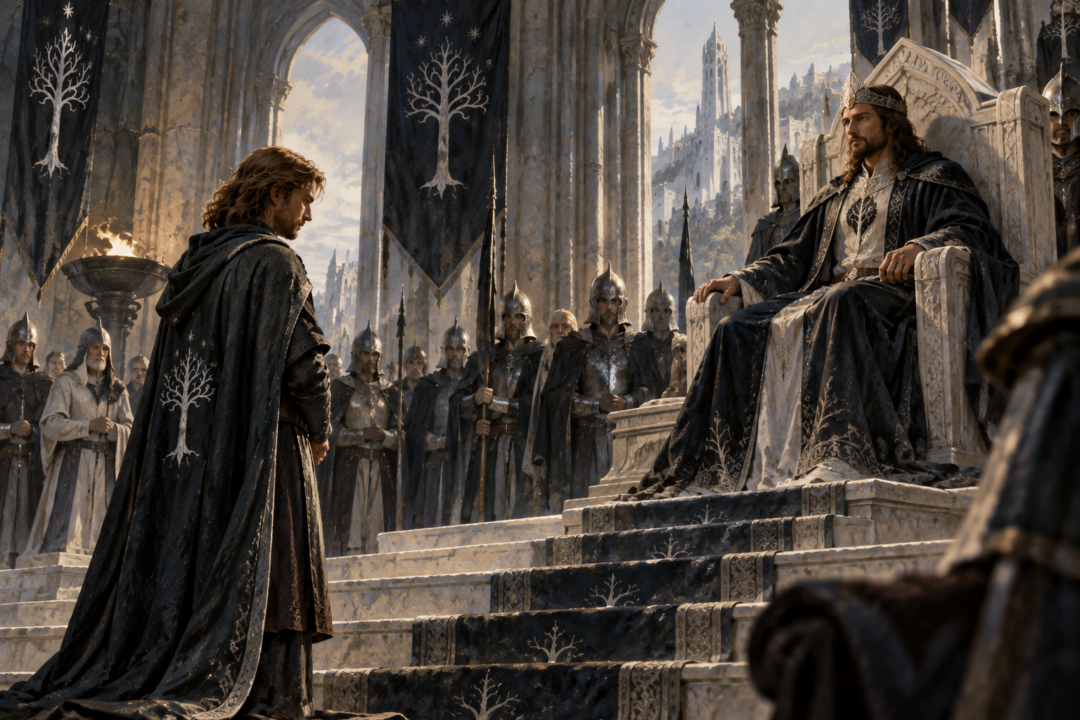
When Aragorn enters Minas Tirith as King Elessar, Gondor seems to have reached the moment its Stewards were created to await. The King has returned. The long interregnum is over. The White Tree can flower again beneath a crowned ruler.
So what is left for Faramir to do?
At first glance, his office appears almost self-cancelling. The House of Húrin had governed Gondor because there was no king. Denethor wielded royal authority without taking the royal title. Once Aragorn assumes the throne, it would be easy to imagine the Stewardship becoming an obsolete institution—a temporary solution whose purpose has finally expired.
Yet that is not what happens.
Faramir surrenders the rule of Gondor to Aragorn, but he does not cease to be Steward. Aragorn confirms the office in his line, while also making him Prince of Ithilien. The distinction reveals something important about Gondor's political restoration: the return of the King does not erase the institutions that preserved the realm during his absence.
It puts them back into their proper relationship.

The Stewards Were Never Supposed to Replace the Kings
The apparent contradiction begins with the nature of the Stewardship itself.
Gondor's Stewards existed before they became its rulers. They were high officers of the kingdom, traditionally drawn from the House of Húrin. Only after the disappearance of King Eärnur did the Steward Mardil take up the government of Gondor in the king's absence.
From Mardil onward, the Ruling Stewards governed the South-kingdom for generations.
But they did not become kings.
That distinction mattered enormously. The Stewards sat in authority, commanded Gondor's armies, administered its lands and passed their position from father to son, yet the royal claim was not formally absorbed into their house. Their rule was custodial in principle even when, after centuries, the return of a king could seem increasingly remote.
Denethor expresses the accumulated pride and tension within this arrangement. He is no mere caretaker in practical terms: he is the effective sovereign of a great realm at war. But Gondor's political memory still distinguishes between Steward and King.
Faramir therefore inherits two things at once: an ancient office and the extraordinary governing authority that office acquired during the absence of the royal house.
Aragorn's return ends the second.
It does not require the destruction of the first.
Faramir Gives Up the Rule, Not the Stewardship
The coronation makes this distinction unusually clear.
After victory over Sauron, Faramir is still acting as Steward. When Aragorn comes to the city, Faramir brings out the White Rod, the emblem of his office, and offers it to him.
Aragorn gives it back.
The gesture is the constitutional heart of Faramir's future.
Faramir is no longer the man governing Gondor because the throne is empty. Aragorn has accepted the crown and assumed the kingship. The exceptional authority exercised by the Ruling Stewards has reached its natural end.
But the Steward himself remains.
That makes sense once the office is separated from the emergency circumstances that had enlarged it. A steward can serve a king. Indeed, that was the older relationship.
The Return of the King therefore does not abolish Faramir's purpose. It restores its original context.
This is also why the transition can happen without a struggle between the two men. Faramir does not need to be politically destroyed for Aragorn to become King, because Faramir never attempts to convert his inherited stewardship into a competing kingship.
His legitimacy is compatible with Aragorn's.

Aragorn Deliberately Preserves Faramir's Office
Aragorn goes further than simply allowing Faramir to retain an old title.
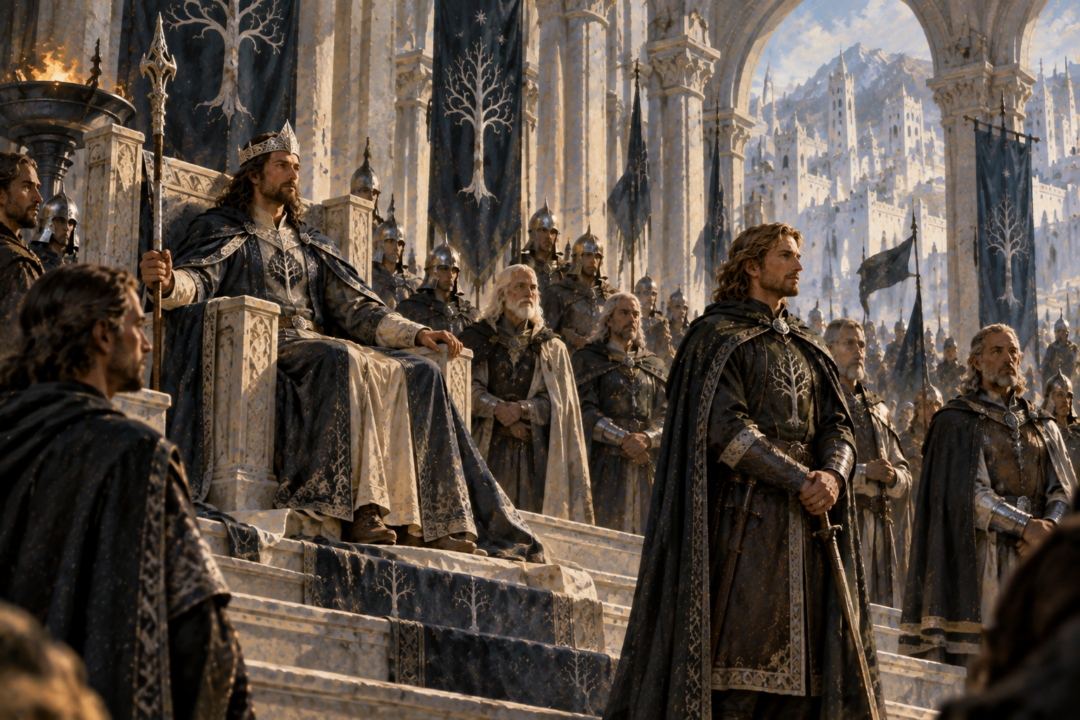
During the celebrations following his coronation, the King declares that the office of Steward will continue. As recorded in "The Steward and the King," Faramir and his heirs are to retain that office while their line lasts.
That decision matters.
If the Stewardship had existed only as a substitute monarchy, preserving it would indeed seem unnecessary. But Aragorn treats it as a legitimate office of the restored kingdom.
The difference is hierarchy.
Under Denethor, the Steward stands at the summit of Gondor because no king occupies the throne. Under Aragorn, Faramir remains one of the kingdom's greatest lords, but the supreme royal authority belongs unmistakably to Elessar.
The Stewardship has therefore survived by contracting from an extraordinary form of regency-like government back toward a great office beneath the Crown.
The texts do not provide a detailed administrative handbook explaining Faramir's routine duties under Elessar, so it would be unsafe to invent a precise portfolio for him. What they do establish is enough: Faramir retains the Stewardship, and Aragorn explicitly confirms its continuation.
Its survival is not an accident or an unresolved relic.
It is part of the new settlement.
Then Aragorn Gives Faramir Something New
Faramir's position becomes even more substantial because Aragorn does not merely preserve what he inherited.
He makes Faramir Prince of Ithilien.
This is a major territorial lordship in a region with enormous strategic and symbolic importance. Ithilien had long been exposed to the Shadow. Its settlements had suffered as Gondor's strength declined, and during the War of the Ring Faramir himself had commanded Rangers operating there from Henneth Annûn.
After Sauron's fall, the land can be restored rather than merely defended.
Faramir is therefore connected to Ithilien in two very different ages: first as a captain fighting a retreating war beneath Mordor's shadow, and afterward as its prince in a reunited and victorious kingdom.
He also settles at Emyn Arnen with Éowyn.
The transformation is striking. Faramir does not remain in Minas Tirith as a diminished remnant of the old regime, watching another house occupy the authority once wielded by his father.
He becomes one of the principal lords of the new age.
His importance changes form.
Ithilien Makes Faramir More Than a Ceremonial Survivor
The title Prince of Ithilien prevents an easy misunderstanding about Faramir's postwar status.
He is not simply being permitted to keep an honorific because Aragorn respects him.
Ithilien is a real land requiring renewal after generations of pressure and warfare. The narrative also associates its restoration with new settlement. Legolas later brings Elves from Greenwood into Ithilien, and the land becomes renowned for its renewed beauty.
Faramir's lordship therefore points toward reconstruction.
The contrast with Denethor's final days could hardly be stronger.
Denethor's world is contracting. Osgiliath is contested, Ithilien lies under constant threat, Minas Tirith prepares for siege, and Gondor's surviving strength is being consumed in resistance to Mordor.
Faramir inherits that collapsing frontier as a soldier.
Prince Faramir receives it back as a land with a future.
The texts do not narrate the details of his administration, taxation, reconstruction programs or day-to-day government, and those should not be invented. But his title, residence and standing make clear that Ithilien is not merely decorative property attached to his name.
Faramir has become its prince.
The Stewardship Also Solves a Problem of Continuity
There is a deeper wisdom in Aragorn's treatment of Faramir.
A restored monarchy could theoretically have defined itself by rejecting everything associated with the previous government. Instead, Aragorn incorporates the legitimate institutions and loyalties of Steward-ruled Gondor into his own reign.
Faramir is uniquely suited to make that possible.
He is Denethor's surviving heir, a respected captain of Gondor and the new Steward. Yet he also accepts Aragorn without the rivalry that might have turned restoration into a dynastic crisis.
This allows Gondor to experience restoration as continuity rather than institutional annihilation.
The old order is corrected, not treated as worthless.
That distinction reflects the history of the Stewards themselves. Their line did not create Gondor, and their authority was never formally identical to kingship. They preserved a kingdom whose political structure still remembered the missing monarch.
Faramir can consequently serve the returned King without repudiating his ancestors' office.
The office survived because, at its deepest level, it belonged to the monarchy rather than standing against it.
Faramir's Story Reverses Denethor's Tragedy
There is also a powerful personal reversal here.
Denethor increasingly sees the future through the possibility of displacement and loss. His confrontation with Gandalf makes clear that he does not welcome the prospect of yielding his authority to another claimant merely because that claimant asserts royal descent.
Faramir ultimately occupies exactly the situation his father dreaded: another man becomes King, and the House of the Stewards no longer rules Gondor.
Yet Faramir is not erased.
He loses supreme government and gains a secure place within a larger restored order. He remains Steward. He becomes Prince of Ithilien. He marries Éowyn. His house continues with dignity beneath the Crown rather than being extinguished by it.
That does not mean Denethor's concerns can be reduced to simple ambition; his character and despair are considerably more complicated. But the outcome demonstrates that the return of the King did not require the humiliation of Denethor's house.
There was room in Aragorn's kingdom for Faramir precisely because Faramir did not need to possess the highest authority in order to serve Gondor meaningfully.

The Office Survives Because Its Temporary Power Was Never Its Whole Identity
The easiest mistake is to define the Steward of Gondor entirely by what Denethor was doing during the War of the Ring.
At that moment, the Steward governs the kingdom.
But that is the exceptional historical condition, not the complete definition of the office.
Once the monarchy is restored, Faramir no longer needs to exercise the authority of an uncrowned ruler. The Stewardship can survive because stewardship existed independently of that extraordinary power.
Aragorn therefore does not have two competing rulers.
He has a King, and beneath him a hereditary Steward who is also one of the realm's greatest territorial lords.
Faramir's survival is consequently more than a reward for personal virtue. It demonstrates how the restoration of Gondor actually works.
The Return of the King is not a reset in which centuries of Gondorian history are discarded.
The crown returns. The extraordinary rule of the Stewards ends. The Stewardship itself remains. Ithilien receives a prince. And the son of Denethor discovers that surrendering the highest power does not make him redundant.
It finally allows his ancient office to become what it was always capable of being again:
service beneath a King.
Sources & Notes
- Tolkien Gateway — Stewards of Gondor https://tolkiengateway.net/wiki/Stewards_of_Gondor
- Tolkien Gateway — Faramir https://tolkiengateway.net/wiki/Faramir
- Tolkien Gateway — Prince of Ithilien https://tolkiengateway.net/wiki/Prince_of_Ithilien
- Tolkien Gateway — The Steward and the King https://tolkiengateway.net/wiki/The_Steward_and_the_King
The Stewardship predates the Ruling Stewards; the coronation restores royal authority while Aragorn confirms Faramir as Steward and Prince of Ithilien. The institutional reading is interpretive synthesis.