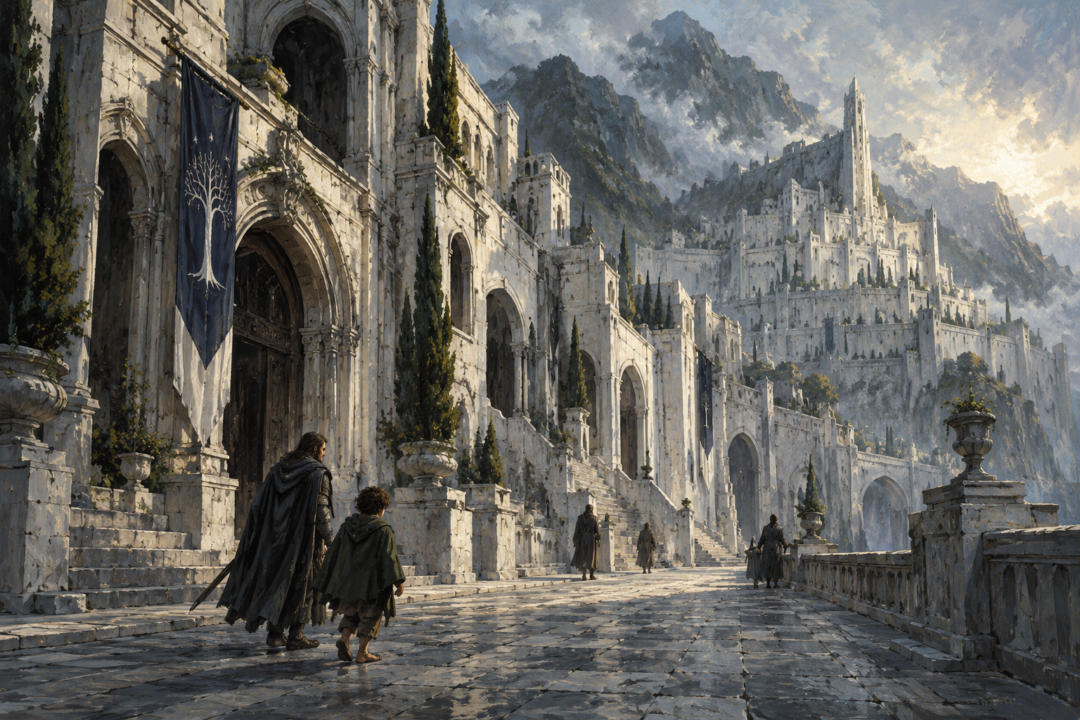
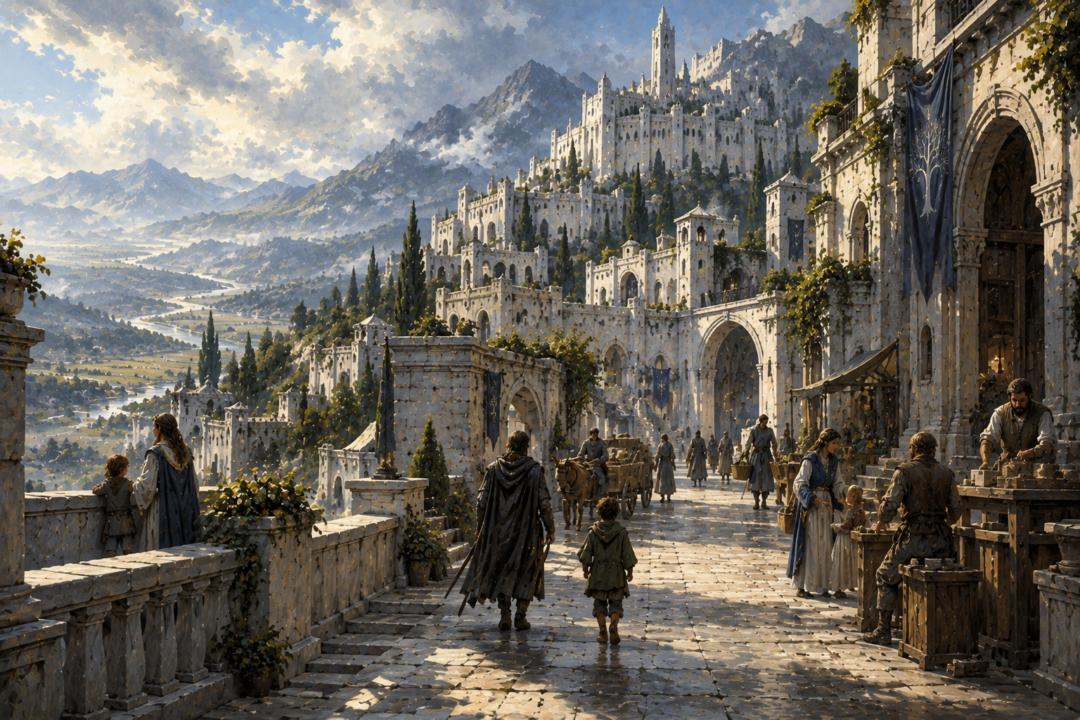
When Pippin first enters Minas Tirith, he expects the great city of Gondor to overwhelm him. It does. Seven levels rise against Mount Mindolluin, ringed with stone walls and crowned by the Citadel. Compared with anything the hobbit has previously seen, the city is enormous, ancient, and formidable.
Then he begins to notice what is missing.
The streets pass great houses and courts associated with families that once lived there, but many are silent. Tolkien’s description is unusually explicit: Minas Tirith is declining year by year and already lacks roughly half the population that could comfortably inhabit it.
That detail changes the meaning of the White City.
Minas Tirith is not merely a fortress waiting for Sauron’s attack. It is a city built for more people than remain alive to fill it. Its empty houses are therefore part of a much larger story: the long demographic contraction of Gondor.
The Emptiness Predates the Siege
It is important to distinguish two different kinds of emptiness.
When the armies of Mordor approach, Minas Tirith becomes still more sparsely populated because civilians are sent away. Pippin sees wagons carrying women, children, and elderly people southward to places such as Lossarnach. The Pelennor is also emptied as war approaches.
But that evacuation does not explain the abandoned houses Pippin notices when he first rides through the city.
The text already describes Minas Tirith as falling into decay and lacking about half the inhabitants it could accommodate. Its silent courts belong to an older process.
This means the city’s emptiness is not simply a temporary consequence of military preparations. The siege exposes a condition that already existed.
Minas Tirith had inherited the physical scale of a more populous Gondor.
Its people could no longer match that inheritance.
Gondor Had Been Losing People for Centuries
The decline visible in Minas Tirith did not begin with Denethor.
Appendix A gives Gondor a long history of catastrophes that reduced both its strength and its population. Civil conflict during the Kin-strife caused enormous destruction. Foreign invasions repeatedly exhausted the kingdom. Territorial losses gradually contracted its effective borders.
One disaster was especially important: the Great Plague of Third Age 1636.
The plague devastated Gondor. King Telemnar and his children died, and the population of Osgiliath was severely affected. Gondor’s ability to maintain its older system of fortifications and territorial control weakened afterward.
Osgiliath never truly recovered its former greatness.
That matters because Osgiliath had once been the chief city of Gondor, straddling the Anduin between Minas Anor and Minas Ithil. The later political importance of Minas Tirith belongs partly to a world in which the older urban geography of the kingdom had already collapsed.
The White City was becoming more important at the same time that Gondor as a whole was becoming smaller.
That is one of the great ironies of its history.
Osgiliath Shows What Minas Tirith Has Not Yet Become
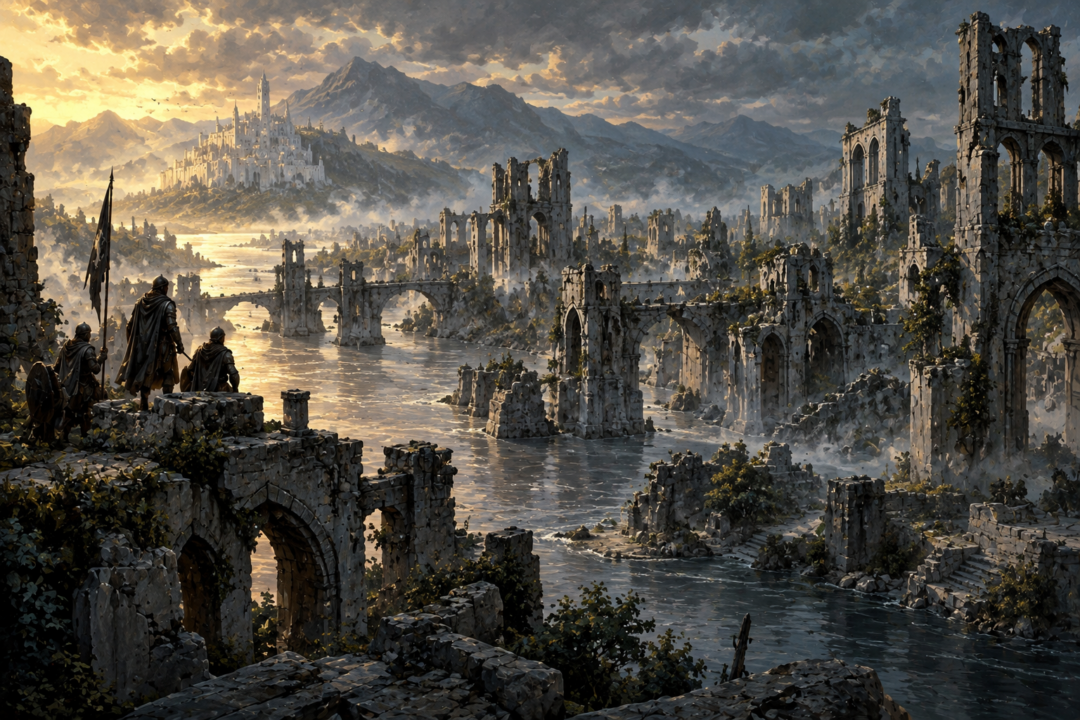
The ruins of Osgiliath provide the clearest warning of where demographic decline can lead.
Once the great city of the realm, it was damaged during the Kin-strife, struck terribly by plague, and later repeatedly contested as Gondor’s eastern frontier collapsed toward the Anduin.
By the War of the Ring, Osgiliath is no longer functioning as the populous capital of an expansive kingdom. It has become a battlefield and defensive position.
Minas Tirith has not reached that state. It remains inhabited, governed, maintained, and militarily powerful.
Yet the comparison is difficult to miss.
One great Gondorian city has already become a ruin. Another contains impressive houses without enough families to inhabit them.
The stages are different, but they belong to the same historical movement: Gondor has inherited more civilization than its surviving population can fully occupy.
Ithilien Reveals the Human Cost of the Retreat
The same pattern appears beyond the cities.
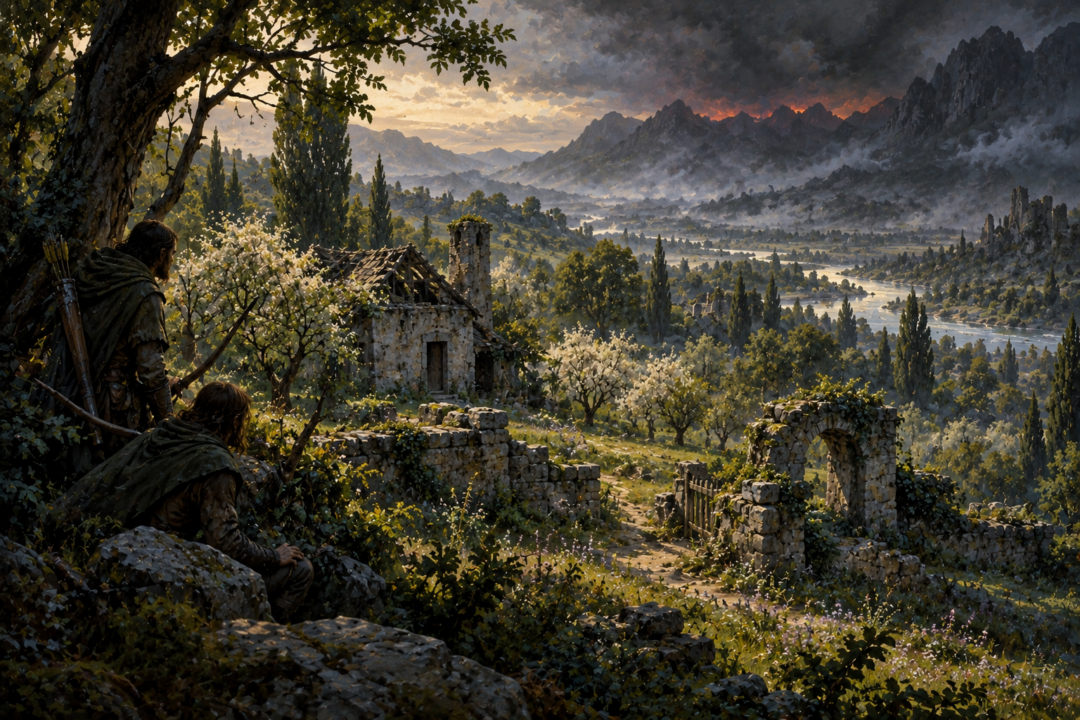
Ithilien had once been a populated region of Gondor east of the Anduin. But the growth of the threat from Mordor gradually made ordinary settlement increasingly dangerous.
After Minas Ithil fell to the Nazgûl in Third Age 2002, Gondor faced an enemy stronghold on its eastern frontier. Later attacks drove more inhabitants westward. Appendix A records that in 2901 most of the remaining people of Ithilien fled across the Anduin because of attacks from Mordor.
By the War of the Ring, Ithilien is beautiful but largely emptied of civilian settlement.
Faramir’s Rangers can still operate there. Gondor still claims and defends it. But military presence is not the same thing as a thriving population.
This distinction helps explain Minas Tirith.
Gondor has not simply lost battles. It has lost inhabited space.
Families have withdrawn. Settlements have disappeared. Formerly populated regions have become frontiers, ruins, or patrol zones.
The shrinking population visible inside Minas Tirith is therefore part of a geographic retreat stretching across generations.
Even the Pelennor Is Less Populous Than Its Fertility Suggests
The Pelennor Fields make the demographic problem especially striking.
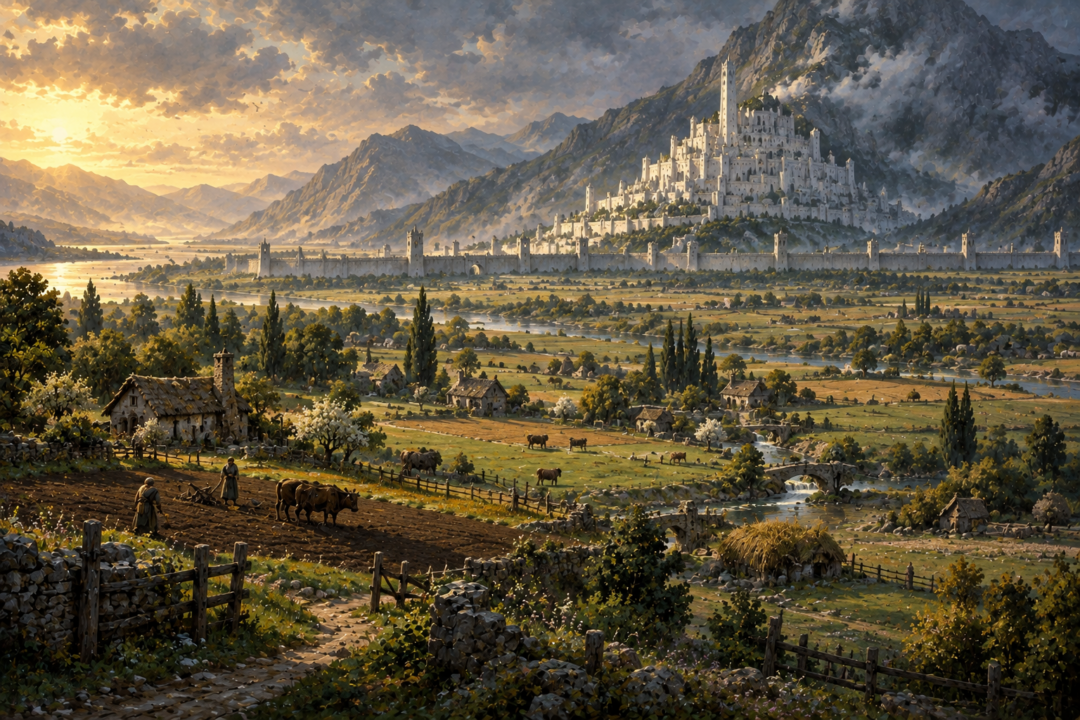
They are not an empty battlefield by nature. Before the siege, they are the fertile townlands of Minas Tirith: tilled fields, orchards, homesteads, barns, livestock enclosures, and streams descending toward the Anduin.
Yet the text notes that the husbandmen and herdsmen living there are not numerous.
This is easy to overlook because the Pelennor remains productive. Gondor has not become a wasteland. Agriculture continues, provincial populations survive, and substantial communities remain elsewhere, particularly in regions such as Lossarnach and Lebennin.
That is precisely why “decline” should not be confused with “near extinction.”
Gondor still possesses people, food, armies, craftsmen, nobles, and functioning institutions. The southern fiefs can send troops to Minas Tirith, even though their forces are constrained by the threat from the Corsairs.
The demographic picture is therefore one of contraction rather than total collapse.
There are still enough people to maintain civilization.
There are no longer enough to fill the civilization Gondor inherited.
The Architecture Remembers a Larger Society
This is why the houses Pippin passes are so important.
Buildings preserve demographic history.
A city can lose population much faster than it loses streets, walls, courtyards, monuments, gates, and houses. When that happens, architecture becomes evidence of vanished human density.
Minas Tirith was not built as an archaeological ruin. Its empty spaces were meant to contain households.
Pippin sees names carved above old doors and understands that significant families once occupied them. The text does not provide a census, nor does it explain the fate of every household. We should therefore avoid imagining specific migrations or family histories that are never stated.
But the broad conclusion is explicit: the city once held more people, and by 3019 many of its dwellings stand silent.
The physical city has outlived part of the society for which it was made.
That may be the most powerful visual expression of Gondor’s decline anywhere in The Lord of the Rings.
Decline Does Not Mean Gondor Has Become Weak or Decadent
There is also an important distinction between demographic decline and moral decline.
Late Third Age Gondor is not portrayed simply as a corrupt civilization deserving extinction.
Its soldiers remain disciplined. Its craftsmen maintain extraordinary works. Its rulers preserve knowledge stretching back through centuries. Beregond, Faramir, Prince Imrahil, and many others demonstrate that Gondor still possesses courage, loyalty, and cultural memory.
Even Denethor, before despair overwhelms him, is presented as a formidable ruler rather than a mere decadent administrator.
The tragedy is therefore sharper.
Gondor remains capable.
It simply has fewer resources with which to carry the accumulated burden of its history.
Every wall still needs defenders. Every frontier requires soldiers. Every farm needs workers. Every house requires another generation to inhabit it.
Stone can survive population loss remarkably well.
Kingdoms cannot.
The Empty City Explains Gondor’s Military Problem
This demographic reading also helps explain why Gondor’s military situation is so desperate.
Minas Tirith possesses extraordinary fortifications, but walls are only useful when there are enough defenders to hold them.
The Rammas Echor around the Pelennor demonstrates the same problem on a larger scale. Gondor can construct and repair formidable defenses, yet the territory those defenses must protect is enormous.
This is a recurring feature of declining powers: their strategic obligations can remain larger than the population available to support them.
Gondor must defend Minas Tirith, the Anduin crossings, its southern lands, the approaches from Mordor, and its coast against the threat of the Corsairs.
The arrival of troops from the southern fiefs therefore matters enormously. So does Rohan’s alliance.
Gondor is fighting not merely against a powerful enemy but against the accumulated arithmetic of centuries of loss.
Aragorn’s Return Is Associated With Renewal, Not Just Victory
This also gives greater meaning to what happens after Sauron falls.
Aragorn does not merely inherit Denethor’s chair or take command of the surviving army. He restores the kingship of the reunited realm, and the narrative deliberately surrounds that restoration with images of renewal.
A living sapling of the White Tree is found.
Faramir becomes Prince of Ithilien, and the land is intended for renewed settlement and governance rather than remaining permanently an abandoned military frontier.
The city itself enters a new political age.
The texts do not provide detailed demographic statistics showing how quickly Minas Tirith repopulates, so it would be wrong to claim that Aragorn instantly reverses centuries of population decline.
But the direction of the imagery is unmistakable.
The old pattern has been interrupted.
For much of the Third Age, Gondor moves from settlement toward abandonment, from eastern territories toward western refuges, from populous cities toward ruins.
After the War of the Ring, the movement can begin to run the other way.
The Saddest Thing About Minas Tirith Is Not Its Broken Stone
When Pippin enters Minas Tirith, the city has not yet been breached.
Its walls stand.
Its Tower rises.
Its banners still represent a realm capable of resisting the Shadow.
And yet its decline is already visible.
Not primarily in shattered masonry, but in doors nobody opens.
That is what makes Minas Tirith such an effective image of Gondor at the end of the Third Age. The city is simultaneously magnificent and underfilled, powerful and diminished, carefully preserved and slowly emptying.
Its architecture remembers a larger population than the present can supply.
Osgiliath shows what has already been lost. Ithilien shows how settlement has retreated. The Pelennor shows fertile land inhabited less densely than its richness might suggest. Minas Tirith gathers all those losses into one unforgettable urban image.
A great city does not need to be destroyed to reveal that a civilization is shrinking.
Sometimes all you need is a street built for generations that never came.
Sources & Notes
- Tolkien Gateway — Minas Tirith https://tolkiengateway.net/wiki/Minas_Tirith
- Tolkien Gateway — Osgiliath https://tolkiengateway.net/wiki/Osgiliath
- Tolkien Gateway — Great Plague https://tolkiengateway.net/wiki/Great_Plague
- Tolkien Gateway — Ithilien https://tolkiengateway.net/wiki/Ithilien
These references document Minas Tirith’s depopulation, Osgiliath’s losses, the Great Plague, and the flight from Ithilien. The interpretation of empty space as demographic evidence is the article’s synthesis.