The tragedy of the Noldor does not begin with the burning ships at Losgar, the Kinslaying at Alqualondë, or even the Oath of Fëanor. Before any Noldorin host leaves Aman, something quieter and politically dangerous has already happened: the House of Finwë has effectively divided between two centers of power.
One stands in Tirion upon Túna, the ancient city of the Noldor. The other gathers far to the north at Formenos, the stronghold built after Fëanor’s banishment.
The texts never formally call Formenos a second royal court. Yet the arrangement unmistakably creates something resembling one. Fëanor does not go north alone. His seven sons accompany him. Followers gather around him. His treasure, weapons, and the Silmarils are removed from Tirion. Most importantly, Finwë—the King of the Noldor—chooses to leave the capital and dwell with his eldest son.
Meanwhile Fingolfin governs those Noldor who remain in Tirion.
Long before open rebellion, the Noldor have therefore become a people with one king, another acting ruler, two royal households, and two geographical centers. Fëanor’s punishment was intended to restrain a political crisis. Instead, through Finwë’s decision, it exposes how deep that crisis already runs.
The Crime That Forces the Division Into the Open
The immediate cause is Fëanor’s confrontation with Fingolfin.
Melkor has spent years poisoning relations among the Noldor, spreading suspicions concerning the Valar and encouraging fears that Fëanor’s position might be threatened. Fëanor does not knowingly become Melkor’s servant; indeed, he distrusts him. But he nevertheless gives voice to ideas that Melkor has deliberately cultivated.
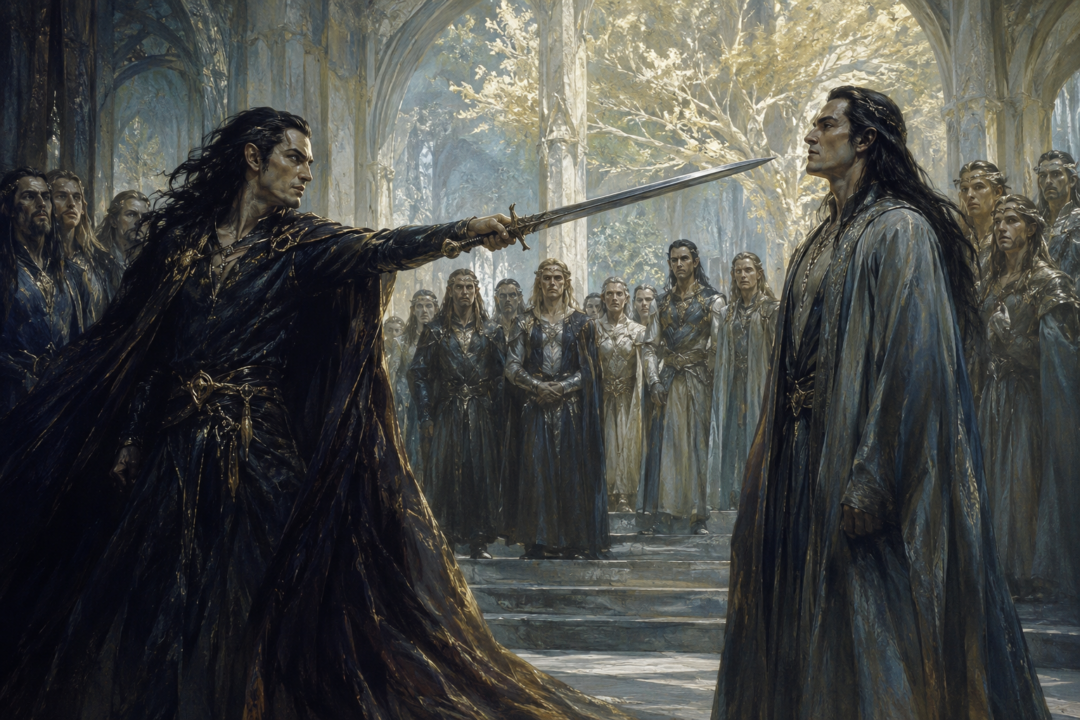
The decisive moment comes after Fingolfin goes before Finwë during a council of the Noldorin lords. Fëanor enters armed and eventually threatens his half-brother with a sword. The Valar summon the brothers to judgment. Melkor’s manipulation is uncovered, but that discovery does not absolve Fëanor of responsibility for his own act. He is banished from Tirion for twelve years. Fingolfin declares that he will release him from the penalty when that period is fulfilled.
This distinction matters.
Fëanor is not exiled because the Valar mistake Melkor’s lies for his own invention. They learn who has been sowing the unrest. Fëanor is punished because he has turned political suspicion into armed intimidation.
Yet his departure does not remove his influence.
It relocates it.
Formenos Becomes More Than a Place of Punishment
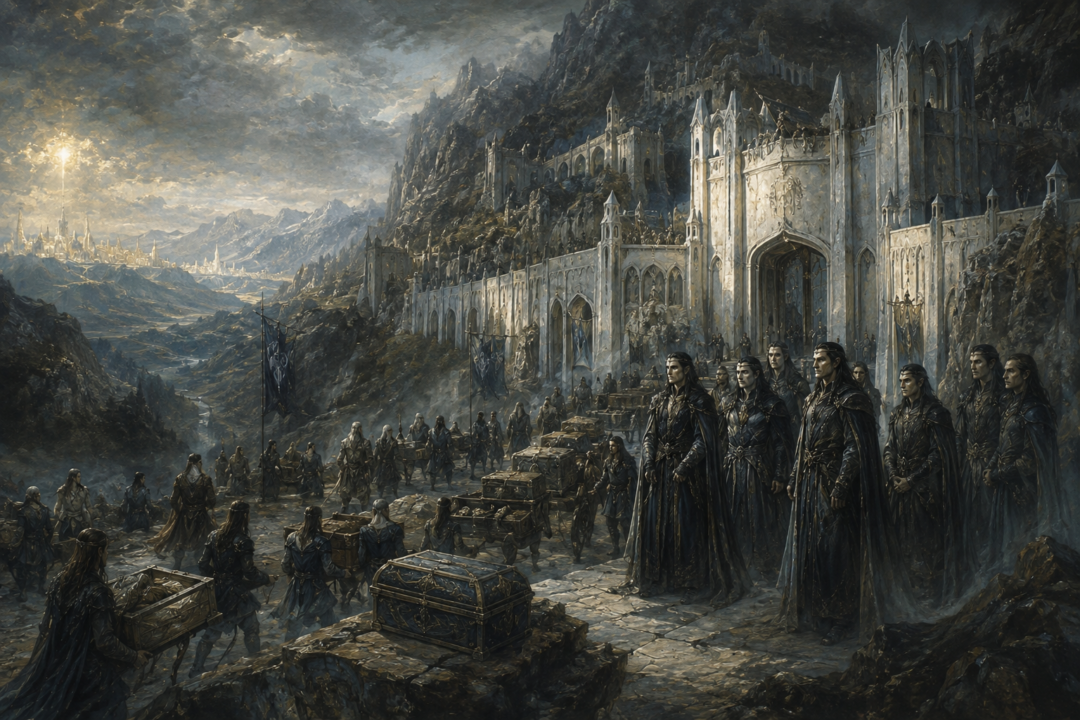
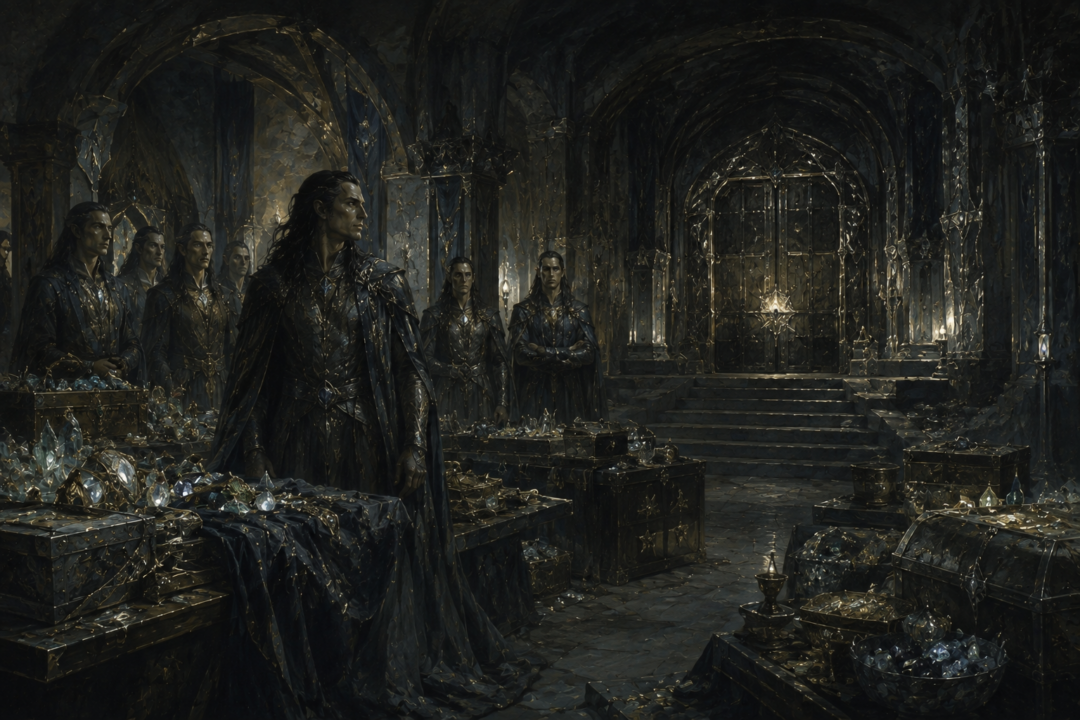
Fëanor goes north and establishes Formenos as a fortified residence and treasury. His seven sons go with him, and a body of followers accompanies them. There he stores great wealth, weapons, and above all the Silmarils, kept securely within the stronghold.
That immediately distinguishes Fëanor’s exile from simple isolation.
He remains surrounded by his immediate dynasty. He retains followers. He possesses extraordinary material wealth. He controls the Silmarils, objects whose fame has already spread through Aman. And his new home is not described merely as a dwelling but as a strong place associated with treasure and arms.
Calling this a formal rival kingdom would go beyond the text. There is no declaration that Formenos is a separate Noldorin realm, nor does Fëanor proclaim himself king there while Finwë lives.
But politically, Formenos has many of the ingredients of a competing center of allegiance.
The eldest son of the king has his own household, his own following, his own fortified seat, and his seven adult sons around him.
Then Finwë arrives.
That changes everything.
Finwë Turns Banishment Into a Dynastic Crisis
Finwë is not sentenced to exile.
He chooses it.
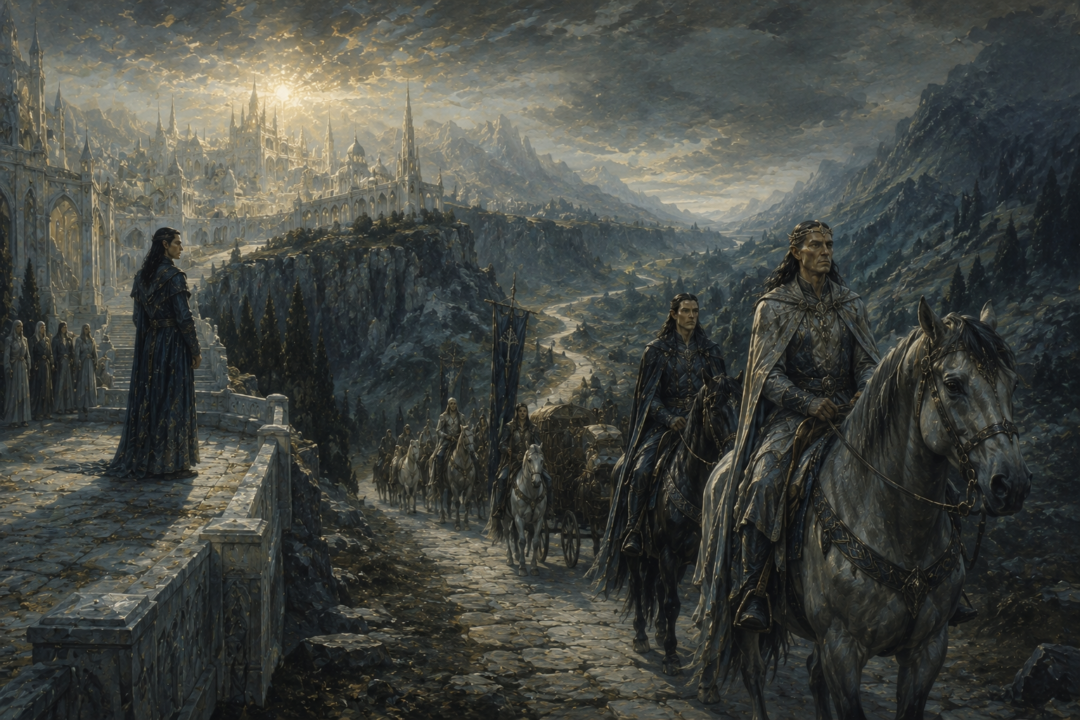
Because of his love for Fëanor, the King leaves Tirion and goes to Formenos. The rule of the Noldor who remain in Tirion consequently passes to Fingolfin.
This is perhaps the most politically consequential detail in the entire episode.
Had Finwë remained in Tirion, Fëanor’s banishment might have remained what the Valar intended: the temporary removal of one dangerously enraged prince from the center of Noldorin political life.
Instead the king himself leaves the capital.
Finwë’s motive is personal loyalty, not an explicitly declared constitutional program. The text emphasizes his love for Fëanor. Yet whatever his intention, the effect is political. Royal legitimacy and day-to-day government cease to occupy the same place.
Finwë is still the king, but Fingolfin rules in Tirion.
That creates an extraordinary situation. The Noldor in the city obey a prince whom Fëanor has already feared as a rival, while the actual king resides with Fëanor beyond the city.
One can therefore read Formenos as an unofficial dynastic court gathered around the senior branch of Finwë’s house, while Tirion develops a functioning government centered on Fingolfin.
The rivalry Fëanor feared has become structurally real—but partly because of Fëanor’s own actions.
The Bitter Irony of Fingolfin’s New Authority
Melkor’s most effective lie is not simply that the Noldor should distrust the Valar. He also inflames rivalry inside Finwë’s family.
Fëanor becomes convinced that Fingolfin seeks to supplant him.
Then Fëanor draws a weapon against Fingolfin.
Then Fëanor is banished.
Then Finwë follows Fëanor.
And as a consequence, Fingolfin actually becomes ruler of the Noldor in Tirion.
The irony is almost perfect.
Fëanor’s attempt to resist an imagined displacement helps create the very political arrangement he fears.
That does not prove that Fingolfin had secretly wanted Fëanor removed; the narrative gives no basis for such a conclusion. On the contrary, Fingolfin shows willingness to reconcile with his brother. At the later festival in Valinor he again offers his hand and acknowledges Fëanor’s precedence as elder brother.
But by then the experience of divided leadership already exists.
For years, the Noldor have lived with Fingolfin governing Tirion while Fëanor, his sons, and Finwë inhabit Formenos.
The later split during the Flight of the Noldor does not emerge from nowhere.
Its political shape has been rehearsed before anyone crosses the sea.
Two Houses Are Learning to Exist Apart
The division is not yet the later division of the Exiles in Beleriand. It would be inaccurate to project the mature Fëanorian and Fingolfinian factions backward in every detail.
Still, the family geography is significant.
At Formenos stand Fëanor and his seven sons, the core of the house that will later be bound together by the terrible Oath.
At Tirion remains Fingolfin, governing much of the Noldorin population left behind by the banished prince.
Fëanor’s own wife Nerdanel does not accompany him into exile; later tradition places her apart from him and associated with Indis rather than with the household at Formenos.
Even before the great rebellion, therefore, Fëanor’s choices are narrowing the circle immediately around him.
His father follows.
His sons follow.
Not everyone else does.
That pattern becomes much more destructive after the Darkening.
Melkor Recognizes Where the Real Fault Line Lies
Melkor eventually comes to Formenos.
That choice is revealing.
He approaches Fëanor at the northern stronghold and attempts once more to exploit his anger against the Valar. But when Melkor’s words reveal his desire for the Silmarils, Fëanor recognizes his purpose and shuts him out.
Fëanor deserves credit for that moment. He is not simply deceived whenever Melkor speaks. He identifies the threat and refuses him entry.
Yet the larger damage Melkor wanted has already been done.
The Noldor are politically divided. Distrust has entered Finwë’s family. Weapons have been forged where once the Eldar had little need of them. Fëanor has withdrawn with his sons and treasures. Finwë has abandoned the center of government to join him.
Melkor does not need to rule Formenos.
He only needed to help create the fears that made Formenos politically necessary in Fëanor’s mind.
Finwë’s Death Makes the Temporary Division Permanent
The arrangement might theoretically have ended.
Fëanor’s sentence was limited. Fingolfin had offered forgiveness. Reconciliation was still possible.
Then the Two Trees are destroyed.
During the Darkening, Melkor comes against Formenos. Finwë is slain, and the Silmarils are stolen.
Encyclopedia of Arda
This is the point at which a temporary political fracture becomes something much harder to repair.
The one figure who still stands above both branches of the royal family is gone.
Finwë had contributed to the division by choosing Fëanor’s company over residence in Tirion, but his continued kingship also meant that both Fëanor and Fingolfin remained sons beneath the same father and king.
His death removes that living center.
Now the question of succession can no longer remain theoretical.
Fëanor claims the kingship after his father’s murder, while Fingolfin already possesses years of experience ruling the Noldor of Tirion. Later, after catastrophe, abandonment, and Fëanor’s death in Middle-earth, the kingship will settle upon Fingolfin, with Maedhros relinquishing the claim of the House of Fëanor.
The political fracture first exposed by Formenos survives the man whose departure helped create it.
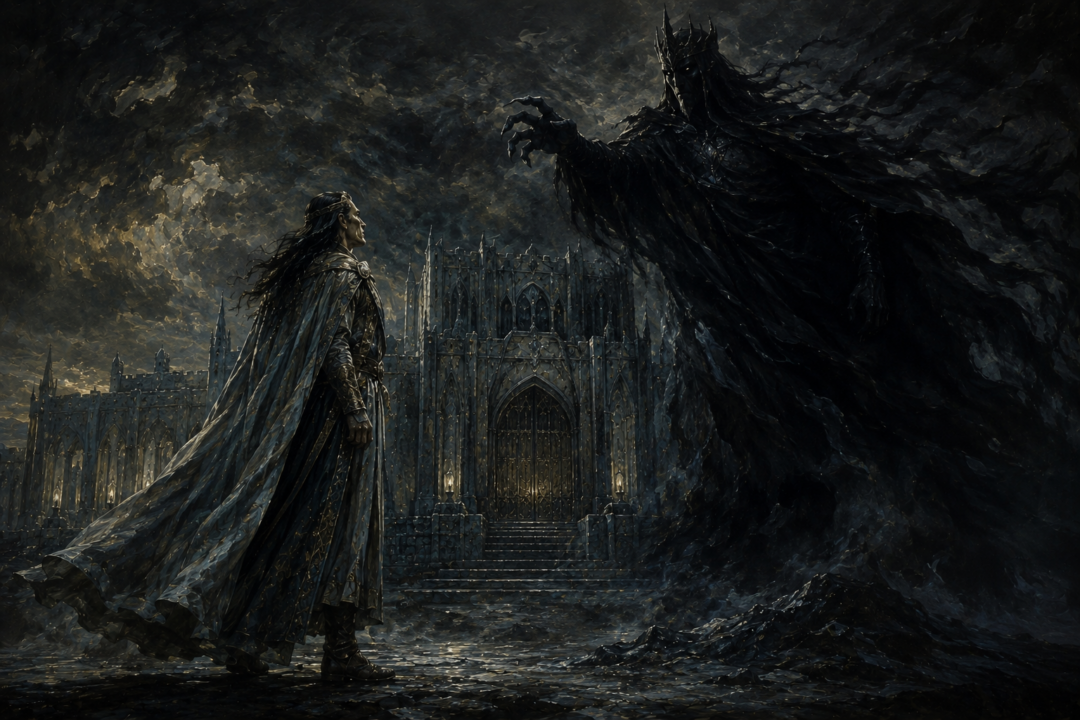
The First Exile Begins Before the Noldor Leave Aman
The great irony is that Fëanor becomes an exile before he leads the Noldor into Exile.
His first exile is limited, judicial, and contained within Aman. His later rebellion is vastly greater in scale and consequence.
But Formenos foreshadows what follows.
A charismatic prince withdraws from an established center. His sons gather around him. Followers choose his side. Wealth and weapons move with them. Authority divides between competing members of the same royal house. Personal grievance becomes inseparable from public leadership.
Nothing at Formenos makes the later disaster inevitable. The texts repeatedly preserve moments when reconciliation remains possible.
Yet Formenos reveals that the Noldor are already capable of becoming two political communities while still living under the light of the Trees.
That may be the deepest significance of Fëanor’s banishment.
The Valar remove one prince from Tirion to end a confrontation. But Finwë’s love for his eldest son carries the kingship northward with him, while practical rule remains with Fingolfin in the city.
For a time, the Noldor possess something stranger than a civil war and more dangerous than an ordinary family quarrel: two centers of loyalty that have not yet admitted they are rivals.
When the Darkening comes, that unresolved division is waiting for it.
Sources & Notes
- The Encyclopedia of Arda — Fëanor: biographical reference covering his conflict with Fingolfin, banishment, and establishment at Formenos — https://www.glyphweb.com/arda/f/feanor.html
- The Encyclopedia of Arda — Formenos: reference for the northern stronghold where Fëanor and his followers formed a separate centre of power — https://www.glyphweb.com/arda/f/formenos.html
- The Encyclopedia of Arda — Finwë: background on the High King who followed his banished son to Formenos — https://www.glyphweb.com/arda/f/finwe.html
- The Encyclopedia of Arda — Fingolfin: background on Fëanor’s half-brother and the competing Noldorin succession — https://www.glyphweb.com/arda/f/fingolfin.html
Sources document the key people, places, institutions, and chronology used in this interpretation.