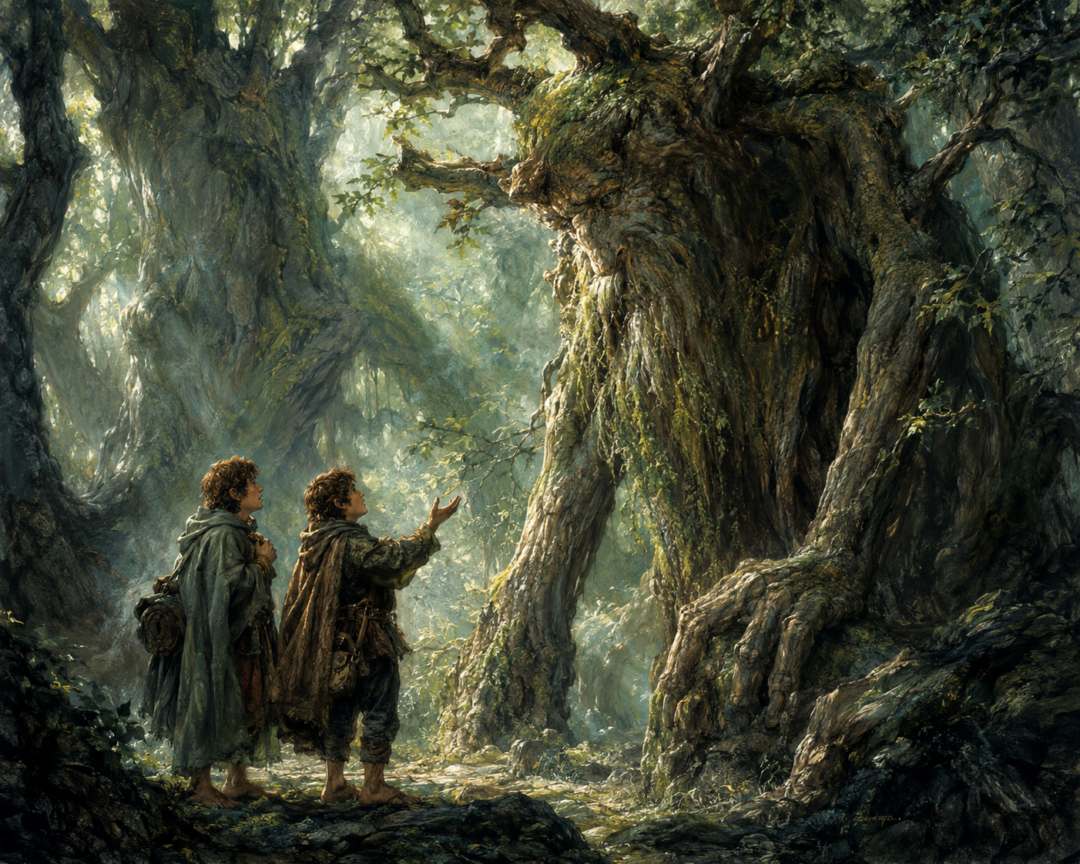
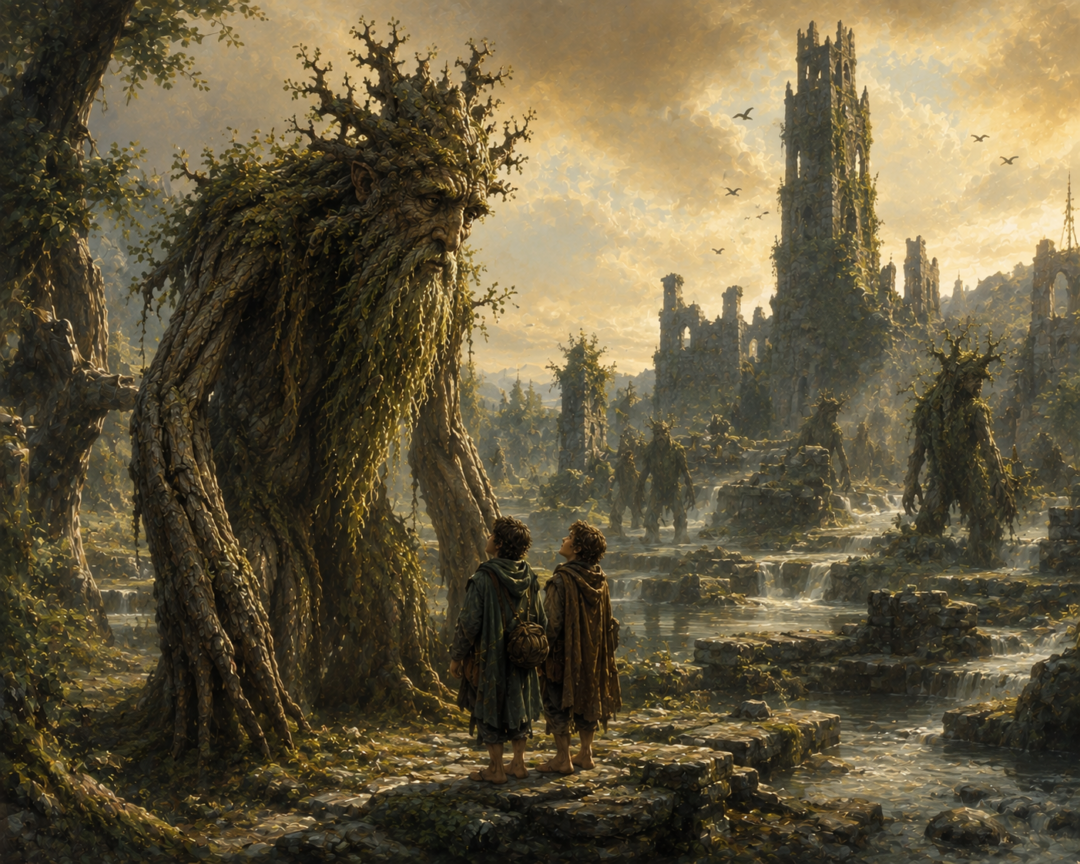
When Merry and Pippin first meet Treebeard in Fangorn Forest, the ancient Ent does not begin by asking where they come from, whom they serve, or why two small strangers have appeared in his wood.
His first difficulty is more fundamental: he cannot work out what they are.
Treebeard knows Elves. He knows Dwarves, Men, Ents, beasts, birds, trees, Orcs, and creatures whose histories reach back into ages the Hobbits barely understand. Yet Merry and Pippin do not fit the inherited order of living things he learned when he was young.
So Treebeard does something revealing. He searches his memory for a list.
The moment is comic, but it exposes something much larger about Treebeard. For one of the oldest living beings encountered in Middle-earth, knowledge is not merely a collection of facts. It is accumulated memory, preserved in names, songs, categories, and stories. Merry and Pippin confront him with an unsettling possibility: the world has changed while his ancient knowledge has remained behind.
Treebeard’s First Problem: What Are These Creatures?
Treebeard encounters Merry and Pippin after their escape from the Orcs at Parth Galen and their flight into Fangorn.
The Hobbits are strange enough to make even an Ent hesitate.
Treebeard admits that, had he seen them before hearing their voices, he might have mistaken them for small Orcs and stepped on them. Their voices matter because they stir some distant association in his memory and help persuade him that these creatures deserve closer attention.
Then comes the question that defines the encounter: what are they?
Treebeard says that he cannot place them because they do not appear to belong in the old lists he learned when young. He therefore begins recalling what is usually called the Long List of the Ents, a piece of traditional lore cataloguing living creatures.
Its beginning places special emphasis on the Free Peoples: Elves, Dwarves, Ents, and Men. It then moves through animals such as beavers, bears, hounds, eagles, oxen, hawks, and others.
But there is no Hobbit.
To Treebeard, that absence is genuinely puzzling.
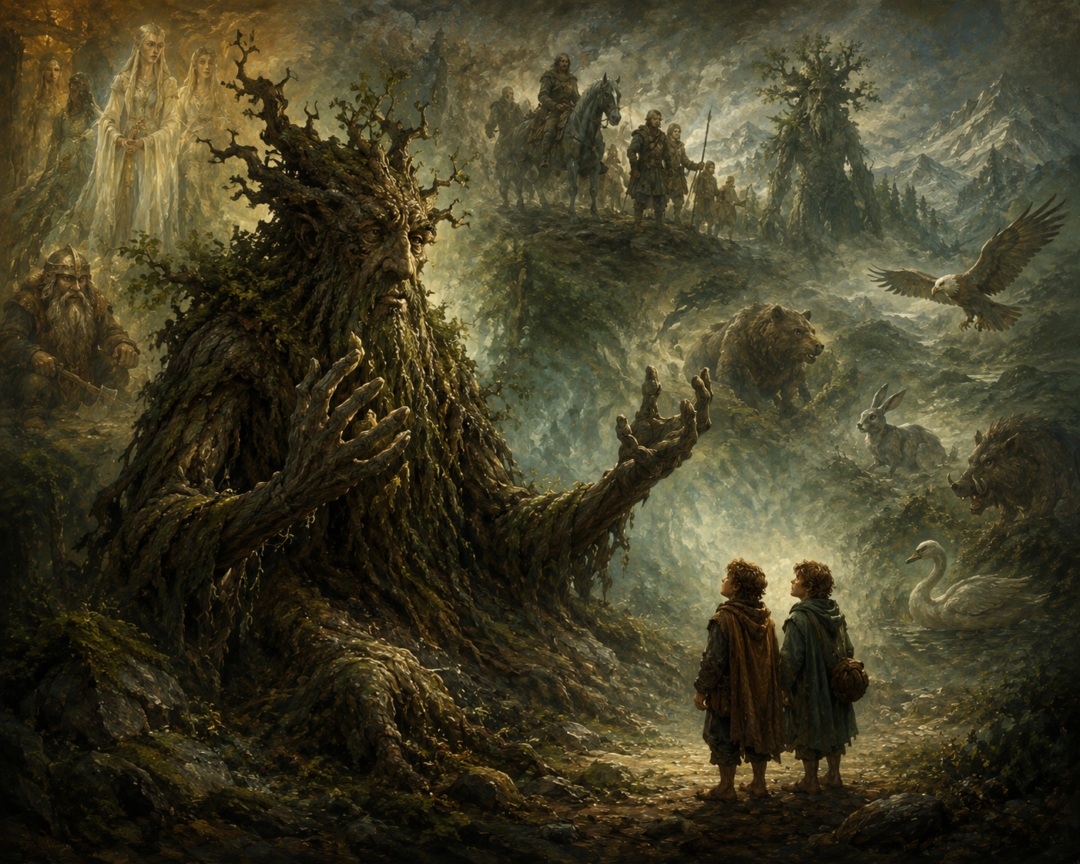
The Long List Is More Than a Joke
It is easy to read the scene as a charming joke about Hobbits being overlooked by the great and ancient peoples of Middle-earth. Merry effectively says as much: Hobbits always seem to have been omitted from old lists and stories.
But the Long List is also a system for preserving knowledge.
Its rhythmic, memorable form resembles the other rhymes of lore found throughout The Lord of the Rings: information made easier to retain because it has been shaped into verse. Treebeard is not consulting a written encyclopedia. He is reaching into inherited memory.
That matters because Ents experience history on a scale radically different from Hobbits.
Treebeard remembers landscapes that have vanished. He recalls walking in regions of Beleriand that disappeared beneath the sea at the end of the First Age. His songs preserve memories of places such as Tasarinan, Ossiriand, Neldoreth, and Dorthonion. The geography of his memory is partly a geography that no longer exists.
The old list belongs to that same immense reservoir of remembrance.
Merry and Pippin have therefore discovered something extraordinary: they are standing in front of a creature whose memory reaches into the Elder Days, yet that creature does not know what a Hobbit is.
Ancient knowledge and complete knowledge are not the same thing.
Hobbits Expose a Blind Spot in Ancient Wisdom
This contradiction is especially fitting because obscurity is one of the Hobbits’ greatest protections.
Hobbits are not newly created beings at the time of the War of the Ring. Their own records do not reach back to their earliest beginnings, but the Prologue to The Lord of the Rings makes clear that they had existed for a long time before the events of the story. They are related to Men, though their precise beginnings lie outside surviving Hobbit memory.
What they lack is prominence.
For much of recorded history, Hobbits have lived beyond the attention of the powerful. The Shire itself exists largely outside the calculations of rulers and enemies. Even Sauron begins the central crisis of The Lord of the Rings knowing dangerously little about the land from which the Ring-bearer comes.
Treebeard’s ignorance is very different from Sauron’s, but both situations reveal the same underlying fact: Hobbits have slipped beneath the notice of beings who believe they understand the important pieces on the board.
Treebeard’s reaction, however, is crucially different.
He does not force Merry and Pippin into an existing category once the evidence stops fitting.
He changes the category.
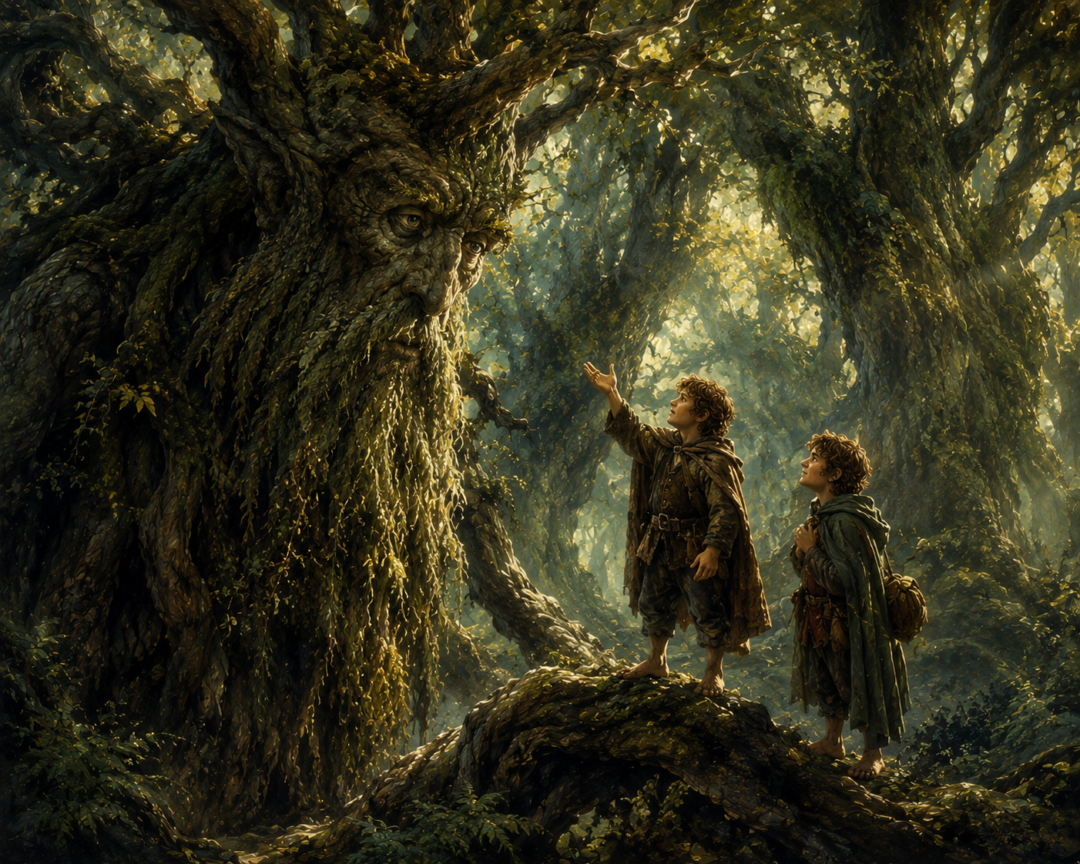
Pippin Solves the Problem by Rewriting the Lore
After Treebeard recites part of his list, Merry observes that Hobbits have been left out of old lists and old stories despite having existed for a long time.
Pippin offers a wonderfully Hobbit-like solution: make a new line.
He proposes placing Hobbits near Men and describing them as smaller, hole-dwelling folk. Treebeard considers the suggestion and accepts that it works.
This seems like a tiny exchange. In fact, it tells us something important about Treebeard’s relationship with tradition.
His old lore is authoritative, but it is not untouchable.
When reality contradicts the inherited list, Treebeard does not reject reality.
The list must change.
Later, after the overthrow of Saruman’s power at Isengard, Treebeard reveals that Hobbits have indeed entered the lore. His revised lines remember them as the “Hobbit children,” the “laughing-folk,” and the “little people.”
Merry and Pippin have gone from being unclassifiable strangers to part of Entish cultural memory.
That transformation is one of the quietest consequences of the War of the Ring.
Names Matter Because Treebeard Thinks in Stories
Treebeard’s concern with classification becomes even more meaningful when placed beside his attitude toward names.
When Merry asks for his real name, Treebeard refuses to give it quickly. In Entish thought, a true name is not simply a convenient label. Treebeard explains that his name is continually growing because he has lived so long, and that names in his own language tell the story of the things to which they belong.
This helps explain why identifying Merry and Pippin cannot be a trivial matter.
To classify something properly is partly to understand its story.
Treebeard also associates ancient words with the Elves, telling the Hobbits that the Elves began the old naming. The wider legendarium supports the deep connection between Elves, awakened trees, and the origins of Entish speech: in Treebeard’s own account, Elves desired to converse with everything and taught trees to speak, while the trees in turn helped the Ents develop their own speech.
Treebeard therefore inhabits a world where language, memory, and identity are closely connected.
Merry and Pippin arrive without a place in that inherited linguistic map.
Their presence demands a new name in the story.
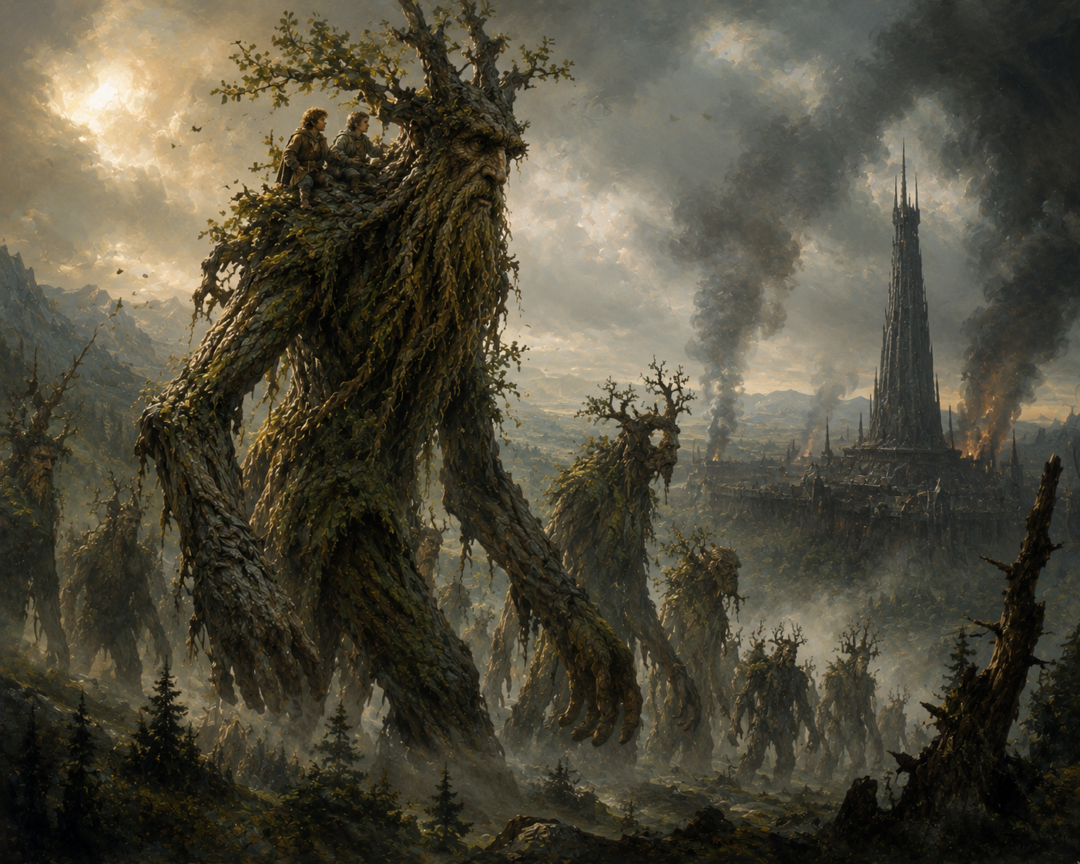
The Scene Also Reveals Treebeard’s Greatest Strength
Treebeard is extraordinarily old, but he is not portrayed as infallible.
His age gives him depth of memory, not perfect awareness of everything happening in Middle-earth. Indeed, the Fangorn chapters repeatedly contrast his immense historical perspective with the urgent events unfolding around him.
Saruman has been destroying trees. Orcs are moving through the land. War is spreading. Gandalf has passed through death and returned. Rohan is under pressure. Yet Treebeard and the Ents have not already marched to war.
Their slowness is not simple stupidity or cowardice. Ents think slowly because they are deeply rooted in long memory and reluctant to make irreversible decisions hastily.
The encounter with the Hobbits dramatizes this temperament on a miniature scale.
Treebeard encounters something unfamiliar.
He observes.
He questions.
He compares it with inherited knowledge.
And then, when the old knowledge proves incomplete, he revises his understanding.
That capacity to revise matters enormously, because Merry and Pippin soon bring him information about Saruman. The Hobbits do not single-handedly create the Ents’ grievances against Isengard; Treebeard already knows of destruction in the forest and eventually speaks bitterly of trees he has lost. But the Hobbits become part of the chain of events leading toward the Entmoot and the march on Isengard.
The creatures missing from Treebeard’s list become participants in one of the decisive blows against Saruman.
The Classification Problem Becomes a Theme of the Whole War
There is a broader irony here.
Again and again, the powerful misjudge what appears small, obscure, provincial, or insignificant.
Saruman increasingly thinks in terms of machinery, domination, military force, and usefulness. Sauron searches for the Ring through assumptions shaped by his own desire for power. Neither builds his strategy around the possibility that small people might carry the central burden of resistance without seeking power for themselves.
Treebeard’s initial mistake resembles that larger pattern only superficially.
He underestimates nothing deliberately. He simply lacks a category.
And unlike the great enemies, he is willing to learn.
That difference is decisive.
The scene in Fangorn suggests that wisdom does not mean possessing a perfect list of everything that exists. Even an ancient being can encounter something his inherited lore failed to record.
Wisdom lies partly in what happens next.
Treebeard could have dismissed Merry and Pippin because they did not fit his old understanding. Instead, he listens long enough for his understanding to expand.
By the end, Hobbits have not merely entered his list. They have entered the history of the Ents.
The Smallest People Force the Oldest Memory to Change
There is something wonderfully appropriate about Merry and Pippin becoming a correction to ancient lore.
Hobbits spend much of The Lord of the Rings entering stories that seem too large for them. They walk into the affairs of kings, Wizards, Elves, Ents, and the surviving powers of older ages. Again and again, they appear at first to be accidental witnesses.
Then they alter events.
In Fangorn, that pattern begins almost literally as a problem of classification.
Treebeard looks at two Hobbits and discovers that the world contains something his ancient list does not.
He could treat that as evidence that the creatures are wrong.
Instead, he eventually treats it as evidence that the list is incomplete.
That is the deeper meaning beneath the humor of the scene. Middle-earth is full of old lore, old songs, old names, and old memories, but the living world continues beyond them. Even the oldest keeper of memory must sometimes make room for something unexpected.
And in this case, the missing entry turns out to matter far more than anyone could have guessed.
Sources & Notes
- The Encyclopedia of Arda — Treebeard: biographical reference on the Ent who encounters Merry and Pippin and struggles to place hobbits in his lore — https://www.glyphweb.com/arda/t/treebeard.html
- The Encyclopedia of Arda — Ents: overview of the shepherds of trees and their slow, cataloguing way of understanding the world — https://www.glyphweb.com/arda/e/ents.html
- The Encyclopedia of Arda — Hobbits: overview of the people absent from Treebeard’s traditional lists of living creatures — https://www.glyphweb.com/arda/h/hobbits.html
- The Encyclopedia of Arda — Entmoot: context for Entish deliberation and the decision-making culture Treebeard represents — https://www.glyphweb.com/arda/e/entmoot.html
Sources document the key people, places, institutions, and chronology used in this interpretation.