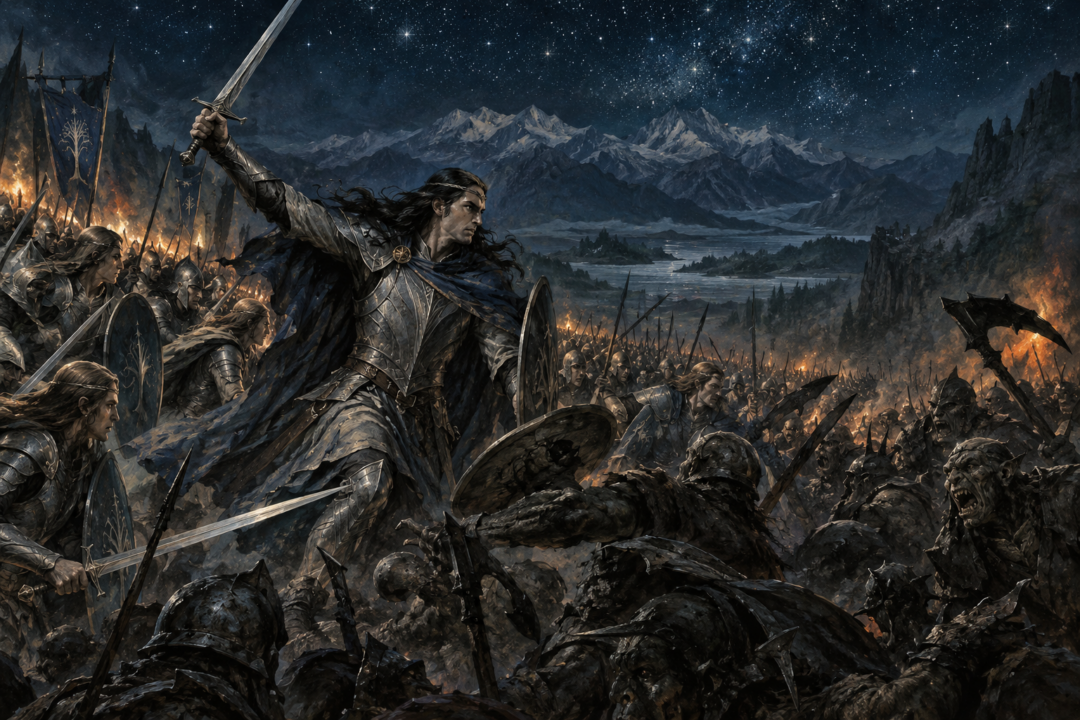
Fëanor comes to Middle-earth for a war that he expects to shape the fate of the world. He has sworn the terrible Oath of Fëanor, led part of the Noldor into exile, crossed the sea in stolen ships, abandoned Fingolfin’s people behind him, and burned those ships at Losgar. Ahead lies Morgoth, and within Morgoth’s possession are the three Silmarils.
Yet one of the strangest facts about Fëanor’s story is how little time he actually spends fighting that war.
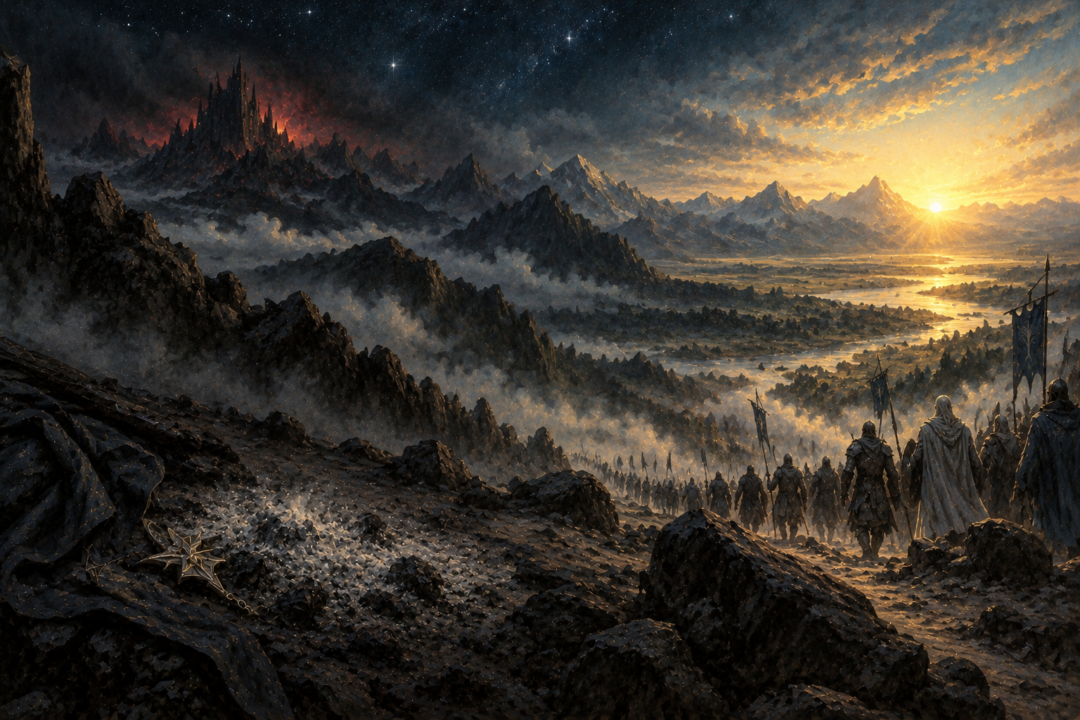
He never sees the Sun rise over Middle-earth.
His entire personal campaign in Beleriand—landing, establishing himself in Mithrim, winning the Battle-under-Stars, pursuing Morgoth’s armies toward Angband, confronting the Balrogs, and dying beneath the distant peaks of Thangorodrim—takes place while the world is still lit by stars.
The great wars caused by his rebellion will continue for centuries.
Fëanor himself is gone before the first sunrise.
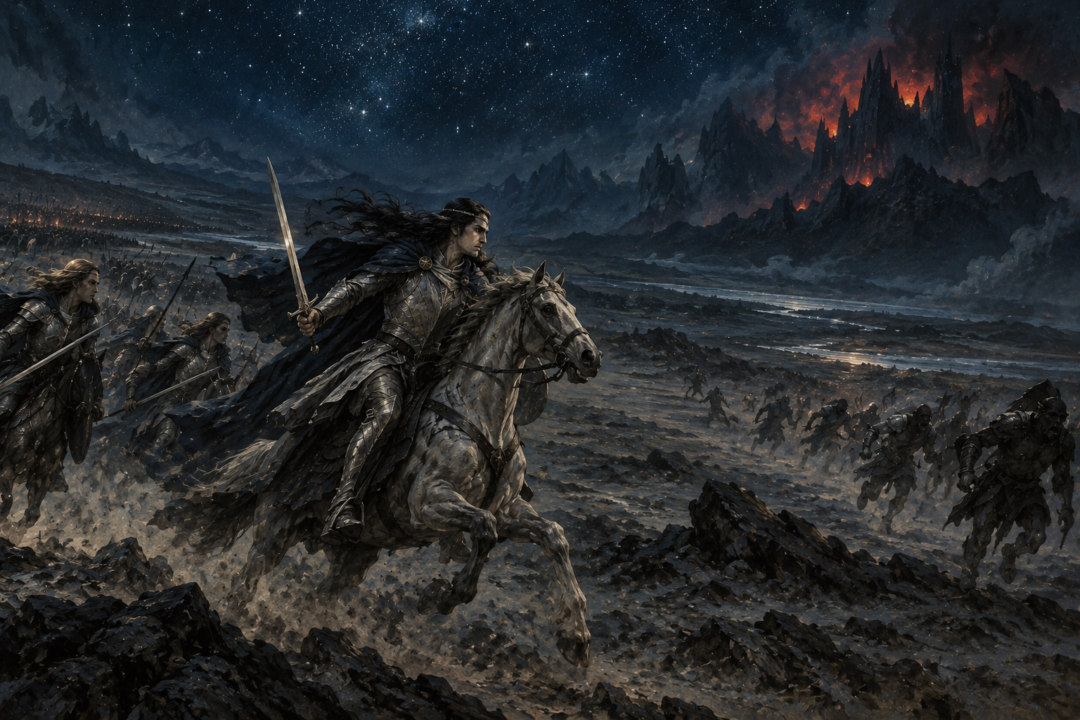
Fëanor Arrives in a World Without the Sun
When Fëanor lands in Middle-earth, the familiar astronomical world of the later First Age does not yet exist.
The Two Trees have been destroyed. The Moon and Sun have not yet risen. Beleriand remains beneath the stars, the ancient lights under which the Elves first awakened long before.
Fëanor’s people land at the Firth of Drengist and burn the ships at Losgar. The flames have consequences beyond the immediate betrayal of Fingolfin. Across the sea, Fingolfin’s abandoned host sees the distant light and understands what Fëanor has done.
Morgoth’s servants also become aware that enemies have arrived.
The returning Noldor proceed into Hithlum and camp beside Lake Mithrim. They have barely established themselves when Morgoth attempts to destroy them.
It appears, at first, to be exactly the kind of war Fëanor believes he can win.
Morgoth Strikes—and Fëanor Wins
Morgoth sends a great force against the newly arrived Noldor before they can fully establish themselves.
The result is disastrous for Morgoth.
The Exiles have only recently left Aman, and the Noldor who followed Fëanor are formidable warriors. Though Morgoth’s Orcs greatly outnumber them, they are defeated and driven back.
This becomes the Dagor-nuin-Giliath: the Battle-under-Stars.
Its name is important. The battle occurs before the first rising of the Moon, and therefore before the first sunrise as well.
The fighting lasts ten days in the reckoning given in The Silmarillion. Another army of Morgoth, which had been operating farther south against the Havens of the Falas, moves northward. Celegorm intercepts it near Eithel Sirion and drives the enemy into the Fen of Serech.
Almost the entire Orc-host is destroyed.
Militarily, Fëanor has achieved an extraordinary opening victory.
And that victory is precisely what makes what follows possible.
The Victory Confirms Fëanor’s Most Dangerous Belief
Fëanor has already defied powers greater than himself.
He has rejected the authority of the Valar. He has ignored the Doom pronounced upon the rebellious Noldor. He has participated in the disastrous flight from Aman, taken the ships of the Teleri after bloodshed at Alqualondë, and abandoned Fingolfin’s people.
Now he reaches Middle-earth and immediately crushes Morgoth’s army.
It would have been easy for such a victory to seem like vindication.
But victory over Morgoth’s Orcs is not victory over Morgoth.
This distinction becomes fatal.
As the defeated enemy flees northward, Fëanor refuses to stop. His wrath drives him forward toward Angband. The main strength of his army falls behind until he is advancing with only a comparatively small following.
The campaign changes character at that moment.
Fëanor is no longer merely exploiting a battlefield victory. He is racing toward the fortress of the greatest enemy in Arda without the strength of his host concentrated around him.
And Morgoth still possesses weapons Fëanor has not yet faced.
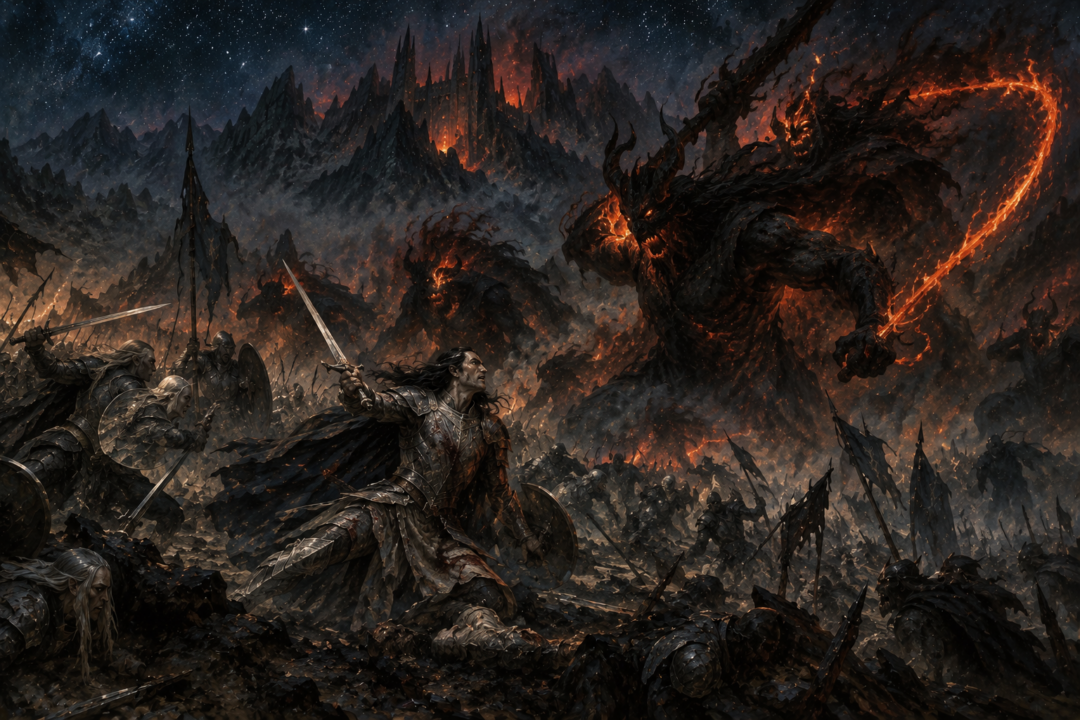
The Balrogs Come Out of Angband
Fëanor reaches the region of Dor Daedeloth, the dreadful land surrounding Morgoth’s fortress.
There the pursuit ends.
From Angband come the Balrogs.
These are not merely another body of Orcs that can be swept aside by the fury of the Noldor. Fëanor is surrounded, and the battle becomes desperate.
He fights on despite receiving many wounds.
Eventually Gothmog, Lord of Balrogs, strikes Fëanor down with a mortal wound.
His sons arrive with reinforcements and drive the Balrogs away, but the central fact cannot be reversed.
Fëanor has not captured Angband.
He has not confronted Morgoth.
He has not recovered even one Silmaril.
He has not even reached the fortress he crossed the world to attack.
His war is already over.
Fëanor Finally Understands the Scale of the War
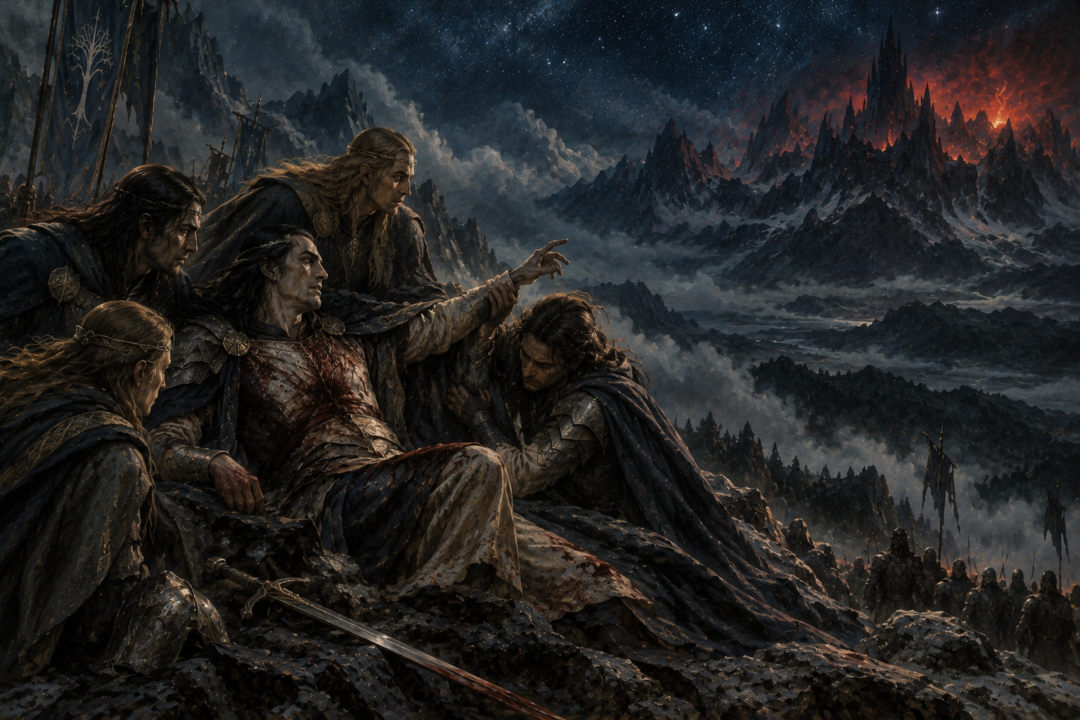
His sons carry him away from the battlefield toward Mithrim.
Near the pass of Ered Wethrin, Fëanor commands them to stop. From there he can look northward and see the peaks of Thangorodrim above Morgoth’s fortress.
This is one of the most revealing moments in his entire story.
Fëanor has spent his rebellion acting as though will, courage, and refusal to submit can overcome almost any obstacle. Yet in death his perception becomes clearer.
Looking upon Thangorodrim, he understands that no power of the Noldor alone will overthrow those towers.
That realization does not cause him to release his sons.
Instead, he curses Morgoth and lays upon his sons the duty of fulfilling their oath and avenging him.
That is the final tragedy.
Fëanor recognizes that the task exceeds the strength available to them, but the Oath remains.
The father dies.
The obligation survives.
His Body Becomes Ash
Fëanor’s death is unlike the ordinary deaths of the Eldar described elsewhere.
His spirit is so fiery that when it departs, his body falls into ash.
There is no tomb of Fëanor in Beleriand.
No grave becomes a monument to the first High King of the Noldor in exile. His sons are left with an oath, an enemy they cannot defeat alone, and a war whose architect has vanished almost as soon as it began.
The image is remarkably fitting.
The ships burned at Losgar.
Fëanor himself burns away at death.
And the destructive fire of his decisions continues long after the man who made them is gone.
Then Morgoth Demonstrates How Trapped the Sons Already Are
Fëanor’s death does not end the crisis.
Morgoth sends messengers offering terms and even pretends that he will surrender a Silmaril. Maedhros agrees to a meeting, though neither side truly trusts the other and both bring more strength than agreed.
Morgoth brings the greater force.
Maedhros is captured.
Morgoth then attempts to use him as leverage, demanding that the Noldor abandon their war and leave Beleriand.
But the sons of Fëanor cannot simply renounce their purpose. Their oath binds them to pursue anyone who possesses a Silmaril and withholds it from them.
So almost immediately after Fëanor’s death, his eldest son hangs captive from Thangorodrim while the remaining brothers confront the consequences of an oath they cannot easily escape.
The campaign has already ceased to belong to Fëanor.
His sons have inherited it.
Only Afterward Does the Sun Rise
Meanwhile, the people whom Fëanor abandoned have accomplished something astonishing.
Fingolfin and his followers cross the Helcaraxë.
Their suffering has been severe, but they finally enter Middle-earth. Around this period the Moon first rises, and then comes the first rising of the Sun.
The contrast with Fëanor could hardly be sharper.
He was the driving force behind the rebellion of the Noldor. He made the Silmarils. He spoke the oath that shaped so much of what followed. He seized the ships needed for the crossing and became the first leader of the returning Noldor to reach Beleriand.
Yet when the new light finally appears over Middle-earth, Fëanor is already dead.
Fingolfin sees the first sunrise in Middle-earth.
Fëanor does not.
The War Fëanor Started Becomes Larger Than Him
This is what makes the brevity of Fëanor’s Beleriand campaign so striking.
The consequences of his choices fill the history of the First Age, but his direct participation in that history is astonishingly short.
Others will establish realms across Beleriand.
Fingolfin will become High King. Finrod will build Nargothrond. Turgon will rule hidden Gondolin. The Noldor will contain Morgoth for centuries during the long Siege of Angband.
Men will awaken beneath the Sun and eventually enter Beleriand.
Beren and Lúthien will recover a Silmaril from Morgoth’s crown—something Fëanor never comes close to accomplishing himself.
And the Oath will continue to drive Fëanor’s sons toward increasingly terrible choices as the Silmarils pass into other hands.
The founder of the conflict sees almost none of it.
Fëanor’s First Victory Was Also His Last
There is a powerful irony at the heart of Fëanor’s campaign.
He does not arrive in Beleriand and immediately fail.
He wins.
The Battle-under-Stars is a devastating victory for the Noldor. Morgoth’s attempt to crush the newcomers before they can establish themselves collapses.
But Fëanor cannot separate victory from total victory.
He pursues when restraint would have preserved his strength. He outruns the greater part of his host. He approaches Angband as though the momentum of one battlefield triumph can carry him all the way to Morgoth.
It cannot.
The Balrogs stop him before he reaches his enemy’s gates.
His final sight of Thangorodrim gives him the understanding that his fury had previously denied him: the Noldor cannot overthrow Morgoth by their own power.
That realization arrives too late to save him and too late to undo the oath.
So Fëanor’s campaign ends beneath the same ancient stars under which it began.
The Sun has not yet risen.
Men have not yet awakened.
The kingdoms most associated with the First Age have not yet been founded.
The centuries-long struggle against Angband has scarcely begun.
Yet Fëanor—the maker of the Silmarils, leader of the rebellion, and source of the oath that will haunt Beleriand—is already gone.
His war lasts far longer than he does.
And that may be the final irony of Fëanor: he sets an age in motion, but dies before he can see its first dawn.
Sources & Notes
- Tolkien Gateway, “Dagor-nuin-Giliath” — https://tolkiengateway.net/wiki/Dagor-nuin-Giliath
- Tolkien Gateway, “Fëanor” — https://tolkiengateway.net/wiki/F%C3%ABanor
- Tolkien Gateway, “Of the Sun and Moon and the Hiding of Valinor” — https://tolkiengateway.net/wiki/Of_the_Sun_and_Moon_and_the_Hiding_of_Valinor
These secondary reference entries identify the relevant Tolkien texts and document the characters, events, and objects discussed. Explanations of motives and practical consequences remain interpretation unless explicitly stated in the cited texts.