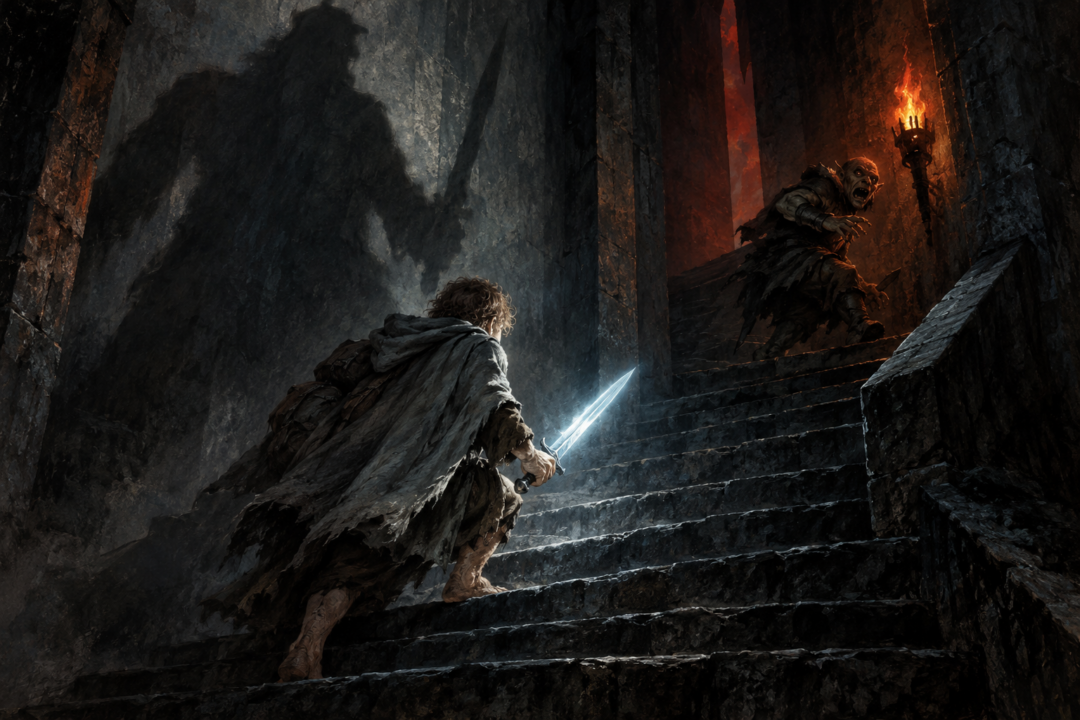
Sam Gamgee enters the Tower of Cirith Ungol as almost the least likely figure imaginable to terrify a fortress of Orcs.
He is a gardener from the Shire, alone in Mordor, frightened, exhausted, and searching desperately for Frodo. Yet by the time he climbs the Tower, the surviving Orcs are convinced that something far more dangerous is coming after them.
They imagine a great warrior—probably an Elf, perhaps one of the dreaded Númenórean kindred they call “tarks.”
The remarkable part is that their conclusion is not simply comic misunderstanding. From the evidence available to them, it is almost reasonable.
Sam has wounded Shelob, cut through her webs, escaped detection, passed the supernatural Watchers of Cirith Ungol, entered the fortress carrying an Elven blade, and begun climbing toward them. When one Orc actually sees him, Sam does not even appear to be a small hobbit.
For a moment, the frightened gardener becomes exactly the nightmare the Orcs have already imagined.
The Orcs Have Already Invented Sam Before They See Him
The misunderstanding begins before Sam enters the Tower.
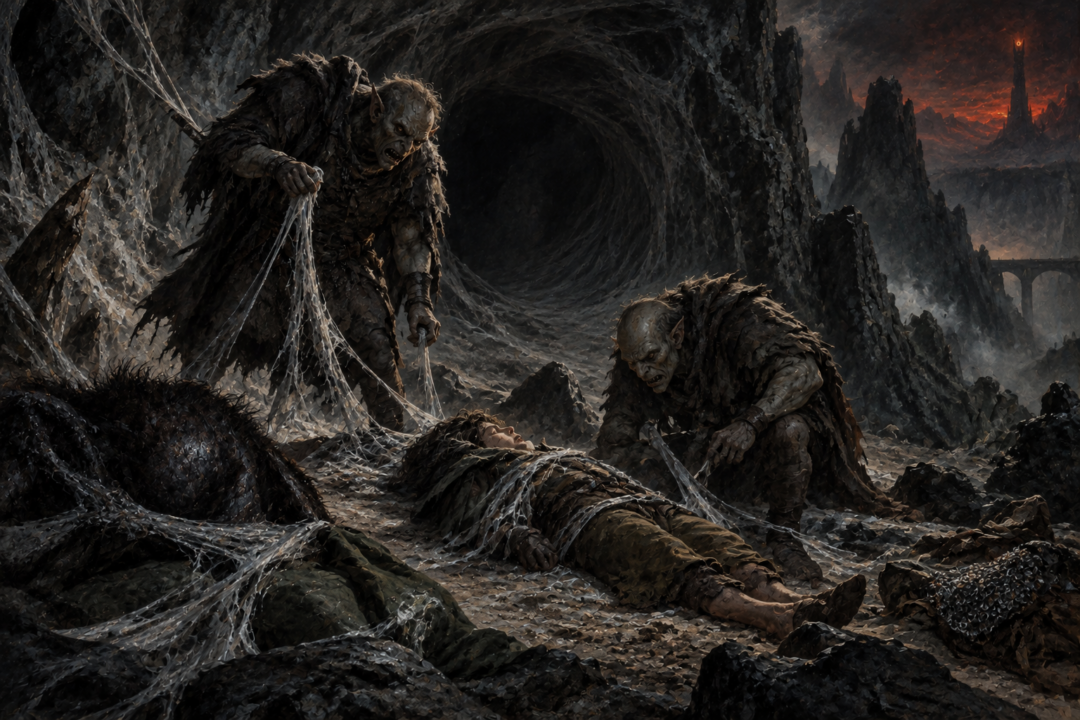
After Shelob attacks Frodo, Shagrat and Gorbag find Frodo's body and examine what has happened around him. Gorbag notices evidence that does not fit the obvious explanation.
Someone cut Shelob's web. Someone cut the cords wrapped around Frodo. Most astonishingly, someone wounded Shelob herself.
That matters enormously.
Gorbag insists that no one has managed such a thing before within their experience. He therefore concludes that another intruder must still be loose near Cirith Ungol. Judging from the evidence, he imagines a large warrior, probably an Elf, armed with an Elven sword and perhaps an axe.
The reader knows the truth.
The terrifying unidentified warrior is Sam.
The Orcs are wrong about his size and identity, but not about what he has accomplished. Sam really did cut Shelob's web. He really did attack her. Armed with Sting and the Phial of Galadriel, he drove her away after one of the most desperate fights in the story.
Gorbag's mistake is therefore revealing. He can understand the deed, but he cannot imagine the person who performed it.
A hobbit does not fit his idea of power.
So he invents someone who does.
Why an Elf Seems Like the Obvious Answer
The Orcs repeatedly associate the mysterious intruder with Elves, and there are good reasons inside the story for that conclusion.
Sting is an ancient Elven blade from Gondolin. It shines when Orcs are near, and the Orcs recognize the danger associated with such weapons. The evidence around Shelob therefore points toward an enemy equipped with Elvish things.
But their reaction goes deeper than identifying a sword.
When Sam later confronts an Orc inside the Tower, the light of Sting is described through the Orc's terror as something reminiscent of cruel stars in dreaded Elven lands. The language strongly suggests that Elves and their works occupy a frightening place in Orcish imagination.
To the Orcs, then, “Elf-warrior” is not merely a species identification. It represents a kind of ancient and hateful enemy armed with powers they fear.
Sam finds their mistake amusing enough that he begins using it himself. After passing the Watchers and setting off the alarm, he mockingly announces that the “great Elf-warrior” has arrived with his Elven sword.
He knows exactly who they think is coming.
And for once, their fear works in his favor.
The Other Possibility: A “Tark”
There is another revealing possibility in the Orcs' conversation.
Snaga later tells Shagrat that the approaching fighter might be one of the hated Elves—or one of the “tarks.”
The term is explained in the text as an Orcish word for someone of Númenórean descent. In the context of the late Third Age, that points toward the great Men associated with Gondor and the Dúnedain.
Snaga specifically connects this possibility with Sam's passage through the Watchers.
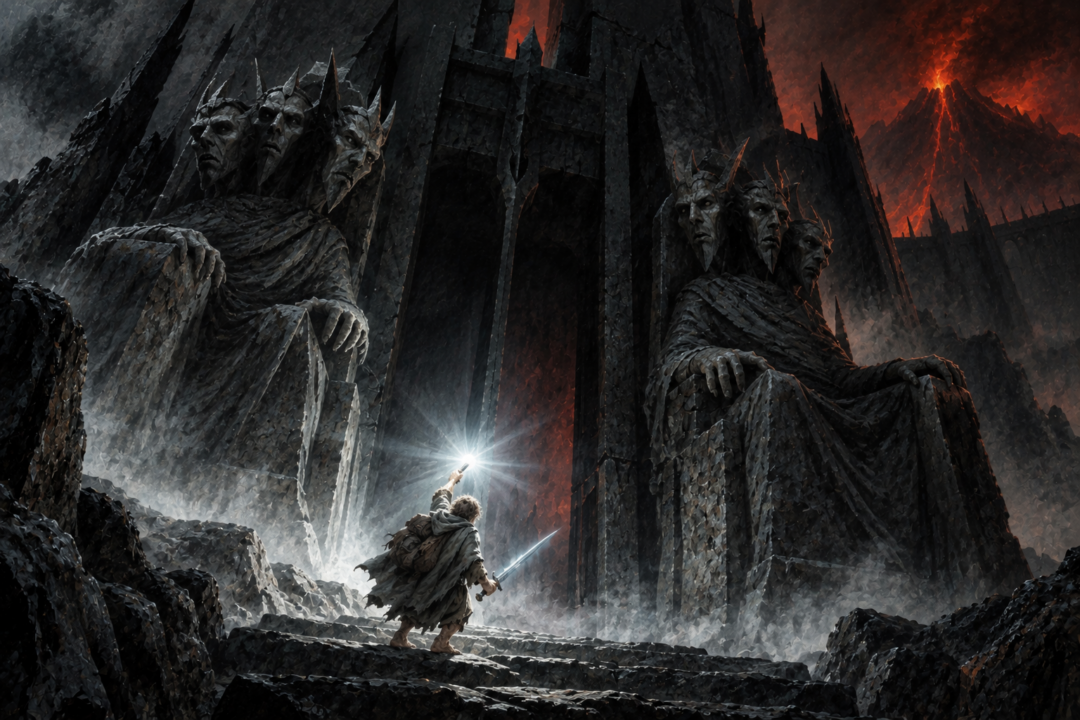
The Watchers guarding the entrance are not ordinary sentries. They are monstrous seated figures possessing a hostile will that can prevent an enemy from passing. Sam himself initially cannot overcome them by strength of will.
He succeeds by drawing out the Phial of Galadriel. Its light causes the Watchers' resistance to waver long enough for him to pass.
Then their alarm sounds.
The Orcs inside do not know about Galadriel's Phial. They know only that someone has somehow crossed a barrier they consider formidable.
Snaga therefore treats the feat as evidence of a powerful enemy. His remark that getting past the Watchers is “tark's work” shows the respect—or fear—the Orcs attach to such foes.
Again, they misidentify Sam while correctly recognizing that something extraordinary has happened.
Then an Orc Actually Sees Sam
The strangest moment comes when Sam is climbing through the Tower.
He hears an Orc approaching down the stairs. Frightened, Sam instinctively clutches the Ring at his breast, though he does not put it on.
Then the Orc sees him.
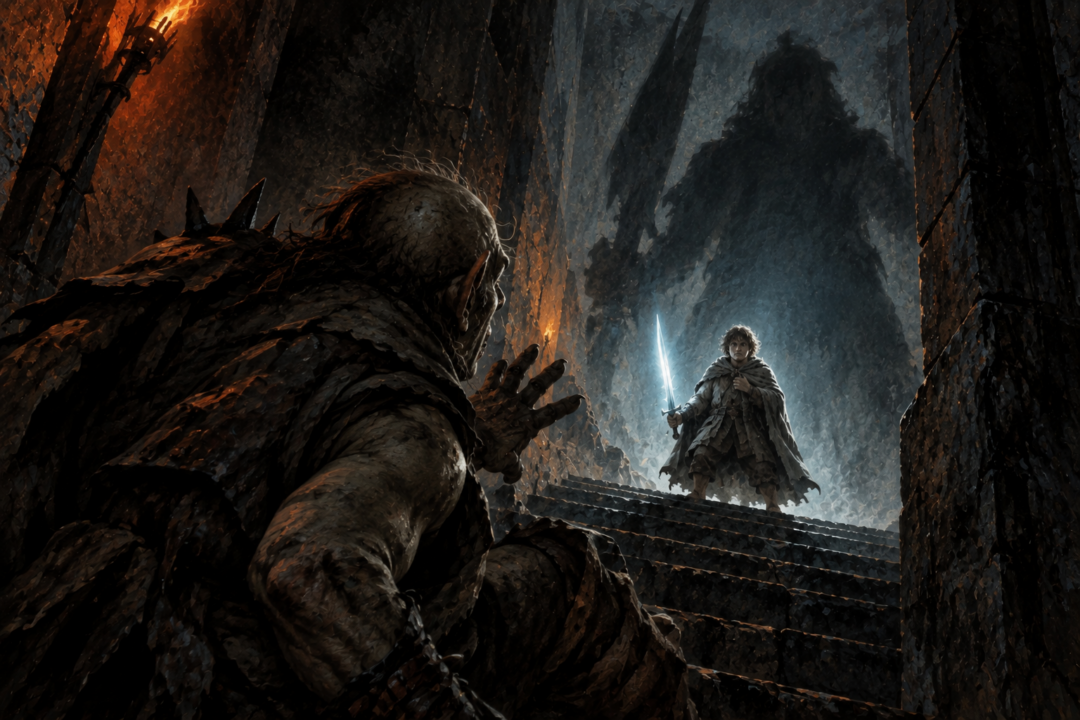
What it perceives is explicitly not simply a frightened little hobbit.
Sam appears as a great shadowy figure looming in the uncertain light. Sting burns painfully in the Orc's sight, while Sam's other hand is held against his breast, concealing what the narration describes as a menace of power and doom.
The Orc panics and runs.
This is important because the earlier belief in a great warrior was deduction. Gorbag had reconstructed an imaginary enemy from the evidence around Shelob.
Now that expectation seems almost to become visible.
The text does not give a mechanical explanation saying that the Ring literally casts an illusion transforming Sam into a giant Elf. It is safer not to describe the scene that way.
But the Ring is clearly part of what the Orc senses. Soon afterward the narration makes the connection stronger: although Sam is not holding the Ring in his hand, its hidden presence remains a threatening power to the servants of Mordor.
The Orc is seeing Sam through fear, darkness, expectation, Sting's Elven light, Sam's grey cloak, and the oppressive presence of the Ring.
All of those things combine into something much larger than Sam's physical body.
The Ring Makes the Moment More Dangerous
This scene becomes even more interesting because Sam has just resisted one of the Ring's greatest temptations.
Near Mordor, its power presses heavily upon him. Sam briefly imagines himself transformed into “Samwise the Strong,” a heroic commander who could overthrow Sauron and turn the wastes of Mordor into a vast garden.
But Sam rejects the fantasy.
His ordinary humility saves him. He understands that he does not truly need a realm or armies of servants. His own small garden, worked with his own hands, is enough.
That makes the Tower scene almost an ironic echo of the temptation.
The Ring has offered Sam an imaginary version of greatness. Sam refuses it.
Yet shortly afterward, the Orcs perceive him as something great and terrible anyway.
The difference is crucial.
Sam does not conquer Cirith Ungol by becoming the mighty lord imagined by the Ring. He succeeds because he remains Sam: frightened but loyal, humble but determined, searching for Frodo when nearly every sensible calculation tells him to flee.
His apparent greatness is almost incidental.
His real strength lies somewhere else.
The Orcs' Fear Is Built on Their Own Mistake
There is another layer to the episode.
The Tower has already been devastated before Sam properly enters it.
The Orcs of Shagrat and Gorbag have turned on one another after quarrelling over Frodo's possessions, especially his mithril coat. Their greed, rivalry, suspicion, and brutality erupt into murderous fighting.
By the time Sam arrives, the fortress is filled with Orc corpses.
From the perspective of the few survivors, the situation must seem horrifying.
A mysterious warrior has wounded Shelob. The prisoner has strange equipment. An unknown enemy remains loose. The garrison has destroyed itself. The Watchers suddenly sound their alarm.
Then footsteps begin climbing the Tower.
The Orcs have no reason to imagine that the approaching enemy is a hobbit gardener who is nearly as terrified as they are.
Their own fear supplies the missing explanation.
The great warrior they expect becomes the great warrior they perceive.
Sam Uses the Legend Against Them
One of the most delightful aspects of the episode is how quickly Sam realizes what is happening.
When the Orc flees from him, Sam becomes bolder and gives chase, declaring that the Elf-warrior is loose.
He is effectively weaponizing the Orcs' own rumor.
Yet the comedy never entirely removes the danger. Sam is still alone inside an enemy fortress. Frodo may be dying somewhere above him. Shagrat and Snaga remain dangerous. The Ring hangs around Sam's neck in the land where its power is strongest.
The humor works because Sam knows how absurd the misunderstanding is.
The Orcs think a legendary enemy has invaded Cirith Ungol.
Sam knows that enemy is Sam Gamgee.
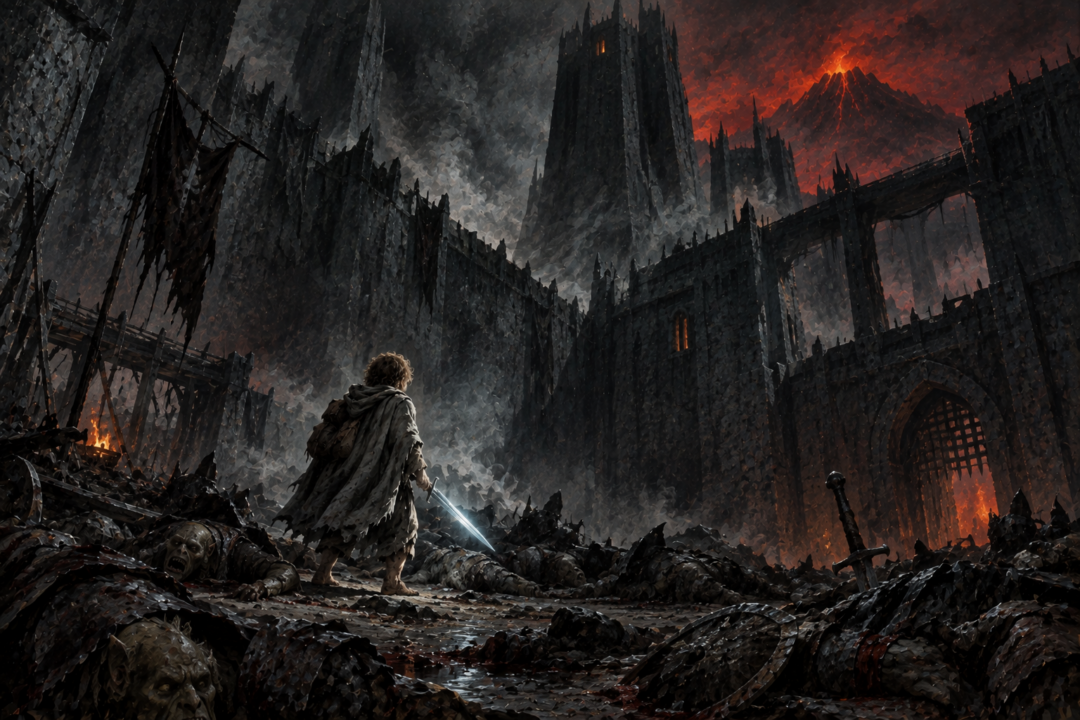
What the Orcs Really See
So what do the Orcs think Sam is?
At first, Gorbag concludes that the unknown attacker is probably a large Elf-warrior. Later Snaga allows two frightening possibilities: one of the “bloody-handed Elves” or a Númenórean “tark.” When he actually encounters Sam, he sees something less precisely identifiable but even more terrifying—a looming figure armed with painful Elven light and carrying a hidden menace of power.
There is no need to turn this into a literal magical disguise.
The scene is more powerful without one.
The Orcs see the evidence of Sam's courage without understanding its source. They see someone who faced Shelob and survived. Someone who carries an Elven sword. Someone who passed the Watchers. Someone advancing alone through a fortress of corpses with an unknown power hidden at his breast.
They assume such deeds must belong to a mighty warrior.
What they cannot imagine is that courage in Middle-earth does not always look mighty.
Sometimes it is a king riding openly to battle. Sometimes it is an Elf-lord facing an ancient enemy.
And sometimes it is a terrified gardener climbing a dark staircase because his friend is somewhere at the top.
Sources & Notes
- Tolkien Gateway, “The Tower of Cirith Ungol” — https://tolkiengateway.net/wiki/The_Tower_of_Cirith_Ungol
- Tolkien Gateway, “Snaga (orc of Mordor)” — https://tolkiengateway.net/wiki/Snaga_(orc_of_Mordor)
- Tolkien Gateway, “Gorbag” — https://tolkiengateway.net/wiki/Gorbag
These secondary reference entries identify the relevant Tolkien texts and document the characters, events, and objects discussed. Explanations of motives and practical consequences remain interpretation unless explicitly stated in the cited texts.