Why the Noldor Could Not Simply Reproduce the Ships of the Teleri
When Fëanor led the rebellious Noldor toward Middle-earth, one practical problem stood between his people and their destination: the Sea.
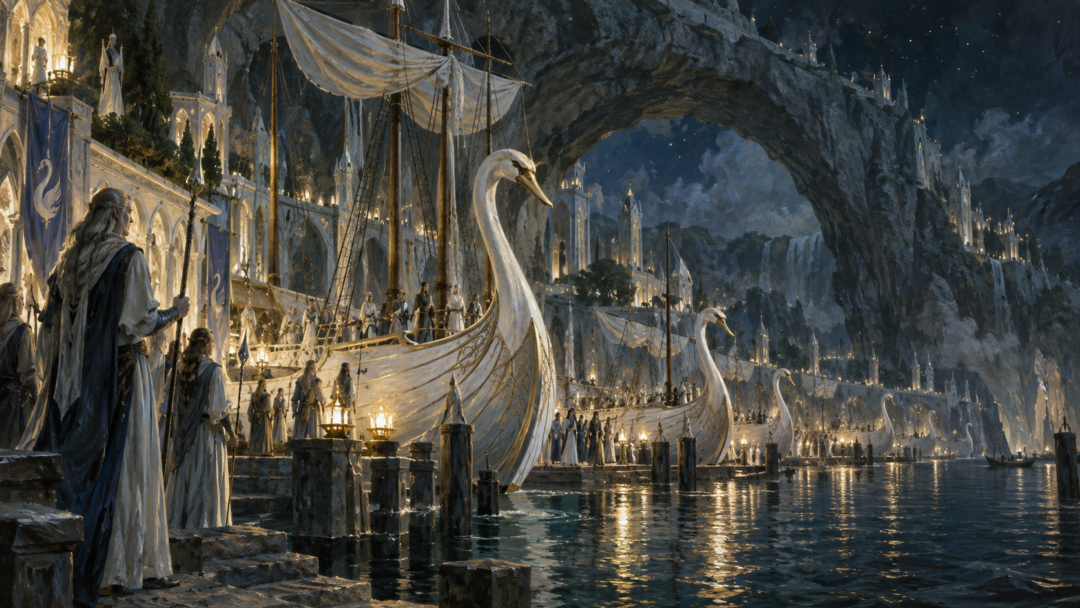
The answer seemed to be waiting at Alqualondë. The Teleri possessed their famous white ships, vessels shaped in the likeness of swans and built for the waters of Eldamar. Fëanor demanded their use. King Olwë refused.
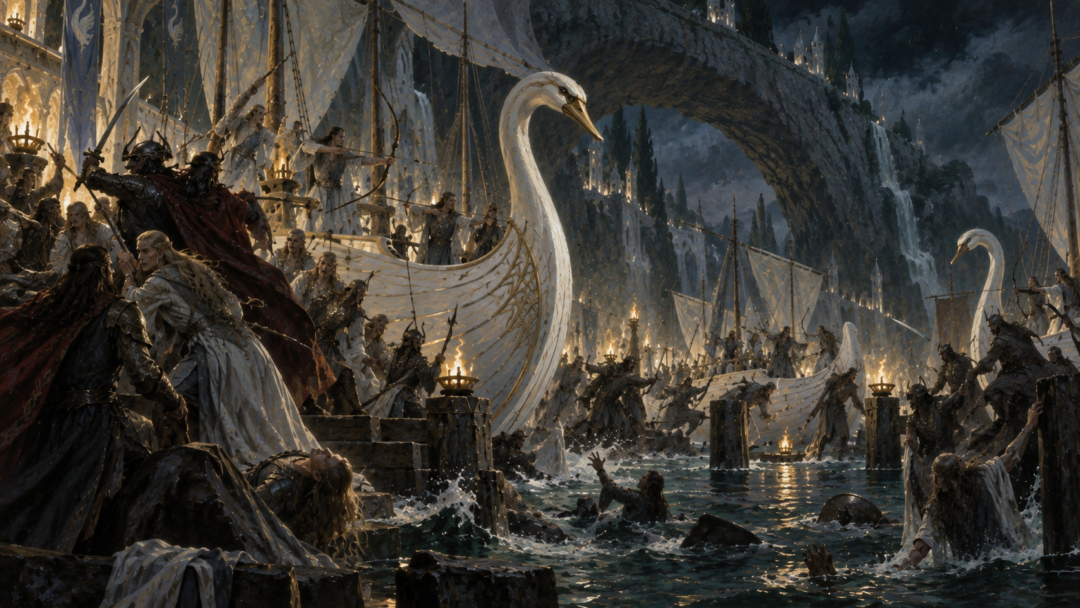
What followed became the First Kinslaying.
Yet beneath that tragedy lies an easily overlooked question. The Noldor were among the greatest craftsmen the Elves ever produced. They carved stone, worked metals and jewels, raised cities, and created works that could never be equalled. If they needed ships so badly, why not simply build their own?
The answer reveals something important about craftsmanship in Middle-earth. Great skill was not interchangeable. The Noldor's genius did not automatically make them masters of every art, and the ships of the Teleri were not merely wooden machines whose design could be copied once someone understood their shape.
They belonged to another tradition entirely.
The Noldor Were Great Craftsmen — But Not Masters of Every Craft
It is easy to treat "the Noldor were master craftsmen" as though it meant that any technological problem could be solved by putting enough Noldorin smiths to work.
The texts do not support that assumption.
The Noldor became especially associated with knowledge, smithcraft, stonework, jewels, and the making of extraordinary objects. Their greatest craftsmen learned much from Aulë, and Fëanor carried their creative powers to an almost unimaginable height.
But the Teleri followed a different path.
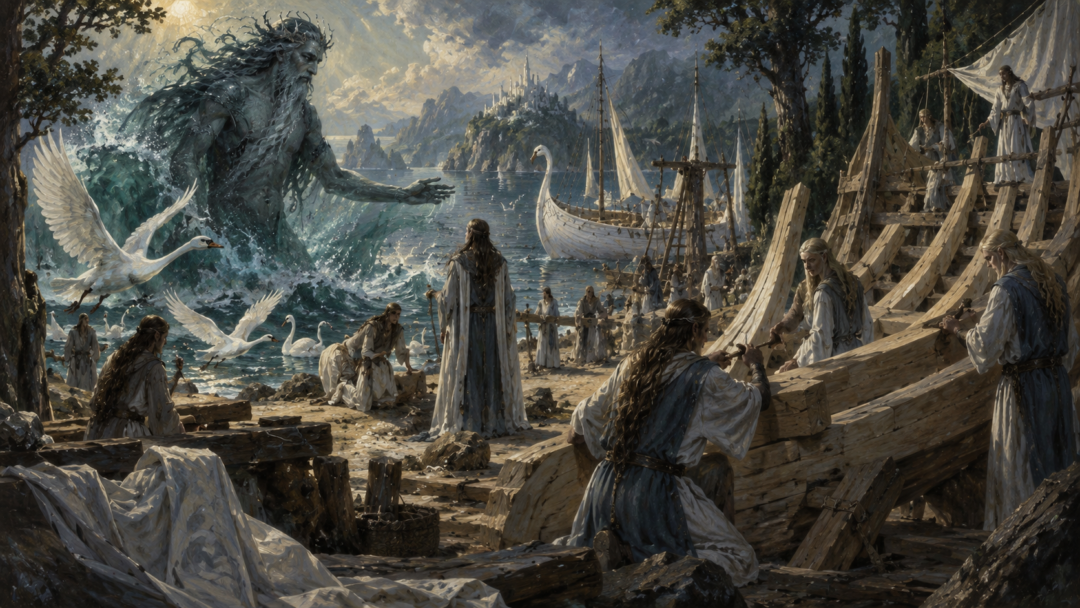
Their deepest affinity was with water and the sea. After dwelling for a long time on Tol Eressëa, they desired to reach the shores of Aman. The craft that enabled them to do so did not originate among the Noldor.
In The Silmarillion, Ossë is sent to the Teleri and teaches them shipbuilding. Earlier versions of the tradition vary somewhat in whether Ulmo or Ossë is emphasized as the teacher, but the essential point remains remarkably stable: Telerin shipcraft came from the powers associated with the Sea.
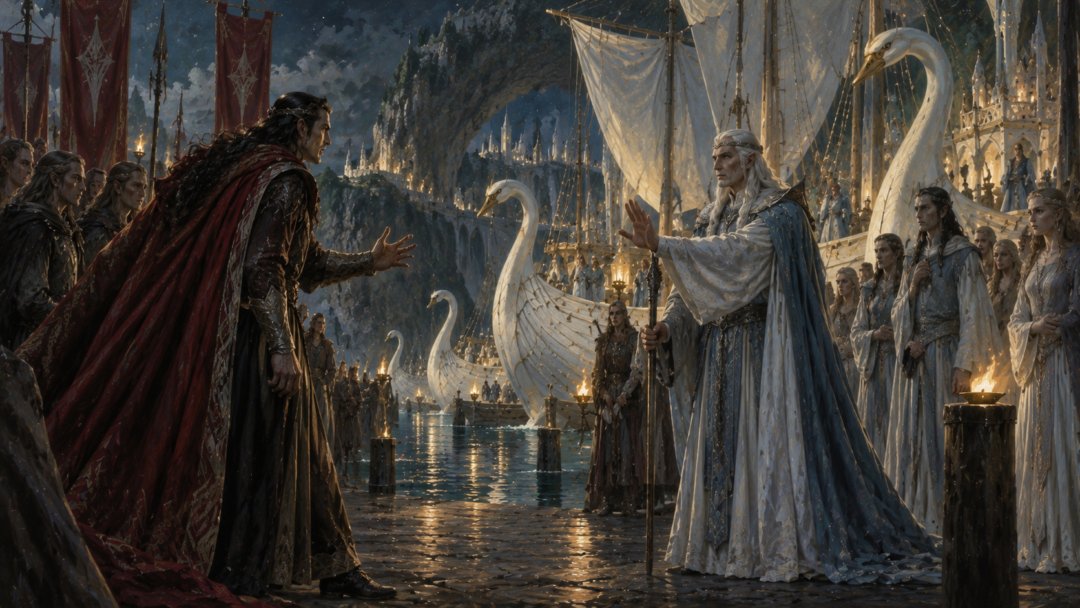
Olwë makes precisely this distinction when Fëanor demands his vessels.
The Noldor had helped the Teleri in other ways. Fëanor even reminds Olwë that the Noldor had assisted in building their haven. But Olwë draws a firm boundary around the ships themselves: that craft had not been given to the Teleri by the Noldor.
This matters because knowledge among the Eldar was specialized.
Being the greatest jewel-smith in Aman did not automatically make someone the greatest shipwright.
Telerin Shipcraft Came From Their Relationship With the Sea
The Teleri did not merely receive instructions for assembling hulls.
Their entire history had prepared them for life beside the sea.
They had lingered during the Great Journey, remained behind when other Eldar crossed to Aman, and lived for an age upon Tol Eressëa. They loved the sound of the waves, became especially close to Ossë, and eventually settled not deep within Valinor but along the shores of Eldamar.
At Alqualondë, their culture remained profoundly maritime.
They sailed the Bay of Elvenhome in their swift vessels. They gathered pearls from the sea. Their haven stood beneath a great sea-carved arch. Even their ships reflected their identity: they were white and fashioned in the likeness of swans, with golden beaks and eyes of gold and jet.
Shipbuilding was therefore not simply one more craft practiced by the Teleri.
It had become part of who they were.
The Noldor could see the finished ships. They could presumably examine timber, sails, oars, and hulls. But there is no textual evidence that they had acquired the Teleri's shipbuilding tradition before the Flight.
Knowing that something has been made is not the same as possessing the accumulated knowledge required to make its equal.
And Fëanor did not have generations in which to learn.
He believed he had to leave immediately.
Olwë's Comparison With the Silmarils Explains Everything
The most revealing explanation comes from Olwë himself.
When he refuses Fëanor, he compares the ships directly with the jewels of the Noldor. The white timbers had been worked by Telerin hands, while their sails had been woven by their wives and daughters. They were, in Olwë's description, works of their hearts whose like they would not make again.
That comparison is extraordinary because Fëanor, of all people, should have understood it.
The Silmarils were not valuable merely because they contained rare materials. Their uniqueness came from the achievement embodied in their making. Even Fëanor could not simply manufacture another identical set after surrendering the originals.
Olwë tells him that the ships should be understood in the same way.
This does not necessarily mean that the Teleri could never construct another seaworthy vessel. Indeed, much later the Teleri possess ships in the great expedition from Aman associated with the War of Wrath. The text therefore should not be read as establishing a magical rule that no Telerin ship could ever be built again.
The stronger and more conservative reading is that these particular masterpieces were irreplaceable: the accumulated work, beauty, memory, and achievement represented by the fleet could not simply be recreated as equivalent objects.
Fëanor understands the value of unique creation when the creation is his.
At Alqualondë, he refuses to respect that principle when the creation belongs to someone else.
That is one of the scene's bitterest ironies.
Why Fëanor Needed the Existing Fleet
There was also a brutally practical problem: time.
Fëanor's departure from Aman was driven by urgency. Finwë had been murdered. Morgoth had stolen the Silmarils. The Two Trees were dead. Fëanor had sworn his terrible oath, and he was determined to pursue Morgoth before hesitation divided his followers.
Building an ocean-going fleet from nothing would have required knowledge, materials, labor, and time.
The text never says that the Noldor were fundamentally incapable of learning shipbuilding. Nor does it establish that an Elf of the Noldor could never become a skilled shipwright.
What it does establish is that the ships they needed already existed, while their builders refused to surrender them.
For Fëanor, delay itself had become an enemy.
That transforms the question. It was not simply, "Could the Noldor ever learn to build ships?"
Perhaps they could.
The immediate question was whether Fëanor's enormous migrating host could obtain a fleet capable of carrying them toward Middle-earth without abandoning his momentum.
He chose seizure rather than patience.
Stealing the Ships Did Not Give the Noldor Mastery of the Sea
The aftermath also demonstrates the difference between possessing a craft and possessing its product.
After the Kinslaying, the Noldor captured the vessels and attempted to operate them. The wording of the narrative is revealing: they manned the oars as best they could.
These were not naturally their ships.
Nor did possession make the voyage easy. The sea rose against the slayers, and some vessels were wrecked. Later, after reaching the far north and crossing to Middle-earth, Fëanor made another catastrophic decision.
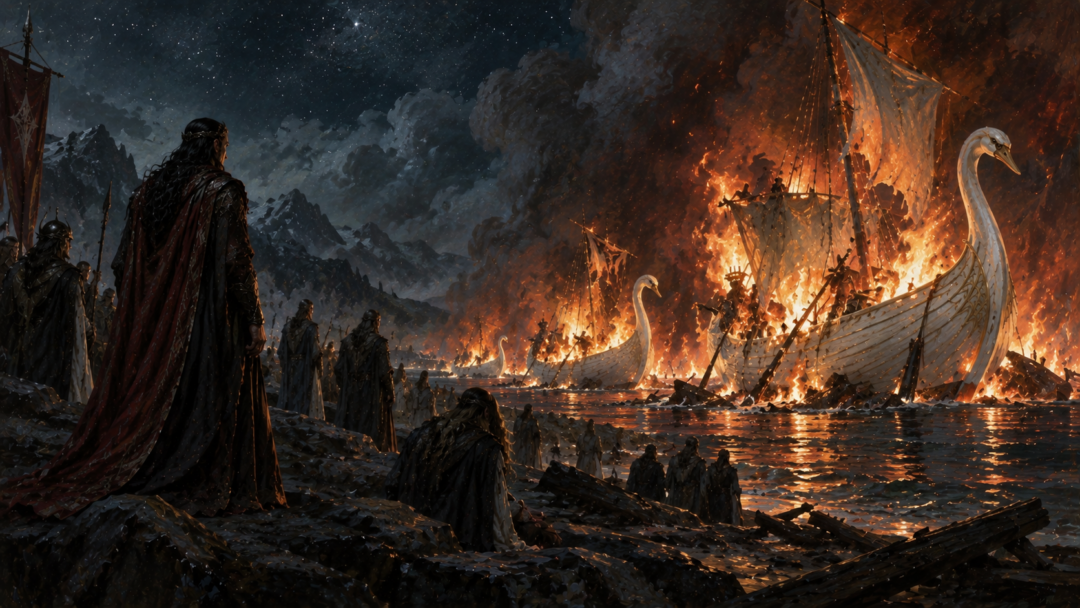
At Losgar he burned the ships.
The act prevented Fingolfin's people from using them to cross the Sea and forced the abandoned host toward the dreadful passage of the Helcaraxë.
But the burning also destroyed what Fëanor had murdered to obtain.
The Noldor did not simply build replacement swan-ships afterward. The unique fleet of Alqualondë was gone.
Its destruction therefore carried more than strategic significance. Something created through the particular history and artistry of the Teleri had been taken from its makers and deliberately consumed by fire.
Craft in Middle-earth Is More Than Technology
This episode makes more sense when craftsmanship in Middle-earth is understood as something deeper than technical competence.
The greatest works are frequently bound to particular makers, peoples, histories, and moments.
The Silmarils cannot simply be reproduced because someone knows jewelcraft. The Two Trees cannot simply be replaced with another pair of luminous trees. Likewise, Olwë does not regard his fleet as interchangeable transportation.
A masterpiece may contain knowledge that can be taught, but its significance is not reducible to instructions.
That distinction explains why the obvious modern question — "Why didn't the Noldor just copy the ships?" — does not quite fit the world in which the story takes place.
Nothing explicitly says that Noldorin shipbuilding was impossible.
What the texts show is that the Teleri possessed a maritime craft learned from the powers of the Sea and cultivated within their own people, while the Noldor urgently needed finished vessels they did not know how to replace quickly.
More importantly, the ships were unique works belonging to the Teleri.
Fëanor's tragedy was not that he failed to understand the value of irreplaceable craftsmanship.
He understood it better than almost anyone.
When the Valar asked for the Silmarils to restore the Trees, he knew that destroying his greatest work would cost him something that could never simply be made again.
Then he reached Alqualondë and encountered another people saying essentially the same thing about theirs.
And instead of accepting their answer, he took their masterpieces by force.
That is what makes the white ships more than a logistical detail in the Flight of the Noldor. They expose the moral contradiction at the heart of Fëanor's rebellion: a maker who fiercely defended the uniqueness of his own creation became willing to destroy lives rather than acknowledge the same sacred value in the creations of others.
Sources & Notes
- Tolkien Gateway, “Swan-ships” — https://tolkiengateway.net/wiki/Swan-ships
- Tolkien Gateway, “First Kinslaying” — https://tolkiengateway.net/wiki/First_Kinslaying
- Tolkien Gateway, “Olwë” — https://tolkiengateway.net/wiki/Olw%C3%AB
These secondary reference entries identify the relevant Tolkien texts and document the characters, events, and objects discussed. Explanations of motives and practical consequences remain interpretation unless explicitly stated in the cited texts.