Why Maglor Casts His Silmaril into the Sea Rather Than Die with It
At the end of the First Age, the three Silmarils have finally escaped the hands that spent centuries trying to possess them.
One shines in the sky upon Eärendil. One is carried into the fiery depths of the earth by Maedhros. The last passes briefly into the hands of Maglor—and then vanishes beneath the Sea.
The striking detail is that Maglor does not follow his brother.
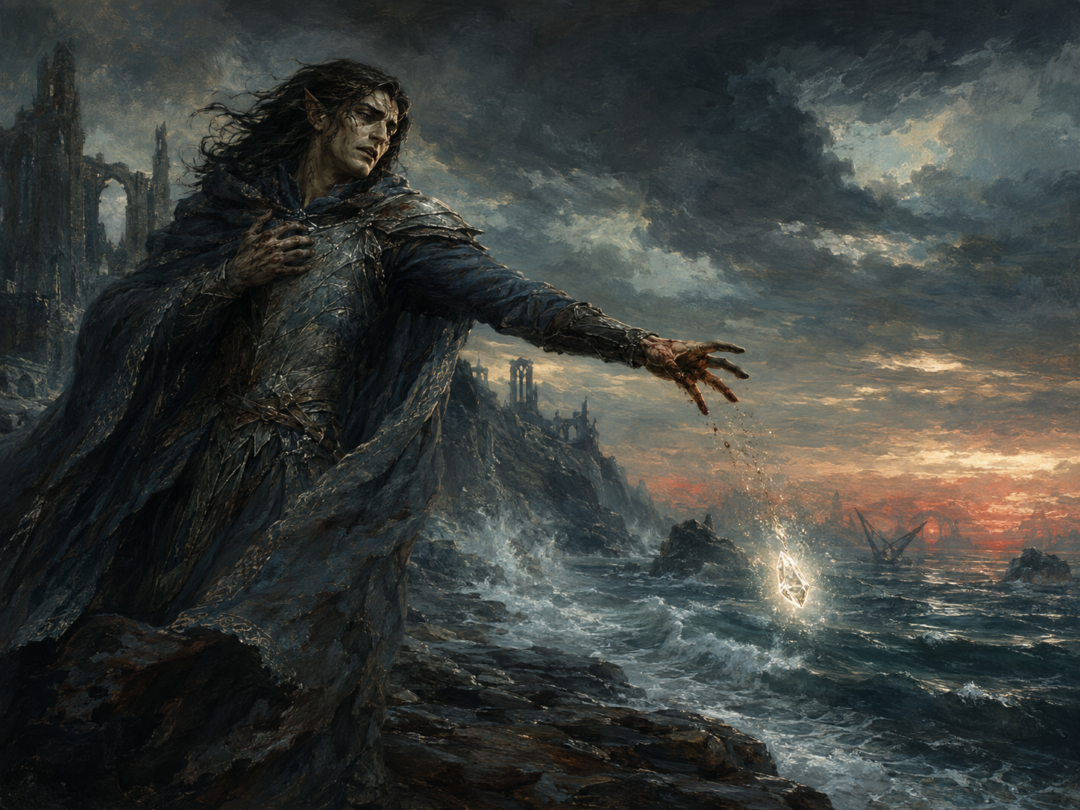
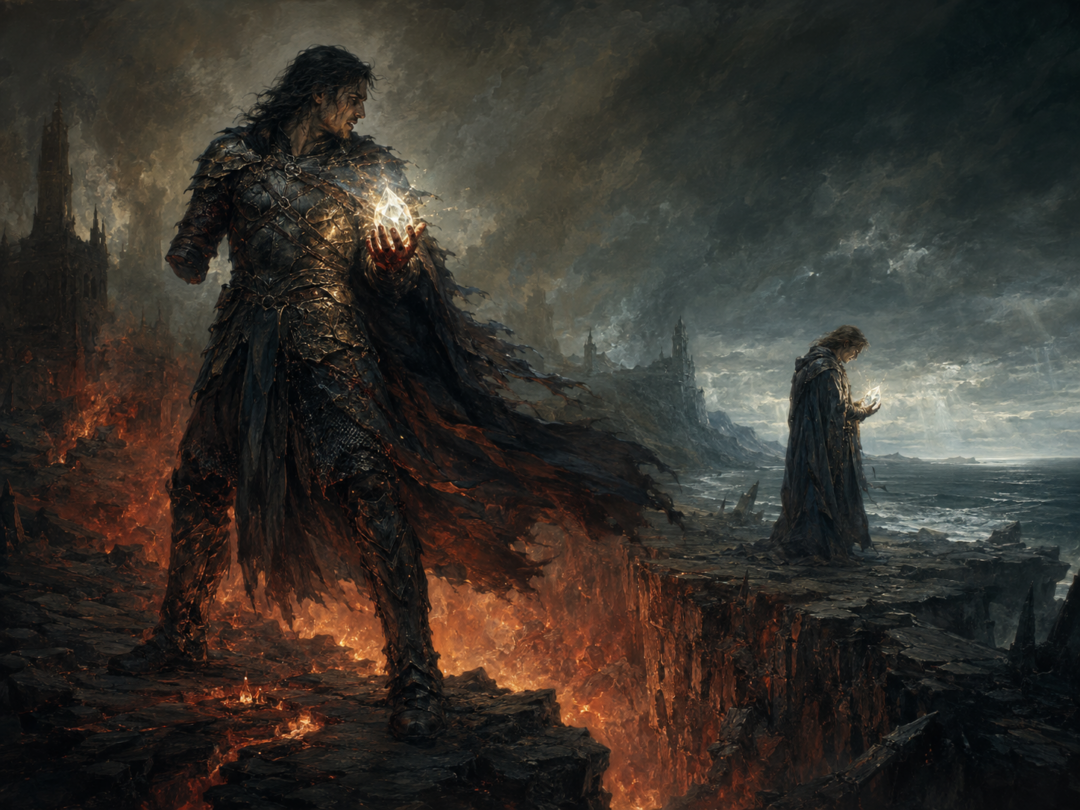
Maedhros, confronted with the unbearable pain of the jewel and the collapse of everything the sons of Fëanor had claimed for themselves, throws himself into a fiery chasm with his Silmaril. Maglor also finds the jewel impossible to endure. But instead of dying with it, he casts the Silmaril away.
Then he lives.
It is hardly a merciful ending. The surviving son of Fëanor becomes a solitary wanderer beside the waves, singing in pain and regret and never returning to the Elves.
That difference between the brothers matters. Maglor's fate suggests something more complicated than simple survival. He finally relinquishes the object that has ruled his family—but he cannot undo what was done in its pursuit.
The Silmaril Was Supposed to Prove Their Claim
By the end of the War of Wrath, almost everything connected with Fëanor's rebellion has collapsed.
Morgoth has been defeated. Beleriand is being broken apart. Six of Fëanor's seven sons are dead. Only Maedhros and Maglor remain.
Two Silmarils are recovered from Morgoth's Iron Crown and placed in the keeping of Eönwë, herald of Manwë. The brothers demand that the jewels be surrendered to them, appealing to their descent from Fëanor and to the oath they swore concerning anyone who withheld a Silmaril from them.
Yet their position has changed catastrophically.
The oath did not simply lead them into war against Morgoth. It drove the sons of Fëanor into violence against other Elves, including the assaults on Doriath and the Havens of Sirion. By the end, their attempt to recover the Silmarils has become inseparable from the bloodshed committed in their name.
Eönwë tells them that because of their deeds, their right to the jewels has become void. They must return to the West and submit to the judgment of the Valar.
Maglor initially wants to accept that judgment.
Maedhros does not.
Maglor Already Knows the Oath Has Become a Trap
The conversation between the surviving brothers before their final theft is essential to understanding Maglor's later choice.
Maglor argues that they should submit. Maedhros answers that the oath still binds them. The brothers had sworn by Ilúvatar, invoking terrible consequences upon themselves if they failed to pursue the Silmarils.
Their dilemma is therefore not presented as a simple case of greed.
They believe themselves caught between two forms of ruin.
To continue pursuing the jewels means committing further evil. To abandon the oath seems, to them, to invite the punishment they called down upon themselves when they swore it.
Maglor nevertheless raises the possibility that breaking the oath may now be less terrible than fulfilling it.
That is an extraordinary change.
The oath once justified action. Now Maglor recognizes that obedience to it may itself perpetuate evil.
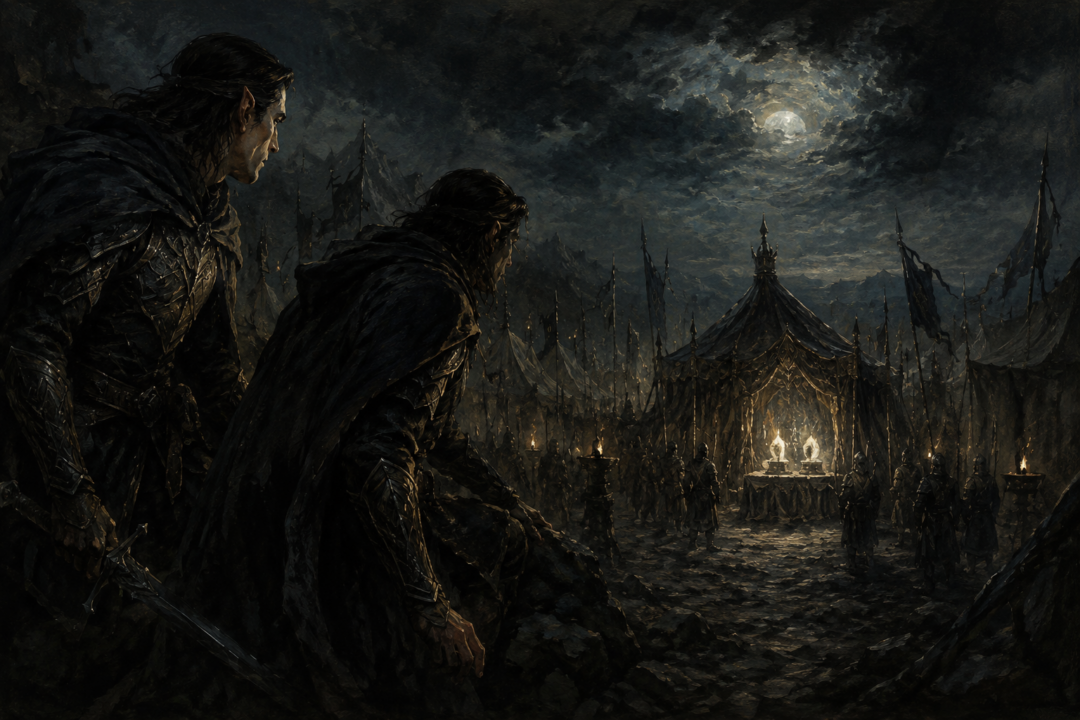
He still yields to Maedhros, however. Together they enter Eönwë's camp by night, kill the guards, and take the Silmarils.
The tragedy is that Maglor understands the moral trap before committing the final crime—and still walks into it.
The Silmaril Gives Them the Answer They Refused to Accept
After the brothers escape with the jewels, each takes one.
For generations the sons of Fëanor have behaved as though recovering the Silmarils would vindicate them. Their father's creations were their inheritance. The oath existed to reclaim them. Everything could therefore be imagined as moving toward a final restoration.
Instead, possession becomes judgment.
The Silmarils burn them.
The jewels had been hallowed by Varda long before the rebellion of the Noldor, so that evil or unclean hands could not touch them without suffering. Morgoth himself had been burned by them.
Now the sons of their maker cannot endure them either.
For Maedhros, the meaning is unmistakable. The narrative explicitly says that he understands his right to the Silmaril has become void and that the oath is vain.
Nothing remains to justify the centuries of suffering.
The object for which brothers killed, kingdoms fell, and innocent people died is finally in his hand—and that very object rejects him.
Maedhros Cannot Survive That Knowledge
Maedhros responds with annihilation.
In anguish and despair, he throws himself into a fiery chasm while still carrying the Silmaril.
His ending joins the jewel permanently to his death.
There is a grim logic to it. Maedhros has spent much of the First Age trying to fulfill an oath that repeatedly destroys everything around him. When the oath finally proves incapable of delivering even the possession it promised, he sees no path beyond it.
Maglor experiences the same physical torment, but he makes a different choice.
He separates himself from the Silmaril.
Rather than carrying it into death, he casts it into the Sea.
The text does not give a detailed account of his thoughts at that instant, so it would go beyond the evidence to claim that Maglor consciously chose repentance, hope, or redemption.
What can be said is simpler and more powerful: he finally lets the jewel go.
Throwing It Away Is the One Thing the Oath Never Taught Him to Do
For the sons of Fëanor, the Silmarils had become objects that must be recovered regardless of cost.
Possession was the command.
Anyone withholding a jewel could become an enemy. Alliances, kinship, and mercy repeatedly came second to the oath.
Maglor's final action reverses that entire pattern.
He possesses a Silmaril and refuses to keep it.
He neither returns it to the Valar nor entrusts it to another bearer. He throws it beyond his own reach into the deep waters.
This does not erase his crimes, and the narrative does not present it as absolution. Yet symbolically, it is the first permanent act of renunciation available to him.
The Silmaril can no longer command another murder from Maglor's hand because Maglor no longer possesses it.
The object remains precious.
The desire to possess it finally ends.
Why the Sea Matters
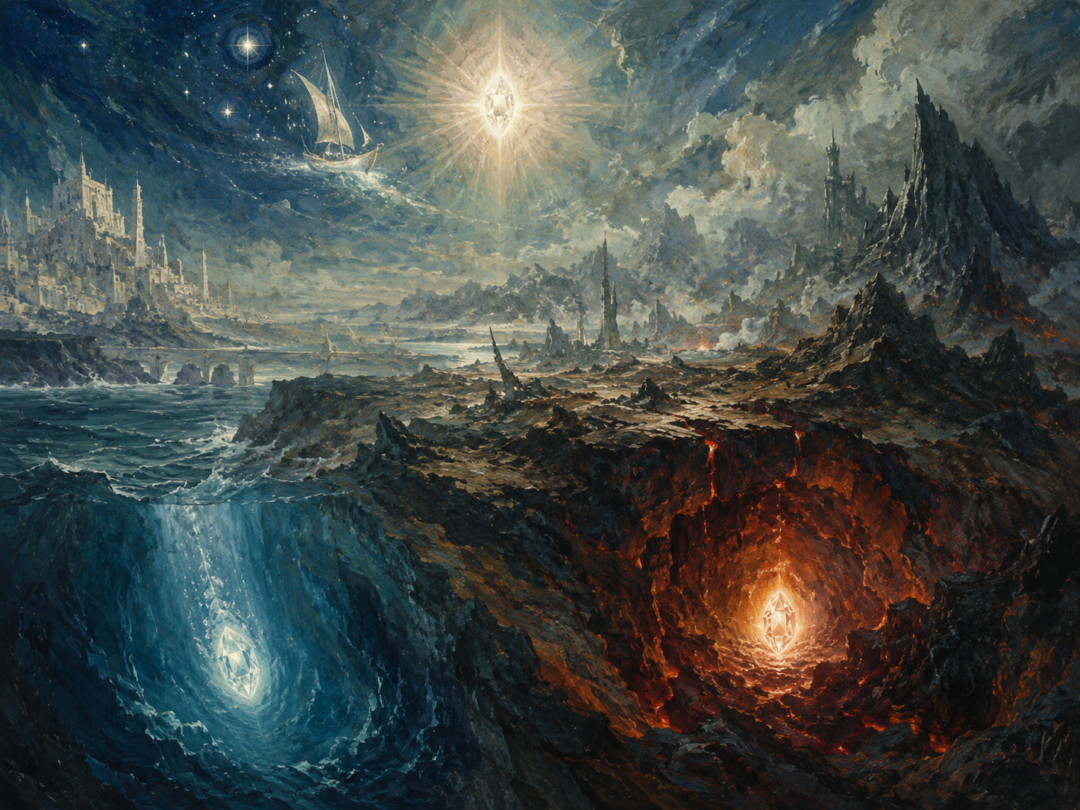
The Silmarils ultimately come to rest in three different realms of the world.
Eärendil bears one through the heavens. Maedhros carries another into the fires within the earth. Maglor casts the third into the waters.
This distribution gives the ending of the Silmarils an almost mythic completeness: air, earth, and sea each receive one of the jewels that once contained the unmarred light of the Two Trees.
Maglor's particular destination also creates a striking contrast with his brother's.
Maedhros disappears into enclosed fire.
Maglor remains beside the open Sea.
The text does not explicitly explain the symbolism of this contrast, so any deeper reading must remain interpretive. Yet the image is difficult to ignore. Maedhros's ending is immediate and final. Maglor's is extended indefinitely.
He must continue carrying memory rather than the jewel.
Maglor Survives, but Survival Is Not Escape
After casting away the Silmaril, Maglor does not return to ordinary Elven life.
He wanders along the shores, singing in pain and regret beside the waves. He never comes back among the people of the Elves.
That is not the ending of someone who has simply freed himself.
Maglor has escaped possession of the Silmaril, but not the consequences of having pursued it.
His identity as a singer makes the punishment especially poignant. Maglor was renowned among the great singers of the Eldar. At the end of his story, song remains to him—but it has become lament.
The warrior no longer fights for the Silmarils.
The oath-taker no longer possesses one.
The singer remains, turning memory into grief.
Whether the tradition of his endless wandering should be understood literally across later ages is less important than what the final image communicates: Maglor survives beyond the catastrophe, but he does so outside the communities to which he once belonged.
He Does Not Choose Death, but Neither Does He Receive Redemption
It is tempting to describe Maglor as the repentant son of Fëanor.
There is some support for seeing him as increasingly horrified by the oath. He hesitates before the final theft. Earlier, after the attack on the Havens of Sirion, he fosters Elrond and Elros, and the account says that love grew between them. His final life is explicitly marked by regret.
But the texts stop short of declaring him forgiven.
His last act does not repair Doriath. It does not restore the slain at Sirion. It does not undo the guards killed when he and Maedhros stole the final Silmarils.
Maglor's ending is therefore more severe than a conventional redemption.
He discovers how to stop.
He does not discover how to undo.
That distinction may be the heart of his fate.
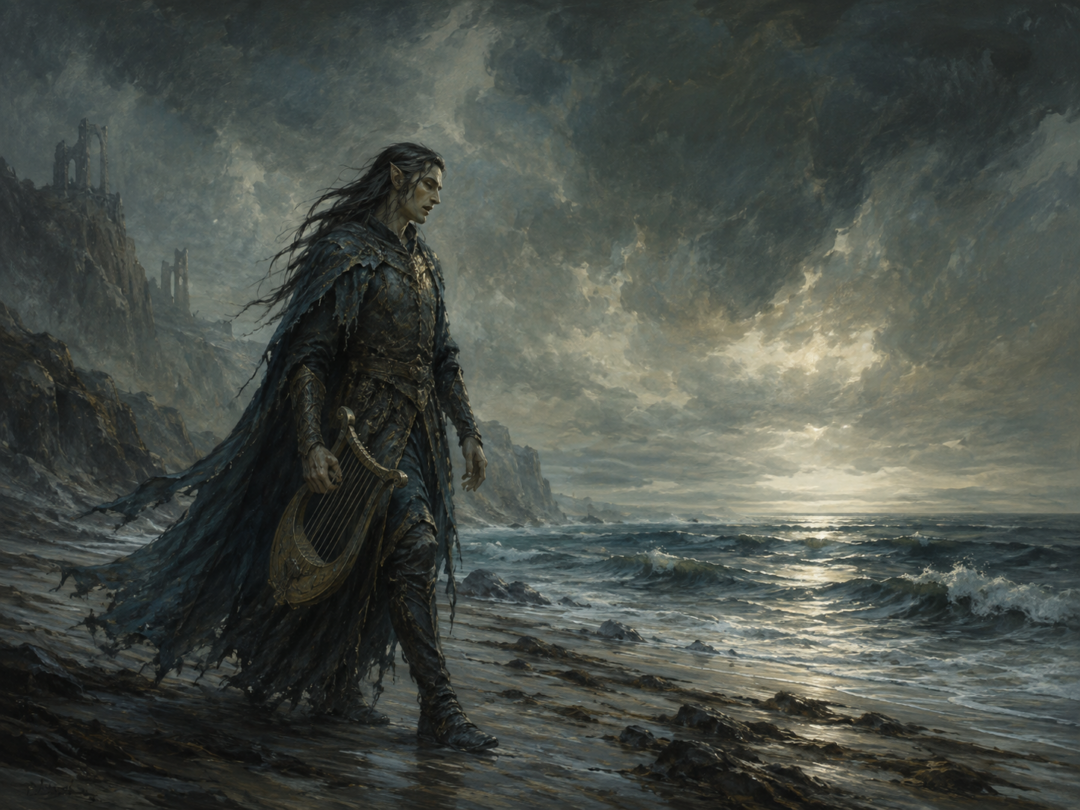
The Last Son of Fëanor Finally Releases Fëanor's Greatest Work
The Silmarils begin as objects of extraordinary beauty, containing the blended light of the Two Trees.
Yet once Fëanor becomes possessive of them and Morgoth steals them, the jewels become bound to nearly every great catastrophe that follows his house.
At the end of that history, Maglor performs an act his father could never bring himself to perform.
He gives one up.
Not peacefully. Not triumphantly. Not without terrible suffering.
He throws it into the Sea because he can no longer endure it.
And then, unlike Maedhros, he remains alive to endure everything else.
That may be why Maglor's fate feels uniquely haunting. Death would have ended his pain in the same instant that it ended his possession of the jewel. Instead, the Silmaril disappears beneath the waves while Maglor remains upon the shore.
The jewel passes out of history.
The memory does not.
And the last surviving son of Fëanor becomes not the keeper of his father's greatest treasure, but the singer of what pursuing it cost.
Sources & Notes
- The Encyclopedia of Arda — Maglor: biography and his final casting of a Silmaril into the Sea — https://www.glyphweb.com/arda/m/maglor.php
- The Encyclopedia of Arda — Maedhros: his role in the oath and death with a Silmaril — https://www.glyphweb.com/arda/m/maedhros.php
- The Encyclopedia of Arda — Oath of Fëanor: wording, consequences, and the Sons of Fëanor — https://www.glyphweb.com/arda/o/oathoffeanor.php
- The Encyclopedia of Arda — Silmarils: their hallowing and final fates in air, earth, and sea — https://www.glyphweb.com/arda/s/silmarils.php
Background references for Maglor and Maedhros, the Oath of Fëanor, and the Silmarils’ final fates. Primary narrative: J.R.R. Tolkien, The Silmarillion, ‘Of the Voyage of Eärendil and the War of Wrath.’