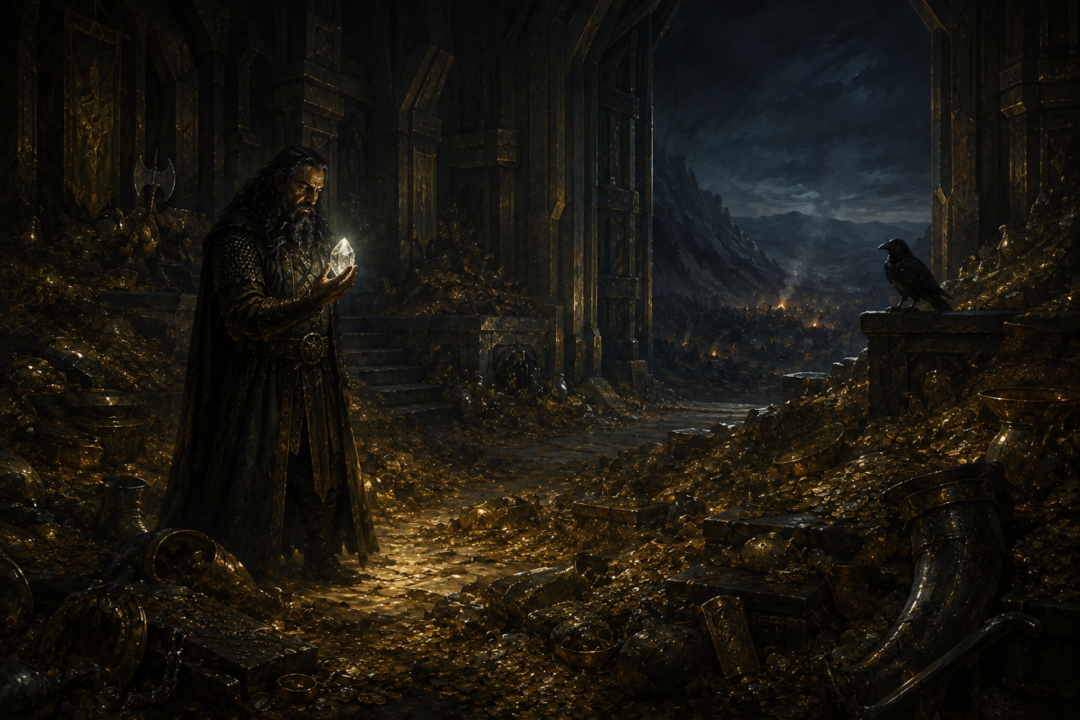
The most revealing thing Thorin Oakenshield does after Smaug’s death is not refusing Bard’s claim.
It happens earlier.
Before the Men of Lake-town have formally presented their case at the Gate of the Lonely Mountain, before Bard has demanded compensation, and before the Mountain is declared under siege, Thorin has already sent word to Dáin Ironfoot.
That timing matters.
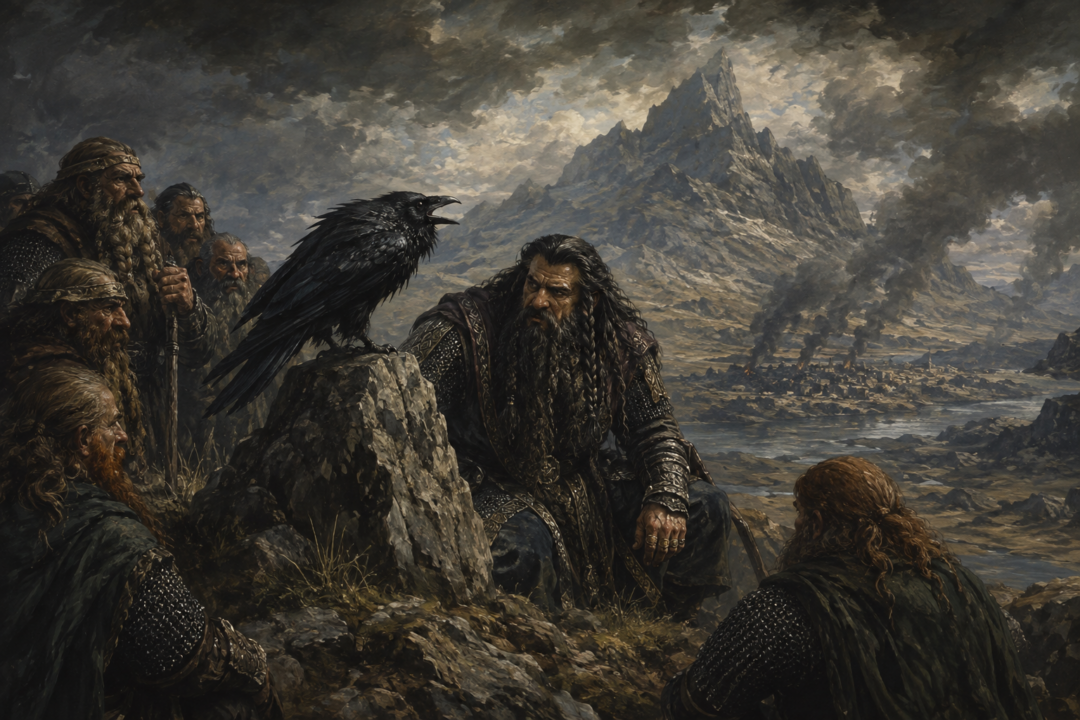
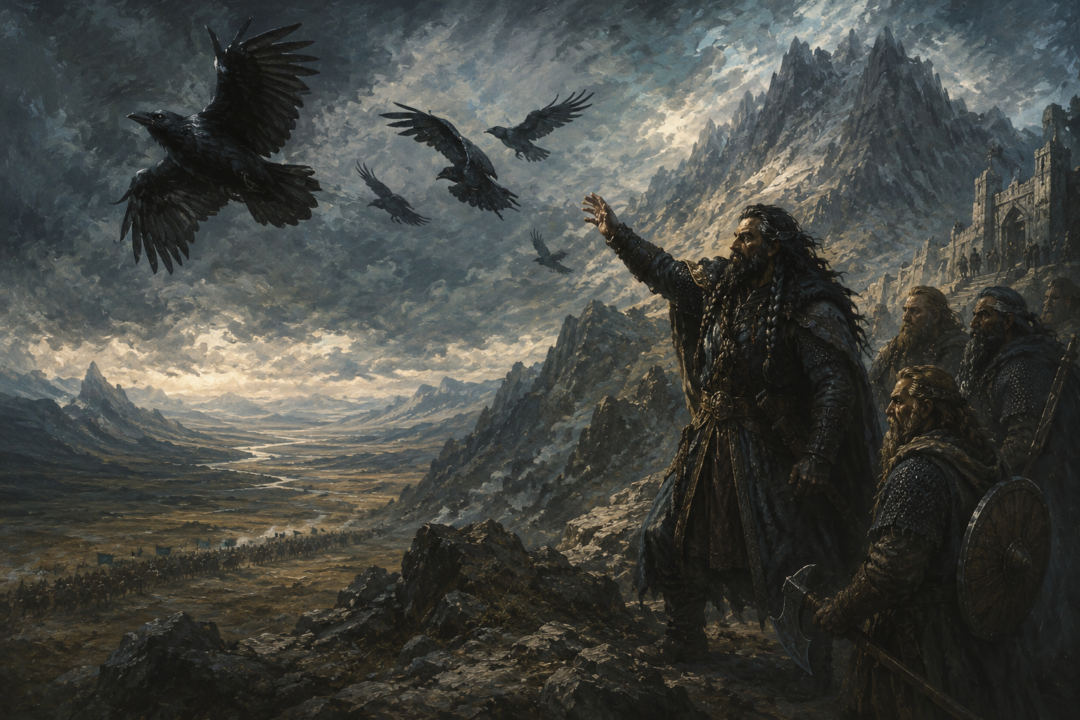
When Roäc brings news that Smaug is dead, he also warns Thorin that armed Men and Elves are moving toward Erebor. Roäc hopes for peace and specifically recommends Bard as a man worth trusting. Thorin’s response is to ask the ravens to summon his scattered kin—especially Dáin, his cousin in the Iron Hills, because Dáin is nearby and commands well-armed followers.
Thorin is not yet rejecting a specific offer.
He is preparing for the possibility that diplomacy will fail before diplomacy has properly begun.
That does not necessarily mean Thorin has secretly decided on war. The situation is more complicated—and more tragic. His decision reveals how completely he already views the crisis through the language of possession, kinship, defense, and distrust.
Roäc Brings Victory—and Immediately Warns of Another Danger
The news should have been the end of Thorin’s struggle.
Smaug is dead. Erebor, lost for generations, can be reclaimed. The surviving heirs of Durin can return to their ancestral halls.
Yet Roäc’s message transforms victory into a new crisis almost immediately.
The old raven tells Thorin that news of Smaug’s fall is spreading. Men and Elves are moving toward the Mountain, and treasure is already in their thoughts. But Roäc does not simply warn of enemies.
He gives political advice.
He distinguishes Bard from the Master of Lake-town, identifying Bard as descended from Girion of Dale and describing him as grim but trustworthy. More importantly, Roäc openly expresses a desire for peace among Dwarves, Men, and Elves after the long devastation caused by Smaug.
There is a price attached to that peace: gold.
That is the crucial test.
Roäc is effectively telling Thorin that possession of Erebor does not mean every problem can be settled by asserting ownership. The surrounding peoples have suffered too, and peace may require Thorin to surrender some portion of what he has recovered.
Thorin listens—but chooses another priority.
He asks for Dáin.
Thorin Is Thinking About Numbers Before Claims
Thorin’s request makes practical sense.
There are only thirteen Dwarves in his company, with Bilbo beside them. They possess an enormous treasure in a strategically vulnerable position while larger groups are approaching.
Roäc himself has just reminded Thorin how small a remnant they are.
So Thorin does something any threatened ruler might consider reasonable: he calls for reinforcements.
He asks the ravens to contact Dwarf-kind elsewhere, with particular urgency placed on Dáin in the Iron Hills. Dáin is Thorin’s cousin, lives comparatively near Erebor, and has many armed followers.
The important distinction is that Thorin does this before hearing Bard’s formal claims.
He therefore cannot yet know precisely what Bard will demand.
His decision is based on the approaching hosts themselves and on the expectation that the treasure will be contested.
This makes Thorin’s action defensive in one sense, but it also changes the political situation. Once armed reinforcements are marching toward Erebor, Thorin is no longer merely protecting thirteen companions until negotiations occur. He is building the strength to resist demands he has not yet heard.
That is the first sign that the dispute may be hardening before either side has formally argued its case.
Thorin Has Reasons to Be Suspicious
It would be too simple to portray Thorin as irrationally choosing greed over obvious friendship.
From his perspective, the circumstances are deeply threatening.
The treasure under Erebor was accumulated by his people before Smaug seized it. Thorin has spent much of his life as an exile from the kingdom his grandfather ruled. Now, almost immediately after the Dragon dies, armed outsiders are moving toward the recovered Mountain.
Thorin also knows that the Elvenking is among them.
His history with the Wood-elves is hardly reassuring. Thorin and his companions were imprisoned in the Elvenking’s halls during their journey, and they escaped only through Bilbo’s intervention.
When Thorin later sees the Elven host allied with the Lake-men, that earlier hostility matters.
Even Bard’s first approach occurs under conditions Thorin considers unacceptable: armed forces are outside his gate, and the Men have allied themselves with Elves.
So there is a legitimate security problem.
But that is exactly why the timing of Dáin’s summons is so revealing.
Thorin does not merely prepare himself to negotiate from safety. He begins assembling Dwarven strength before determining whether the claims approaching him might have justice behind them.
Bard’s Claim Is Stronger Than Thorin Wants to Admit
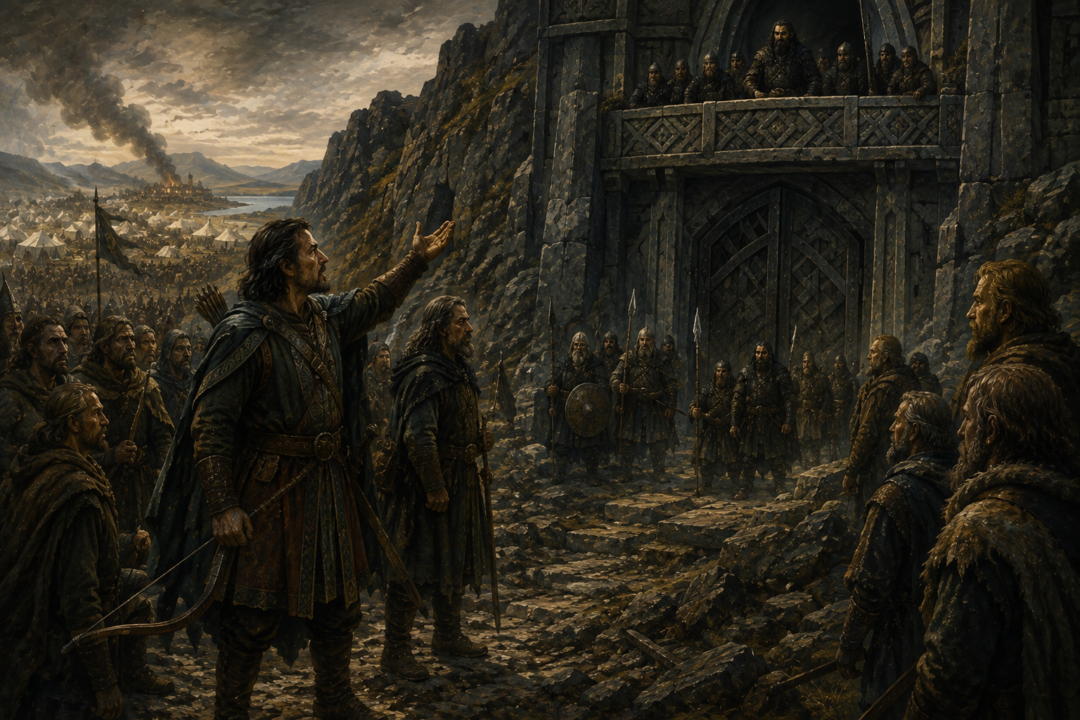
When negotiations finally occur, Bard does not simply say that Smaug is dead and therefore he wants treasure.
He presents several grounds for compensation.
Part of the wealth of Dale was taken by Smaug when the Dragon destroyed the town, meaning not everything in the hoard can automatically be treated as the uncontested property of Thorin’s house. Bard is Girion’s heir, giving him a direct connection to ruined Dale.
There is also the destruction of Lake-town.
Smaug attacked Esgaroth after Bilbo and the Dwarves disturbed him in Erebor, and Bard’s people have been left homeless. Bard himself killed the Dragon.
None of this means that Bard owns the entire hoard, and the text does not suggest that he does.
It means that there is a real dispute requiring settlement.
Thorin, however, increasingly treats possession of the Mountain as the decisive fact. He is willing to consider aid for the Lake-men under different circumstances, but he refuses to bargain while armed forces remain before his gates, especially while the Elvenking is involved.
Both sides therefore possess arguments that make sense from within their own positions.
And meanwhile Dáin is marching closer.
Roäc Understands Where This Is Going
Roäc becomes one of the quiet moral voices of the crisis.
He is not hostile to the Dwarves. Quite the opposite: his family has an ancient friendship with them. His father Carc remembered the days before Smaug, and the ravens remained connected to the fortunes of the Mountain.
That makes his warnings harder for Thorin to dismiss as enemy propaganda.
Roäc wants the restored kingdom to survive.
Yet when he later reports that Dáin is approaching with hundreds of Dwarves, he explicitly disapproves of the course events are taking. He warns Thorin that the treasure may bring about his death.
The warning is striking because the treasure was supposed to represent restoration.
Thorin crossed Wilderland to reclaim his inheritance. Now the inheritance itself threatens to turn his allies into enemies and his victory into catastrophe.
Roäc can see that military strength is not solving the dispute.
It is narrowing the remaining paths to peace.
Dáin Is Not Summoned After Diplomacy Fails
This is the detail most easily lost when the story is remembered primarily as a confrontation at Erebor.
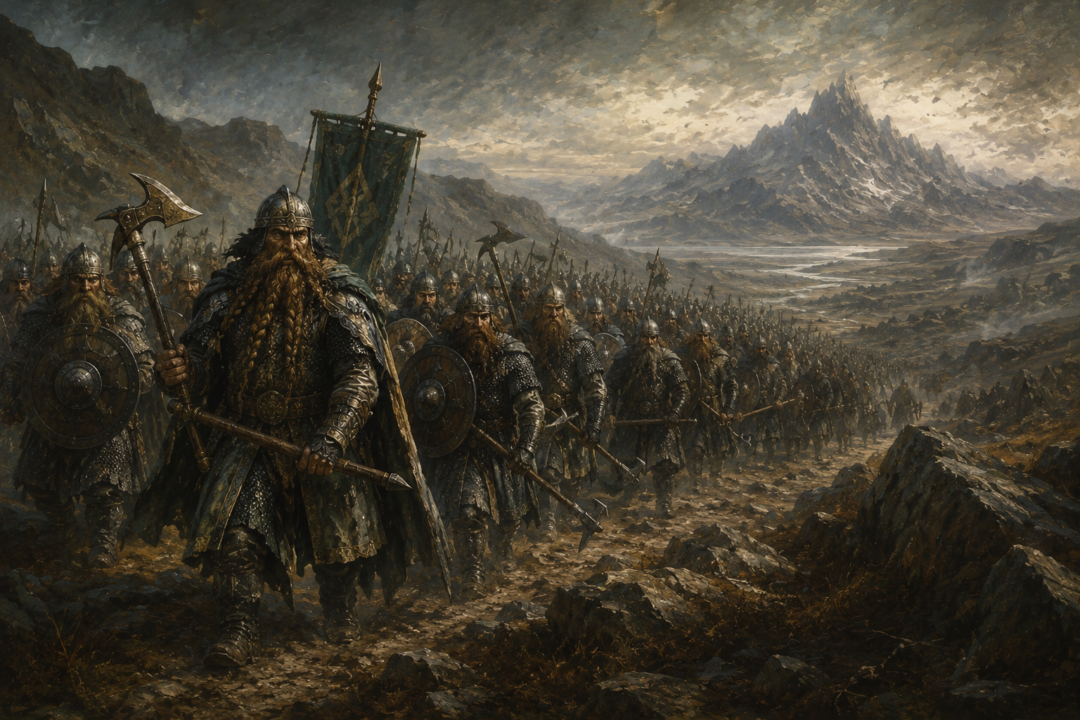
Dáin is already coming.
That changes how the later negotiations should be read.
Thorin is negotiating while expecting reinforcements. Bard and the Elvenking do not initially know everything Thorin knows about the approaching Dwarves. Thorin therefore has a reason to delay and resist pressure: time may dramatically improve his position.
After Bilbo secretly gives the Arkenstone to Bard and the Elvenking, the situation becomes even more desperate. Thorin sends further messages through Roäc informing Dáin of developments and urging caution and speed.
By then, diplomacy has nearly collapsed.
But the original decision was made much earlier.
Thorin had chosen to summon Dwarven military support almost as soon as he learned other peoples were coming toward the treasure.
The reinforcements are not the consequence of failed negotiations.
They are part of the conditions under which those negotiations take place.
The Tragedy Is That Thorin’s Fear Is Not Entirely Wrong
Thorin’s great mistake would be easier to dismiss if everything he feared were imaginary.
It is not.
People really are coming for the treasure.
Armed forces really do surround Erebor.
The Elvenking really has brought a host.
Thorin really is badly outnumbered.
And the hoard really does contain the inheritance of his people.
The tragedy lies in what Thorin does with those truths.
He becomes increasingly unable to distinguish defending a legitimate inheritance from refusing legitimate claims against it. Every concession begins to look like surrender. Every outside demand begins to look like an attempt to rob him.
That is why summoning Dáin is so important.
It is a rational defensive action that also exposes Thorin’s deeper state of mind.
He prepares to defend ownership before he has fully confronted obligation.
Bilbo Eventually Does What Thorin Cannot
Bilbo’s response provides the clearest contrast.
He does not deny that Thorin has rights. Nor does he suddenly become an enemy of the Dwarves.
Instead, he recognizes that the standoff is moving toward bloodshed.
When Roäc reports Dáin’s approach, the danger becomes immediate. If the armed Dwarves reach the Mountain while Men and Elves are maintaining the siege, fighting may become almost unavoidable.
Bilbo therefore uses the one thing Thorin values above nearly everything else: the Arkenstone.
By secretly delivering it to Bard and the Elvenking, Bilbo attempts to create leverage for a settlement.
His act is a betrayal from Thorin’s perspective, and Thorin reacts furiously when he discovers it. Yet Bilbo’s motive is to prevent a conflict among peoples who should not need to destroy one another.
That is also what Roäc had wanted from the beginning.
Peace may cost gold.
Thorin cannot yet accept that price.
The Summons to Dáin Reveals the Real Conflict
The confrontation at Erebor is not simply a story about greed.
It is about what happens when rightful possession becomes incapable of recognizing competing duties.
Thorin has genuine claims. Bard has genuine claims. The Lake-men have genuinely suffered. The Dwarves have genuinely suffered. The Elvenking’s presence complicates everything further.
There is no solution in which every party simply receives everything it wants.
That is why Roäc’s counsel matters.
The old raven understands something Thorin temporarily cannot: recovering the Mountain is not enough. A restored Erebor must somehow live beside Dale, the Lake-men, and the Woodland Realm.
Thorin’s first instinct is instead to make certain that he cannot be forced to yield.
So before Bard formally makes his case, before the siege is declared, before the Arkenstone becomes a bargaining weapon, a raven is already flying toward the Iron Hills.
Dáin is already coming.
And in that small chronological detail lies much of the tragedy of the gathering storm: Thorin begins preparing to win the confrontation before he has discovered whether the confrontation might still be avoided.
Sources & Notes
- https://www.encyclopedia-of-arda.com/r/roac.php — The Encyclopedia of Arda: Roäc (the raven’s news, counsel for peace, and role carrying Thorin’s summons to Dáin).
- https://www.encyclopedia-of-arda.com/i/ironhills.php — The Encyclopedia of Arda: Iron Hills (Dáin’s nearby realm and the origin of the armed Dwarven force marching to Erebor).
- https://www.encyclopedia-of-arda.com/d/dainironfoot.php — The Encyclopedia of Arda: Dáin Ironfoot (Thorin’s kinsman and the leader summoned from the Iron Hills).
- https://www.encyclopedia-of-arda.com/b/battleoffivearmies.php — The Encyclopedia of Arda: Battle of Five Armies (the wider crisis into which the treasure dispute and Dáin’s approach develop).
Sources checked for relevance and availability.