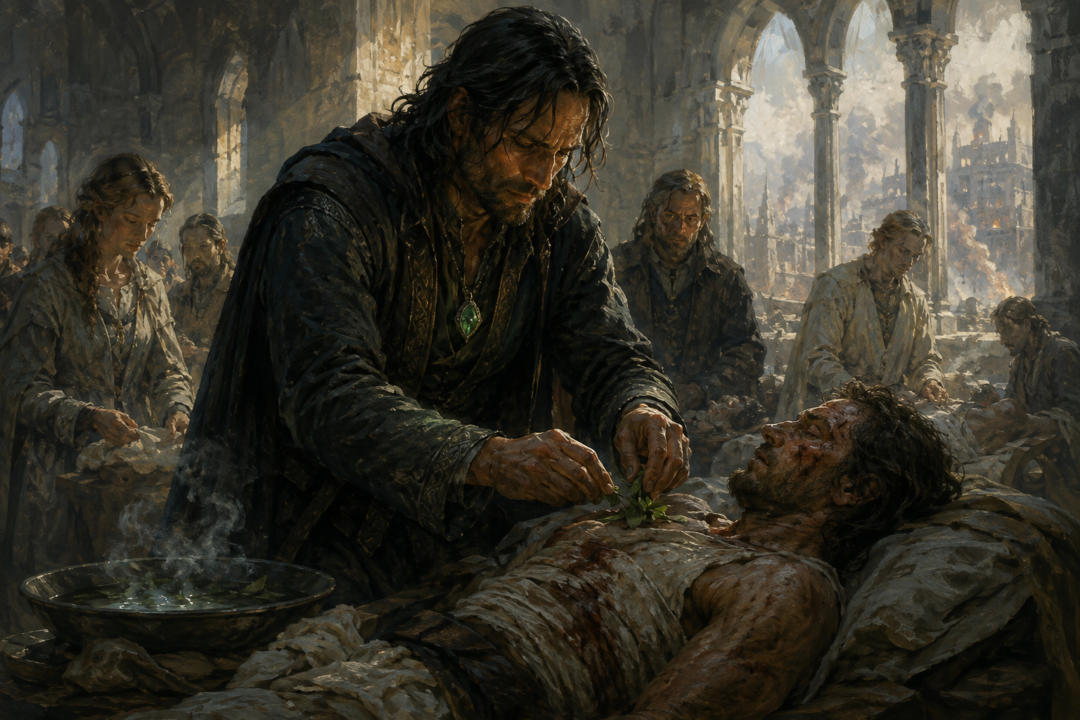
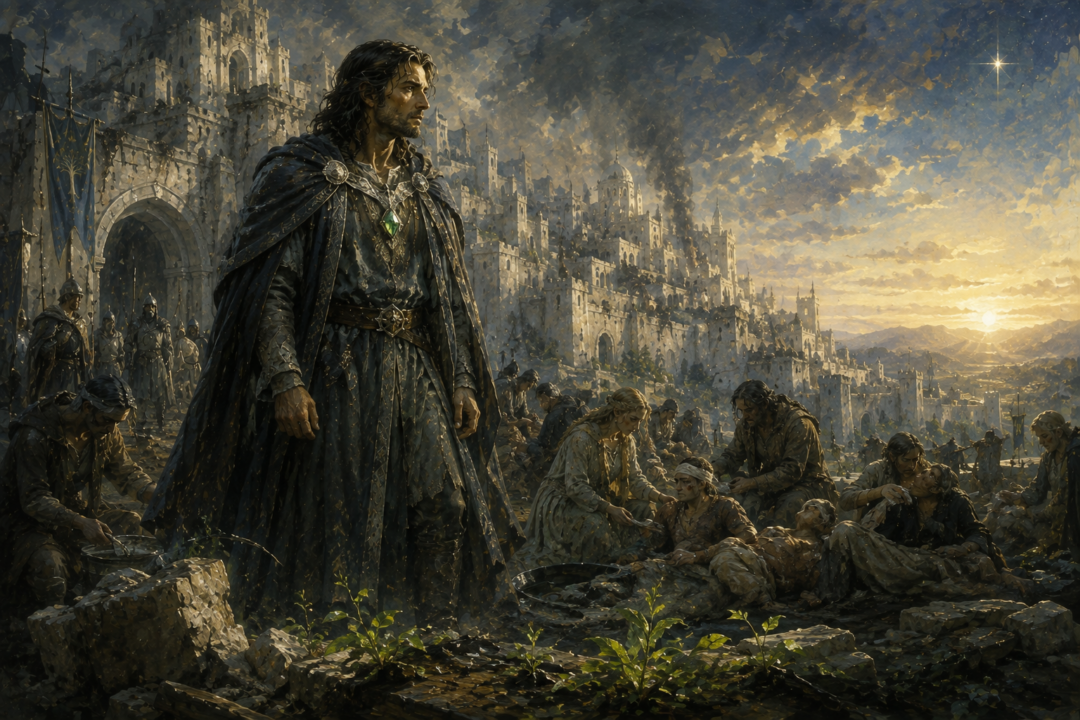
When Aragorn enters the Houses of Healing after the Battle of the Pelennor Fields, he carries a green stone upon his breast. He names himself Elessar, the Elfstone, and Envinyatar, the Renewer. Yet the wounded are not restored by a simple flash of jewel-magic. Aragorn works through knowledge, touch, endurance, and athelas.
That distinction matters.
Behind the Elfstone worn by Aragorn lies a much stranger history preserved in the writings collected in Unfinished Tales. In those accounts, the Elessar is not merely an emblem associated with a healer. It can be a jewel with an extraordinary restorative virtue of its own: something through which damaged things appear renewed and whose bearer may bring healing by touch.
The different versions never settle into one perfectly harmonized history. But taken together, they reveal something more interesting than a continuity problem. The Elessar repeatedly gathers around itself the same ideas: healing, renewal, greenness, memory, resistance to decay, and the hope that wounded Middle-earth might become fair again.
What changes is where the healing power resides.
The Elessar in The Lord of the Rings: The Healer Wears the Stone
The published Lord of the Rings gives us the safest starting point because here the Elessar is unquestionably the green jewel Galadriel gives Aragorn in Lórien.
She presents it as something destined for him and connects it with the name Elessar. Aragorn subsequently wears the stone openly. By the time he reaches Minas Tirith, the jewel has become part of the public revelation of who he is.
But The Lord of the Rings does not clearly say that Aragorn heals Faramir, Éowyn, Merry, and the other afflicted because the Elfstone itself magically cures them.
Instead, Aragorn explicitly speaks of using the power and skill given to him. He calls for athelas, a plant whose virtues are closely connected with the hands and knowledge of the rightful king. His treatment combines the herb with his own healing ability, and the narrative repeatedly emphasizes his hands.
This fulfills the old saying remembered by Ioreth: the hands of the king are the hands of a healer.
The symbolism is extraordinarily tight. Aragorn bears a green jewel, calls himself Elessar and Envinyatar, and immediately acts as a restorer of people whom the Shadow has nearly destroyed.
Yet the novel does not require the stone itself to perform the cures.
The distinction prevents us from treating the Elfstone like a fantasy healing device. In the published narrative, its strongest function is emblematic. The healer wears the sign of renewal.
The Earlier Elessar Has Far More Explicit Power
The material published in Unfinished Tales, in the section usually called “The Elessar,” gives the jewel a much more direct supernatural association with restoration.
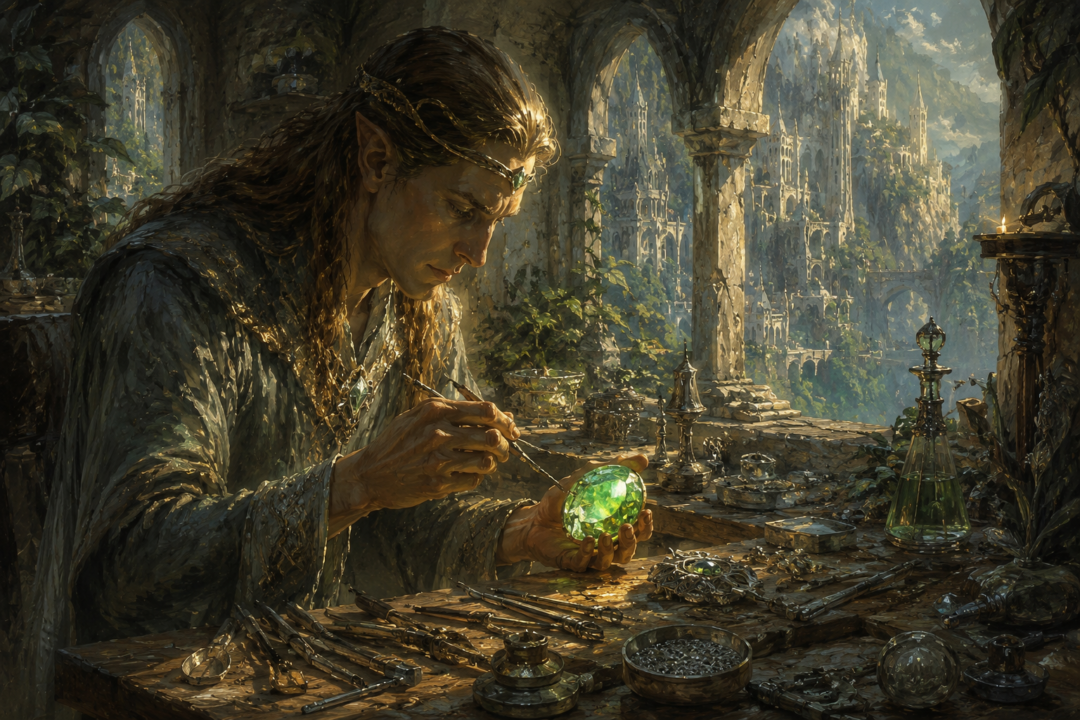
One account attributes the original stone to Enerdhil, a jewel-smith of Gondolin. He makes a green gem in which the clear light of the Sun is caught.
Its reported properties are remarkable.
Those looking through it could see things that were withered or burned as though healed or restored to the grace of youth. More importantly, the hands of its bearer were said to bring healing from hurt to what they touched.
This is much more explicit than anything established about Aragorn’s jewel in The Lord of the Rings.
Here the Elessar does not simply signify healing. Healing belongs to the legend of the object itself.
That produces one of the most important differences between the versions: the older jewel participates directly in restoration, whereas in the published War of the Ring narrative Aragorn’s own identity as healer dominates the scene.
Idril and Eärendil: Healing a Wounded Middle-earth
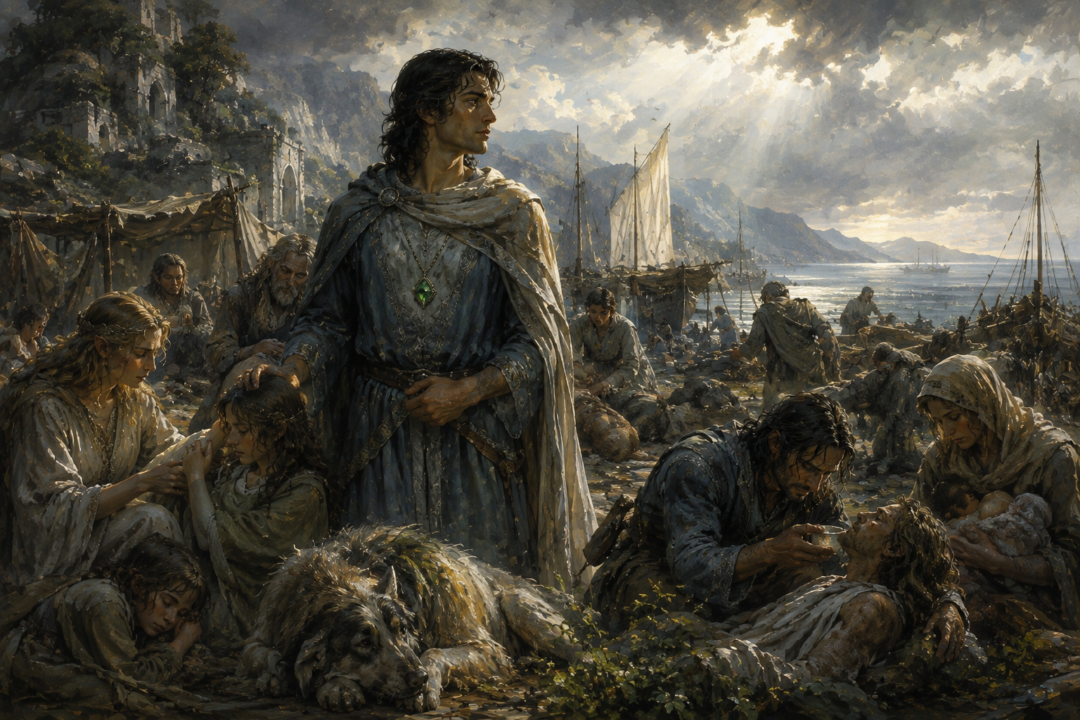
In the Enerdhil version, the jewel passes to Idril of Gondolin and survives the city’s destruction with her. Before her departure, she leaves it to her son Eärendil because Middle-earth has grievous hurts that he might heal.
That phrase gives the stone a scale far larger than battlefield medicine.
Eärendil’s association with the Elessar is not limited to treating an individual wound. At the Havens of Sirion, refugees from the catastrophes of Beleriand have gathered: Elves, Men, and even beasts fleeing the horrors of the North. While Eärendil remains there, the account describes healing and renewed prosperity around them.
The Elessar therefore becomes associated with recovery after devastation.
This is a recurring pattern in its mythology. The jewel belongs not to a world untouched by evil, but to people living after terrible losses. Gondolin has fallen. Beleriand is collapsing under war. Refugees have been driven toward the sea.
The stone does not erase that history.
Instead, it represents the possibility that something wounded can become green again.
That is a deeper meaning of healing than merely closing wounds.
Galadriel Changes the Meaning Again
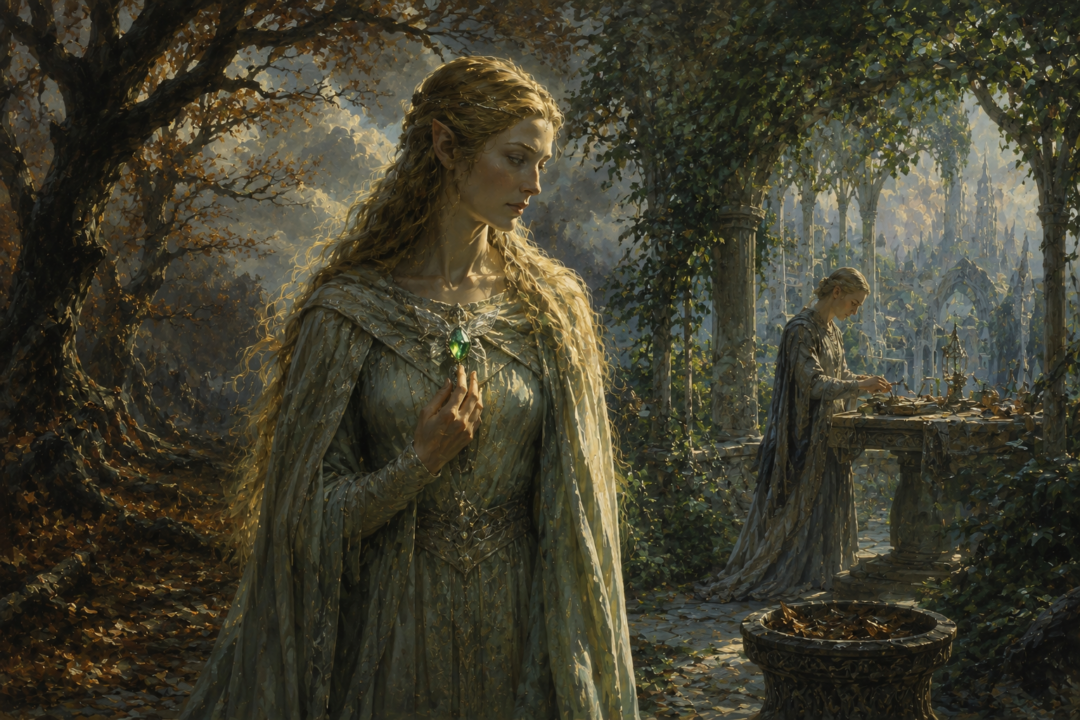
Another account shifts the story into the Second Age and places Galadriel’s desire at its center.
Here the problem is not primarily injured bodies. It is the fading and deterioration of Middle-earth itself.
Galadriel longs for the beauty of the lands she inhabits not to diminish. In one version, Celebrimbor fashions another Elessar for her, inspired by the earlier stone. This second jewel possesses less power than its predecessor, but while Galadriel uses it, things around her grow fair.
The emphasis has changed.
With Eärendil, healing is bound to refugees and the wounds left by catastrophic war. With Galadriel, restoration becomes entangled with preservation: the Elvish desire to resist loss and maintain beauty in a changing world.
This connects the Elessar thematically with one of the great problems of the Elves in the Second and Third Ages. Their struggle is not merely against enemies. It is also against fading.
The Elessar offers, temporarily, an answer.
But it is not the final answer.
The Shadow of the Three Rings
In the Celebrimbor version, the arrival of Nenya changes Galadriel’s relationship with the Elessar. Once she possesses the greater Ring, she no longer believes she needs the green stone in the same way.
That detail places the Elessar within a much larger pattern of Elvish attempts to preserve what they love.
Yet the Elessar is not simply an early version of a Ring of Power. The texts do not establish such an equivalence, and its associations remain distinct. The stone is repeatedly linked with sunlight, greenness, healing, and restoration.
Its imagery is unusually organic.
A damaged thing appears young again. A hurt thing is healed. A darkened land grows fair.
Those ideas are very different from domination.
The Elessar’s ideal form of power is restorative rather than coercive.
And that distinction eventually makes Aragorn a remarkably appropriate bearer.
Was Aragorn Wearing Eärendil’s Original Stone?
This is where the textual traditions refuse to give a single answer.
One account allows the original Elessar associated with Eärendil to return from the West. Olórin—Gandalf—brings it as a token connected with the hope that Middle-earth has not been abandoned, and it eventually comes to Galadriel.
Another tradition instead has Celebrimbor make a second Elessar.
There are further variations over whether Enerdhil or Celebrimbor made the original jewel.
These accounts should not be forced into a single artificial chronology. The surviving material represents alternative conceptions.
But the uncertainty produces a fascinating consequence.
If Aragorn receives Eärendil’s own Elessar, he bears an ancient instrument of healing that has returned to a wounded Middle-earth at the end of the Third Age.
If he receives Celebrimbor’s later Elessar, the symbolism remains powerful but changes. Aragorn inherits an Elvish attempt to preserve and renew Middle-earth, yet as a mortal king his task is not to freeze the world in an earlier age. His reign begins a new one.
Either way, the stone reaches someone called the Renewer.
Aragorn’s Healing Does Not Depend on the Jewel
The temptation is to combine every version and conclude that Aragorn’s healing powers come from the Elessar.
The texts do not justify that conclusion.
Aragorn possessed healing knowledge before Galadriel gave him the jewel. His abilities are connected with his ancestry, education, experience, knowledge of herbs, and the traditional sign by which the rightful king would be recognized.
In the Houses of Healing, he uses athelas and his own skill. He even wishes Elrond were present because Elrond possesses greater power.
Nothing in that scene requires the green stone to function as the mechanism of healing.
Instead, an older idea appears to have become concentrated into Aragorn himself.
In the Unfinished Tales material, the bearer of the Elessar can possess hands that heal.
In The Return of the King, the crucial sign is that the king himself has healing hands.
That parallel should be treated as thematic rather than as proof of a hidden magical mechanism. But it is difficult to miss.
The jewel and the king have become reflections of one another.
Why the Name “Elessar” Matters
After Aragorn heals the stricken in Minas Tirith, word spreads through the city that the King has indeed returned. The people call him Elfstone because of the green jewel he wears, fulfilling the foretold association of that name with him.
This means the Elessar’s symbolism reaches its climax precisely when Aragorn heals.
He does not first prove himself by sitting on a throne.
He does not seize the city through political declaration.
He enters quietly, tends people damaged by the Shadow, and leaves behind evidence of restoration.
Only afterward does recognition spread.
That makes “Elessar” more than a royal ornament. The name gathers together kingship and renewal.
From a Healing Stone to a Healing King
Across the different traditions, the Elessar’s exact history remains unstable. Its maker changes. Its journey changes. Even the question of whether Aragorn possesses the original jewel or another stone changes.
Its central imagery does not.
The Elessar remains green in a world threatened by withering. It carries light into ages darkened by Shadow. It is associated with making the hurt whole and the faded fair.
The most striking development is that these qualities ultimately become inseparable from Aragorn’s kingship.
The earliest legends can imagine a wondrous jewel whose bearer heals by touch. The published story gives us something subtler: a king whose healing hands prove what kind of king he will be, while the green stone upon his breast gives that vocation a name.
The Elessar does not merely promise that the past can be preserved.
In Aragorn’s hands, its symbolism points toward renewal after loss.
And that may be the most important difference of all. Middle-earth cannot remain unchanged. The Elves are departing, the Third Age is ending, and much that was beautiful will pass away.
The answer is not to make time stop.
It is to heal what can still be healed—and begin again.
Sources & Notes
- https://www.encyclopedia-of-arda.com/e/elfstone.php — The Encyclopedia of Arda: Elfstone (the Elessar’s variant histories, makers and bearers, and restorative associations in Unfinished Tales).
- https://www.encyclopedia-of-arda.com/e/elessar.php — The Encyclopedia of Arda: Elessar (Aragorn’s royal name and its connection to Galadriel’s green jewel and renewal).
- https://www.encyclopedia-of-arda.com/a/athelas.php — The Encyclopedia of Arda: Athelas (the healing herb Aragorn uses, distinguishing his healing practice from any automatic jewel effect).
- https://www.encyclopedia-of-arda.com/h/housesofhealing.php — The Encyclopedia of Arda: Houses of Healing (the setting and patients of Aragorn’s healing work after the Pelennor Fields).
Sources checked for relevance and availability.