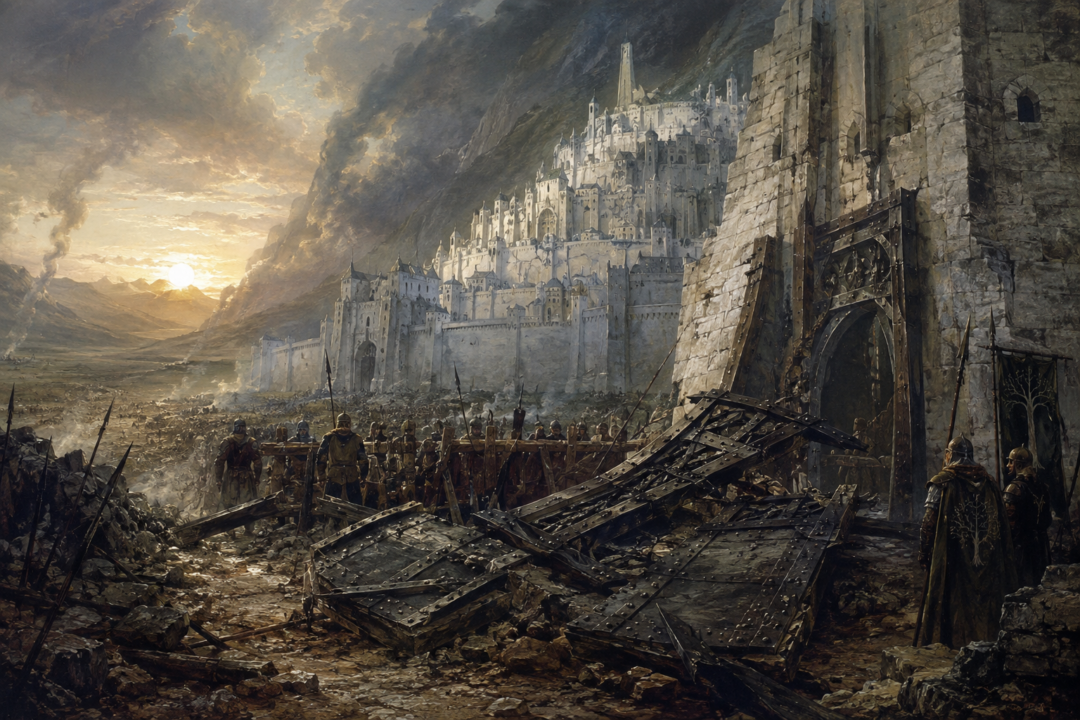
The Great Gate of Minas Tirith had stood against enemies for generations. Then, during the siege of the City, Grond came against it.
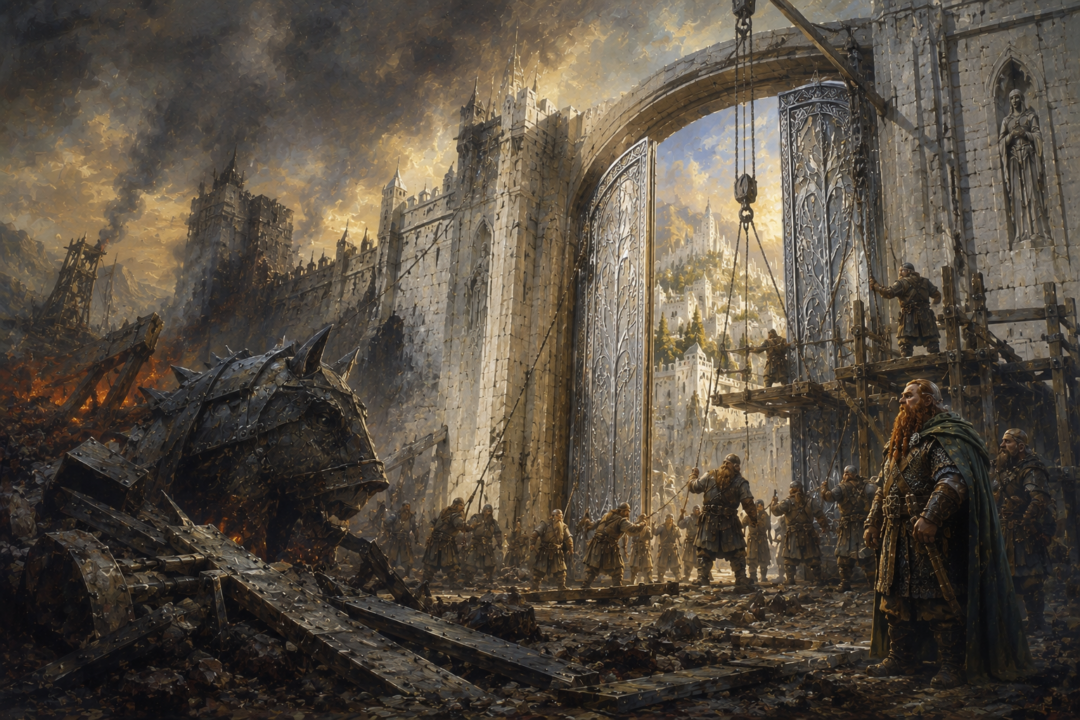
The enormous ram was brought forward under the command of the Witch-king, and at its final stroke the Gate was shattered. When victory finally came on the Pelennor Fields, Gondor had survived—but the principal entrance to its capital lay broken.
The solution recorded in The Lord of the Rings is striking. In the years after the War of the Ring, Gimli brought Dwarves from Erebor south to the Glittering Caves of Aglarond. Appendix A tells us that these Dwarves performed great works for Gondor and Rohan, and that they made new gates for Minas Tirith from mithril and steel.
That choice makes sense for reasons deeper than the familiar idea that Dwarves are simply good craftsmen. Gimli’s people combined extraordinary skill in stone and metal with a new geographical base close to Gondor, personal bonds with the restored king, and an established willingness to build for other peoples.
The replacement Gate therefore becomes a small but revealing symbol of the Fourth Age: something destroyed by the Shadow is rebuilt through alliances created during the war.
The Gate Was More Than a Broken Door
Minas Tirith was built in seven levels, each defended by its own wall, but the Great Gate was the principal entrance into the City.
Its destruction was consequently one of the defining moments of the siege.
The forces of Mordor did not merely attack the walls at random. Grond was brought against the Gate, and the Witch-king himself came forward as it was broken. For a moment the way into the City stood open, with Gandalf confronting the Lord of the Nazgûl beyond the shattered entrance.
The arrival of the Rohirrim changed the battle before the Enemy could exploit that breach decisively. Minas Tirith survived, but its Gate did not.
After the battle, a temporary barrier could serve immediate practical needs. A permanent replacement was another matter. Gondor needed an entrance worthy of the capital of the restored kingdom.
And that is where Gimli's people become especially important.
Gimli Had Already Discovered the Future Home of His People
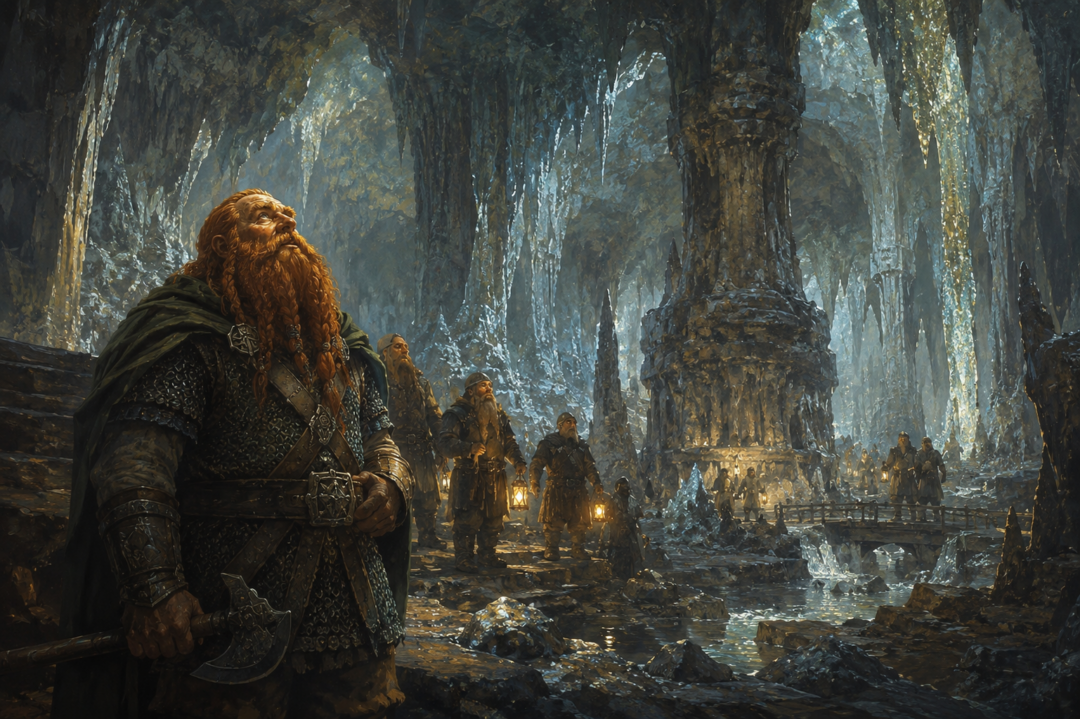
During the Battle of the Hornburg, Gimli entered the caverns behind Helm's Deep. His reaction is one of the clearest demonstrations that Dwarven craft in Middle-earth is not merely industrial.
He is overwhelmed by their beauty.
Later, while travelling with Legolas, Gimli describes the Glittering Caves with extraordinary enthusiasm. He speaks of chambers, columns and stone formations whose beauty should not simply be hacked apart for profit. When Legolas worries about what Dwarves might do to such a place, Gimli answers with an important description of Dwarven craftsmanship: they would work carefully, taking stone only where appropriate and improving what they found rather than thoughtlessly destroying it.
That conversation matters when considering Minas Tirith.
Gimli is not proposing a community of crude miners. His vision of Aglarond is of craftsmen capable of combining strength, stonework, metalwork and beauty.
After Sauron's fall, that vision becomes reality. Appendix A records that Gimli brought Dwarves of Erebor south and became Lord of the Glittering Caves.
A new centre of Dwarven craftsmanship had appeared in the White Mountains.
These Were Dwarves of Erebor
The origin of Gimli's settlers matters.
They came from Erebor, the Lonely Mountain, one of the great Dwarven centres restored after the events of The Hobbit. Gimli himself was the son of Glóin, one of Thorin Oakenshield's companions.
By the end of the Third Age, Erebor was again a functioning Dwarven kingdom. During the War of the Ring it had faced its own invasion: Dáin Ironfoot and King Brand died fighting before the Gate of Erebor while their peoples were besieged within the Mountain. After Sauron's downfall, the northern kingdom survived under Thorin III Stonehelm.
The Dwarves who followed Gimli south therefore belonged to a living craft tradition, not to a scattered remnant without a homeland.
Their new settlement at Aglarond extended that tradition into the south.
This is important because the texts do not say that Gimli personally stood at a forge and single-handedly manufactured the replacement Gate. Appendix A describes the works of the Dwarves of the Glittering Caves collectively.
The Gate was the achievement of a community.
Dwarven Skill Fits the Problem Almost Perfectly
Across Tolkien's legendarium, Dwarves are repeatedly associated with exceptional work in stone and metal.
Their maker, Aulë, is himself the Vala most closely associated with substances, craft and smith-work. The Dwarves' love of stone, metals and making is therefore embedded deeply in their origins.
Their history repeatedly demonstrates those abilities.
Khazad-dûm was one of the greatest subterranean realms ever constructed in Middle-earth. Erebor became another centre of mining and craftsmanship. In the First Age, the Dwarves of Belegost and Nogrod were renowned for their works, although their history also contains darker episodes showing that craftsmanship did not make them morally infallible.
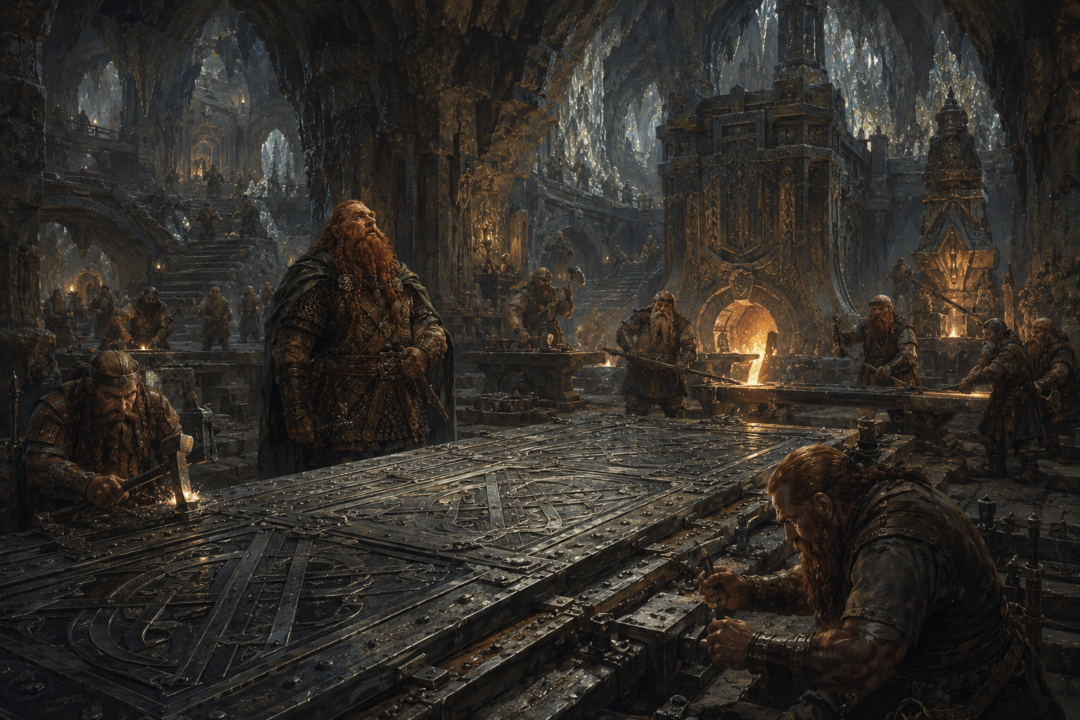
A gate for Minas Tirith demanded exactly the disciplines in which Dwarven culture excelled: metalwork, structural understanding and monumental construction.
But the new Gate was no ordinary iron replacement.
It was made of mithril and steel.
Mithril Makes the Gate Extraordinary
Mithril was one of the most remarkable substances known in Middle-earth.
Gandalf explains in The Fellowship of the Ring that it was light, extraordinarily hard, and could be beaten and polished beautifully. The most famous surviving example is Frodo's mithril coat, originally made for an Elven prince and later given to Bilbo by Thorin.
By the late Third Age, mithril was enormously precious because its great source beneath Khazad-dûm was no longer accessible to Dwarven mining.
That makes the use of mithril in the new Gate remarkable.
The text does not explain where Gimli's people obtained the necessary mithril, nor does it give us the Gate's exact construction. We should therefore resist inventing a technical answer. It is not stated that mithril was discovered at Aglarond, for example.
What we can say is that the canonical account explicitly identifies the new gates as being made of mithril and steel.
This was therefore not merely a repair.
The ruined entrance of Minas Tirith was replaced with something exceptional.
Gimli Was Also Someone Aragorn Could Trust
Technical skill explains why Dwarves could undertake the work. Gimli's personal history helps explain why his people fit so naturally into the restored kingdoms.
He had fought beside Aragorn from the breaking of the Fellowship onward.
They passed through some of the darkest events of the war together: the pursuit across Rohan, Helm's Deep, the Paths of the Dead, the march through southern Gondor and the final campaign against Mordor.
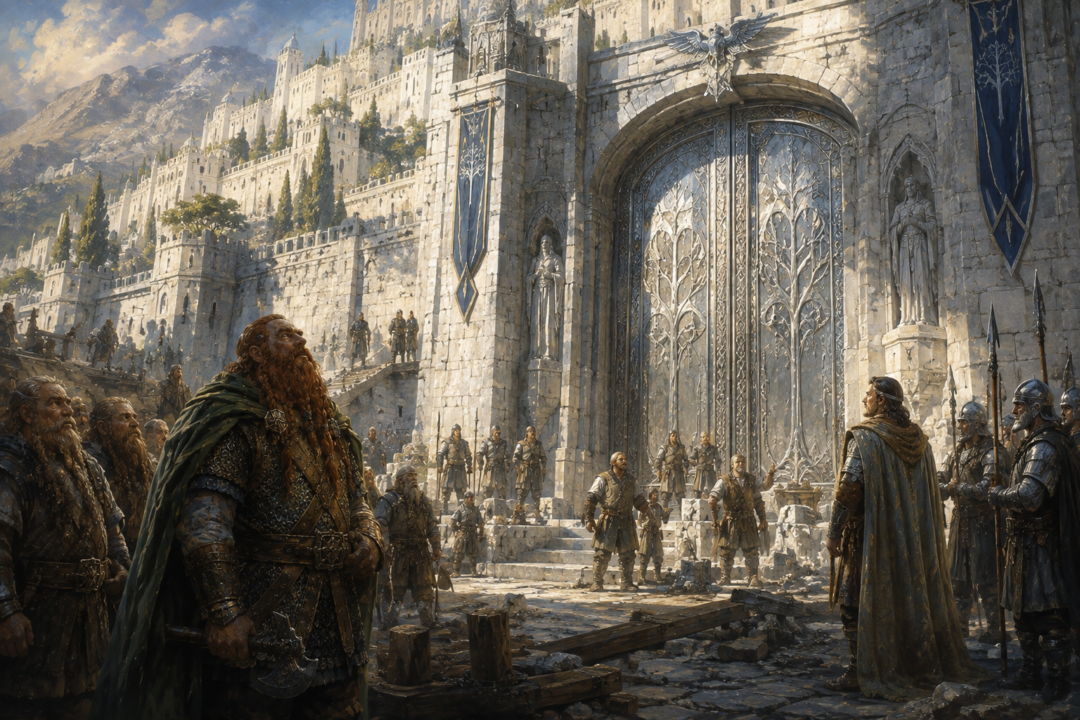
By the time Aragorn became King Elessar, Gimli was not an unknown foreign craftsman offering his services. He was one of the surviving members of the Fellowship and a proven friend.
His new colony also occupied a remarkable position.
Aglarond lay in Rohan, while Gimli's people performed works for both Rohan and Gondor. A Dwarf from Erebor had effectively become the head of a new Dwarven community in the south whose craftsmanship benefited two kingdoms of Men.
The alliances forged during the war were becoming permanent features of the peace.
The Dwarves Did More Than Build One Gate
Appendix A says that Gimli's people accomplished “great works” in Gondor and Rohan.
The new gates of Minas Tirith are the most specifically identified example, but the wording points to broader activity.
That makes the Aglarond colony significant.
The Fellowship had united representatives of peoples who often lived separately and carried old suspicions. Gimli and Legolas provide the most obvious personal example of those barriers being overcome. Their friendship does not magically erase the long history between Elves and Dwarves, but it shows that inherited distrust does not have to determine individual relationships.
The works of Gimli's people extend the same theme into politics and craftsmanship.
Dwarves are no longer merely allies who arrived for a battle. They participate in rebuilding the world that survives it.
The Gate Reverses the Meaning of Grond’s Victory
There is also a powerful symbolic contrast in what happens to the Great Gate.
Grond represents destructive craft.
It is a manufactured weapon designed for one purpose: to break what others built. Its assault allows the Witch-king to pass through an entrance that had protected Minas Tirith for centuries.
The Dwarves' work represents the opposite use of skill.
They take the site of that destruction and create a new defence from mithril and steel.
The text does not explicitly present the Gate as a deliberate philosophical answer to Grond, so that should remain interpretation rather than stated authorial meaning. But the contrast is difficult to miss.
One great work of craftsmanship destroys.
Another restores.
And the second survives into the new age.
A Perfect Monument to the Fellowship’s Victory
The most interesting thing about the new Gate may be that it is not a monument in the conventional sense.
Gimli's people do not commemorate the War of the Ring by building a statue of the Fellowship.
They build something useful.
Every traveller entering Minas Tirith would pass through a structure created by Dwarves who had come south because of relationships formed during the war.
That is an unusually fitting legacy for Gimli.
His importance in the story is partly martial—he is a formidable warrior—but his people ultimately leave their greatest visible mark through making rather than killing.
The Great Gate had been destroyed at the moment when Gondor seemed closest to extinction.
Under the restored kingdom, it was rebuilt by allies who would scarcely have belonged to Gondor's story in earlier generations.
That is why Gimli's people are not merely a plausible choice for the work.
They are almost the ideal one.
The new Gate joins Dwarven craft, Gondorian renewal, the wealth of the old world and the friendships of the Fellowship in a single structure. What Grond shattered in the final convulsion of the Third Age, the Dwarves of Aglarond remade for the Fourth.
Minas Tirith did not simply receive its old Gate back.
It entered the new age through one built by its friends.
Sources & Notes
- https://www.encyclopedia-of-arda.com/g/greatgateofminastirith.php — The Encyclopedia of Arda: Great Gate of Minas Tirith (its destruction by Grond and its postwar replacement in mithril and steel).
- https://www.encyclopedia-of-arda.com/g/glitteringcaves.php — The Encyclopedia of Arda: Glittering Caves (Gimli’s postwar Dwarven colony at Aglarond and its works for Gondor and Rohan).
- https://www.encyclopedia-of-arda.com/g/gimli.php — The Encyclopedia of Arda: Gimli (his Erebor background, lordship of the Glittering Caves, and Fourth Age works).
- https://www.encyclopedia-of-arda.com/g/grond.php — The Encyclopedia of Arda: Grond (the great ram used to break Minas Tirith’s Gate during the siege).
Sources checked for relevance and availability.