The destruction of Númenor was neither the first violent alteration of Tolkien’s world nor the last catastrophe suffered by its inhabitants. Long before Ar-Pharazôn challenged the Valar, mountains had been overthrown, seas enlarged and civilizations extinguished. Even the powers entrusted with ordering Arda could not always defend it without contributing to its destruction.
Yet asking how many catastrophes occurred invites a precision Tolkien’s writings do not support. The legendarium contains no authoritative register of disasters or consistent threshold separating catastrophe from destructive warfare. Its deepest concern is the cumulative consequences of destruction. Arda survives its catastrophes, but rarely emerges undiminished.
1. The First War and the Marring of Creation
Arda’s earliest catastrophe cannot be assigned a single date. Its origin precedes the physical world, in Melkor’s discord within the Music of the Ainur. This discord is the metaphysical antecedent of subsequent destruction, not a geological disaster within an already completed world.
In the Ainulindalë, Melkor repeatedly obstructs the Valar’s shaping of Arda. Mountains, valleys and seas emerge through construction and opposition rather than the uninterrupted realization of their designs.
The First War, described in the opening chapter of the Quenta Silmarillion, belongs to this primordial struggle. Tulkas enters Arda and drives Melkor away, allowing the Valar to resume their labours. Tolkien supplies no inventory of landscapes destroyed during the conflict.
The philosophical writings collected in Morgoth’s Ring (HoMe X), particularly Myths Transformed, develop the significance of Melkor’s involvement with matter. His dispersal of power into Arda’s physical substance makes its corruption more enduring than the occupation of fortresses or devastation of battlefields.
Counting this process as one catastrophe is an editorial convenience, not a distinction established by Tolkien. The Marring is the condition within which later catastrophes occur.
2. The Fall of the Lamps and the End of the Spring of Arda
The destruction of Illuin and Ormal provides the first clearly bounded disaster on a world-altering scale in The Silmarillion.
Raised upon enormous pillars in the north and south, the Lamps illuminate the Valar’s dwelling at Almaren. Their light sustains the Spring of Arda, when the Valar’s initial ordering of the world reaches its greatest fruition.
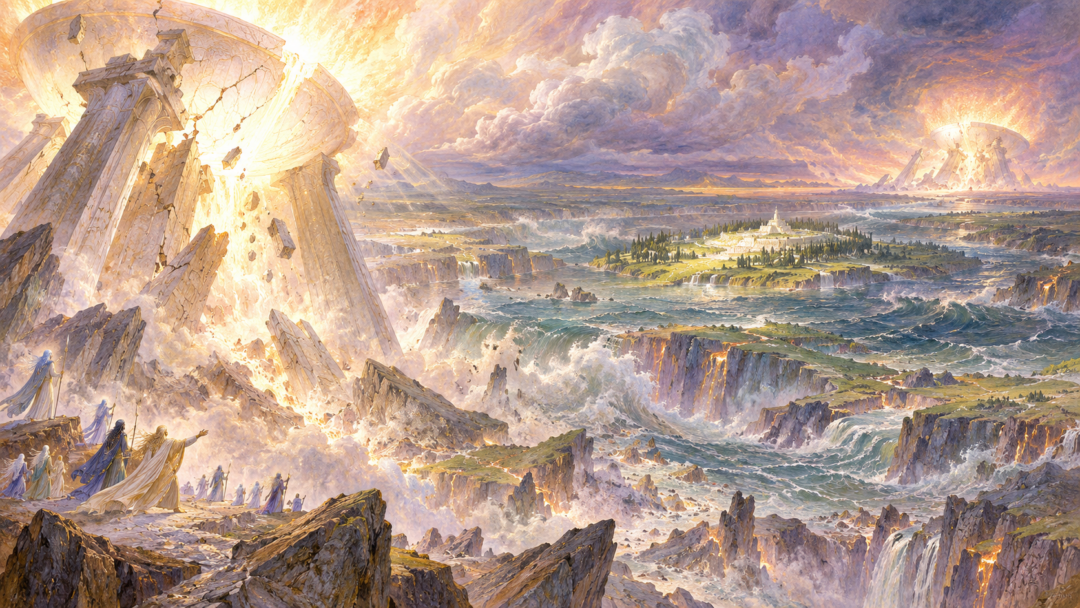
Melkor secretly establishes Utumno and eventually overthrows both Lamps. In Of the Beginning of Days, Tolkien describes the breaking of lands, disturbance of seas and destructive release of the Lamps’ fire. Almaren is ruined, and the world’s original arrangement cannot be restored.
The Valar’s withdrawal to Aman consequently represents more than relocation. Their subsequent ordering of the world proceeds under fundamentally altered circumstances. Valinor and the Two Trees succeed Almaren and the Lamps without reproducing their universal illumination.
This disaster also exposes the weakness of numerical accounting: although two Lamps are destroyed, their overthrow constitutes one connected assault and general catastrophe. Counting them separately would obscure Tolkien’s narrative unity.
3. The Battle of the Powers and the Darkening of Valinor
The next great physical upheaval arises from an attempt to protect the newly awakened Elves. In Of the Coming of the Elves and the Captivity of Melkor, the Valar wage war against Melkor and besiege Utumno. This conflict, generally called the Battle of the Powers, reshapes Middle-earth, particularly its western regions, and widens the Great Sea.
Not every catastrophe, therefore, results directly from Morgoth’s deliberate malice. The Valar fight to protect the Children of Ilúvatar, yet their intervention has destructive consequences. Tolkien distinguishes moral intention from physical outcome.
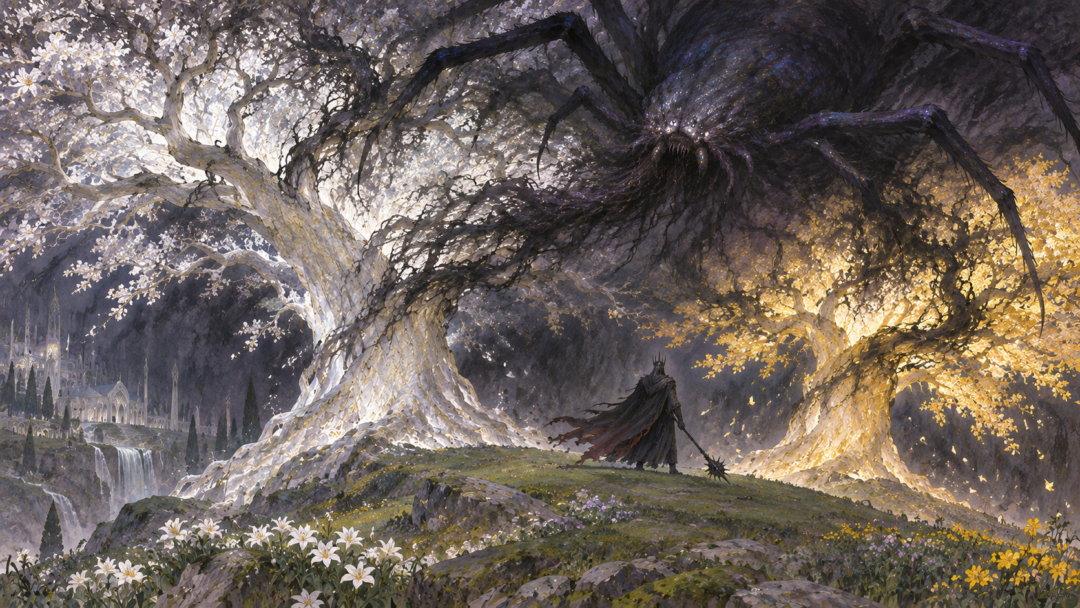
The poisoning of the Two Trees constitutes a different kind of catastrophe. In Of the Darkening of Valinor, Melkor and Ungoliant destroy Aman’s sources of light. The consequences extend into Finwë’s murder, the theft of the Silmarils and the rebellion and departure of the Noldor, narrated in succeeding chapters.
The Darkening destroys an irreplaceable good rather than submerging a continent. A geological catalogue could omit it; a history of Arda’s fundamental losses could scarcely do so.
Even the subsequent creation of the Sun and Moon, within the published Silmarillion‘s cosmology, does not resurrect the Trees. It transforms the conditions of life in response to their destruction.
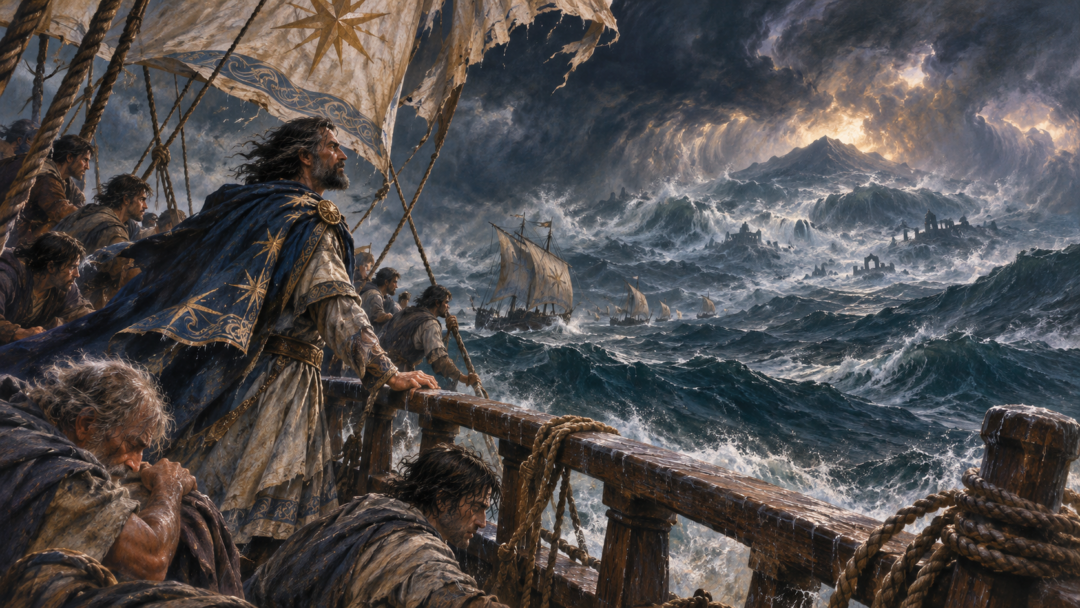
4. The First Age: A Civilization Destroyed by Stages
The wars of Beleriand resist treatment as one disaster. Successive military reversals extinguish possibilities that survived earlier conflicts.
The first battle of the Wars of Beleriand brings grave losses to the Sindar, while the Dagor-nuin-Giliath includes Fëanor’s death. The Dagor Aglareb, however, is a Noldorin victory. These distinctions, established in Of the Sindar and Of the Return of the Noldor, prevent the traditional sequence of battles from serving as an equivalent catalogue of catastrophes.
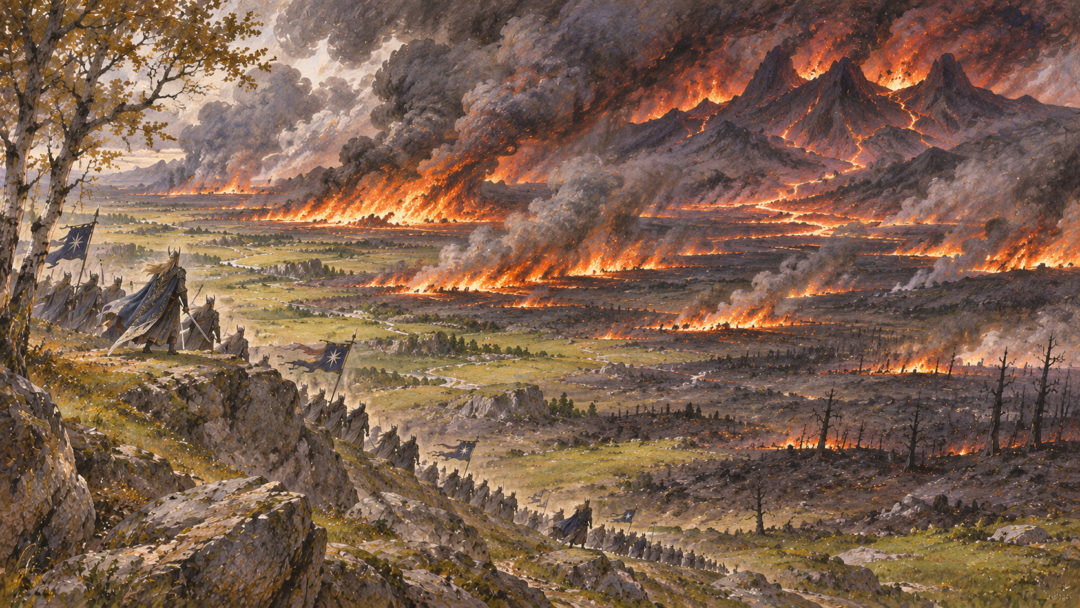
The Dagor Bragollach is a clearer example. In Of the Ruin of Beleriand and the Fall of Fingolfin, Morgoth breaks the Siege of Angband through an assault accompanied by rivers of fire. Ard-galen becomes Anfauglith. Military defeat coincides with environmental devastation and the collapse of territorial defences.
The Nirnaeth Arnoediad, narrated in Of the Fifth Battle, destroys the great hope of overthrowing Morgoth through the combined strength of Beleriand’s peoples. Major leaders perish or are captured, and organized resistance collapses in several regions.
The remaining hidden or defended kingdoms fall separately. Nargothrond succumbs to Morgoth’s forces under Glaurung; Doriath is destroyed through conflicts involving the Nauglamír and the Silmaril; Gondolin falls after the betrayal of its location. Their respective accounts appear in Of Túrin Turambar, Of the Ruin of Doriath and Of Tuor and the Fall of Gondolin.
Counting the Bragollach, Nirnaeth and three ruined kingdoms individually yields at least five distinguishable catastrophes. This grouping remains interpretive: Doriath alone suffers multiple assaults, and detailed enumeration requires decisions about dividing connected events.
The First Age is best understood here as a prolonged civilizational catastrophe punctuated by particular disasters.
5. The War of Wrath and the Drowning of Beleriand
The greatest physical disaster of the closing First Age is inseparable from victory over Morgoth.
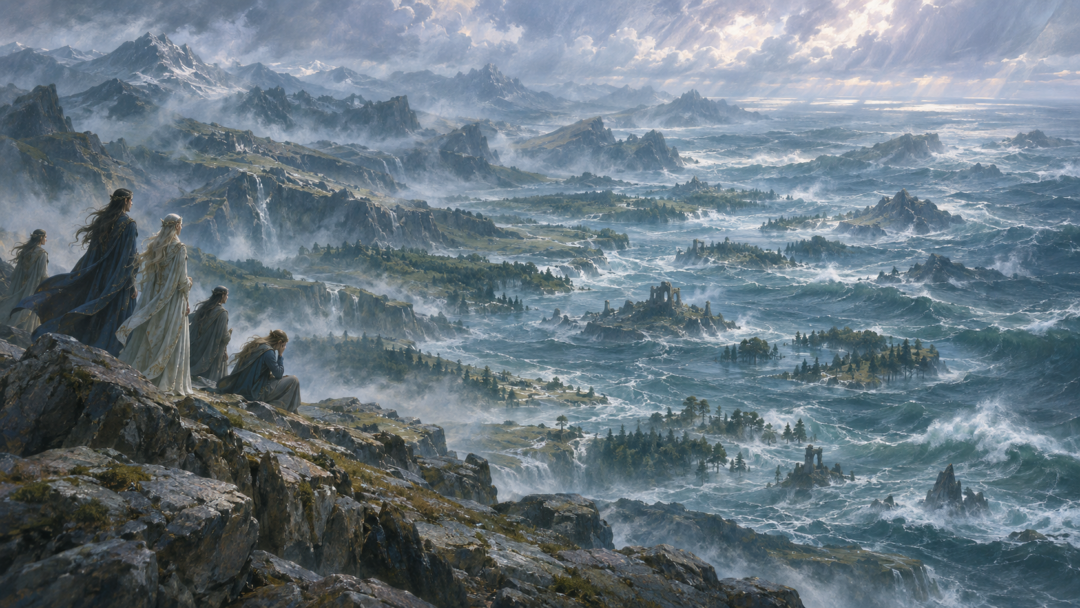
In Of the Voyage of Eärendil and the War of Wrath, the Host of the West brings Angband to ruin. Morgoth is captured, but the conflict also breaks the northern and western lands. The sea enters territories whose inhabitants dominate the history of the Quenta Silmarillion.
Most of Beleriand disappears beneath the waters. Surviving lands and islands preserve fragments of its geography; the maps and geographical references of The Lord of the Rings retain the relationship between drowned territories and later western coastlands.
Tolkien provides insufficient physical detail to attribute every geographical change to particular combatants or weapons. Assigning specific portions of the destruction to Eönwë, the dragons or individual Valar would exceed the evidence.
A broad historical accounting should therefore treat the War of Wrath and Beleriand’s drowning as one interconnected catastrophe, while distinguishing its military and geographical aspects.
The paradox is that Morgoth’s defeat, indispensable to the remaining peoples’ survival, does not restore the world preceding his ascendancy. The victorious Second Age inherits a diminished western Middle-earth.
6. Númenor and the Unmaking of the Old World
The Downfall of Númenor in Second Age 3319 differs from preceding catastrophes in the nature of the intervention producing it.
According to the Akallabêth, Ar-Pharazôn sails against Aman after Sauron persuades him to challenge the prohibition against Númenóreans entering the Undying Lands. Manwë appeals to Ilúvatar, and the Valar relinquish their government of the world for the occasion.
Númenor is overwhelmed, the invading armament destroyed, and Aman and Eressëa removed from the ordinary geographical world accessible to mortal mariners. Subsequent passage to the West requires the Straight Road. The Lord of the Rings, Appendix B, supplies the date; Letter 131 summarizes the wider transformation of the world’s constitution.
Within the Akallabêth‘s cosmological framework, this is more than an inundation: it marks a transition between fundamentally different arrangements of the world.
Extending that account to every version of Tolkien’s mythology presents difficulties. The late cosmological experiments in Myths Transformed consider a world spherical from the beginning. They demonstrate Tolkien’s reconsideration of the older cosmology without establishing a complete replacement narrative resolving every consequence for the Downfall.
Númenor’s destruction remains central, but the published mythic account must be distinguished from Tolkien’s unfinished cosmological revisions.
7. The Lesser Geography of Later Catastrophes
World-altering disasters become less prominent in Middle-earth’s later recorded history, but regional destruction continues.
Eregion’s destruction in Second Age 1697 during Sauron’s war against the Elves ends a major centre of Elvish craftsmanship. Appendix B of The Lord of the Rings records the event, while Unfinished Tales, in The History of Galadriel and Celeborn, provides greater detail.
The War of the Last Alliance brings immense destruction despite Sauron’s defeat. Of the Rings of Power and the Third Age also records the devastation of the Entwives’ lands during the conflict. The Brown Lands preserve geographical evidence of their ruin.
Appendices A and B of The Lord of the Rings record further calamities: the Great Plague beginning in Third Age 1636, Arthedain’s fall in 1974, the awakening of Durin’s Bane in 1980 and subsequent abandonment of Khazad-dûm, and the Long Winter of 2758–2759. The Fell Winter of 2911 and ensuing devastating floods belong to the same history of regional suffering.
Smaug’s destruction of Erebor and Dale in 2770, recounted in The Hobbit and dated in Appendix B, displaces surviving populations and destroys their former political and economic order.
Even the War of the Ring concludes with physical catastrophe. In Mount Doom, the One Ring’s destruction accompanies Barad-dûr’s collapse and tremendous upheaval in Mordor. Again, defeating a Dark Lord coincides with destroying the material structures through which his power operated.
Such episodes cannot be excluded from a general history of disasters merely because they do not reproduce the Downfall’s scale.
8. So How Many Catastrophes Were There?
A deliberately narrow accounting of destructive transformations of the world’s physical configuration yields five principal episodes: the primordial wars of the Powers, the destruction of the Lamps, the Battle of the Powers against Utumno, the War of Wrath with Beleriand’s drowning, and the Downfall of Númenor.
Adding the Darkening of Valinor produces six foundational catastrophes, provided that the destruction of sources of light is admitted alongside geographical transformations.
Neither figure is canonical. Both are analytical groupings constructed from the narrative. Including separate First Age devastations, the destruction of Second Age kingdoms and recorded Third Age disasters necessarily increases the number. Tolkien establishes no rule determining where enumeration should stop.
Nor should the prophesied Last Battle count as accomplished history. The Second Prophecy of Mandos, preserved among earlier writings published in The Lost Road and Other Writings (HoMe V), belongs to Tolkien’s developing eschatology. Its textual status and future orientation distinguish it from the narrated destruction of Beleriand or Númenor.
The question of how many times Arda has suffered catastrophe is ultimately rhetorical. It directs attention to the accumulated losses behind the landscapes inhabited by Tolkien’s later characters. Drowned kingdoms, abandoned halls, ruined fortresses and diminished sources of light testify to a history in which victory does not necessarily restore what evil has destroyed.
That distinction is fundamental to Tolkien’s conception of Arda Marred. The world endures, but its endurance is not equivalent to its healing.
Sources & Notes
This article is based on close reading and interpretation of Tolkien's published works and related source material where relevant.