A name belonging to another book
Fíli and Kíli’s mother is Dís, but her name never appears in The Hobbit. Her identity is established instead in Appendix A of The Lord of the Rings, specifically in Part III, ‘Durin’s Folk’, where Tolkien provides a fuller history and genealogy of Thorin’s family. Knowing something about the characters of The Hobbit is not necessarily the same as having learned it from that book.
The confusion is understandable because the genealogical information fits the narrative naturally. Dís belongs to the family whose fortunes determine the expedition to Erebor. Her sons participate in the quest, her brother leads it, and its concluding catastrophe takes all three of their lives. Nothing in her identification contradicts the earlier story. Nevertheless, it belongs to a different textual setting, concerned with the history of a people and its ruling house rather than primarily with Bilbo’s experiences.
Tolkien’s later account does not correct an erroneous identification of the brothers’ mother in The Hobbit. It supplies a name that the earlier narrative never provides. This distinction between correction and supplementation is essential to understanding what the two books independently establish.
What the unexpected party actually tells us
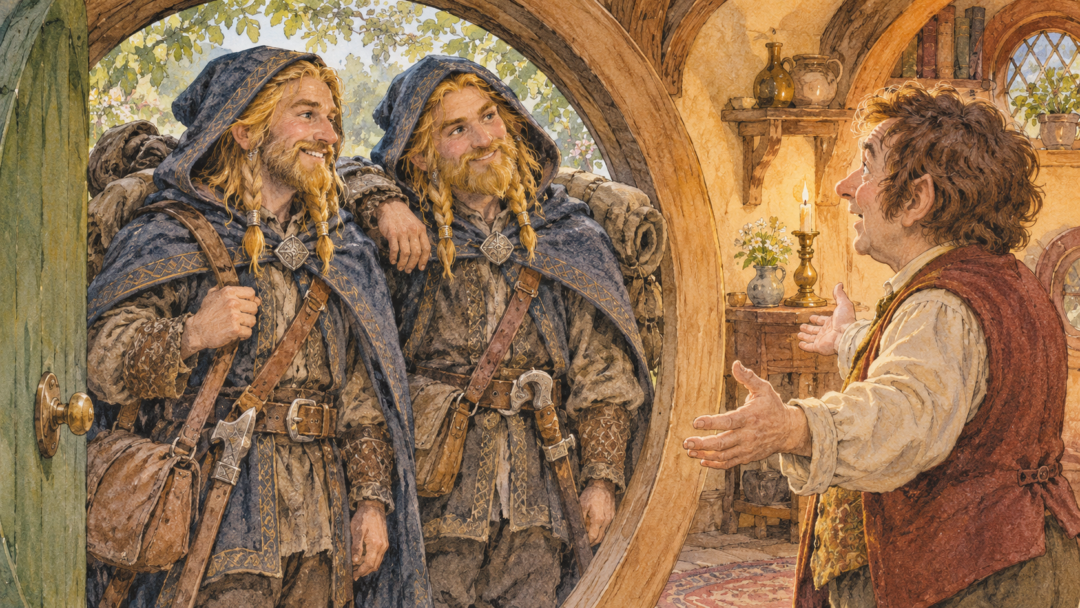
Chapter 1 of The Hobbit, ‘An Unexpected Party’, establishes Fíli and Kíli as a recognisable pair through their arrival, appearance and participation in the gathering at Bag End. Their relative youth subsequently distinguishes them from the older Dwarves, and their relationship as brothers forms part of their identity within the company. Their introduction, however, provides no account of their parentage.
This economy of information characterises the presentation of the company. Tolkien provides enough detail to distinguish its members and establish their functions without supplying a complete genealogy for every traveller. Thorin’s ancestry receives particular attention because his hereditary claim to the Mountain is fundamental to the undertaking. His account of the kingdom’s destruction explains why its recovery matters and why the treasure represents more than an opportunity for enrichment.
That selective interest in ancestry is not an exhaustive family history. Even when Thorin explains his house’s dispossession, the narrative concentrates on the events that make the expedition necessary. Naming his sister is not part of that explanation.
Readers can therefore understand the quest, its leader and the younger brothers’ place in the company without encountering the name Dís. The omission creates no narrative difficulty; it becomes particularly noticeable when readers bring to the adventure the broader historical knowledge supplied by Tolkien’s other writings.
The maternal relationship revealed at the end
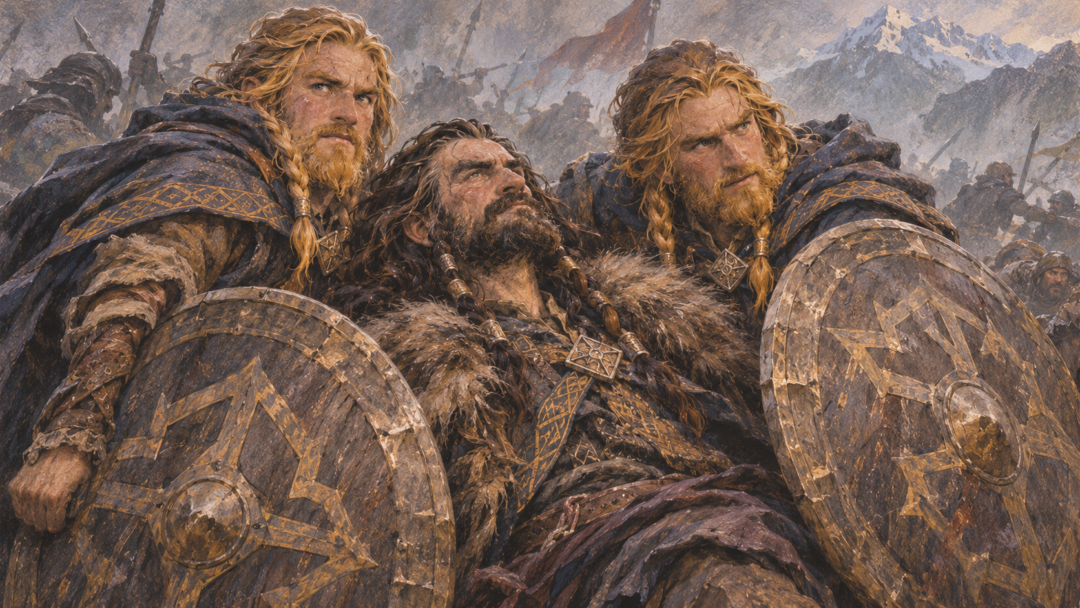
The decisive statement about the brothers’ relationship to Thorin occurs in Chapter 18, ‘The Return Journey’. In the aftermath of the Battle of Five Armies, Tolkien explicitly identifies Thorin as their mother’s elder brother, explaining the relationship in connection with the deaths of Fíli and Kíli while defending him.
This establishes more than general membership of the same family. Thorin is specifically their maternal uncle, making their mother his younger sister, although her personal name remains undisclosed.
It would therefore be inaccurate to claim that The Hobbit tells us nothing whatsoever about Dís. Once Appendix A establishes her identity, we can recognise the woman indirectly mentioned in this passage. The earlier text establishes her family relationship without naming her. An unnamed referent is not the same as an explicit personal identification.
The placement of this information is significant. Tolkien emphasises the maternal relationship when its tragic cost becomes apparent. Fíli and Kíli have not merely died in the same battle as their leader; they have died defending a close member of their family.
The explicit statement of kinship may be interpreted as intensifying the tragedy. The passage does not, however, independently explain their thoughts or establish that their mother instructed them to protect Thorin. The securely established facts are their relationship, their act of defence and its fatal outcome.
The earlier clue in Lake-town
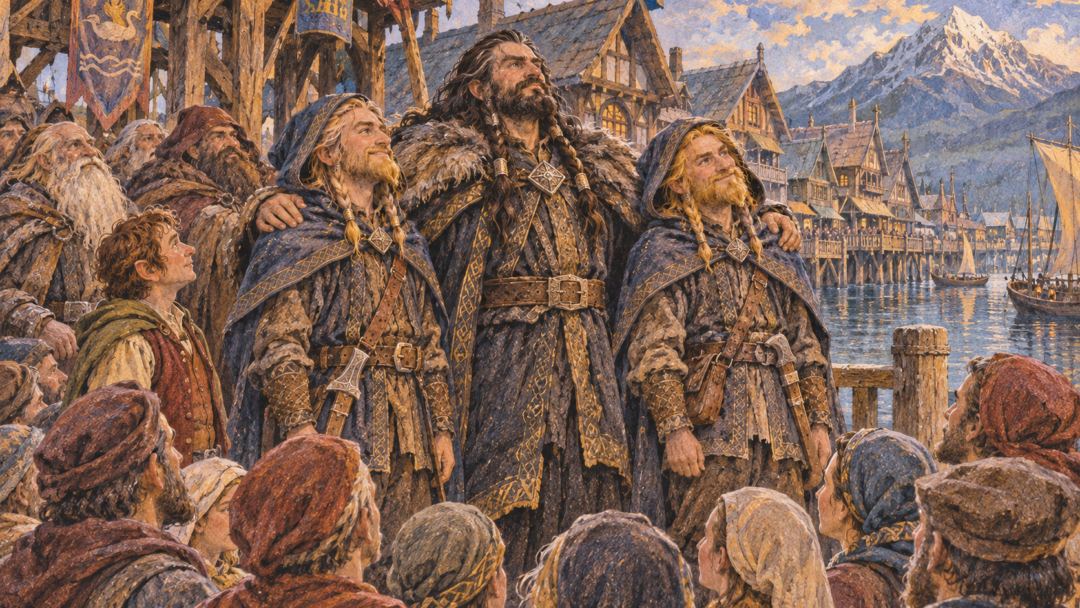
The relationship is disclosed before the final battle. In Chapter 10, ‘A Warm Welcome’, Thorin introduces Fíli and Kíli in Lake-town as his sister’s sons, describing them through their descent from his father’s daughter and thereby placing them within the family of Thráin.
This reference occurs where ancestry has immediate political significance. Thorin announces his identity to a community whose traditions preserve the memory of the kingdom under the Mountain. His descent supports his claim to recognition, and introducing his nephews associates them with that hereditary standing.
Yet even where royal identity matters, their mother remains unnamed. Thorin establishes the brothers’ credentials through their relationship to himself and his father rather than through his sister’s personal name.
Together, Chapters 10 and 18 provide the framework into which the later identification of Dís fits. The first establishes the brothers’ maternal descent within Thráin’s house; the second recalls their relationship to Thorin in the context of their deaths. Neither supplies the name subsequently recorded in the Appendices.
The contrast is compelling. At Lake-town, kinship supports a public assertion of dynastic identity and the possibility of restoration. After the battle, it accompanies the destruction of that branch of the family. This contrast is an interpretation of the narrative’s structure, not an additional historical fact supplied by Tolkien.
Where Tolkien actually names Dís
The authoritative identification appears in The Lord of the Rings, Appendix A, III, ‘Durin’s Folk’. Published with The Return of the King in 1955, this material extends Dwarvish history considerably beyond the account in The Hobbit, first published in 1937.
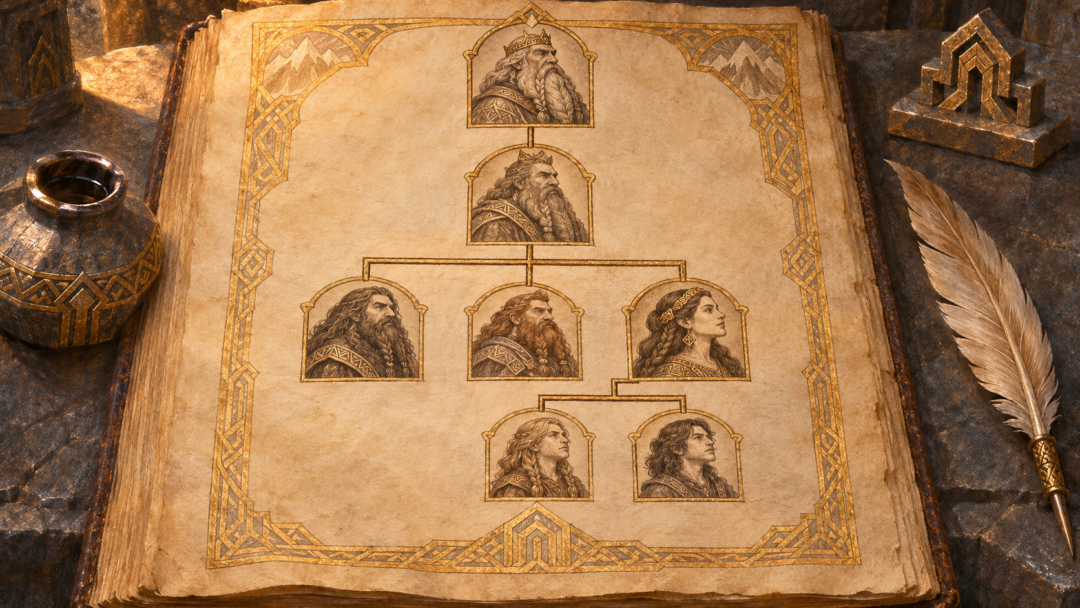
Tolkien identifies Dís as the daughter of Thráin II and the mother of Fíli and Kíli. The accompanying genealogical table places her alongside her brothers, Thorin II Oakenshield and Frerin, recording her birth in the year 2760 of the Third Age. Fíli and Kíli appear beneath her in the family tree.
Her identity requires no reconstruction by readers. The name is neither an editorial conjecture nor an invention of subsequent adaptations: it belongs to Tolkien’s published account of Durin’s house.
The genealogy makes explicit the generational connections that The Hobbit handles selectively. Dís is Thrór’s granddaughter, Thráin II’s daughter, Thorin and Frerin’s sister, and the mother of the two youngest members of Thorin’s company. Through her, the brothers belong to the royal house whose lost kingdom they help recover.
The nature of this additional information matters. The Appendix identifies Dís genealogically; it does not make her an active participant in the narrated expedition, supply conversations with her sons or describe her experiences during their absence. The name is canonical, but an extensive personal biography is not thereby established.
Why this particular Dwarf-woman is remembered
Tolkien’s notice concerning Dís is especially remarkable because he describes her as the only Dwarf-woman named in the histories under discussion. The statement accompanies information attributed to Gimli concerning Dwarf-women, their relative scarcity and their infrequent appearance outside Dwarvish communities. These observations belong to Appendix A, ‘Durin’s Folk’, not Bilbo’s account of his journey.
The qualification concerning the histories is important. Tolkien describes the surviving record as presented within his work, not suggesting that other Dwarf-women lacked personal names or that Dwarvish society contained no other women of historical importance. The limitations of the record are not equivalent to limitations upon the lives it describes.
Further explanation appears in The Peoples of Middle-earth, the twelfth volume of The History of Middle-earth, Chapter IX, ‘The Making of Appendix A’, within the developmental material concerning ‘Durin’s Folk’. There Tolkien explicitly connects the preservation of Dís’s name with the heroic deaths of Fíli and Kíli.
This explanation establishes a connection between the genealogy and the closing chapters of The Hobbit without requiring speculation about Tolkien’s intentions. The deaths concluding the brothers’ participation in Bilbo’s story also explain, in the developmental text, their mother’s exceptional named recognition.
The later historical notice can thus be interpreted as a form of remembrance, a literary reading supported by Tolkien’s explanation. It does not mean that the surviving text describes Dís’s mourning, records her response to the news or establishes whether she was alive when her sons died.
What a genealogical entry cannot establish
The certainty of Dís’s identification should not encourage certainty about unresolved matters. The published family tree identifies neither her husband nor her death date. Neither The Hobbit nor ‘Durin’s Folk’ supplies a developed personal portrait from which her temperament, political ambitions or domestic relationships might reliably be reconstructed.
Even her experience of the expedition requires caution. Appendix A establishes her birth and her children’s identities, but the absence of a recorded death date does not prove that she survived until Erebor’s recovery. Conversely, nothing in the cited passages establishes that she died before the expedition began. Her fate at the time of the battle remains unrecorded there.
Readers may imagine her sons’ departure, her attitude towards Thorin’s undertaking or her reception of news from the Mountain. Such imaginings are legitimate creative responses, provided they are not presented as events Tolkien actually narrates.
The same caution applies to the brothers’ motives. Chapter 18 explicitly connects their defence of Thorin with their maternal relationship to him. A particular promise made to Dís before their departure, however, would be a fictional elaboration rather than an established textual fact.
The scarcity of information about Dís does not diminish the authority of what survives. Her genealogical position is certain because Tolkien records it clearly. That certainty allows us to acknowledge the surrounding silence without attempting to fill it with unsupported assumptions.
Two books, two kinds of knowledge
The apparent discrepancy between The Hobbit and Appendix A disappears once their different purposes are recognised. The earlier book discloses the relationship between Thorin and his nephews through episodes within the adventure. The later historical account gives that relationship a formal position within the genealogy of Durin’s house.
Reading the Appendix retrospectively changes the significance of familiar passages. Thorin’s reference to his father’s daughter at Lake-town acquires a definite personal referent. The mention of the brothers’ mother after the battle becomes an indirect reference to a woman whose name survives in the wider history of the Dwarves. The earlier passages have not changed; the reader’s knowledge has.
This distinction matters throughout Tolkien’s legendarium. Information supplied elsewhere in his writings may illuminate a particular book without belonging to its actual wording. A coherent account of Middle-earth can draw upon narrative and supplementary historical material, but claims about what an individual narrative contains must remain accountable to that narrative.
The answer is therefore unequivocal. The Hobbit establishes that Fíli and Kíli are the sons of Thorin’s sister, but never names her Dís. Her personal name and formal genealogical identification appear in Appendix A, III, ‘Durin’s Folk’, of The Lord of the Rings. Further explanation of her exceptional named recognition survives in the developmental texts published in The Peoples of Middle-earth.
Dís belongs to the history behind The Hobbit, and her relationship to its central Dwarvish characters belongs to the narrative itself. Her name, however, belongs to the later published record. It is the difference between a family relationship disclosed through adventure and a personal identity preserved through history.
Sources & Notes
This article is based on close reading and interpretation of Tolkien's published works and related source material where relevant.