

The passage that answers the question
Tolkien explicitly states that Manwë faced a more difficult problem than Gandalf in Morgoth’s Ring, the tenth volume of The History of Middle-earth, edited by Christopher Tolkien and first published in 1993. The passage occurs in Part Five, Myths Transformed, Text VII, Notes on motives in the Silmarillion, subsection (ii), on page 400 in the standard pagination.
There Tolkien writes:
Manwë’s task and problem was much more difficult than Gandalf’s.
The sentence is Tolkien’s own assessment, not an inference originating in later scholarship. Its context is a discussion of the fundamental differences between Morgoth and Sauron and their consequences for their opponents.
Tolkien is not primarily comparing Manwë’s and Gandalf’s wisdom, courage or personal suffering. He is explaining why destroying Morgoth’s effective power presented a fundamentally different problem from defeating Sauron.
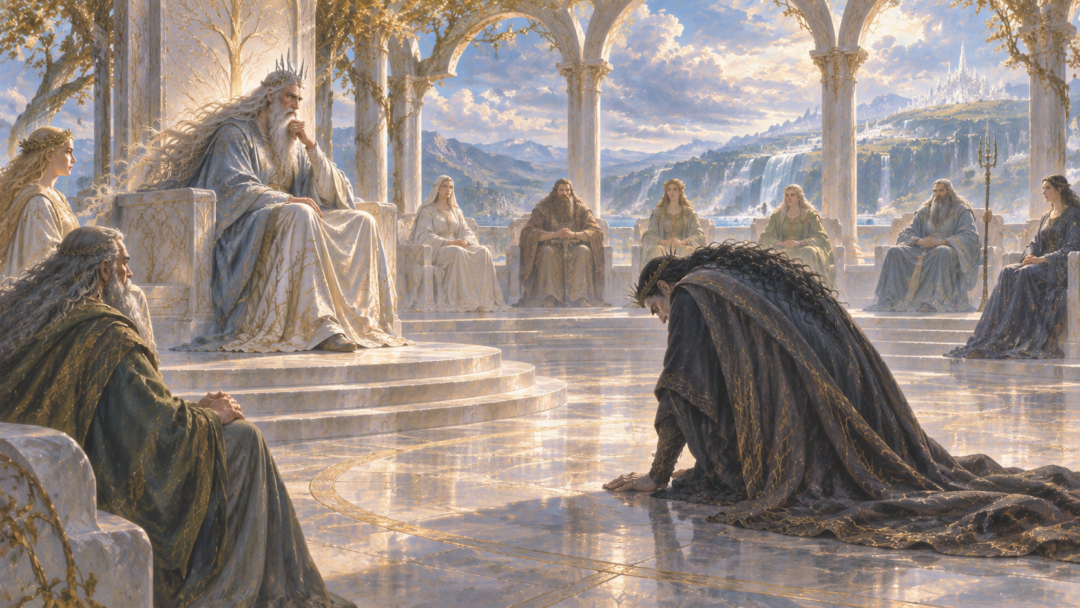
Gandalf could pursue a victory whose decisive condition was the destruction of a particular object. Manwë confronted an adversary whose corruption had become inseparable from the material constitution of the world he governed. This distinction underlies Tolkien’s defence of the Valar’s apparent reluctance to intervene.
Why Morgoth’s Ring was not an object
In subsection (i) of Notes on motives in the Silmarillion, Tolkien distinguishes Morgoth’s expenditure of his native power from Sauron’s subsequent use of his own.
Through prolonged interference with Arda’s formation and development, Morgoth invested himself in the physical world he sought to possess. His diminished personal stature during the later First Age therefore does not represent a straightforward disappearance of his original might. Some of that might had been committed to corrupting his surroundings.
Sauron inherited a world already damaged by his former master. His ambitions were increasingly directed towards controlling its inhabitants, and the making of the Rings supplied a different instrument of domination.
Subsection (ii) develops the consequences of this distinction. Tolkien describes Middle-earth itself as Morgoth’s Ring, an expression that explains the volume’s title but signifies considerably more than a metaphor for Morgoth’s power.
The strategy available against Sauron had no straightforward equivalent against Morgoth. There was no single physical repository of Morgoth’s disseminated power that Manwë could arrange to destroy. Completely removing that corruption would entail destroying the material order into which Morgoth had introduced it.
Yet the Elder King’s responsibility was precisely to preserve that order for the Children of Ilúvatar. His problem was not simply defeating an enemy, but defeating him without destroying the principal object of his stewardship.
This is the argument of Morgoth’s Ring, pages 394–400, culminating in the explicit comparison on page 400.
The wars of the Valar demonstrate the danger
The published Silmarillion supplies the narrative background to Tolkien’s philosophical explanation, particularly in Of the Coming of the Elves and the Captivity of Melkor and Of the Voyage of Eärendil and the War of Wrath.
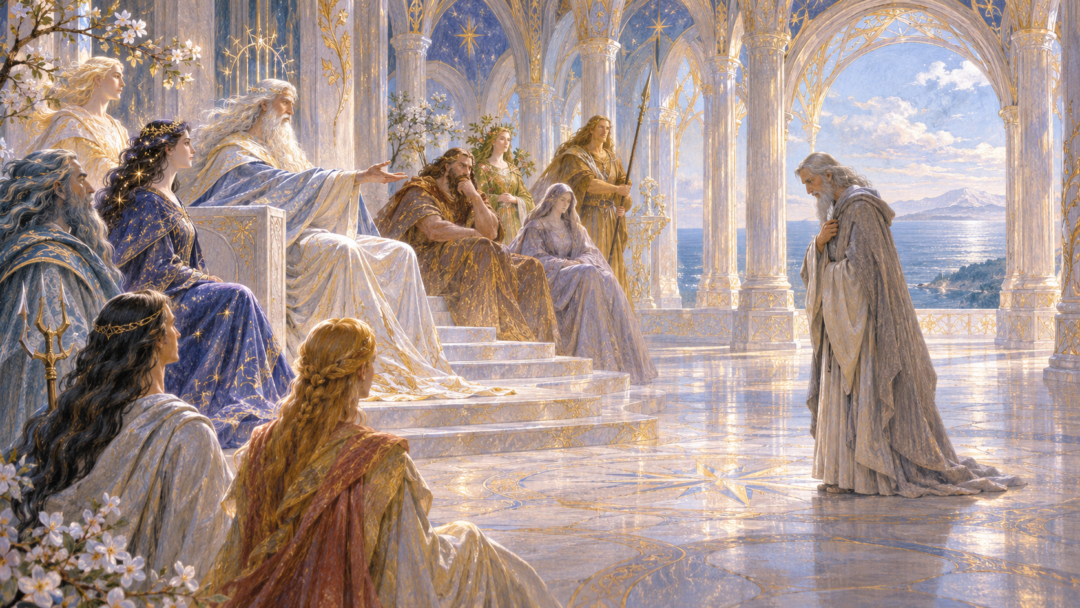
In the former, the awakening of the Elves creates an urgent reason to confront Melkor. The Valar’s intervention against his northern strongholds nevertheless produces immense disturbances in Middle-earth’s geography. Protecting the newly awakened Children requires an exercise of power capable of injuring their dwelling place.
The First Age concludes with the same difficulty on a greater narrative scale. The War of Wrath breaks Morgoth’s military dominion but catastrophically transforms the lands where the struggle occurs. The destruction accompanying Angband’s overthrow prevents intervention by the Powers from being regarded as an uncomplicated remedy for Middle-earth’s suffering.
In Notes on motives in the Silmarillion, subsection (iii), Tolkien considers the timing of this final intervention. He suggests that it can be understood as occurring appropriately, before the destruction of the remaining Eldar and Edain, rather than necessarily being postponed beyond reasonable limits.
This reconsideration does not demonstrate that every earlier decision was faultless. Tolkien instead explains why delay could be prudent despite its terrible human and Elvish costs.
The published Silmarillion illustrates the geographical consequences; Morgoth’s Ring explains the strategic dilemma. Both illuminate the problem, but only the latter contains the direct comparison with Gandalf.
Manwë’s second difficulty: judging a corrupted will
Another dimension of Manwë’s governance appears in the published Silmarillion, in Of Fëanor and the Unchaining of Melkor.
After his imprisonment, Melkor professes repentance. Manwë accepts the possibility of amendment, although other Valar remain distrustful. Tolkien attributes Manwë’s mistaken judgement partly to his own freedom from evil and consequent difficulty understanding Melkor’s inward corruption.
An expanded treatment appears in Morgoth’s Ring, Part Three, The Later Quenta Silmarillion, under the Second Phase of the revisions to Of Fëanor and the Unchaining of Melkor, around pages 272–273.
Genuine repentance matters because a restored Melkor might contribute enormously to healing the world he injured. Manwë’s willingness to entertain that possibility reflects his responsibility towards Arda rather than merely sentimental attachment to his brother.
Subsection (ii) of Notes on motives in the Silmarillion, beginning on page 398, adds a philosophical qualification. Tolkien distinguishes knowledge of another person’s mind from deductions about that person’s intentions. Greater spiritual stature does not automatically confer unrestricted access to another rational being’s inward life, and moral restrictions govern attempts to compel another mind to disclose itself.
Together, these passages suggest that Manwë’s government cannot legitimately depend upon unrestricted surveillance or domination of wills. This is an interpretative connection, consistent with the texts’ explicit arguments.
Nevertheless, Manwë’s difficulty comprehending evil is not the immediate explanation of the famous comparison. Tolkien makes that comparison in connection with the physical dissemination of Morgoth’s power. Judging Melkor’s repentance presents a related but distinct problem.
Gandalf’s corresponding restrictions in Unfinished Tales
The principal complementary source is Unfinished Tales, Part Four, section II, The Istari. Its collected writings explain why the Valar’s emissaries were embodied and why their commission did not authorize them to establish dominion over those they assisted. They were to encourage resistance to Sauron while respecting the independence of its participants.
The Valar’s deliberations over their choice of messengers are particularly relevant. Manwë selects Olórin, who expresses reluctance because of his weakness and fear of Sauron. Manwë regards that reluctance as a reason for his participation. This account belongs to one of the additional writings presented in The Istari, not a complete and uniform history of the Wizards.
Gandalf is therefore not an independent power pursuing a conception of government opposed to Manwë’s. His commission derives from the Powers, and its restrictions express an understanding of authority consistent with Manwë’s allegiance to Ilúvatar.
Gandalf must fulfil his mission without subordinating the Free Peoples to himself. Manwë must resist Melkor without adopting the arbitrary exercise of power characteristic of his rebellion.
Both face restrictions inherent in legitimate authority; Gandalf does not enjoy unrestricted moral freedom. What he possesses, and Manwë does not, is a practicable means of permanently disabling his principal adversary without dismantling the physical world.
The Istari provides the background to this conclusion, but it is not the location of Tolkien’s explicit comparison.
The Letters explain why Gandalf could not simply seize victory
Two supplementary readings are Letter 156, addressed to Robert Murray in November 1954, and Letter 246, addressed to Eileen Elgar in September 1963. Both appear under their established numbers in The Letters of J. R. R. Tolkien.
Letter 156 discusses Gandalf’s mission, death and return. Tolkien explains that Gandalf was intended to strengthen and instruct the opposition to Sauron rather than supplant it. Returning with enhanced authority does not remove his obligation to respect the wills of those he assists.
Letter 246 considers the hypothetical consequences of Gandalf claiming the One Ring and successfully challenging Sauron. Tolkien envisages a disastrous victory in which Gandalf’s conviction of his righteousness would make his subsequent tyranny particularly dangerous.
This hypothetical outcome clarifies why an identifiable means of defeating Sauron does not make Gandalf’s undertaking easy. He cannot legitimately resolve the crisis by appropriating the enemy’s principal instrument and enforcing his own conception of goodness.
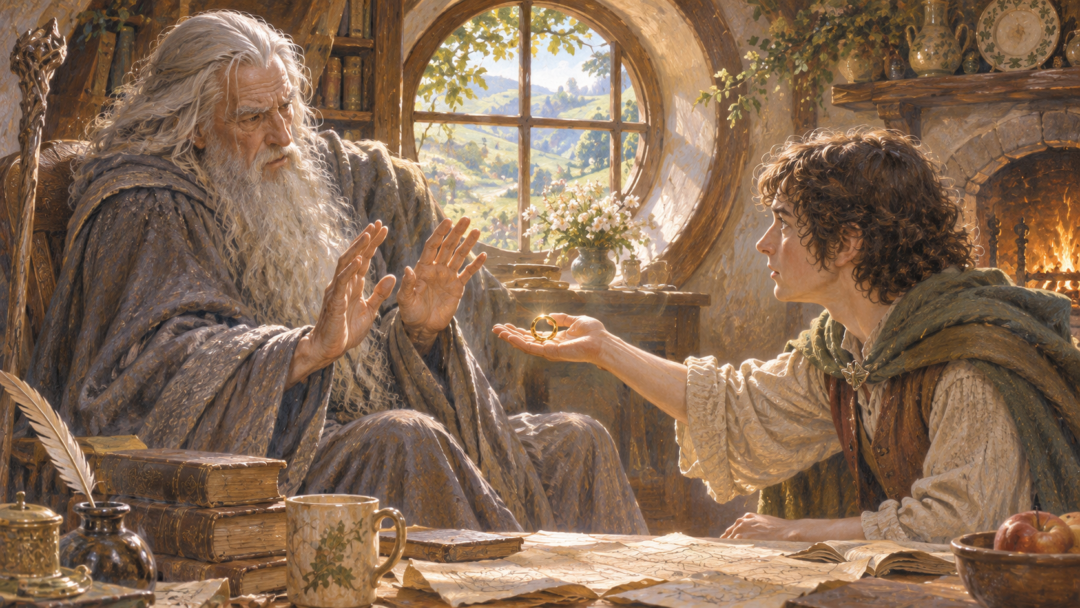
That refusal is dramatized in The Fellowship of the Ring, Book One, chapter 2, The Shadow of the Past, when Frodo offers Gandalf the Ring. It also informs Book Two, chapter 2, The Council of Elrond, where the Ring’s destruction is accepted despite extraordinary dangers.
The comparison concerns the structure of their respective problems, not an absence of moral difficulty in Gandalf’s mission. Gandalf must achieve victory without becoming another tyrant; Manwë must preserve a world whose substance is implicated in its tyrant’s power.
Neither letter contains the explicit comparative statement. Their value lies in explaining Gandalf’s corresponding constraints.
Why even the defeat of Morgoth could not finish Manwë’s work
The ending of the First Age distinguishes overcoming Morgoth personally from removing the consequences of his existence within Arda.
In The Silmarillion, Morgoth’s defeat and expulsion beyond the world do not restore Middle-earth to an unmarred condition. Subsequent history remains subject to corruption, suffering and rebellion, with Sauron’s career demonstrating evil’s survival after his master’s removal.
Morgoth’s Ring provides a more explicit philosophical account of this continuing condition. Besides Text VII of Myths Transformed, readers should consult the preceding Text VI, Melkor Morgoth, beginning around page 390, and the concluding portion of the Athrabeth Finrod ah Andreth material in Part Four.
These writings situate Arda’s corruption within a problem extending beyond an individual historical enemy. The Athrabeth and its accompanying commentary consider the possibility of healing and the relationship between the damaged world and its ultimate destiny. They do not contain another direct comparison between Manwë and Gandalf.
Their relevance is the larger horizon of Manwë’s stewardship: military victory can protect the Children and terminate Morgoth’s dominion, but cannot itself restore the world to the condition envisaged before its corruption.
By contrast, Sauron’s downfall in The Return of the King, Book Six, chapter 3, Mount Doom, accompanies the destruction of the instrument upon which his renewed dominion depends. This does not abolish evil from Middle-earth either. Tolkien’s comparison concerns eliminating Sauron as an effective directing power, not permanently abolishing every evil tendency.
Where the reader should begin
The definitive textual reference is The History of Middle-earth, Volume X, Morgoth’s Ring, Part Five, Myths Transformed, Text VII, Notes on motives in the Silmarillion, subsection (ii), page 400.
For the complete argument, read subsections (i)–(iii), beginning on page 394. The discussion of minds and legitimate authority begins on page 398; Morgoth’s disseminated power is discussed around pages 399–401; subsequent passages consider the Valar’s declining freedom to alter the established world and their intervention against Morgoth.
Complement this essay with Melkor’s captivity and release and the War of Wrath in The Silmarillion, the expanded account of his release in Part Three of Morgoth’s Ring, The Istari in Unfinished Tales, and Letters 156 and 246. Section titles and letter numbers are preferable when pagination differs between editions.
One textual qualification remains essential. Christopher Tolkien’s introduction to Text VII identifies an unfinished essay surviving in different forms. Its contents illuminate his father’s thinking but should not be represented as a fully harmonized, final account resolving every difficulty in the mythology.
Nevertheless, the central comparison is unequivocal. Manwë faced a particularly severe contradiction between defeating Morgoth and preserving Arda. Gandalf could seek the destruction of Sauron’s Ring. Manwë could not destroy Morgoth’s equivalent without destroying the world entrusted to his care.
Sources & Notes
This article is based on close reading and interpretation of Tolkien's published works and related source material where relevant.