Two journeys that are less alike than they appear
The apparent discrepancy between the Three Hunters’ pursuit across Rohan and Aragorn’s subsequent ride through southern Gondor rests on a misleading comparison. If Aragorn, Legolas and Gimli could cover an extraordinary distance on foot in approximately three days, why did horses not enable them to reach Pelargir sooner? Was the terrain responsible, or was Aragorn conserving his company’s strength?
Tolkien supplies enough evidence to reject the suggestion that the southern expedition was inexplicably slow, but not enough to reconstruct the horses’ speeds or quantify delays at individual obstacles. He describes a rapid military expedition through threatened territory, not an uninterrupted ride between two geographical points.
The question also contains geographical and chronological errors. The pursuit did not begin at Sarn Gebir, nor was its entire distance completed on foot. Meanwhile, the journey from Erech to Pelargir occupied more than three days. Correcting these premises substantially changes the comparison.
What distances did Tolkien actually give?
Sarn Gebir was the stretch of rapids encountered during the Fellowship’s voyage down the Anduin. In The Fellowship of the Ring, Book II, Chapter 9, The Great River, the Company carries its boats past the obstruction before continuing towards the Argonath and Nen Hithoel. The Three Hunters begin their pursuit considerably farther south, following the breaking of the Fellowship near Parth Galen and Amon Hen.
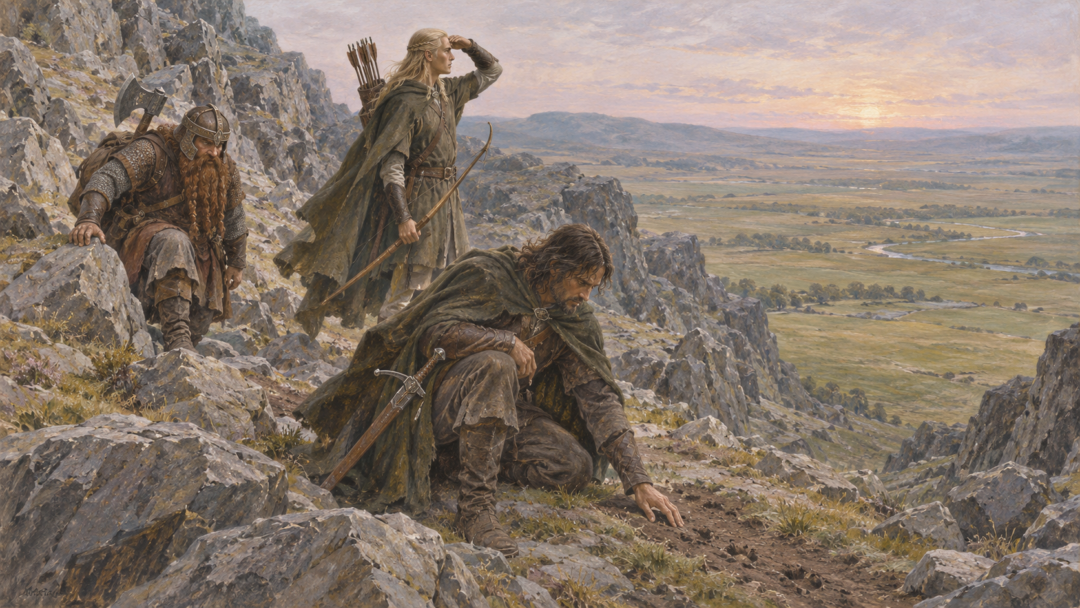
The principal measurement comes from Éomer in The Two Towers, Book III, Chapter 2, The Riders of Rohan. Learning where the companions began, he marvels that they have covered forty-five leagues before the completion of their fourth day. Using the conventional three-mile league, this amounts to approximately 135 miles, or 217 kilometres.
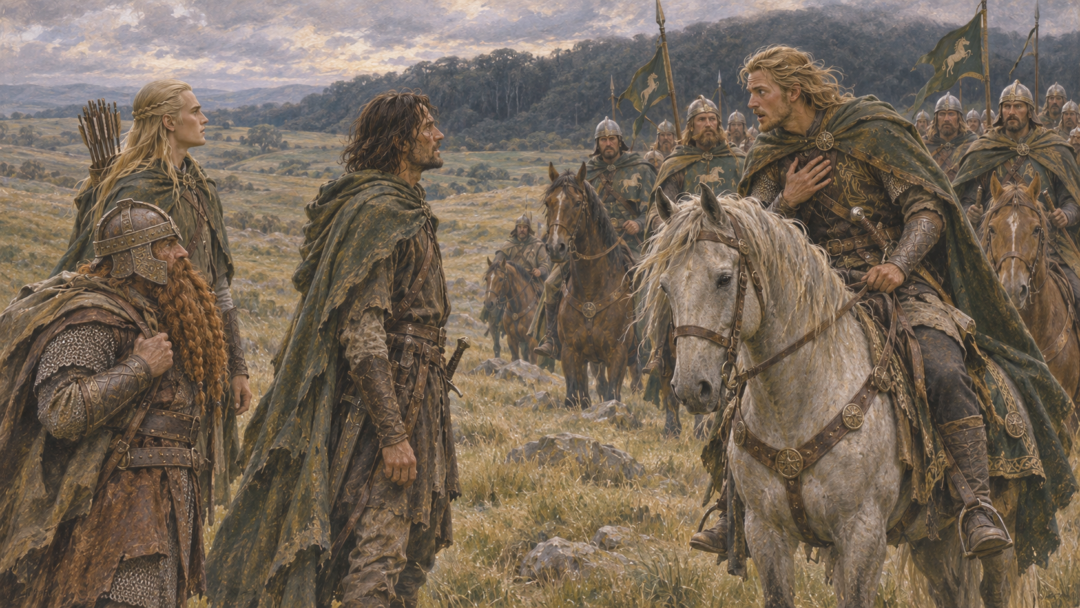
This measurement does not represent the entire distance to Fangorn. As the hunters approach the region where they encounter Éomer, the forest is still approximately ten leagues distant. Éomer lends them Hasufel and Arod, allowing them to complete the journey to the forest’s vicinity on horseback. Aragorn rides Hasufel, while Legolas and Gimli share Arod.
In The Return of the King, Book V, Chapter 9, The Last Debate, Gimli gives the distance from Erech to Pelargir as ninety-three leagues: approximately 279 miles, or 449 kilometres.
The southern ride was therefore slightly more than twice the measured pedestrian pursuit and substantially longer even allowing for the remaining distance to Fangorn. Tolkien’s explicit measurements make estimates from the published maps unnecessary.
The calendar does not give three days for both journeys
Appendix B, The Tale of Years, establishes the chronology. The pursuit begins on 26 February 3019, following Boromir’s death and the capture of Merry and Pippin. Aragorn encounters Éomer on 30 February and reaches Fangorn’s borders that evening. Tolkien’s calendar allows thirty days in February.
Aragorn passes through the Paths of the Dead and reaches Erech on 8 March. He departs from Erech and reaches Calembel on 9 March. On 11 March he reaches Linhir and crosses into Lebennin. On 12 March he drives the enemy towards Pelargir, reaching the port and capturing the fleet on 13 March.
The expedition thus extends across five calendar dates, from 9 to 13 March inclusive. These do not necessarily represent five complete twenty-four-hour periods, since the precise departure and arrival times are insufficiently specified. Nevertheless, three days compresses Tolkien’s chronology beyond what the text permits.
Dividing 279 miles by five produces a crude illustrative figure of nearly 56 miles per calendar day. The hunters would have averaged 45 miles per day if their measured pursuit occupied exactly three days. Neither figure represents an accurately measured travelling speed, but both help explain the apparent discrepancy.
The mounted expedition covered substantially more ground and took longer. Horses provided a considerable advantage; Tolkien never suggests otherwise.
The Three Hunters were not ordinary pedestrians
The pursuit is remarkable precisely because Tolkien refuses to treat it as normal. Éomer’s astonishment provides an assessment from someone accustomed to rapid journeys across the Mark. His recognition of Aragorn’s endurance and his naming of him as Wingfoot establish the achievement as exceptional even by Middle-earth’s standards.
The companions are unusually well suited to such exertion. Aragorn is an experienced Dúnadan and wilderness traveller. Legolas possesses Elvish physical qualities, including the extraordinary lightness of movement demonstrated on Caradhras in The Fellowship of the Ring, Book II, Chapter 3. Gimli repeatedly demonstrates immense endurance despite the particular difficulties sustained running presents him.
Their pursuit is conducted under extreme emotional pressure: Merry and Pippin are prisoners whose survival cannot be guaranteed. The hunters abandon any comfortable travelling routine, undertaking prolonged exertion and abbreviated rests while weighing exhaustion against the diminishing possibility of rescue.
Their progress is nevertheless uneven. Aragorn examines tracks and interprets evidence left by the Orcs and their captives, notably Pippin’s discarded Elven brooch. The enemy’s advantage grows despite their efforts, and Aragorn attributes part of their difficulty to a hostile influence working against them.
The journey therefore establishes neither an ordinary walking rate nor the hunters’ maximum sustainable running rate. It records what three exceptional individuals accomplished under desperate circumstances while tracking an enemy through unfamiliar conditions. Treating their achievement as a baseline for normal travel misunderstands Éomer’s reaction.
Did the terrain favour the pursuit across Rohan?
Terrain matters, but Tolkien offers no grounds for making it the sole explanation. The pursuit begins among the broken ridges and steep approaches of the Emyn Muil, hardly ideal running country. Descending into Rohan, however, the hunters encounter extensive open grasslands where movement and observation of tracks become easier.
Even this apparently favourable country is not uniform. The Riders of Rohan describes changes in elevation, valleys, watercourses and low-lying ground associated with the Entwash. The pursuit is no race along an uninterrupted level road.
Southern Gondor presents a different geography. The expedition leaves the Morthond country, passes through the uplands of Lamedon, crosses the Ciril and Ringló, and reaches the Gilrain at Linhir before entering Lebennin. These features are established in The Passing of the Grey Company, The Last Debate and Tolkien’s accompanying maps.
Established routes and settlements might reasonably facilitate mounted travel. Conversely, hills, river crossings and the necessity of approaching suitable fords can restrict mounted travellers. At Linhir, the crossing is especially significant because armed forces are contesting the vicinity.
Tolkien supplies no continuous description of road surfaces, gradients, bridge conditions or the horses’ movements. Claims that the roads were badly maintained, that riders regularly dismounted or that particular stretches consumed calculable additional hours would therefore be unjustified.
Terrain influenced both journeys, but its precise effect upon their relative speeds remains undetermined. The more decisive difference lies in Aragorn’s objectives.
The Dead were an advantage, not a marching burden
Aragorn’s southern expedition comprised living riders accompanied by a supernatural host. Thirty Rangers from the North, together with Elladan and Elrohir, had joined Aragorn and his companions before the passage beneath the White Mountains. The Grey Company was thus considerably larger than the three-man pursuit across Rohan.
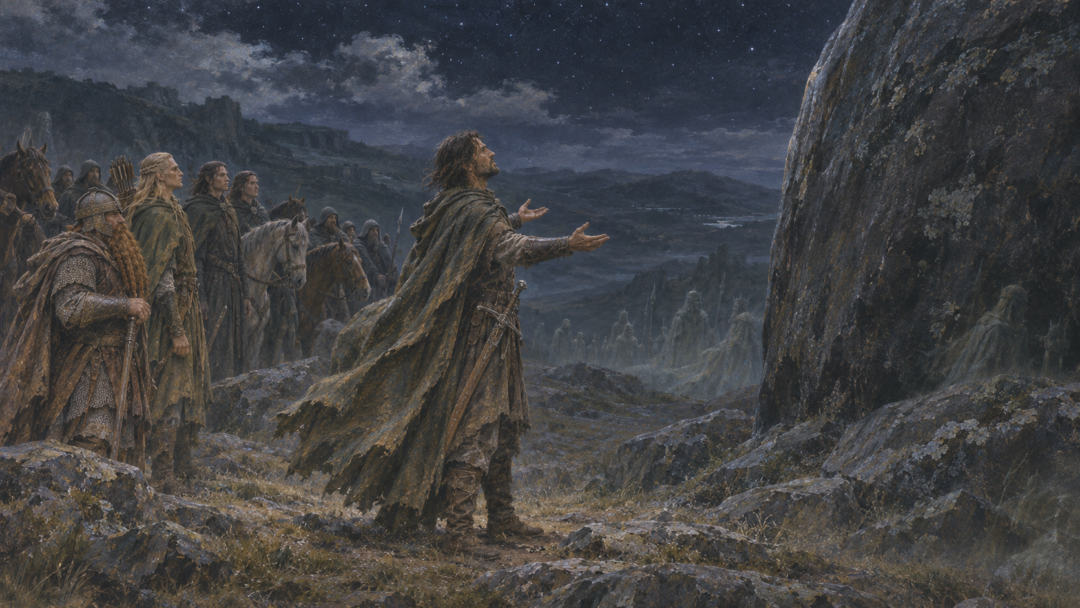
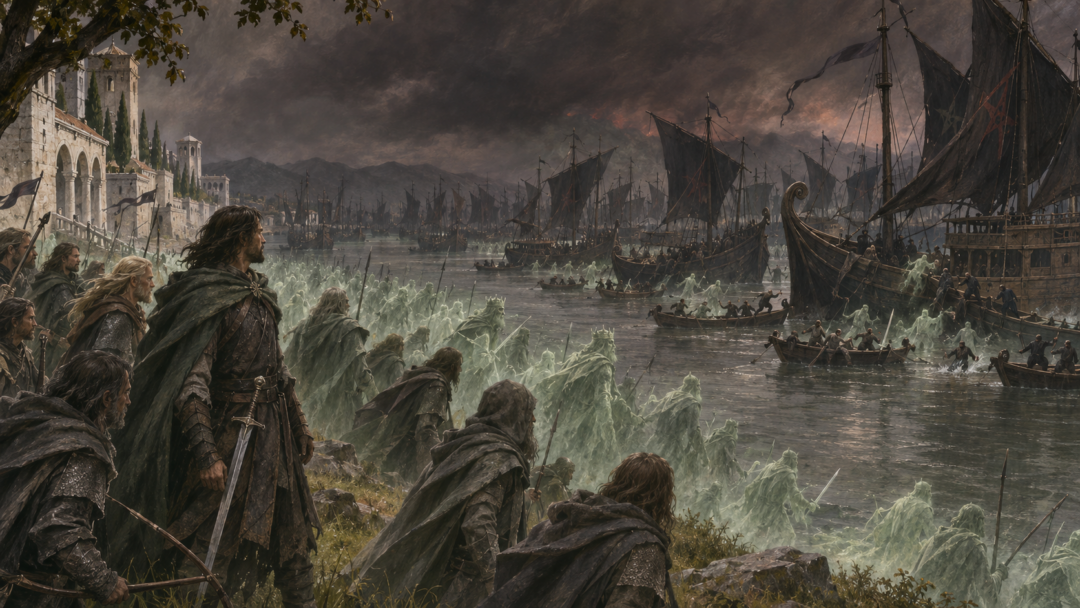
At Erech, Aragorn summons the Oathbreakers, commanding them to fulfil their ancient obligation by assisting him against Sauron’s servants. His intention is to confront the Corsair threat at Pelargir. Gathering the Dead is integral to the expedition, not an unrelated interruption.
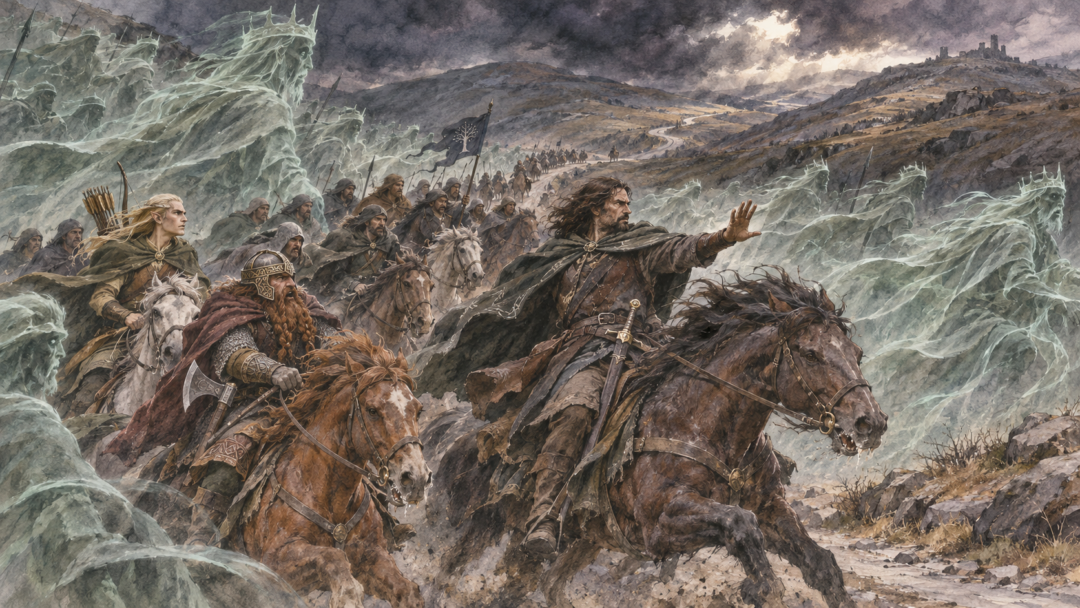
Nevertheless, the spectral army did not necessarily slow the horses. Gimli’s account in The Last Debate explicitly describes the Dead overtaking the mounted company in the uplands of Lamedon, where Aragorn must prevent them from advancing beyond his command.
The Dead are not conventional infantry requiring provisions, sleep or protection from exhaustion. Although Tolkien does not explain every physical property of their manifestation, their movement is clearly not limited to the living riders’ pace.
Their presence depends upon Aragorn’s authority. The expedition is not simply transporting its commander but bringing the power of the fulfilled summons against a particular enemy. Aragorn must direct its employment.
Nothing suggests that he stopped at successive villages to recruit individual ghosts: the decisive summons occurs at Erech. Equally, nothing establishes that dispatching the supernatural host independently to Pelargir would have produced precisely the same result. Tolkien depicts Aragorn leading it himself.
Linhir and Pelargir were military objectives, not waypoints
The strongest evidence against treating the expedition as a simple race appears in Gimli’s account of Linhir. The Men of Lamedon are fighting forces associated with Umbar and Harad near the crossings of the Gilrain. The approaching Dead terrify both sides into flight, with Angbor, lord of Lamedon, the notable exception.
Aragorn instructs Angbor to gather his people and follow towards Pelargir before continuing his advance. Appendix B expressly distinguishes the day spent driving the enemy towards Pelargir from the subsequent capture of the fleet.
These are operational necessities. Aragorn must break the enemy’s offensive, release threatened Gondorian forces and obtain ships capable of carrying reinforcements northwards. Merely reaching Pelargir without securing its vessels would not achieve his strategic purpose.
On 13 March, according to The Last Debate, the company encounters the Corsair fleet, comprising fifty great ships and numerous smaller vessels. The Dead spread terror among the crews, allowing Aragorn to obtain possession of the ships. He subsequently releases the Oathbreakers from their obligation.
The distinction between the Dead and the living reinforcements matters. The spectral host does not accompany Aragorn to fight on the Pelennor. Instead, the captured ships carry living men to relieve Minas Tirith. Gimli describes the subsequent assembly of these forces and the voyage upstream, with the final approach aided by a favourable wind.
This preparation continues beyond Pelargir’s capture and must not be added to the earlier mounted journey. Nevertheless, it demonstrates why the expedition cannot be understood solely in terms of how quickly horses could transport Aragorn from Erech to the Anduin. His destination mattered because of the military resources available there.
Was Aragorn riding as fast as possible?
Tolkien never specifies the horses’ maximum speeds, the availability of replacement mounts, the amount of fodder carried or the number and duration of rests. The published texts consequently cannot establish the expedition’s theoretically fastest achievable journey.
A single rider concerned exclusively with reaching Pelargir might conceivably have arrived earlier. That remains a hypothetical inference, not an established event or a demonstrable measure of Aragorn’s decisions. His company needed to remain effective throughout a campaign; arriving with exhausted mounts or separated companions would not necessarily have served its purpose.
More importantly, the language and chronology of The Last Debate establish urgency. The expedition continues beneath the unnatural darkness spreading from Mordor, confronts the enemy at Linhir and presses towards Pelargir. Nothing indicates leisurely movement or deliberate postponement of the decisive encounter.
The Three Hunters accomplished an extraordinary feat of individual endurance over forty-five measured leagues, followed by a mounted approach to Fangorn. The southern expedition covered ninety-three leagues over a longer period while directing a supernatural host, overcoming enemy resistance and preparing the liberation of Gondor’s southern forces.
Horses enabled Aragorn to travel substantially farther while pursuing his military objectives. Geography influenced his route, but the evidence supports neither blaming terrain alone nor accusing him of riding unnecessarily slowly. His achievement was not reaching Pelargir at the greatest imaginable speed. It was reaching Pelargir in time, with the means to capture its fleet and transform an imminent disaster into the relief of Minas Tirith.
Sources & Notes
This article is based on close reading and interpretation of Tolkien's published works and related source material where relevant.