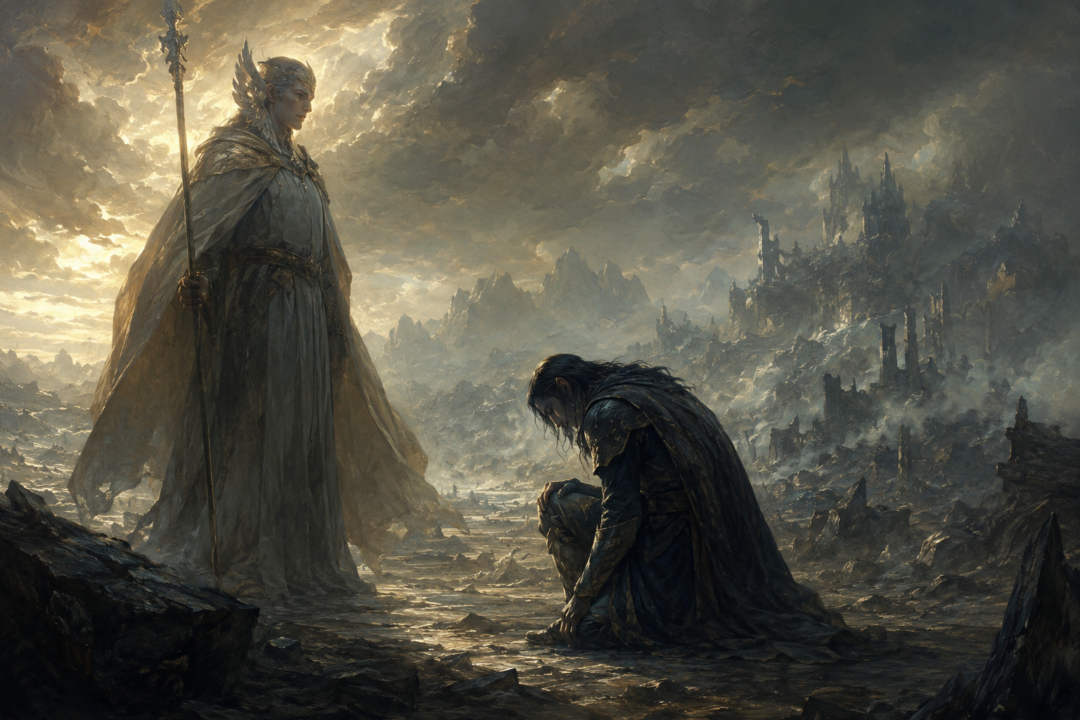
At the end of the First Age, Sauron stands in a position almost impossible to associate with the Dark Lord of later history: defeated, afraid, and apparently asking for mercy.
Morgoth has fallen. Thangorodrim is broken. The power Sauron served for centuries has been overthrown by the Host of the West. And instead of immediately beginning his rise as the next Dark Lord, Sauron approaches Eönwë, herald of Manwë.
He assumes a fair appearance. He makes obeisance. He renounces his evil deeds.
The remarkable part is that the text leaves open the possibility that this repentance was initially genuine, although motivated by fear.
Yet Sauron still does not return to the West.
That distinction reveals something fundamental about his character. Sauron can regret where evil has brought him. He can fear punishment. He can even seek pardon. What he cannot endure is the surrender of his own status and will that genuine submission would require.
His failure begins not because mercy is categorically denied to him, but because he refuses to place himself under judgment.
Sauron After the Fall of Morgoth
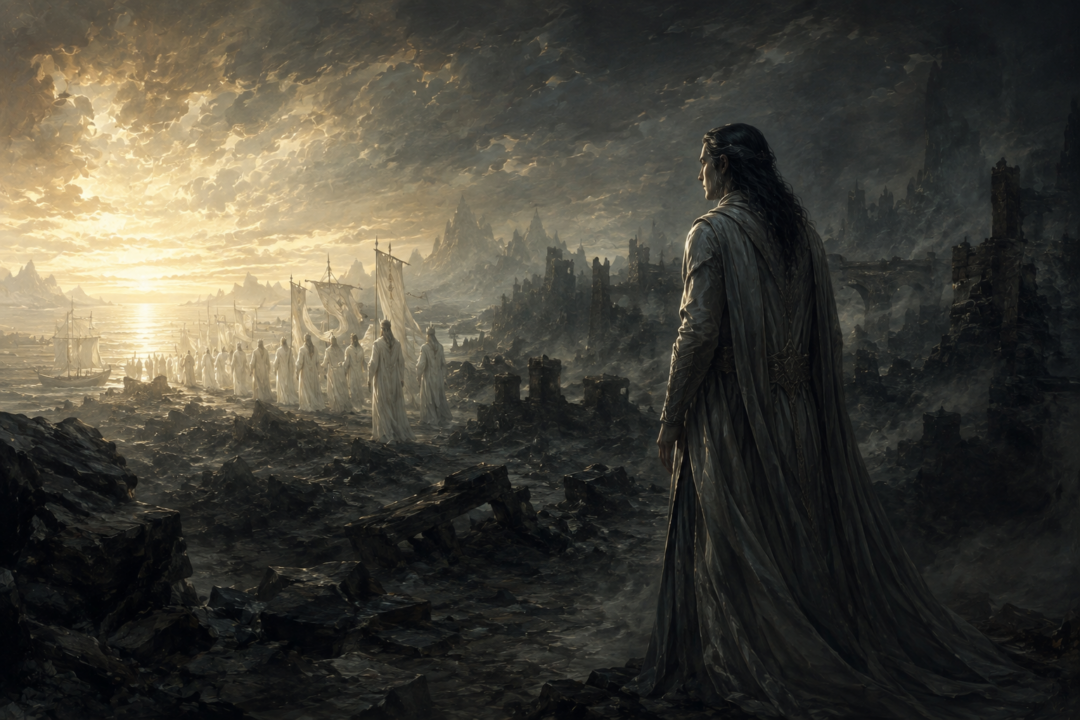
The situation comes after the War of Wrath, when Morgoth's dominion in the northwest of Middle-earth is destroyed.
Sauron had not been merely an incidental servant of Morgoth. In the account later included in Of the Rings of Power and the Third Age, he is described as the greatest and most trusted of Morgoth's servants and exceptionally dangerous because of his ability to change form and appear noble.
But Morgoth's defeat transforms Sauron's circumstances.
The Dark Lord whom he served has been defeated by powers Sauron cannot hope to confront directly. Faced with that catastrophe, Sauron puts on a fair form again and comes before Eönwë.
The text says that he does obeisance and abjures his evil deeds. More importantly, it immediately complicates any simple claim that Sauron was merely pretending.
Some held that his repentance was not initially false.
That qualification matters enormously.
Sauron's later career is built around deception, so it would be easy to read this scene backward and assume that everything he says must be another manipulation. The account does not allow that certainty. It suggests that he may truly have repented, though his repentance arose at least partly from fear after witnessing Morgoth's destruction.
Fear has brought Sauron to the threshold of turning away from evil.
It does not carry him across it.
Eönwë Cannot Simply Pardon Him
Sauron's appeal encounters an important limit.
Eönwë does not possess the authority simply to absolve him.
The text explains that it was not within Eönwë's power to pardon one of his own order. Both Sauron and Eönwë are Maiar, although their loyalties and histories are radically different.
So Eönwë directs Sauron toward the authority whose judgment he must receive: Sauron is commanded to return to Aman and submit to the judgment of Manwë.
This is where the scene changes.
Sauron has approached the victorious representative of the West. He has repudiated his former deeds. But repentance cannot remain merely a declaration made on Sauron's own terms.
He must go back.
He must answer for what he has done.
And he must accept that someone other than himself will determine what follows.
That is precisely what he cannot bear.
The Judgment Sauron Fears
The text gives unusually specific insight into Sauron's hesitation.
He is ashamed and unwilling to return in humiliation. He fears receiving a sentence from the Valar, possibly a long period of servitude through which he would have to demonstrate his good faith.
The passage does not state that such a sentence was certain. It presents long servitude as something that might have been imposed.
That distinction is important. We cannot say exactly what judgment Manwë would have given Sauron.
What we can say is that Sauron refuses even to face the possibility.
And the reason given reaches directly into the psychology of his fall: under Morgoth, his power had been great.
Sauron had possessed enormous authority as Morgoth's chief servant. Submission to judgment would mean abandoning that position entirely. Instead of commanding others, he might have to serve. Instead of deciding what order should look like, he would live under an order imposed upon him.
His repentance therefore collides with pride.
He wants release from the consequences of evil without accepting the humiliation through which his repentance could be tested.
Repentance Is Not the Same as Submission
This is the central tension of the episode.
Sauron may have been sorry.
But sorrow alone does not undo allegiance, domination, or corruption.
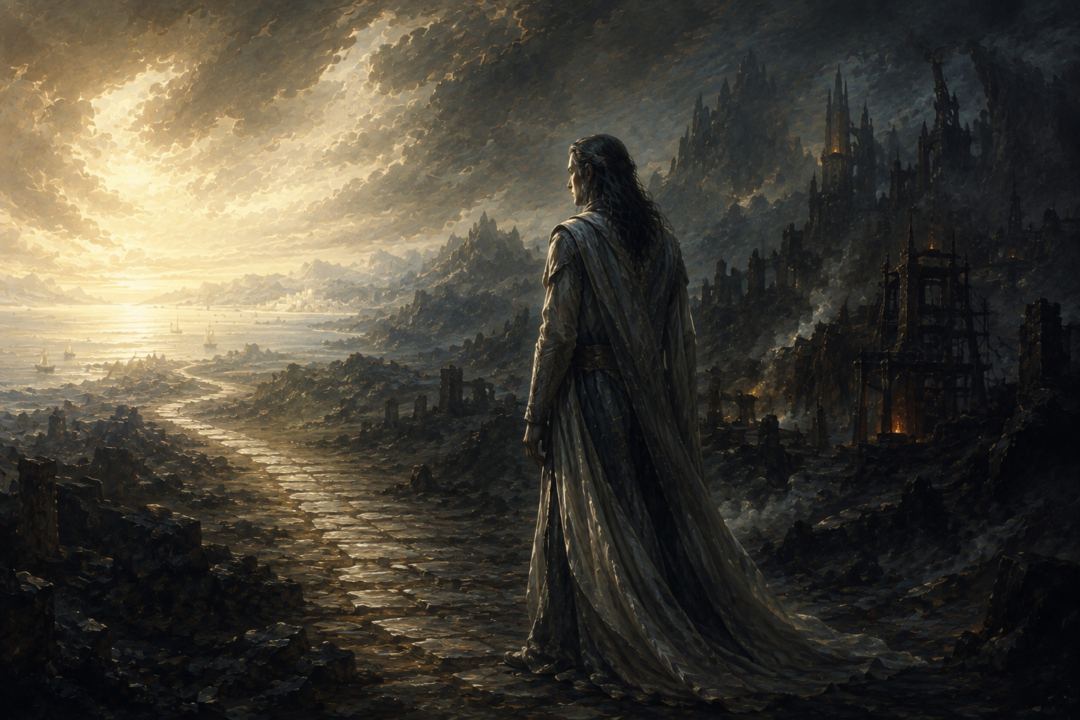
The required next step is obedience: return to Aman and receive judgment.
Sauron refuses.
That refusal makes the episode more tragic than a simple story of a villain pretending to repent. If the account's more generous possibility is accepted, Sauron reaches a genuine moment in which another path remains open to him.
But taking it requires something he increasingly cannot give: control.
The text does not say that Sauron was offered unconditional forgiveness. Nor does it tell us what his ultimate fate would have been had he returned. It tells us that judgment awaited him and that he fled rather than submit to it.
His fear of humiliation becomes stronger than his movement toward repentance.
And so he hides.
Why His Flight Matters
When Eönwë departs, Sauron remains concealed in Middle-earth.
The account then says that he falls back into evil, adding that the bonds Morgoth had laid upon him were very strong.
This should not be simplified into the idea that Sauron lacked agency. The passage has just described a decision: he was commanded to return, and he would not consent.
But it also acknowledges how difficult escape from Morgoth's corruption had become.
Sauron's choice therefore contains both moral responsibility and accumulated bondage. He chooses not to submit, while the habits and attachments formed under Morgoth pull him back toward the kind of power he already knows.
Once he refuses judgment, the alternative available to him is not neutral independence.
It is Middle-earth—and eventually dominion.
The Seed of the Second Dark Lord
Sauron's later actions make this moment especially revealing.
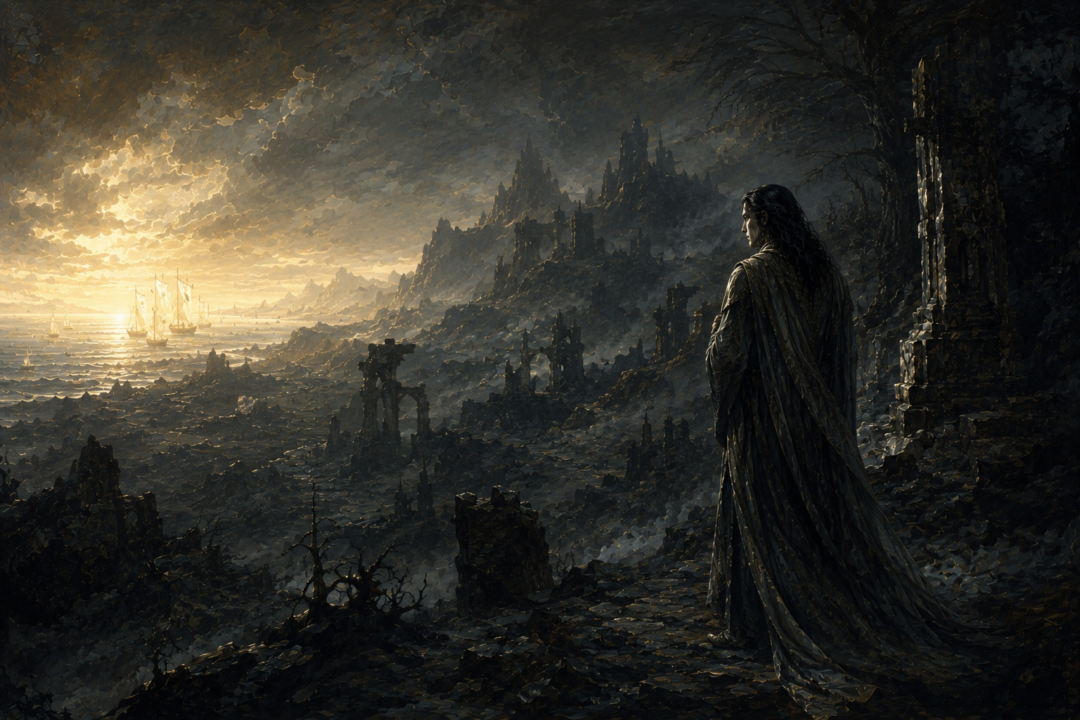
In the Second Age he gradually rises again. He presents himself in a fair guise, deceives the Elven-smiths of Eregion, and ultimately forges the One Ring in an attempt to dominate the bearers of the other Rings.
The scale has changed, but the underlying problem is already visible after the War of Wrath.
Sauron will not accept an order in which his will must be subordinated.
That does not mean the entire Second Age can be reduced to this one scene. His motives develop, and other texts give additional insight into his desire for organization, control, and rule.
But the encounter with Eönwë exposes the contradiction with unusual clarity.
Sauron kneels before authority, yet refuses what that authority requires.
He renounces evil, yet will not surrender the power and pride tied to his former greatness.
He wants pardon, but not judgment.
The Contrast With Morgoth
There is also an important difference between Sauron and his former master.
By the end of the First Age, Morgoth's evil has reached a catastrophic depth. His defeat ends with his removal from the world into the Void.
Sauron's situation after the War of Wrath is different.
He is not immediately treated as simply another Morgoth to be cast out. He is directed toward judgment.
That does not prove what mercy would ultimately have been granted. The text does not reveal Manwë's hypothetical sentence.
But Sauron is given a path that requires him to return rather than hide.
His refusal becomes one of the great turning points between the First and Second Ages.
The future Dark Lord is not shown triumphantly inheriting Morgoth's throne the moment his master falls.
He begins the transition frightened, ashamed, and confronted with a choice.
The Humiliation Sauron Cannot Accept
The word that illuminates the episode is humiliation.
Sauron had been powerful under Morgoth. To return westward as a defeated servant seeking judgment would publicly reverse everything that power had represented.
He would no longer be the great lieutenant dispensing commands from a fortress.
He would be the accused.
That reversal appears intolerable to him.
There is a bitter irony here. By refusing temporary abasement, Sauron eventually creates the conditions for vastly greater ruin.
His attempt to preserve power leads him toward the One Ring, wars against the Elves, the corruption of Númenor, the loss of his ability to assume a fair physical form after Númenor's downfall, and finally the catastrophic defeat of his power when the Ring is destroyed.
The submission he once refused cannot simply be equated with those later disasters; the texts do not present history as such a mechanical equation.
But the contrast is striking.
Sauron will endure almost anything except willingly surrendering mastery.
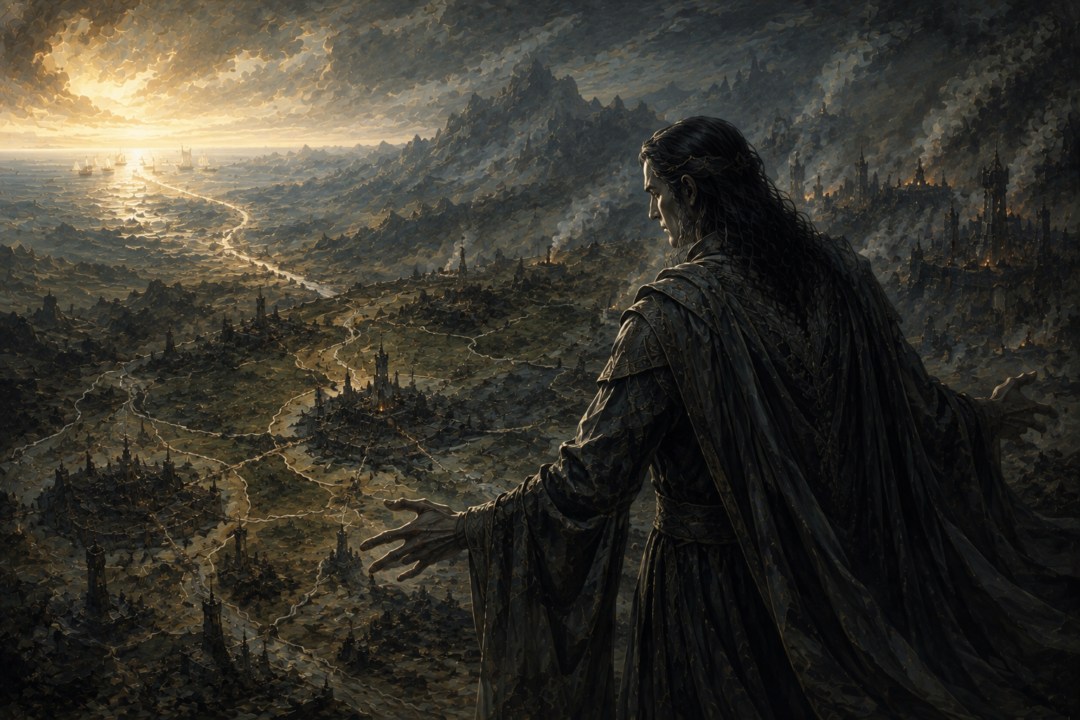
A Dark Lord Who Once Stood at the Threshold
The most disturbing part of Sauron's encounter with Eönwë is that the later Dark Lord does not yet appear completely fixed in the form familiar from the end of the Third Age.
There is still fear in him.
There is shame.
There may even be real repentance.
But repentance demands a next action.
Eönwë cannot grant Sauron the pardon he seeks. He instead points him toward judgment by a higher authority. Sauron must return to Aman, accept whatever sentence is given, and prove that his repudiation of evil is more than words.
Sauron refuses.
He remains in Middle-earth, and the old bonds reassert themselves.
That choice helps explain the Dark Lord he eventually becomes. His deepest problem is not merely that he desires power. It is that he cannot accept a moral order in which his own will is not supreme.
For one brief moment after Morgoth's fall, Sauron bows.
But when bowing must become obedience, he turns away.
And Middle-earth lives with the consequences for thousands of years.
Sources & Notes
- The Encyclopedia of Arda — Sauron: biographical reference covering his service to Morgoth, his surrender to Eönwë after the War of Wrath, and his refusal to return to Aman for judgment — https://www.glyphweb.com/arda/s/sauron.php
- The Encyclopedia of Arda — Eönwë: reference on Manwë’s herald, his leadership of the Host of the West, and his encounter with the repentant Sauron — https://www.glyphweb.com/arda/e/eonwe.php
- The Encyclopedia of Arda — War of Wrath: chronological account of Morgoth’s defeat and the end-of-First-Age setting in which Sauron sought pardon — https://www.glyphweb.com/arda/w/warofwrath.php
- The Encyclopedia of Arda — Manwë: reference on the Elder King whose judgment Eönwë required Sauron to face in Aman — https://www.glyphweb.com/arda/m/manwe.php
Sources document the post-War-of-Wrath encounter, Eönwë’s limited authority, and Sauron’s refusal to submit to Manwë’s judgment.