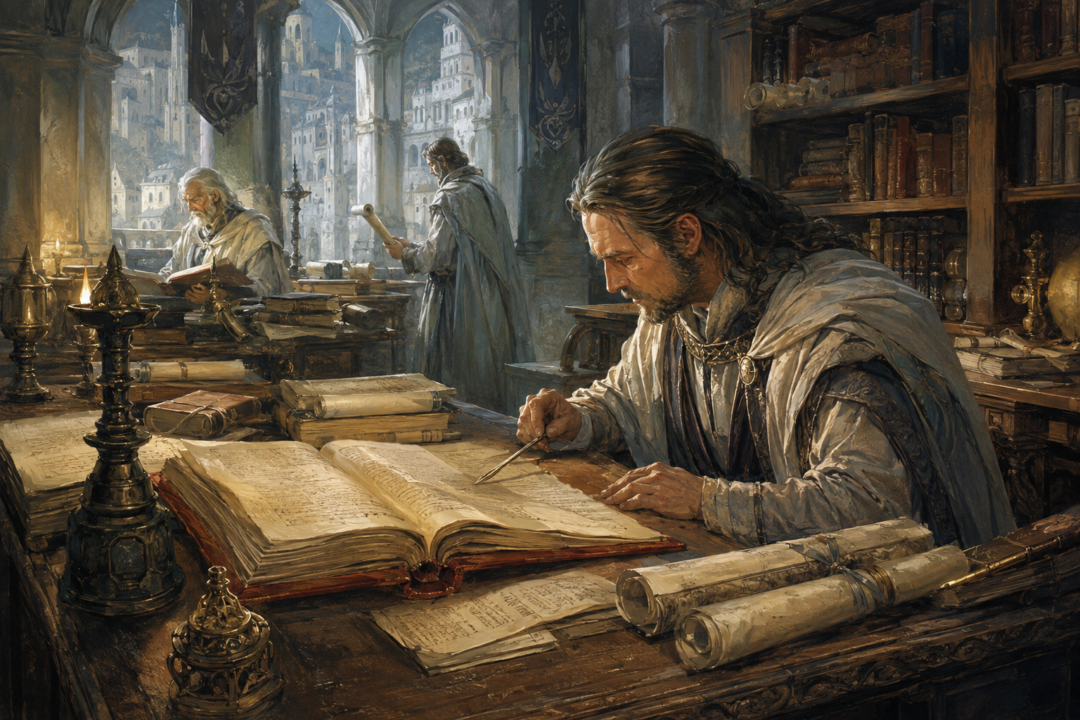
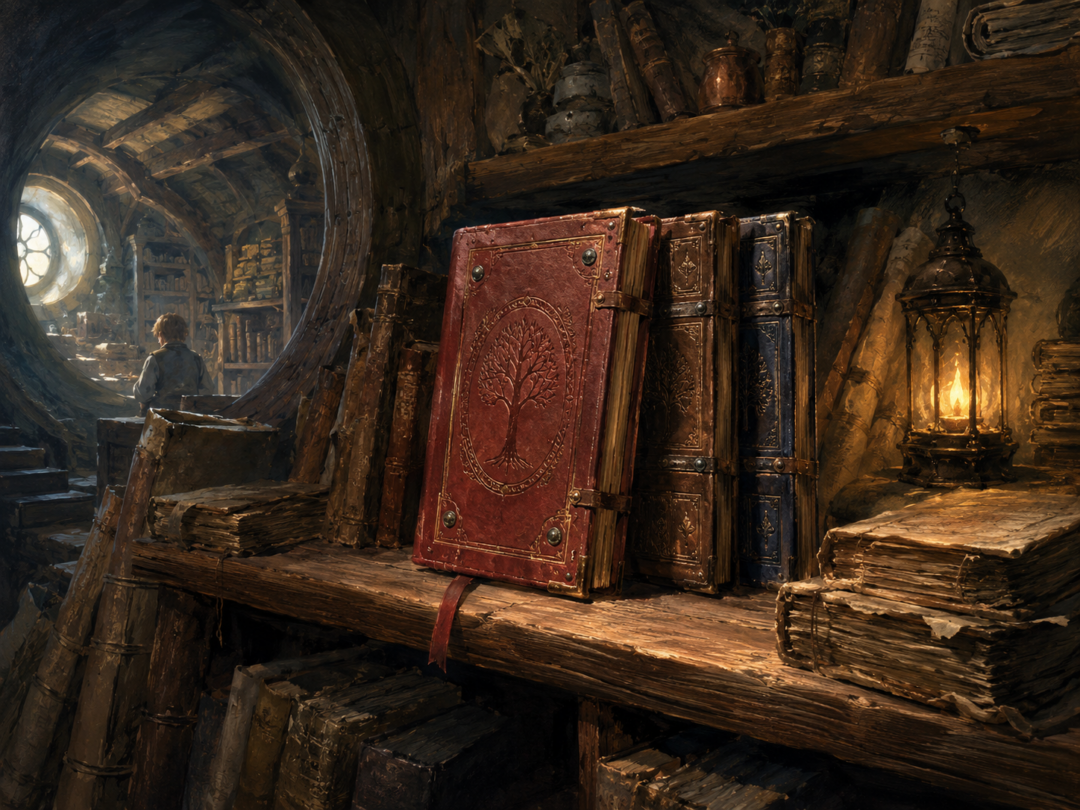
The Red Book of Westmarch seems, at first, like the safest object in Middle-earth.
Swords break. Kingdoms fall. Towers become ruins. Even the Rings of Power pass out of the world. But the hobbits write things down. Bilbo begins his memoirs, Frodo continues the account of the War of the Ring, and the record survives beyond the lives of the people who made it.
Yet the version that matters most to the later textual tradition was not simply Frodo’s original manuscript sitting untouched on a shelf.
It had been copied, carried to Gondor, annotated, corrected, enlarged, copied again, and returned to the Shire.
That sounds like a perfect recipe for scribal corruption.
The surprising part is that Findegil himself is not actually said to have changed the text at all. The crucial alterations happened to the manuscript from which he copied.
That distinction changes how we should understand one of the most intriguing pieces of textual history in Middle-earth.
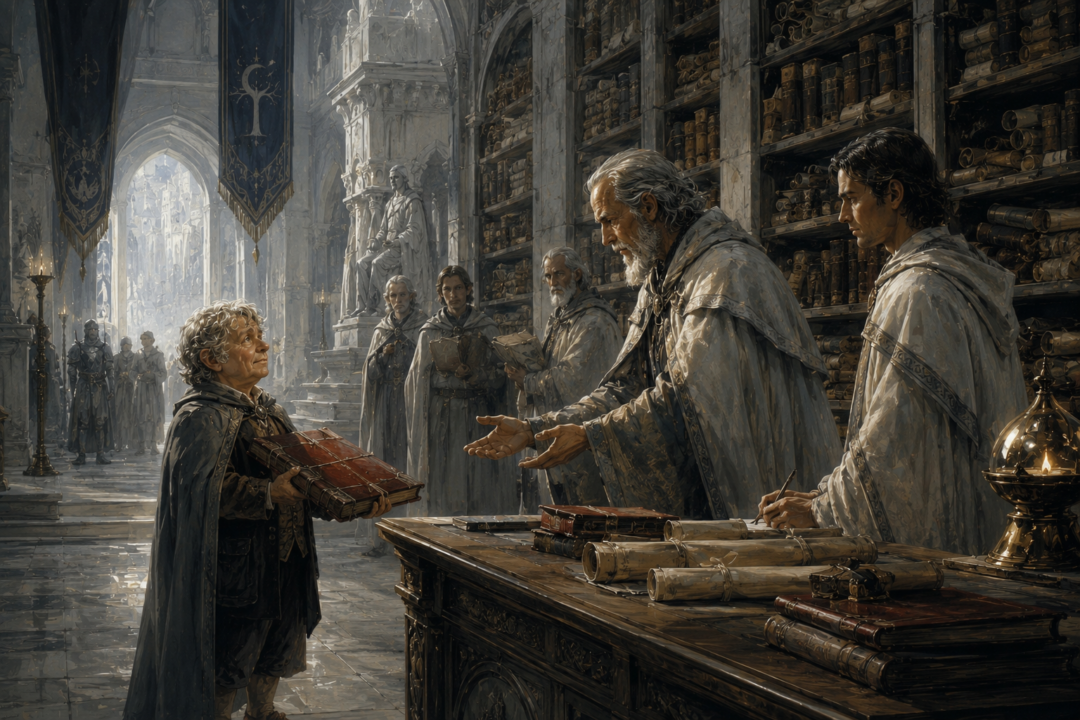
The Red Book Was Already More Than Frodo’s Story
The Red Book began with Bilbo.
His account of the journey to Erebor developed into the memoir associated with There and Back Again. Frodo later inherited Bilbo’s papers and continued the record through the War of the Ring. By the time Frodo departed from the Grey Havens, he entrusted the unfinished book to Sam.
But the material associated with the Red Book extended beyond the main narrative.
Bilbo had also given Frodo three large volumes of his Translations from the Elvish, the result of his years of study in Rivendell. These dealt with the ancient histories and traditions of the Elder Days. A further volume containing genealogies, commentaries, and other material concerning the hobbits of the Fellowship was later associated with the collection in Westmarch.
The original Red Book itself was eventually lost. What survived was a manuscript tradition: copies derived from it, not the physical book in which Bilbo and Frodo had first written their story. The Note on the Shire Records specifically says that many copies were produced, especially copies of the first volume.
And one of those copies became exceptionally important.
King Elessar Asked for a Copy
The manuscript later called the Thain’s Book was the first copy of the Red Book.
According to the transmission history preserved in The Lord of the Rings, it was made at the request of King Elessar. Peregrin Took later brought it to Gondor when he retired there in the Fourth Age.
This matters because the manuscript now crossed a cultural boundary.
The original chronicle had grown largely from hobbit memory and hobbit hands. In Minas Tirith, however, it entered a kingdom possessing its own archives, linguistic knowledge, dynastic traditions, and surviving records of events that stretched far beyond the Shire.
The Thain’s Book therefore did not merely sit in Gondor waiting to be copied.
It was worked on.
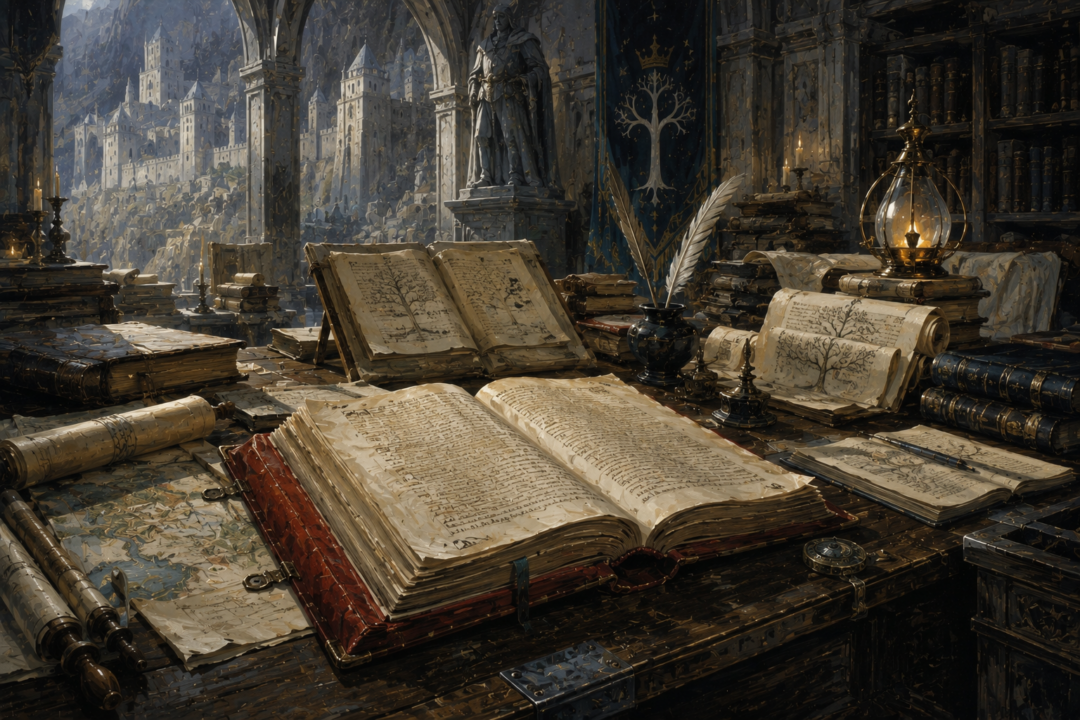
The text explicitly says that in Minas Tirith it received substantial annotation and numerous corrections, particularly involving Elvish names, words, and quotations.
That is the first major answer to the question of what changed.
But it was not Findegil who made those changes—or at least the text never tells us that he did.
The Gondorian Scholars Corrected the Elvish Material
The most clearly identified corrections concern language.
That is significant because the Red Book had been assembled largely by hobbits who had acquired considerable knowledge but were not native speakers of the Eldarin languages.
Frodo knew some Elvish. Bilbo became an unusually learned hobbit through his long association with Rivendell. Sam, Merry, and Pippin all encountered Elvish culture directly. Even so, Gondor preserved learned traditions of its own, and the revised Thain’s Book was evidently checked against better linguistic knowledge available in Minas Tirith.
The corrections are specifically associated with names, individual words, and quotations in Elvish.
We are not given a list of corrected spellings or a table showing earlier and later readings. It would therefore be an invention to claim that any particular Elvish name in the published narrative represents a known Gondorian correction.
What we can say is more interesting.
The textual tradition acknowledges that the hobbits’ record was not treated as infallible.
Its historical testimony could be preserved while its linguistic details were checked and corrected by later scholars.
Middle-earth’s history, in other words, survived partly because later generations were willing to edit their inherited sources carefully rather than merely reproduce their errors.
Gondor Also Added Something the Hobbits Could Not Have Written
The Thain’s Book received more than corrections.
An abbreviated version of portions of The Tale of Aragorn and Arwen was added to it in Gondor. The complete tale is attributed within the tradition to Barahir, grandson of Faramir, and was written after the passing of King Elessar.
This addition changes the character of the manuscript.
The Red Book began as a participant’s record. Bilbo wrote about his own adventure. Frodo recorded events he experienced or reconstructed from the testimony of companions. Sam belonged to the same generation.
The Aragorn and Arwen material represents something different: later historical memory entering the book.
That means the manuscript tradition did not simply move information forward through time. It could also gather new historical material as later events became part of the past.
The Red Book had begun as remembrance.
The Thain’s Book was becoming an archive.
So What Did Findegil Change?
Apparently, nothing.
That is the crucial point.
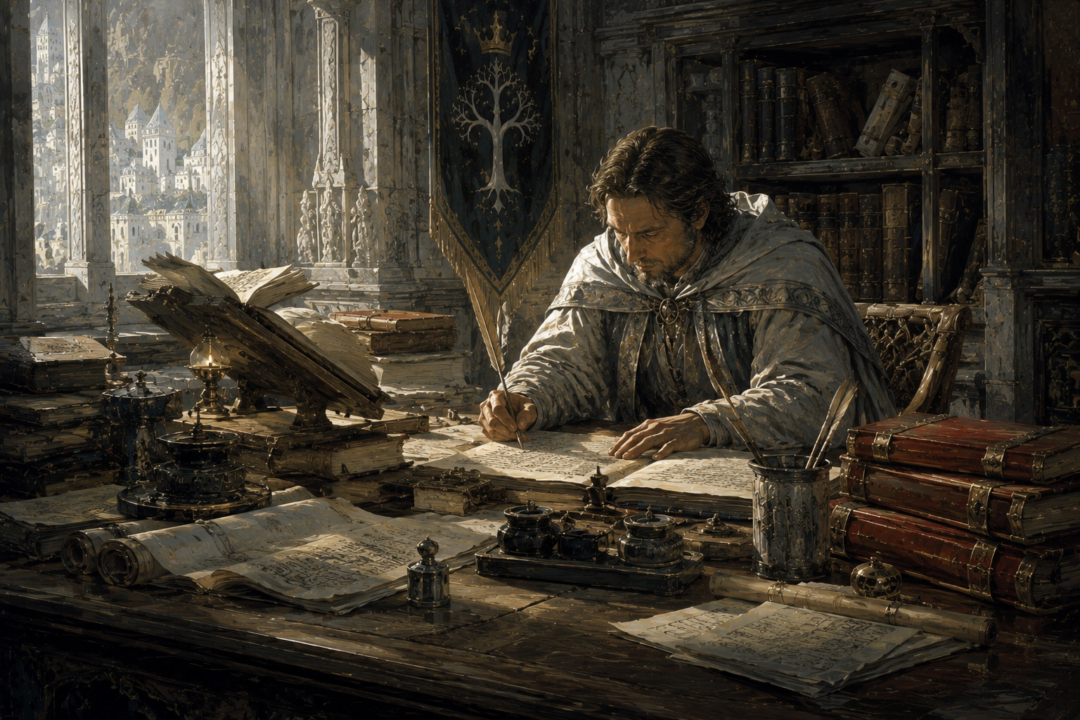
Findegil was the King’s Writer who completed the famous Gondorian copy in Fourth Age 172. His own note describes his manuscript as an exact copy in all details of the Thain’s Book in Minas Tirith.
Taken seriously, that statement means we should not imagine Findegil rewriting Frodo, modernizing Bilbo, polishing passages, or independently correcting the history.
His importance comes from fidelity.
By the time Findegil began copying, the Thain’s Book had already undergone its Gondorian stage of annotation, correction, and supplementation. Findegil’s task was apparently to preserve that developed form accurately.
So there are really two different stages that are easily confused:
Red Book → Thain’s Book: copying followed by later Gondorian annotation, linguistic correction, and additional material.
Thain’s Book → Findegil’s copy: an explicitly described exact reproduction.
The scribal transformation belongs chiefly to the first relationship, not the second.
Findegil Preserved Something Other Copies Lost
There is another reason his manuscript became so important.
The surviving tradition says that Findegil’s copy uniquely preserved the whole of Bilbo’s Translations from the Elvish. These were three substantial volumes created from the written and living sources available to Bilbo during his years in Rivendell.
Other copies of the Red Book apparently concentrated primarily on the narrative of Bilbo and Frodo and did not preserve all of this material.
That reveals one of the quietest dangers in manuscript transmission.
A copyist does not have to alter a sentence to transform what survives.
He can simply leave something out.
A complete collection may become an abbreviated one. An appendix may disappear. A genealogy may no longer seem worth copying. Three cumbersome volumes of ancient Elvish history may be ignored because most readers only want the story of the Ring.
Findegil’s achievement was therefore partly negative: he did not discard what others had failed to preserve.
His fidelity saved material.
“Later Omitted or Lost” Is More Important Than It Sounds
The Thain’s Book is said to have contained much material that was later omitted or lost.
The wording should be handled carefully. We cannot reconstruct everything that disappeared, and we should not invent lost episodes hiding behind familiar chapters.
But the implication is unmistakable: not every descendant of the Red Book contained precisely the same body of information.
That makes the textual history of Middle-earth resemble real historical transmission.
Documents survive unevenly. Some copies are complete; others are abridged. Scholars add notes. Linguistic mistakes are corrected. Later histories enter older collections. Certain branches of the manuscript tradition preserve material that other branches lose.
There is no single magical moment when “the book” becomes permanently fixed.
What survives depends upon custodians.
The Final Irony of the Red Book
The War of the Ring is filled with characters trying to preserve things.
Denethor wants Gondor preserved. The Elves mourn what will vanish with the passing of their Rings. Treebeard remembers creatures and languages already disappearing from the world. Frodo saves the Shire but discovers that he cannot remain fully within the peace he helped create.
The Red Book participates in that same theme on a quieter scale.
Memory survives, but not automatically.
Bilbo gathers lore in Rivendell. Frodo turns suffering into testimony. Sam preserves the book. Elanor and her descendants guard it in Westmarch. A copy reaches Gondor. Scholars correct its linguistic details and add material from their own historical tradition. More than a century later, Findegil reproduces that enriched manuscript with extraordinary fidelity.
The result is neither simply “Frodo’s original book” nor “Findegil’s edited edition.”
It is the product of generations.
And that is the deepest answer to what scribal copying changed.
Findegil’s act of copying was meant not to change the Thain’s Book, but to stop further change from destroying what it contained. The real evolution had already happened around the text: annotations accumulated, Elvish forms were corrected, Aragorn and Arwen’s later history entered the record, and whole bodies of lore survived or vanished depending on which copies were made.
In a world obsessed with the passing of ages, even the story of the Ring survives only because someone, long after its heroes were gone, cared enough to copy every detail.
Sources & Notes
- The Encyclopedia of Arda — Red Book of the Periannath: overview of the manuscript tradition preserving Bilbo’s and Frodo’s records — https://www.glyphweb.com/arda/r/redbookoftheperiannath.html
- The Encyclopedia of Arda — Findegil: reference on the King’s Writer who made the Gondorian copy in Fourth Age 172 — https://www.glyphweb.com/arda/f/findegil.html
- The Encyclopedia of Arda — Thain’s Book: reference for Findegil’s copy and its relationship to the Red Book tradition — https://www.glyphweb.com/arda/t/thainsbook.html
- The Encyclopedia of Arda — Minas Tirith: context for the royal archive where Findegil worked and consulted Gondorian material — https://www.glyphweb.com/arda/m/minastirith.html
Sources document the key people, places, institutions, and chronology used in this interpretation.