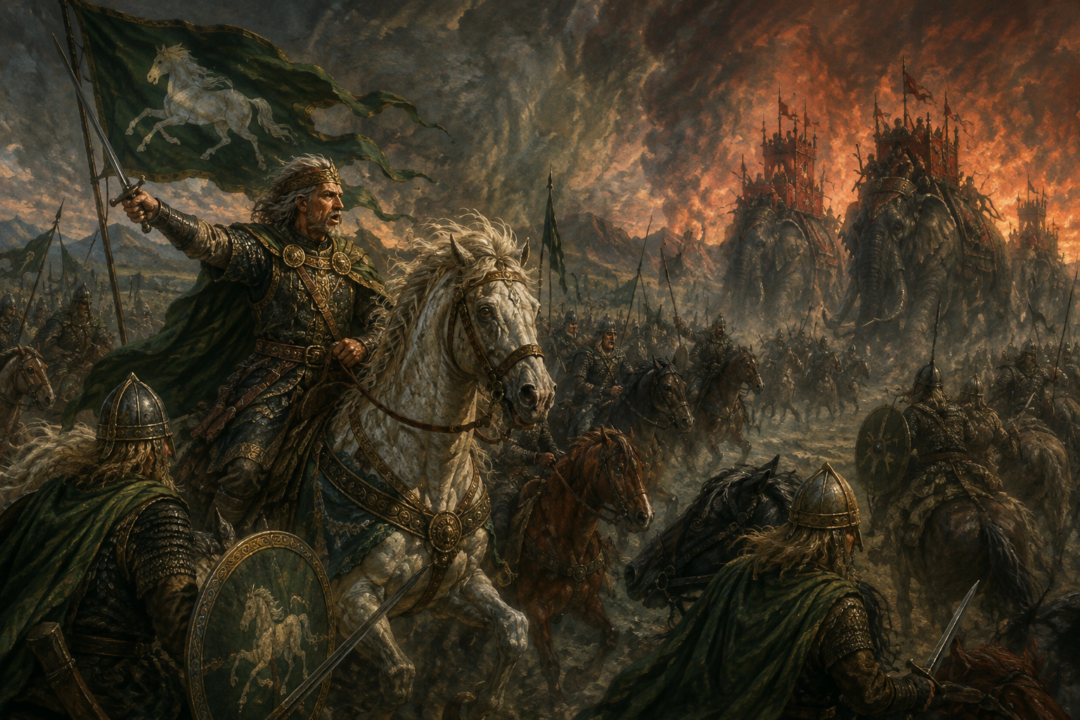
There is a brief moment on the Pelennor Fields when Théoden sees something that should make a cavalry commander turn away.
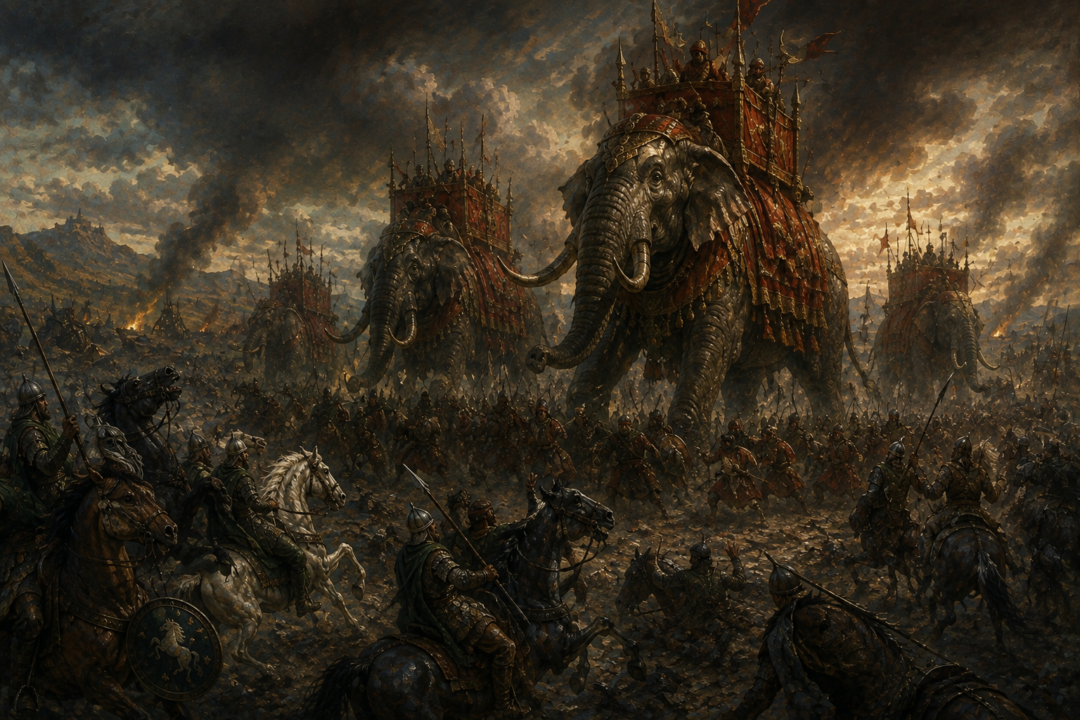
The Riders of Rohan have already smashed into Sauron’s forces. Then the Mûmakil of Harad appear: enormous war-beasts carrying fighting towers, advancing through the battlefield like moving fortresses. Théoden’s riders recoil. Horses scatter. The ordered momentum of the Rohirrim begins to break.
And Théoden’s answer is immediate: he orders the line formed again and sends his Riders forward.
It is one of the clearest expressions of his restored kingship—but there is an important distinction. The command to “reform the line” before charging the Mûmakil belongs to the film adaptation, not to the corresponding event in the novel. In the book, Théoden does not lead a head-on cavalry assault against the Mûmakil. Indeed, the text presents those beasts as something the horses of Rohan cannot effectively approach. Daily Script
Yet the scene is still worth examining beside the book, because its deeper logic draws on something thoroughly consistent with Théoden’s final transformation: when terror threatens to turn an army into individuals, the king makes them a people again.
The Line Is More Than a Formation
“Reform the line” sounds like a tactical command, and on the simplest level that is exactly what it is.
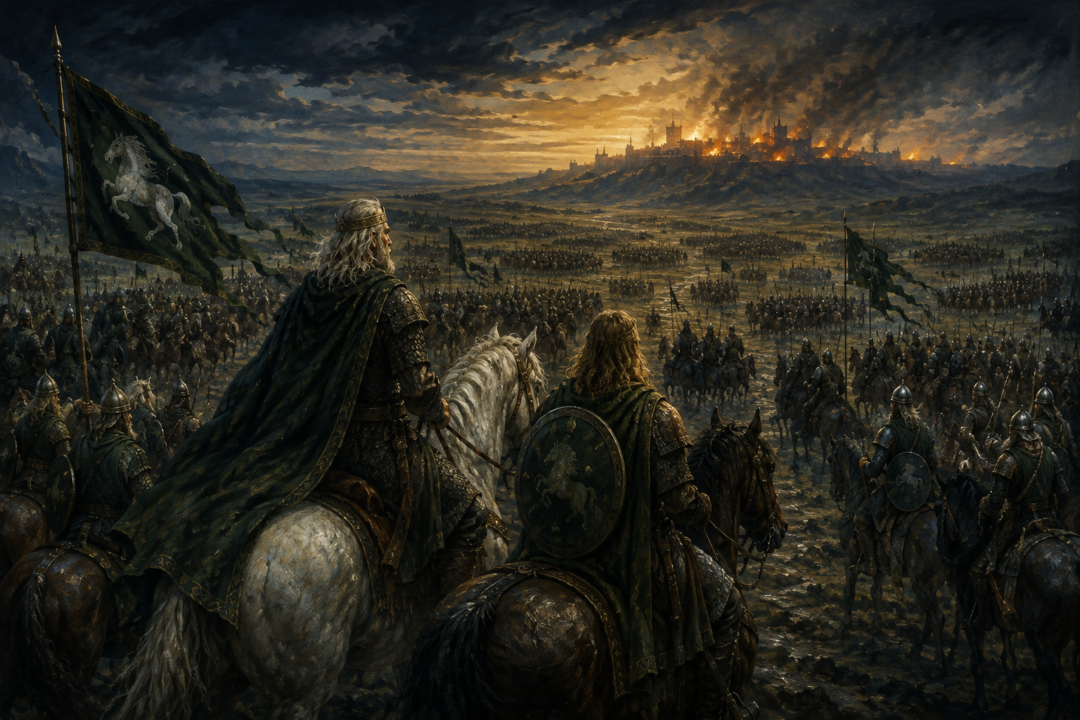
A cavalry force depends upon cohesion. Individual riders scattered across a battlefield lose much of the force that comes from moving together. In the film sequence, the Mûmakil do not merely threaten the Rohirrim physically; their appearance disrupts the Riders psychologically. The sight of them produces hesitation and disorder.
Théoden’s first task is therefore not to defeat the beasts.
It is to restore the Rohirrim.
That distinction matters. He does not begin with an elaborate new plan. He gives his shaken men something immediate and comprehensible to do: return to formation.
The command turns fear into action.
It also recreates hierarchy. Théoden is still king. The horn can still sound. The Riders can still answer. The enemy has changed, but Rohan has not yet ceased to be an army.
This reflects a broader pattern in Théoden’s story. His restoration in Edoras is not simply about becoming physically vigorous again. He resumes command, takes up Herugrim, restores Éomer, rides to war, and begins making decisions for his kingdom after a period in which Wormtongue’s influence had encouraged paralysis and withdrawal.
The opposite of Théoden’s decline is therefore not merely strength.
It is decision.
The Book Gives Théoden an Even More Deliberate Battle Plan
The novel’s arrival of the Rohirrim at the Pelennor Fields is less improvised than the famous cinematic charge can make it appear.
Before the attack, Théoden organizes his host for battle. Grimbold commands riders on one side, Elfhelm another division, while the king rides with Éomer in the central force. The Rohirrim are not simply six thousand horsemen released in one enormous wave; they enter the battle under established commanders with different parts of the field assigned to them.
I Am Pierre Menard
Then the psychological transformation occurs.
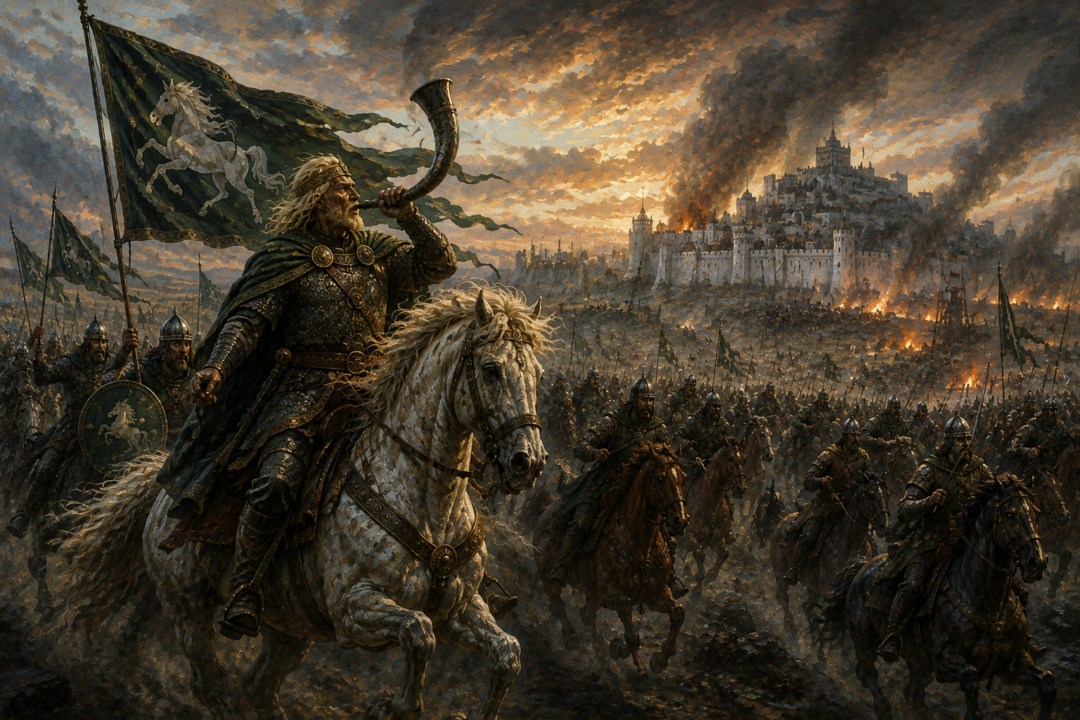
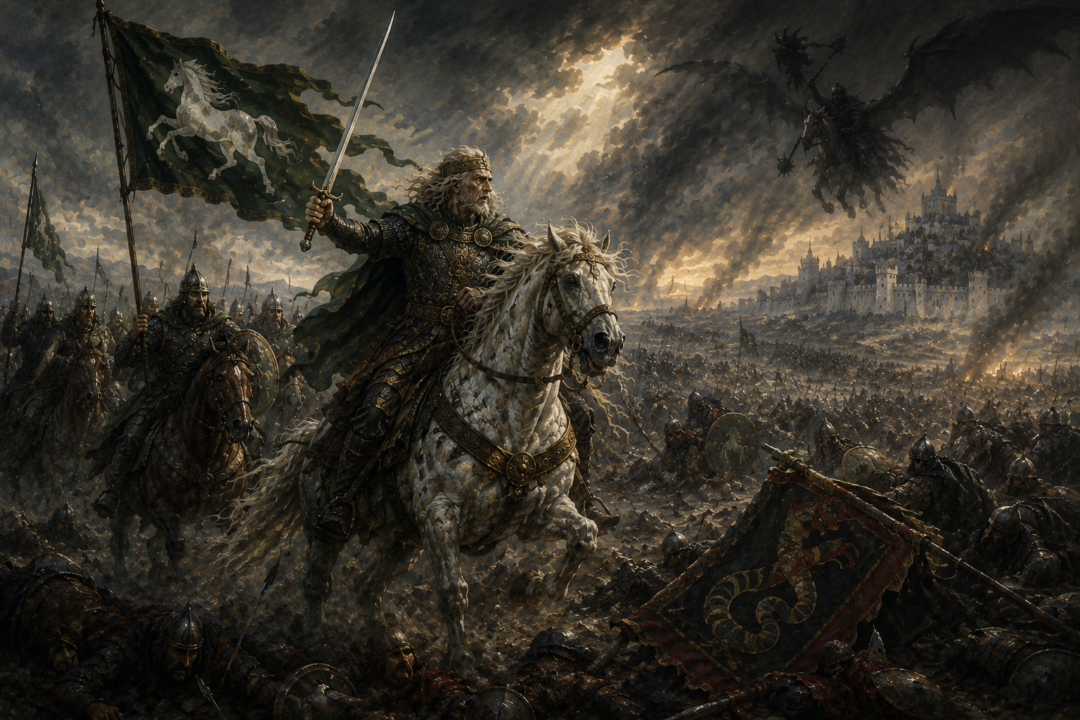
Minas Tirith is burning before them. The battle seems catastrophic. Yet Théoden suddenly appears renewed by the moment. He calls his Riders to battle, blows a horn so fiercely that it breaks, and races ahead beneath the royal banner. His charge strikes the northern portion of the besieging army with devastating force.
This is crucial to understanding the later adaptation.
Théoden’s greatness at the Pelennor is not that he discovers some secret maneuver capable of guaranteeing victory. His greatness is that, when the decisive moment arrives, he becomes the organizing center of the Rohirrim.
The army moves because the king moves.
That is much closer to the heart of the scene than any technical discussion of cavalry tactics.
Why Charging the Mûmakil Is Different in the Book
The film transforms the Mûmakil into the target of a second great Rohirrim charge.
The book does almost the opposite.
After Théoden’s initial success, the Mûmakil become powerful defensive centers for Sauron’s forces. The horses of the Rohirrim fear them and cannot readily be driven against them. Enemy soldiers gather around the great beasts because cavalry cannot easily penetrate those positions.
That difference substantially changes the meaning of the battle.
In the film, Théoden sees an almost impossible obstacle and chooses to attack it directly.
In the novel, the Mûmakil demonstrate that even the spectacular arrival of the Rohirrim has limits. Rohan’s greatest military advantage—its horses—cannot simply solve every problem on the field.
That makes the battle larger than Théoden.
His charge is magnificent, but it does not single-handedly win the Pelennor. Théoden routs enemies in the north and personally encounters the mounted forces of Harad, but major enemy formations remain. Minas Tirith is not yet fully relieved, and the battle continues after his fall. ESL Bits
The difference is important because it prevents courage from becoming magical invulnerability.
The Rohirrim are brave.
They are not unstoppable.
Théoden Has Already Learned What Hesitation Costs
There is another reason the film’s “reform the line” moment feels appropriate for Théoden even though the specific action is invented for the adaptation.
His entire late story is shaped by lost time.
When Gandalf arrives at Edoras, Théoden has been reduced to an aging king surrounded by counsel that discourages action. His son Théodred is already dead. Saruman’s war is already consuming Rohan. Éomer has been estranged from the court.
Once Théoden returns to active kingship, his behavior changes dramatically. He rides west. He fights at the Hornburg. He confronts Saruman at Isengard. When Gondor calls for aid, he musters the Mark and rides south.
Théoden does not become reckless in the book. He listens to counsel and makes plans.
But he no longer allows fear to choose in his place.
That is the deeper continuity behind the adaptation’s Mûmakil scene.
The sight before him is terrible. His reaction briefly reveals that he understands exactly how terrible it is. Then he commands.
The important transition is not from ignorance to bravery.
It is from fear to duty.
The Rohirrim Fight as a Community
Rohan’s military identity also helps explain why re-forming the Riders carries symbolic weight.
The Rohirrim are not portrayed as anonymous professional soldiers detached from their society. Their martial culture is deeply connected with their horses, their lords, their households, their ancestry, and loyalty to the House of Eorl. Théoden’s battle cry addresses them personally as his Riders, and the royal banner travels with the king into battle.
Formation therefore represents more than geometry.
When frightened riders return to the line, they are accepting again that they will face danger together.
That is one reason the horn matters throughout these scenes. A horn can be heard where an individual voice cannot. It gathers scattered attention into one command. At the Pelennor in the novel, Théoden takes the horn of Guthláf, his banner-bearer, and sounds the beginning of the assault before racing forward. Thain's Book
The king, banner, horn, riders, and horses become one moving body.
The film’s second formation repeats that visual language after it has temporarily collapsed.
Théoden Does Not Need to Believe He Will Survive
The most powerful reading of the moment is therefore not that Théoden knows charging the Mûmakil will work.
Nothing in the scene requires that conclusion.
His earlier choices already establish that survival is not the standard by which he measures whether an action must be taken. At Dunharrow, the forces available to him are fewer than hoped, yet he still rides to Gondor. In the novel, roughly six thousand Riders ultimately reach the Pelennor—an immense force, but one entering a battle already dominated by Sauron’s armies.
Théoden’s task is not to guarantee the ending.
It is to fulfill the obligation of the Mark.
That distinction is central to his final greatness.
For much of his introduction, Théoden is a king whose choices have been narrowed by fear, age, grief, manipulation, and the apparent strength of his enemies. At the Pelennor, none of those external dangers has disappeared. Sauron is stronger than ever. Minas Tirith is nearly broken. Théoden is still an old man riding into one of the greatest battles of the Age.
What has changed is Théoden.
He has recovered the ability to act even when action carries terrible cost.
The Tragedy Is That His Courage Does Not Make Him Immortal
Théoden’s charge ends not in personal triumph but death.
In the novel, after driving through the enemy and defeating the chieftain of the Haradrim beneath the Black Serpent standard, Théoden is struck down when the Lord of the Nazgûl descends upon him. Snowmane falls and crushes his master. Éowyn and Merry then confront the Witch-king.
That ending prevents Théoden’s story from becoming a simple tale of restored strength rewarded by victory.
He recovers his kingship only to spend it.
His final days are valuable precisely because he uses them.
That is why the command to reform the line resonates beyond the mechanics of the film scene. It compresses Théoden’s entire late character arc into a few seconds.
Disorder has returned.
Fear has returned.
A greater enemy has appeared.
The king does not pretend otherwise.
He simply refuses to become the helpless man he once was.
The book handles the Mûmakil differently and never gives Théoden this particular command. But the deeper idea remains recognizably aligned with his final role on the Pelennor: when others begin to scatter beneath the weight of terror, Théoden becomes the point around which courage can form again.
He cannot promise his Riders that the line will survive.
He can only form it.
And then ride at its head.
Sources & Notes
- The Encyclopedia of Arda — Théoden: biographical reference covering the king’s command of the Rohirrim at the Pelennor — https://www.glyphweb.com/arda/t/theoden.html
- The Encyclopedia of Arda — Pelennor Fields: geographical context for the charge and battlefield formation outside Minas Tirith — https://www.glyphweb.com/arda/p/pelennor.html
- The Encyclopedia of Arda — Battle of the Field of Gondor: account of the battle in which Théoden reorganized and led the Riders — https://www.glyphweb.com/arda/b/battleofthefieldofgondor.html
- The Encyclopedia of Arda — Rohirrim: overview of the cavalry force and military society under Théoden’s command — https://www.glyphweb.com/arda/r/rohirrim.html
Sources document the key people, places, institutions, and chronology used in this interpretation.