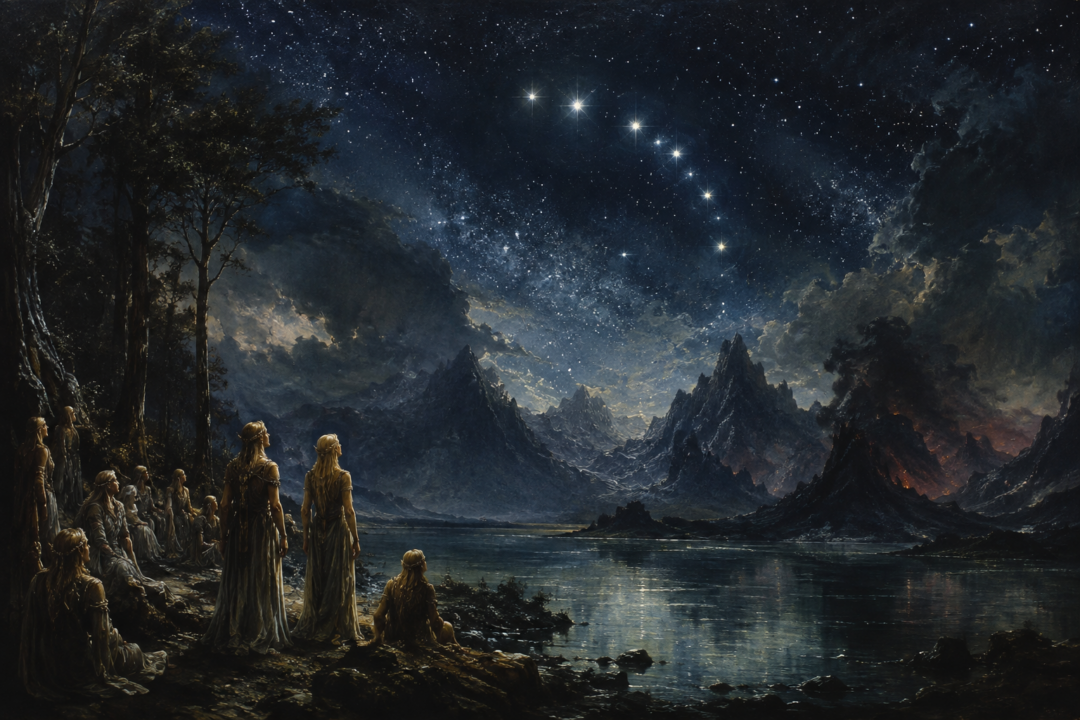
Look north in Middle-earth and one of its oldest histories is still hanging in the sky.
The seven stars called Valacirca—the Sickle of the Valar—are easy to treat as another beautiful piece of celestial lore. Hobbits know the same recognizable star-pattern as the Wain, and Frodo sees the Sickle shining above Bree during his journey east. But its oldest meaning is far more severe.
Varda set those seven stars in the northern heavens as a challenge to Melkor and a sign of his doom.
That makes the Sickle something unusual in Middle-earth. It is not merely a constellation associated with an ancient event. It was deliberately made into a sign before the event it signifies had happened.
The Sickle therefore stands at the intersection of memory, prophecy, and history. It remembers the beginning of the struggle against the Shadow, announces that the Shadow will ultimately fail, and remains visible long after the first Dark Lord has fallen.
A Sign Placed Before the Firstborn Awoke
The origin of Valacirca belongs to an extraordinarily ancient period of Arda.
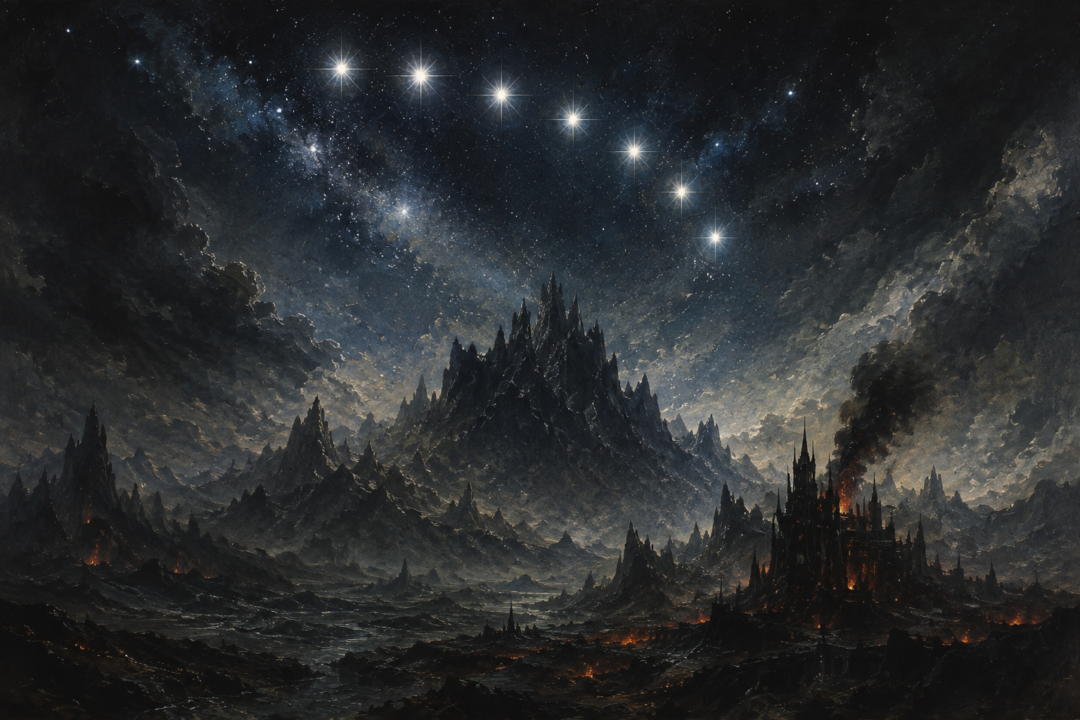
In The Silmarillion, Varda undertakes a great labor of making and ordering stars before the awakening of the Elves. Among the constellations she sets in the heavens is Valacirca, the Sickle of the Valar: seven mighty stars placed high in the north as a challenge to Melkor and a sign of doom.
The direction matters.
Melkor had established himself in the north of Middle-earth, with Utumno as the great stronghold of his early power. The Sickle is therefore not presented as an abstract warning scattered somewhere among the stars. It is deliberately associated with the northern sky.
The heavens themselves appear to answer the darkness below.
This occurs before the Elves awaken at Cuiviénen. When the Firstborn open their eyes, they do so beneath stars newly kindled or ordered by Varda. Their earliest experience of the world is consequently connected with starlight, explaining in part why Varda becomes especially beloved among the Eldar.
Valacirca belongs to that first sky.
Its historical significance begins there: before Elves had kingdoms, before Men had awakened, before the Sun and Moon crossed the heavens, the opposition between the Valar and Melkor had already been given a visible sign.
Why a Sickle?
The name Valacirca is Quenya: the Sickle of the Valar.
The texts do not give us permission to construct an elaborate hidden doctrine around the agricultural meaning of the sickle. It would therefore go too far to claim that the constellation explicitly represents Melkor being “harvested” or cut down in some precisely defined symbolic scheme.
What can safely be said is simpler and stronger.
Its shape is understood as a sickle, and the constellation is explicitly a challenge to Melkor and a sign of doom.
The image therefore has an unmistakably threatening character. This is not merely a crown of decorative lights. The curved stellar figure bears the name of a cutting implement, while its stated purpose concerns the downfall of the greatest rebel in Arda.
Yet its threat is expressed without movement.
Valacirca does not descend from heaven and strike Utumno. It does not function like a weapon in battle. It simply remains overhead.
That distinction is important. Its power as a historical sign comes precisely from its permanence. Melkor may build fortresses, corrupt creatures, wage wars, and dominate enormous regions of Middle-earth, but above those changing circumstances hangs a sign that his apparent mastery is not the final truth about history.
A Memory That Existed Before the Event
Usually monuments are raised after victories.
Valacirca reverses the pattern.
The sign of Melkor’s doom is established while Melkor is still powerful. The victory it represents has not yet been achieved. Indeed, an immense amount of suffering still lies ahead.
Utumno will eventually be broken and Melkor captured, but he will return to evil. The Two Trees will be destroyed. The Silmarils will be stolen. Finwë will be slain. The Noldor will rebel and return to Middle-earth. Beleriand will endure centuries of war before Morgoth is finally defeated in the War of Wrath.
Seen from within that history, the Sickle becomes more than a prediction of one military defeat.
Its presence insists upon a distinction between temporary power and ultimate outcome.
Morgoth can win battles. He can destroy kingdoms. He can inflict losses that cannot simply be undone. The existence of Valacirca does not mean that history will be painless or that evil is incapable of genuine devastation.
It means that domination is not the same thing as final victory.
That is why the constellation can function simultaneously as prophecy and memory. Once Morgoth has fallen, the ancient sign remains. What once pointed forward can now point backward as well.
The warning becomes a memorial.
Beren Turns the Sign Into Defiance
One of the most revealing later appearances of the Sickle comes in the tale of Beren and Lúthien.
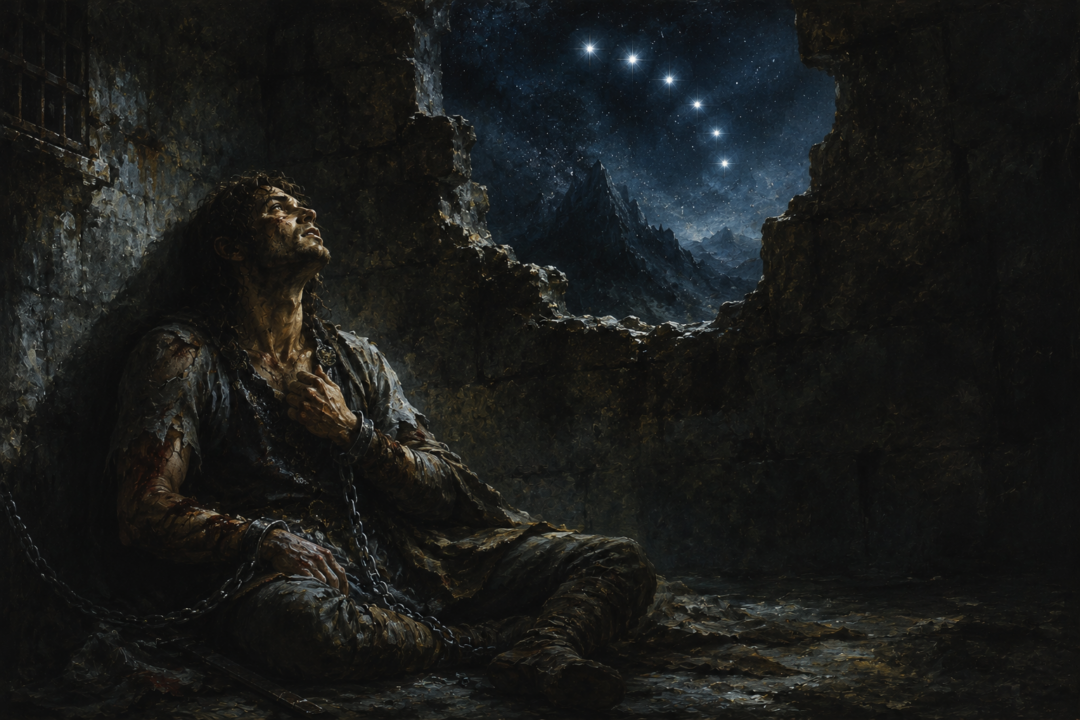
After Beren is captured and brought into Sauron’s power on Tol-in-Gaurhoth, his companions are killed one after another. Beren survives in darkness until he hears Lúthien singing.
He answers her with a song of challenge praising the Seven Stars—the Sickle of the Valar that Varda had placed above the North as a sign for Morgoth’s fall.
The choice is striking.
Beren is imprisoned by Sauron, Morgoth’s greatest servant. He has little reason, judged by his immediate circumstances, to feel triumphant. His companions are dead. He is trapped in the enemy’s fortress. His own strength is almost exhausted.
Yet the symbol he invokes is older than Sauron’s tower and older than Morgoth’s rule in Beleriand.
Beren cannot prove his hope from what surrounds him. He instead reaches toward a history larger than his prison.
The Sickle therefore functions here almost like inherited resistance. Its meaning has passed from the cosmic ordering of the world into song, and from song into the consciousness of someone facing the Shadow directly.
The sign has become usable history.
The Same Stars Above Bree
Thousands of years later, the constellation still appears.
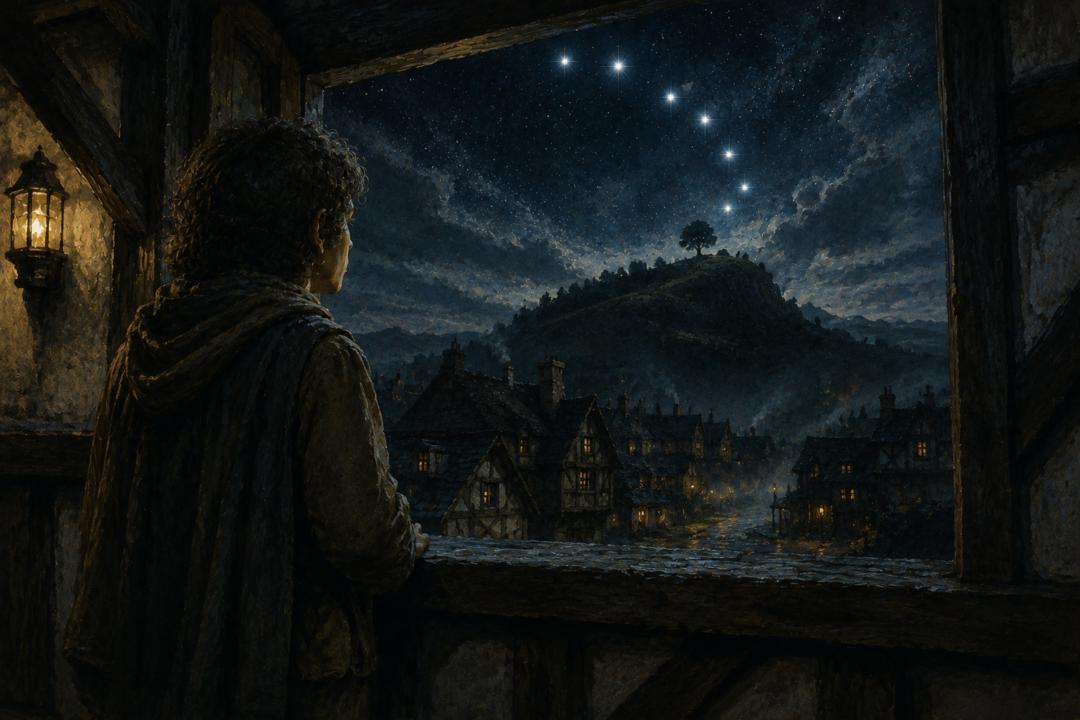
In The Fellowship of the Ring, Frodo looks from Bree and sees the Sickle swinging above Bree-hill.
The passage does not stop to retell the ancient story of Varda and Melkor. That restraint makes the moment more interesting, not less.
Frodo is living beneath the same stars.
By the Third Age, Morgoth has been cast out of the world, Beleriand has vanished beneath the sea, Númenor has risen and fallen, and Sauron has become the immediate Dark Lord threatening Middle-earth. The political geography of the world has changed almost beyond recognition.
Valacirca has not.
For readers who know its older history, the sight creates a remarkable continuity between ages. Frodo’s frightened journey through Eriador takes place beneath a sign first established before the awakening of the Elves.
The ancient struggle and the present struggle are not identical. Sauron is not Morgoth, and the text does not explicitly redefine Valacirca as a prophecy specifically concerning Sauron’s defeat.
But the historical resonance is difficult to miss.
Another Shadow has grown powerful. Another Dark Lord seems almost impossible to overthrow. And the ancient sign of the first Dark Lord’s doom is still turning in the northern sky.
One Sky, Different Memories
The constellation also illustrates how Middle-earth’s peoples inherit history differently.
The Elvish name Valacirca preserves its relationship with the Valar. Elsewhere the seven-star pattern is called the Sickle, while the familiar northern constellation is also known as the Wain.
That difference matters.
A person does not need to know the complete ancient history of an object for that object to survive into a later culture. Names change. Explanations fade. Myth becomes ordinary vocabulary.
Yet the stars remain.
This is one of the recurring patterns of Middle-earth: later peoples inhabit landscapes—and even skies—whose deepest meanings precede them.
A hobbit can recognize a constellation without necessarily carrying the same cultural memory that an Elf might attach to it. The physical sign survives even when knowledge of its first significance becomes uneven.
Valacirca is therefore not merely preserved history. It demonstrates how history becomes layered.
One people sees the Sickle of the Valar.
Another sees the Wain.
Both are looking at the same seven stars.
The Sickle Does Not Promise an Easy Victory
There is an important limit to the symbol.
Valacirca should not be read as evidence that everything in Middle-earth is predetermined in a simple sense, nor as a guarantee that those who oppose evil will personally survive.
The history following its creation is much too tragic for that.
The Elves suffer enormously. Entire realms disappear. Heroes die. Beleriand itself is broken. Even Morgoth’s eventual overthrow requires catastrophic war.
The sign of doom does not eliminate moral choice, sacrifice, or consequence.
Instead, it places evil’s power inside a larger horizon.
Morgoth’s defining ambition is domination: the attempt to make the world answer to his own will. Valacirca silently contradicts that ambition. There remains something above his fortresses that he did not command, bearing a meaning hostile to his claim of mastery.
This is perhaps the Sickle’s deepest historical function.
It does not say that darkness is unreal.
It says darkness is not sovereign.
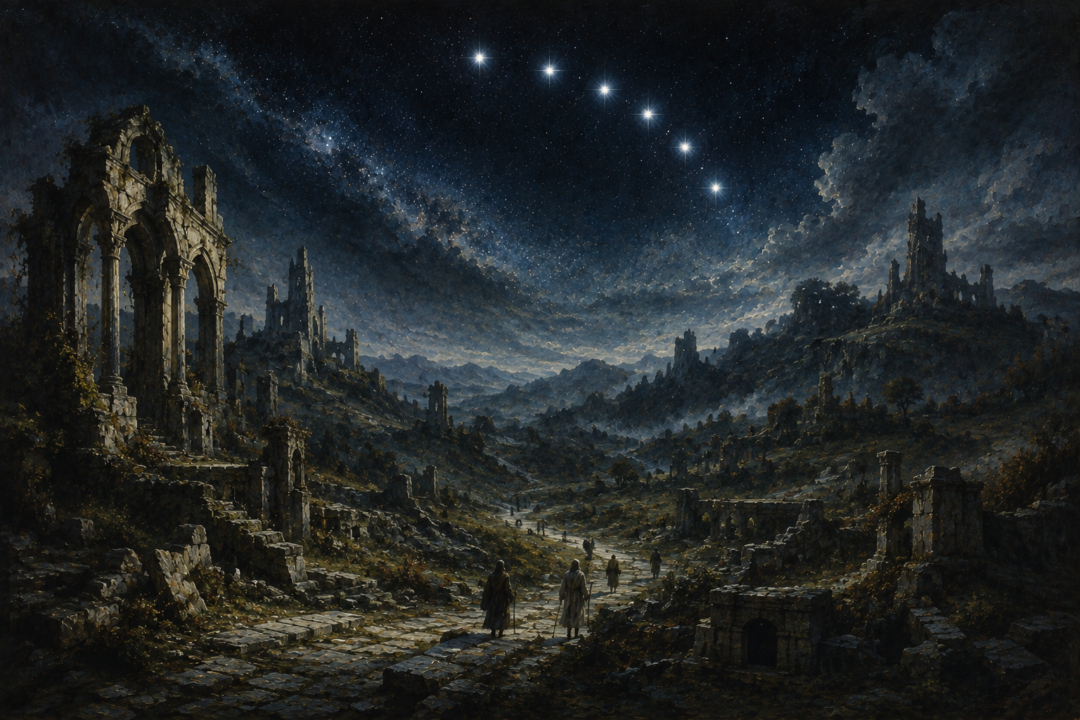
A Monument No Dark Lord Can Tear Down
Middle-earth is filled with ruined monuments.
The towers of the Noldor fall. Númenórean works decay. Cities are abandoned. Statues weather. Roads survive after the kingdoms that built them have vanished.
Valacirca belongs to another scale.
It is a monument written into the heavens.
When Beren invokes it, Morgoth still rules in the North.
When Frodo sees it above Bree, Morgoth has been gone from the circles of the world for more than an age, while Sauron’s power is rising again.
The observers change. Languages change. Kingdoms change. Even the shape of the inhabited world undergoes catastrophe.
The seven stars remain recognizable.
That is why the Sickle of the Valar functions so effectively as a historical sign. It joins the earliest awakening of the Elves to the wars against Morgoth, Beren’s desperate defiance, and the distant world of Frodo.
It remembers a judgment pronounced before nearly all recorded history.
And every time the Shadow rises again, the old sign still hangs above Middle-earth: not a promise that suffering will be avoided, but an ancient reminder that even the greatest Dark Lord was never the final author of the world’s story.
Sources & Notes
- The Encyclopedia of Arda — Sickle of the Valar: overview of the constellation, its seven stars, and its role as a sign hung in the northern sky — https://www.glyphweb.com/arda/s/sickleofthevalar.html
- The Encyclopedia of Arda — Valacirca: reference for the Valarin name and the constellation’s making as a challenge to Melkor — https://www.glyphweb.com/arda/v/valacirca.html
- The Encyclopedia of Arda — The Seven Stars: reference connecting the seven-star pattern with the Sickle of the Valar — https://www.glyphweb.com/arda/s/sevenstars.html
- The Encyclopedia of Arda — Varda Elentári: background on the Vala who set the stars and constellations in the heavens — https://www.glyphweb.com/arda/v/varda.html
Sources document the Sickle’s names, seven-star form, creation, and function as Varda’s challenge to Melkor.