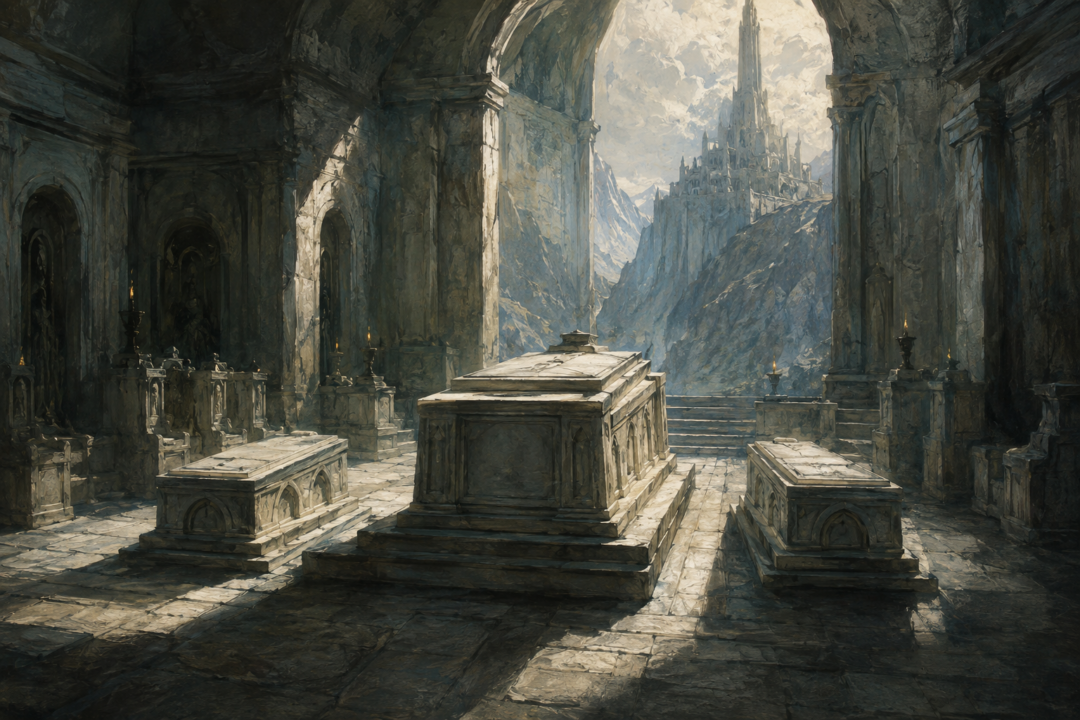
Of all the honours Merry Brandybuck and Pippin Took receive after the War of the Ring, the strangest may be the one they could never enjoy themselves.
They are buried in Gondor.
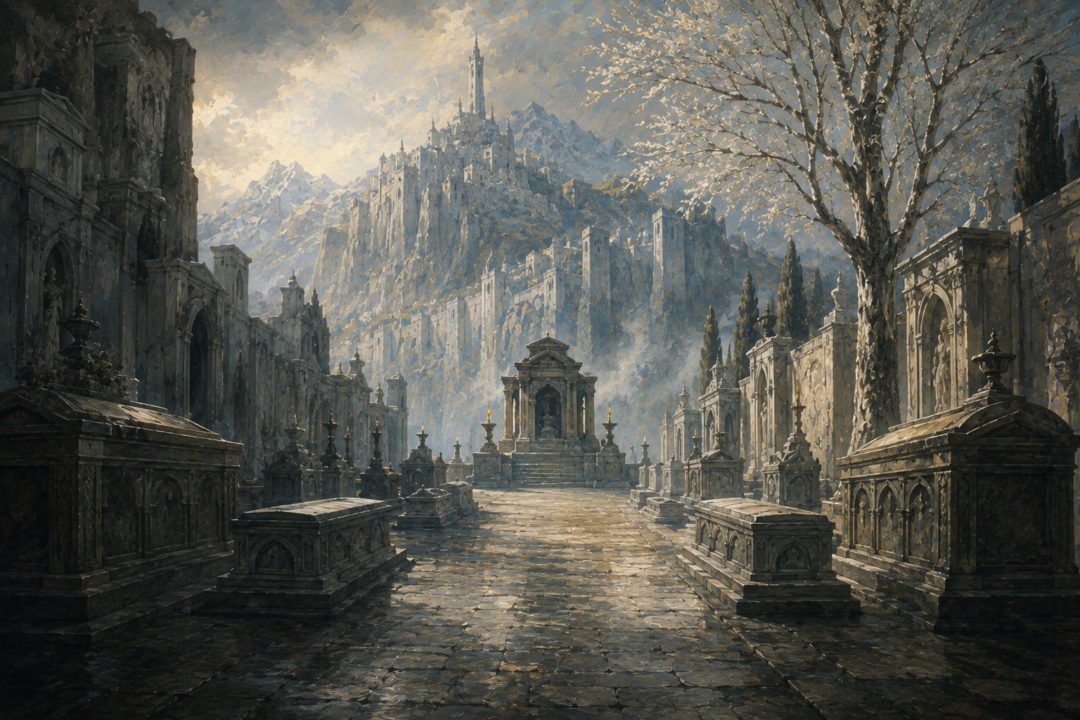
Not merely somewhere within the realm, and not simply as honoured foreigners. After leaving the Shire in old age, Merry and Pippin spend their final years in the South and are laid in Rath Dínen, the hallowed resting place of the great of Gondor. Much later, when King Elessar dies, tradition says that their resting places are set beside his.
It is an extraordinary ending for two hobbits who began their adventure worrying about meals, baths, ponies, and whether they had packed enough food.
But their burial beside Aragorn is more than a sentimental reward for friendship. It quietly completes one of the largest transformations in The Lord of the Rings. Merry and Pippin begin as inhabitants of a secluded country barely noticed by the great powers of the world. They end as figures permanently woven into the royal memory of the Reunited Kingdom.
Their tombs say something that titles alone cannot.
The history of Gondor now has room for hobbits.
They Were Not Simply Aragorn’s Traveling Companions
It is tempting to read the arrangement only as a final reunion of old friends.
That matters, but it does not explain everything.
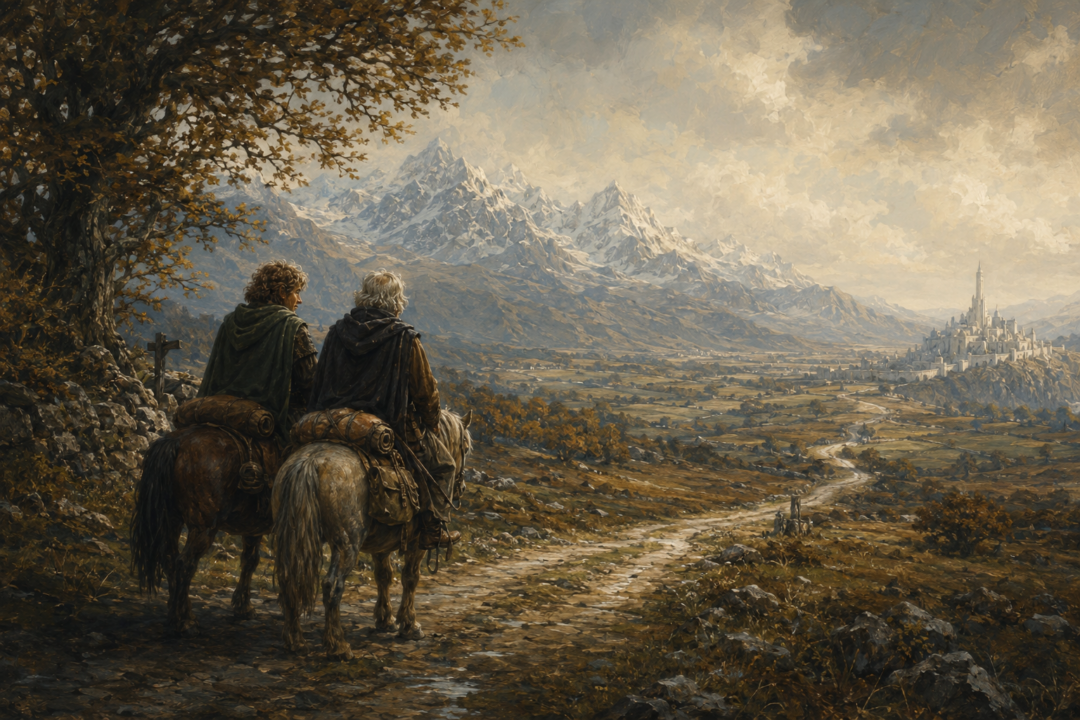
Merry and Pippin were members of the Fellowship, yet their individual paths separated from Aragorn’s for much of the War of the Ring. Their importance grew precisely because they entered the histories of other kingdoms in their own right.
Merry became Théoden’s esquire and rode with the Rohirrim. On the Pelennor Fields, his attack on the Witch-king helped make Éowyn’s decisive blow possible. His bond with Rohan did not disappear after the war: Éomer continued to honour his friendship, and Merry was remembered there as Holdwine.
Pippin entered the service of Gondor after swearing himself to Denethor. During the catastrophe in Minas Tirith, he sought Gandalf when Denethor prepared to burn himself and the still-living Faramir. Pippin thus became personally entangled with the fall of the Stewardship and the survival of the man who would serve Aragorn as Prince of Ithilien.
The two hobbits therefore did not return from the War as anonymous attendants of greater heroes.
They had entered the political and martial histories of the kingdoms of Men.
Their eventual burial in Gondor recognizes that reality.
Rath Dínen Was Not an Ordinary Cemetery
The location matters enormously.
Rath Dínen, the Silent Street, lay within the Hallows of Minas Tirith. This was the burial place associated with Gondor’s Kings, Stewards, and other figures of exceptional rank and remembrance.
Merry and Pippin belonged to none of Gondor’s ancient houses.
They were not descendants of Númenor. They had no claim through blood to the royal tradition. They were not Gondorian captains who had inherited offices from generations of military ancestors.
They were hobbits from Buckland and Tookland.
That contrast is precisely what makes the honour remarkable.
The old Gondor encountered throughout The Lord of the Rings is intensely conscious of inheritance. Its monuments, tombs, Stewardship, royal symbols, and histories are all shaped by remembrance of Númenor and the lost kings. Denethor himself stands inside that immense burden of ancestry.
Yet the restored kingdom does not merely reconstruct the old order exactly as it had been.
Two halflings are eventually laid among its great.
The texts do not provide a formal explanation for why the honour was granted, so it would go too far to invent a specific royal decree or ceremony. But the placement itself is unambiguous evidence of extraordinary esteem.
They have become part of Gondor's remembered history.
Aragorn’s Kingdom Had Already Made the Shire Part of a Larger World
Their burial also makes sense because Aragorn’s relationship with the hobbits did not end at his coronation.
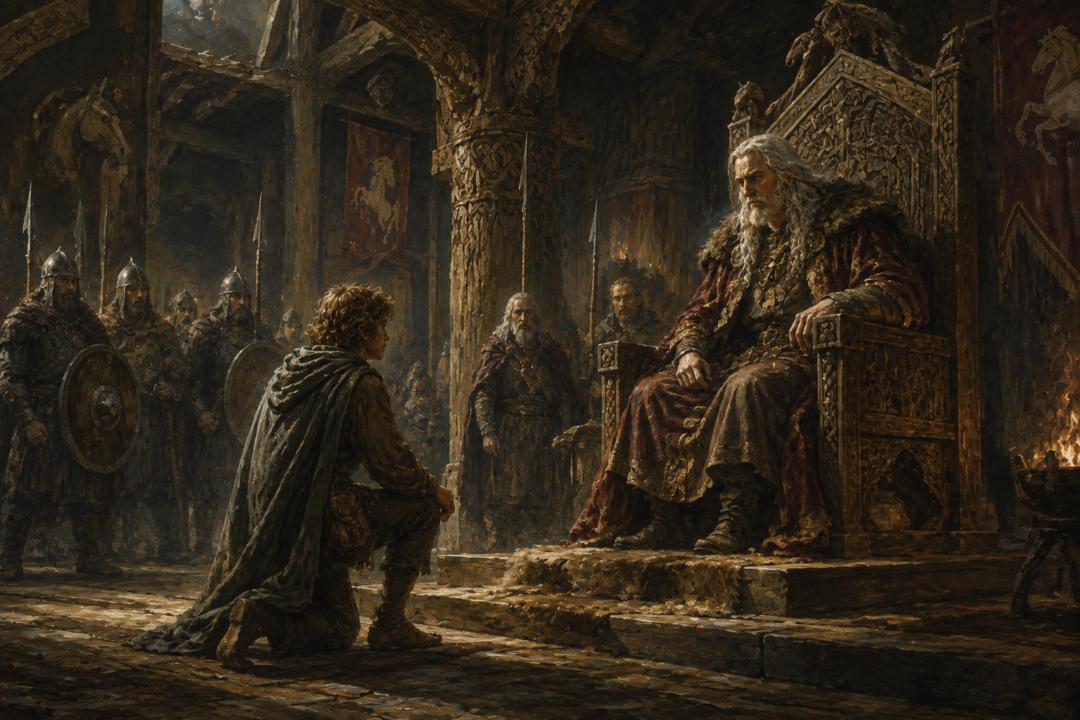
After becoming king, Elessar declared the Shire a Free Land under the protection of the Northern Sceptre and forbade Men from entering it. Later, the Thain, the Master of Buckland, and the Mayor were made Counsellors of the North-kingdom. Merry and Pippin therefore became more than celebrated veterans: through their Shire offices, they occupied recognized positions within the political world of the restored northern realm.
This is an important reversal.
At the beginning of the story, the Shire survives partly because the Rangers guard boundaries that most hobbits do not even know need guarding. The great struggles of the outside world seem remote.
After the War, that ignorance cannot entirely continue.
Merry becomes Master of Buckland. Pippin becomes Thain. Sam becomes Mayor. These are still distinctly hobbit institutions, but their leaders now have personal relationships with the King and knowledge extending far beyond the Shire.
The Shire is not absorbed into Gondor or stripped of its independence. Quite the opposite: Aragorn protects its separation.
Yet separation no longer means historical insignificance.
Merry and Pippin become bridges between the small country they love and the restored realm beyond it.
Their Final Journey South Is a Choice
There is another detail that gives their ending unusual emotional weight.
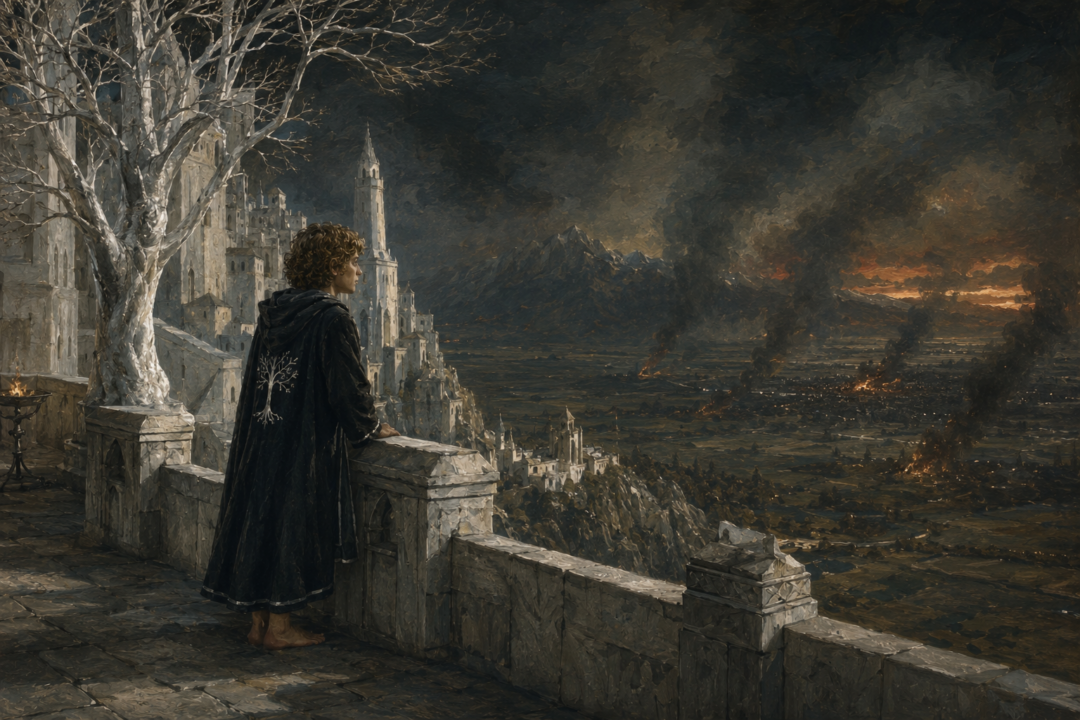
In their old age, Merry and Pippin surrender their offices to their sons and leave the Shire. In the year corresponding to Fourth Age 63, they travel first to Rohan after an invitation from the elderly King Éomer. Merry is then about 102 years old, while Pippin is about 94. They remain through Éomer's final days, and afterward they go to Gondor, where they spend what remains of their lives.
The chronology makes their journey poignant.
They are not leaving home as young adventurers this time.
They are old hobbits deliberately walking back into the lands where their lives were transformed.
Merry returns to the kingdom whose king had accepted his service when he was small, frightened, and desperate not to be left behind. Pippin returns to the city where he had once arrived in the darkness before siege, gazing upward at Minas Tirith while war gathered around it.
They had survived long enough to see those places become peaceful.
Their departure also shows that the friendships forged during the War were not temporary alliances created by necessity. Decades later, Merry still answers Éomer's summons. After the king of Rohan dies, Merry and Pippin continue to Gondor rather than turning home again.
The text does not tell us their private reasoning, so it should not be romanticized into a final planned reunion with Aragorn.
What it does tell us is enough.
They chose to spend the end of their lives in the world they once helped save.
Then Aragorn Is Laid Beside Them
The order of events is easy to miss.
Merry and Pippin die before Aragorn.
Aragorn possesses the long lifespan of the Dúnedain and does not die until Fourth Age 120, at the age of 210. By then the two hobbits have already rested in Gondor for decades. When Elessar finally dies, it is said that the beds of Merry and Pippin are placed beside the bed of the great king.
That distinction strengthens the scene.
It is not simply Aragorn granting his friends places beside himself before his death, at least not in any arrangement explicitly described by the text. The final image preserved by the tradition is instead one in which the dead king joins the two hobbits within the royal memory of Gondor.
The Ranger who met them as Strider at Bree has become the founder of a restored royal house.
The two frightened travellers from the Shire have become Masters, counsellors, knights, scholars, and honoured dead.
At the end, grandeur no longer separates them.
They lie together.
The Fellowship Ends, but Its Meaning Enters History
There is a deeper melancholy here because the Fellowship cannot remain together.
Boromir dies before the victory. Frodo leaves Middle-earth. Sam eventually follows across the Sea. Gandalf departs. Legolas and Gimli have their own strange final tradition. Aragorn, Merry, and Pippin belong to mortal history and ultimately die.
The Fellowship was never destined to become a permanent brotherhood wandering Middle-earth forever.
Its members separate because the Age itself is changing.
That makes the tombs significant.
Merry and Pippin do not remain beside Aragorn because death somehow restores the Fellowship exactly as it was. Frodo, Sam, Boromir, Gandalf, Legolas, and Gimli are absent from Rath Dínen.
Instead, the three graves preserve one particular truth about the new kingdom.
The king of the restored Dúnedain lies beside two members of a people almost entirely overlooked by the old histories of the great.
That would have been difficult to imagine before the War of the Ring.
It becomes possible because the victory over Sauron was never achieved by inherited majesty alone. Aragorn's kingship mattered. Gondor's armies mattered. Rohan's charge mattered.
But so did people whom the powerful repeatedly underestimated.
Merry and Pippin's place in Rath Dínen turns that truth into memory carved into the geography of Gondor itself.
They began the story as hobbits who slipped out of a country most of the world hardly knew existed.
They ended it among the great of Gondor.
And when Aragorn's own long life finally came to its close, the great King Elessar was laid beside them.
Sources & Notes
- The Encyclopedia of Arda — Meriadoc Brandybuck: biographical reference covering Merry’s service, later life, and honour in Gondor — https://www.glyphweb.com/arda/m/meriadocbrandybuck.html
- The Encyclopedia of Arda — Peregrin Took I: biographical reference covering Pippin’s service as a Guard of the Citadel and his later honour — https://www.glyphweb.com/arda/p/peregrintook.html
- The Encyclopedia of Arda — Aragorn Elessar: background on the restored King beside whom the two hobbits were eventually laid — https://www.glyphweb.com/arda/a/aragorn.html
- The Encyclopedia of Arda — Rath Dínen: reference for the royal and stewardly burial precinct of Minas Tirith — https://www.glyphweb.com/arda/r/rathdinen.html
Sources document the key people, places, institutions, and chronology used in this interpretation.