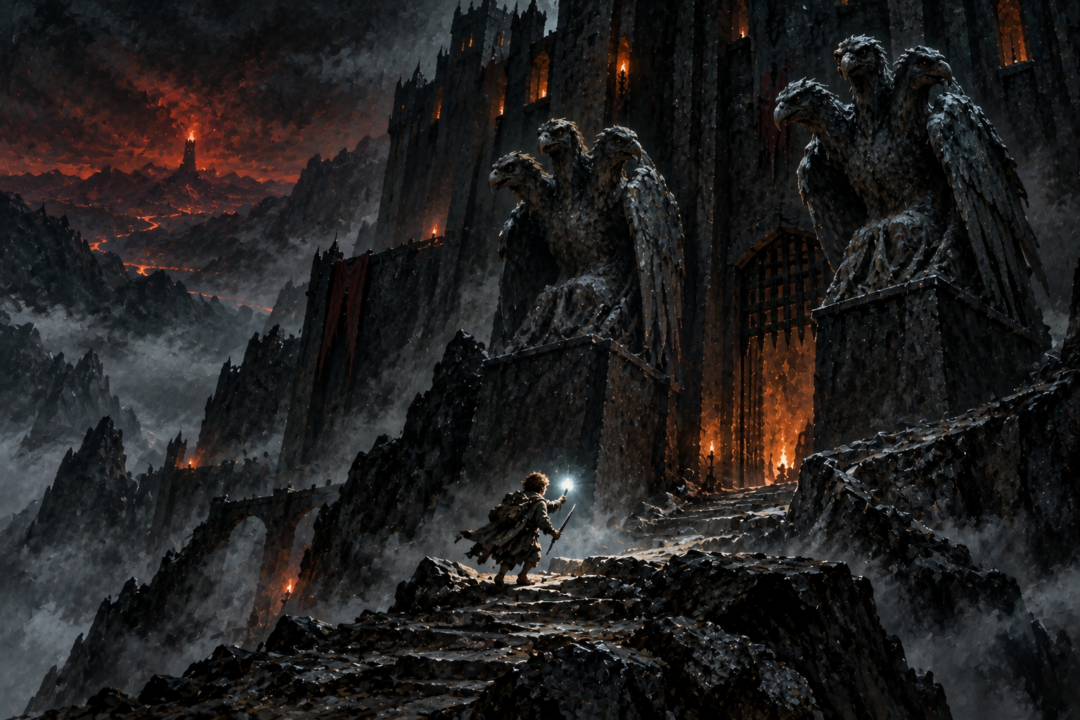
When Samwise Gamgee finally reaches the Tower of Cirith Ungol, he expects the worst kind of rescue imaginable. Frodo has been taken alive by Orcs. Sam is alone in Mordor. Between him and his master stands a fortified tower full of armed enemies.
Yet when Sam passes the dreadful Watchers and enters the fortress, he discovers something almost unbelievable.
The enemy has already done most of his work for him.
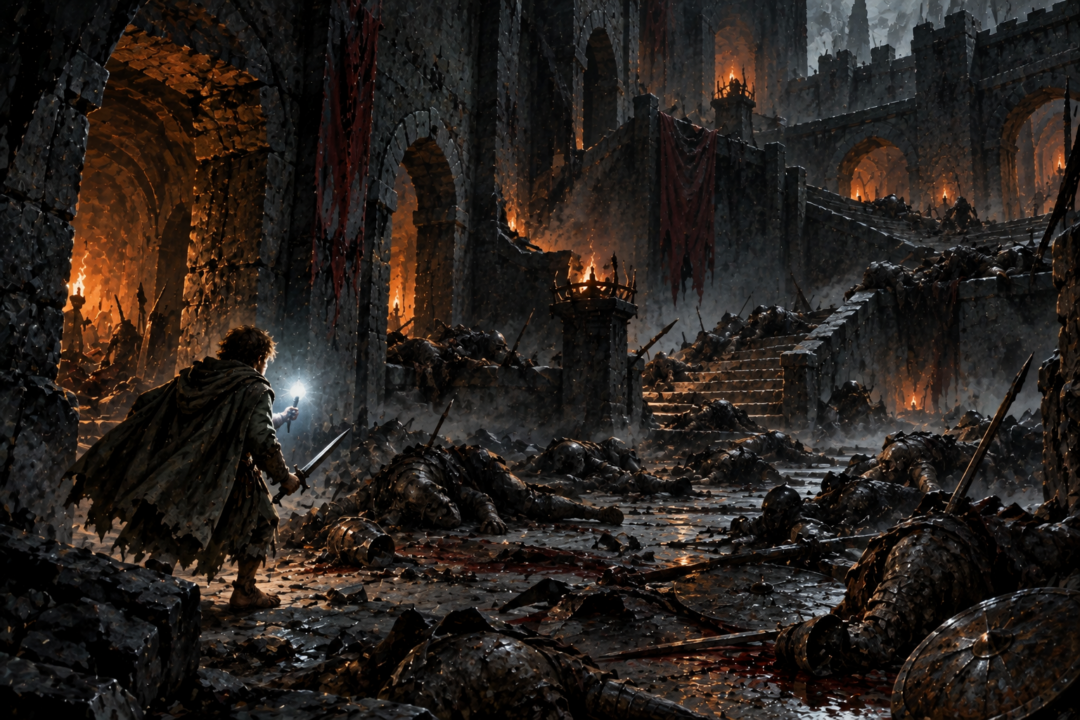
Dead Orcs lie throughout the Tower. Two companies that should have been guarding the same prisoner have slaughtered one another. The fortress has effectively collapsed from within, not because Sam led an assault against it, but because suspicion, greed, rivalry, and fear have turned Sauron's servants against each other.
The destruction of the Cirith Ungol garrison is one of the strangest reversals in The Lord of the Rings. It is also a revealing glimpse of how the Shadow actually functions. Sauron's forces can be disciplined, organized, and terrifyingly effective. But the society behind that military power is poisoned by the very qualities its master encourages.
At Cirith Ungol, that poison finally consumes the guards themselves.
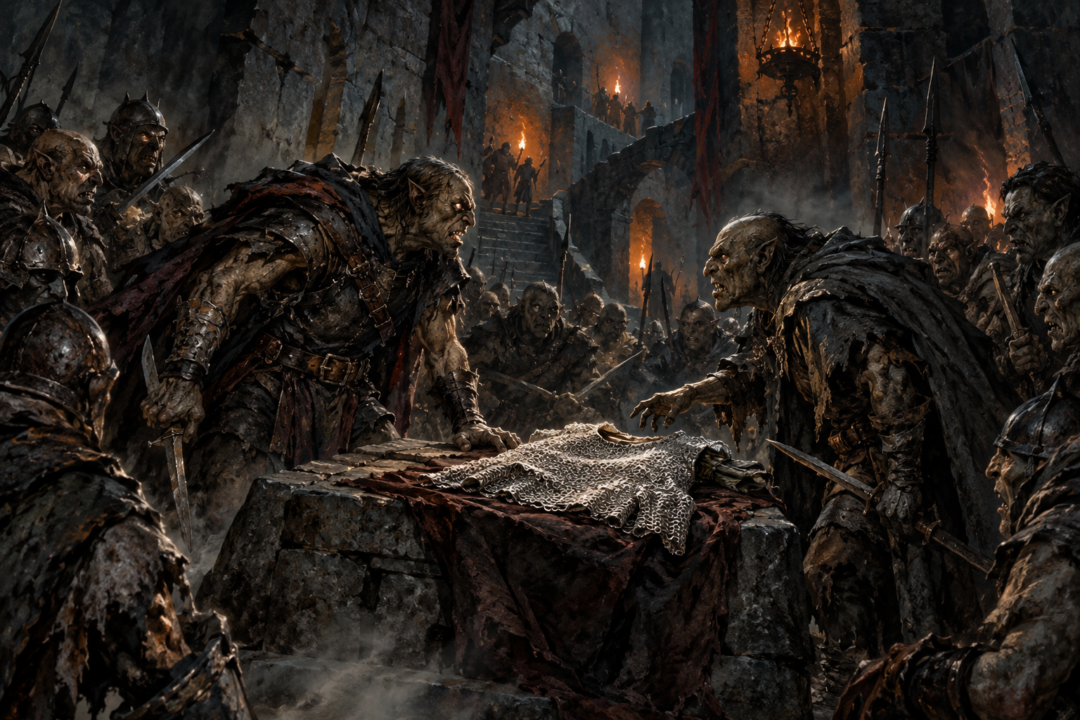
Two Orc Captains Bring Frodo to the Tower
The disaster begins after Shelob attacks Frodo in the pass above Minas Morgul.
Sam believes Frodo has been killed and takes the Ring, intending to continue the quest. Soon afterward, however, Orcs arrive. By following them while wearing the Ring, Sam overhears a conversation that changes everything: Frodo is not dead. Shelob has poisoned and immobilized him, and the Orcs know that her victims can remain alive.
The two principal Orcs are Shagrat and Gorbag.
Shagrat commands the Tower of Cirith Ungol. Gorbag belongs to a company from Minas Morgul. They serve the same overall power, but their conversation immediately reveals that this does not make them comrades in any meaningful sense.
They complain about superiors. They distrust the Nazgûl. They speculate about slipping away someday with a few dependable followers and living by plunder without powerful masters over them.
Most importantly, their conversation shows how thoroughly fear structures their world.
Shagrat knows the orders concerning any prisoner found in these circumstances: the captive must be kept secure until higher authority decides what happens next. Failure could mean death for the guards.
Frodo therefore enters the Tower as an extremely important prisoner.
That should make the Orcs more careful.
Instead, it gives them something valuable to fight over.
The Mithril-Coat Changes Everything
When Frodo is searched, the Orcs discover the mithril-mail shirt that Bilbo gave him in Rivendell.
Its significance is enormous.
The shirt was made of mithril, a substance of extraordinary value, and it is far beyond what the Orcs would expect to find beneath the clothes of an apparently insignificant prisoner. The discovery therefore creates both greed and suspicion.
Gorbag wants the coat.
Shagrat refuses to surrender it.
This disagreement is not merely an argument over treasure. Shagrat has explicit responsibilities as captain of the Tower, and the prisoner's possessions are evidence that must be reported. He understands that the authorities of Mordor will take an intense interest in what has been found.
But personal hostility is already present between the two groups.
The Orcs of Cirith Ungol and the Orcs from Minas Morgul are not depicted as a harmonious military unit. Their captains insult each other, their followers are divided by allegiance, and neither side possesses the trust necessary to settle the dispute peacefully.
The mithril shirt becomes the spark dropped into something already combustible.
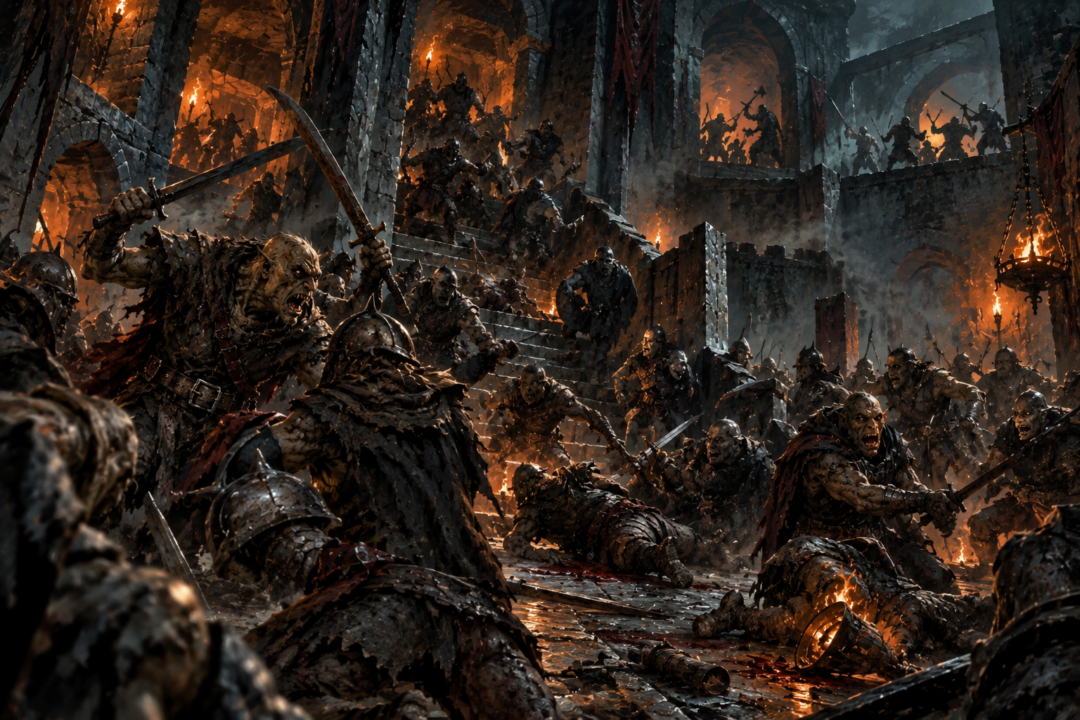
The quarrel becomes violence.
Then the violence spreads.
Mordor's Soldiers Turn Their Weapons on One Another
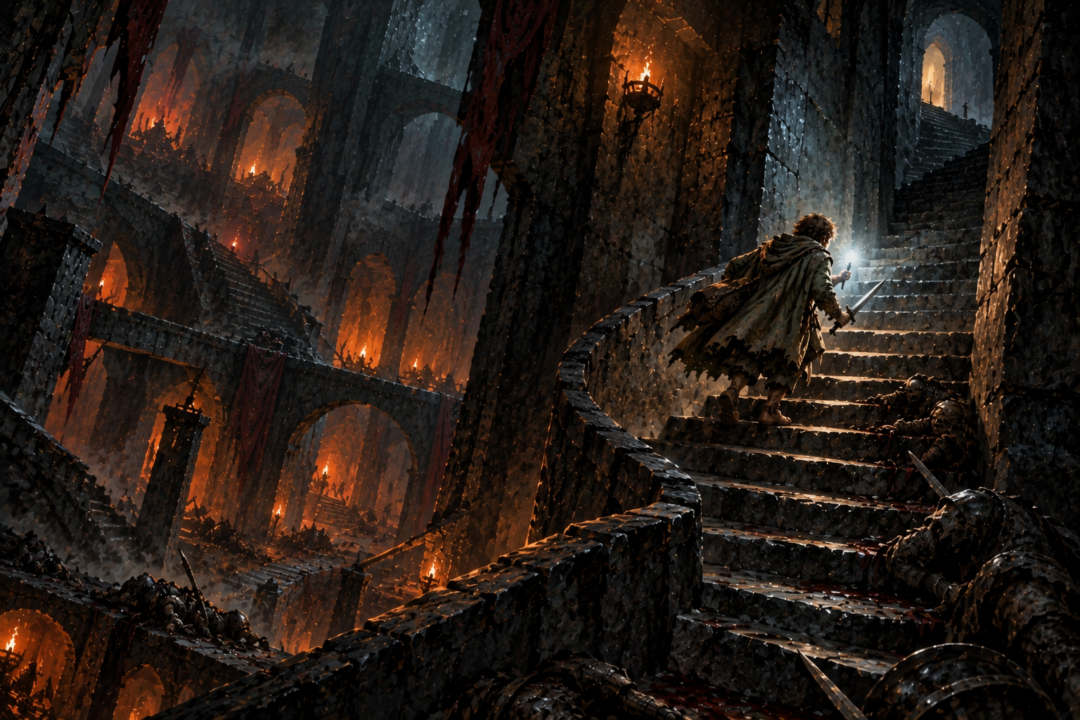
By the time Sam enters the Tower, the struggle has become catastrophic.
The two Orc companies have effectively annihilated each other.
Sam encounters bodies in the courtyard and throughout the fortress. What should have been an overwhelming numerical disadvantage has almost vanished before he has struck a blow inside the stronghold.
This is important because Sam does not defeat the garrison in battle.
His courage is real, and he still has to overcome the Watchers, navigate the Tower, confront surviving Orcs, and find Frodo. But the astonishing opportunity that makes the rescue possible is created by the Orcs themselves.
Their internal violence reaches all the way to their commanders.
Gorbag wounds Shagrat during the struggle. Later, after Gorbag appears to have been finished, he attacks Shagrat again with a broken spear. Shagrat finally kills him.
The partnership overheard by Sam only hours earlier—the two captains imagining a future without their masters—ends with one killing the other.
There is a grim irony here. Gorbag and Shagrat dislike the oppressive hierarchy above them, yet they cannot construct an alternative based on trust. Their fantasy of escaping together collapses as soon as valuable plunder comes between them.
Why Sauron's Army Can Still Be Powerful
It would be easy to interpret Cirith Ungol as evidence that Mordor's forces are simply incompetent.
The wider story does not support that conclusion.
Sauron's armies conduct patrols, maintain fortresses, transmit orders, guard roads, gather intelligence, and move enormous forces across Mordor. The Orcs who find Frodo correctly analyze much of what happened around Shelob's lair. Shagrat understands his orders concerning the prisoner and recognizes the seriousness of the situation.
The weakness is therefore not a complete absence of organization.
It is the kind of organization Mordor possesses.
Its servants obey largely within a system of domination, punishment, rivalry, and fear. They can function efficiently while authority remains overwhelming and objectives remain clear. But Cirith Ungol shows how quickly cooperation can collapse when competing interests appear.
Fear can compel obedience.
It cannot manufacture loyalty.
That distinction becomes decisive inside the Tower.
Sam Benefits From a Weakness He Did Not Create
Sam knows almost nothing about the slaughter before entering Cirith Ungol.
From his perspective, the Tower remains a terrifying obstacle. He has every reason to believe he may be walking into a fortress crowded with enemies.
His entrance is itself difficult. The gateway is guarded by the Two Watchers, dreadful stone figures associated with an oppressive power that resists anyone attempting to pass. Sam uses the Phial of Galadriel to overcome them and forces his way inside.
Only then does he discover the scale of the disaster.
This makes the sequence more powerful than a conventional heroic assault. Sam is not transformed into an unstoppable warrior capable of defeating an entire Orc garrison. He remains one hobbit attempting something far beyond his apparent strength.
Circumstances have opened a narrow path for him.
Even the Orcs misunderstand what is happening. Earlier, after finding Frodo near Shelob's lair, they know that another warrior must have been present. The evidence left behind makes this unseen enemy seem far more formidable than Sam actually appears.
That mistaken fear continues to work in his favor.
The small gardener from the Shire enters the Tower carrying Sting and the Phial, while the surviving Orcs are already shaken by slaughter, suspicion, and stories of an unknown enemy.
Sam's apparent weakness becomes difficult for them to interpret.
The Final Survivors
The destruction is not absolutely complete when Sam arrives.
Shagrat survives the main battle, as does the Orc Snaga. Sam therefore still faces real danger.
Shagrat ultimately escapes from the Tower carrying objects taken from Frodo, including the mithril coat. These possessions later reach Sauron's servants and are displayed by the Mouth of Sauron before the Captains of the West at the Black Gate.
That detail matters because Cirith Ungol is not a total failure for Mordor. Evidence of Frodo's presence escapes even though Frodo himself does not.
Inside the Tower, Sam eventually finds Snaga threatening Frodo in the upper chamber. Snaga falls during the confrontation, and Sam reaches his master.
The rescue succeeds.
But it succeeds because courage meets an opportunity created by the enemy's internal collapse.
Had Shagrat's and Gorbag's companies remained disciplined and united, Sam's situation would have been vastly different. The text never gives us an alternate version of events, so it would go too far to say rescue would have been impossible. What can be said is that the slaughter removes most of the defenders who otherwise stood between Sam and Frodo.
The Deeper Irony of Cirith Ungol
There is an especially fitting irony in where this happens.
Cirith Ungol is supposed to be a place of control. Its Tower dominates the pass into Mordor, and by the late Third Age it serves the power that rules the surrounding land. Everything about the fortress suggests vigilance, confinement, and authority.
Yet its defenders cannot control themselves.
The prisoner does not organize an uprising. No army breaches the walls. Sam does not secretly sabotage the garrison.
A valuable shirt is enough.
That does not mean mithril somehow corrupts the Orcs. The cause is more ordinary and more revealing: greed encounters an already divided group whose members expect betrayal and answer disputes with violence.
Cirith Ungol therefore offers a miniature portrait of a larger theme running through the story. Domination can create enormous concentrations of power while simultaneously weakening the relationships that power depends upon.
Sauron's servants fear punishment from above while distrusting one another beside them.
For most of the War of the Ring, overwhelming military strength hides that weakness.
Inside one isolated tower, it becomes fatal.
Evil Makes Sam's Impossible Rescue Possible
Sam still has to choose to enter Cirith Ungol.
Nothing about the Orcs' quarrel diminishes that courage. He does not know that most of his enemies are dead when he approaches the gate. He believes Frodo is somewhere inside an enemy fortress, and he goes after him anyway.
But once he crosses the threshold, he finds a battlefield that no ally prepared for him.
The servants of Mordor have slaughtered one another over the possessions of the prisoner they were ordered to guard.
That is what makes Cirith Ungol so memorable. The Shadow is not defeated there by a greater display of violence. Its servants briefly become victims of the world they themselves inhabit—a world where fear replaces loyalty, possession invites murder, and cooperation lasts only until self-interest becomes stronger.
Sam walks into the ruins of that failure.
Then, carrying a sword, a small light from an Elvish gift, and an extraordinary devotion to his friend, he climbs toward the last room of the Tower.
The fortress of Mordor has already defeated itself.
Sam only has to survive what remains.
Sources & Notes
- Legendarium — Shagrat and the fight between the two companies https://www.legendarium.page/characters/shagrat/
- Legendarium — Gorbag of Minas Morgul https://www.legendarium.page/characters/gorbag/
- Legendarium — the mithril coat and its seizure in Cirith Ungol https://www.legendarium.page/objects/mithril-coat/
References document the Shagrat–Gorbag rivalry, the orcs' fight over Frodo's mithril shirt, and Sam's entry into the decimated tower; primary narrative is The Lord of the Rings, Book VI, chapter 1.