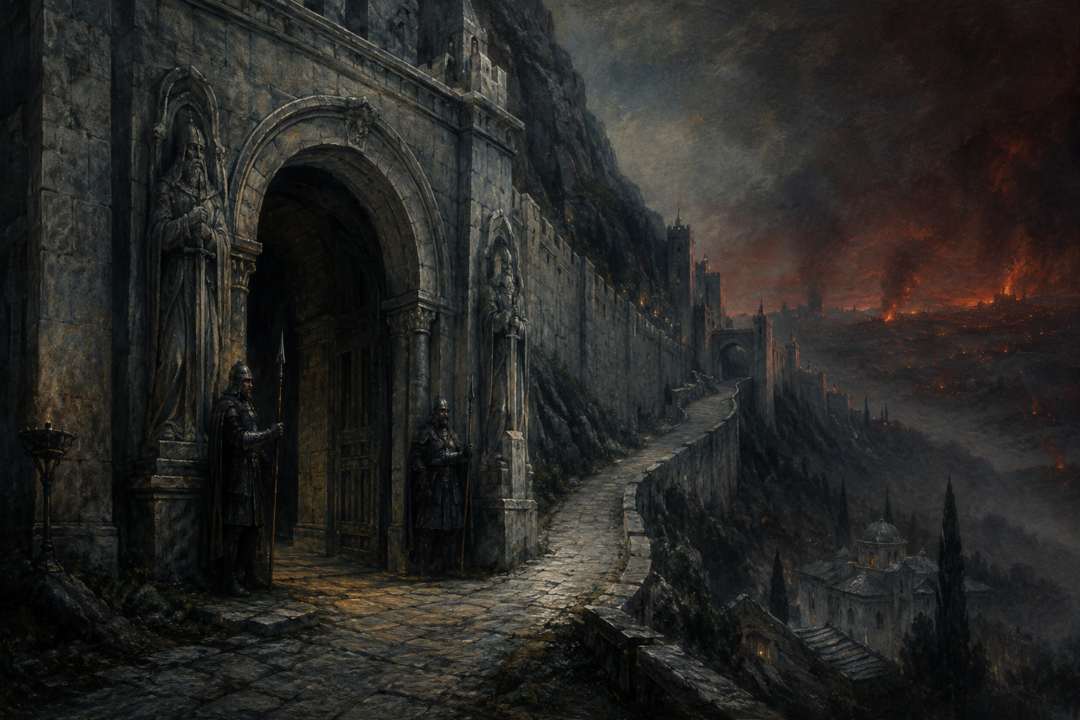
There is a door high in Minas Tirith that is supposed to open only for the dead.
Fen Hollen, the Closed Door, stands in the rearward wall of the sixth circle. Beyond it a descending road leads toward Rath Dínen, the Silent Street, where the Kings and Stewards of Gondor are laid to rest. It is not an ordinary city gate. The way is guarded, secluded, and normally opened only for funerals or for those permitted to tend the Hallows.
Yet during the Siege of Gondor, this carefully protected threshold becomes the scene of something almost unimaginable: a guard of Gondor kills another guard of Gondor, loyal servants fight one another among the tombs, and blood stains a place reserved for the dead.
The enemy never storms Fen Hollen.
No Orc breaks it. No Nazgûl passes through it.
Instead, the conflict reaches Rath Dínen because Gondor itself has been driven into a terrible moral crisis. The battlefield outside Minas Tirith is mirrored by another battle within—one in which obedience, loyalty, despair, and mercy collide.
Fen Hollen Was Designed to Keep the Living Out
Rath Dínen is deliberately separated from ordinary life.
The Hallows lie on the narrow spur between Minas Tirith and Mindolluin. From the sixth level, the way passes through Fen Hollen and descends toward the tombs. The door is kept shut and guarded, emphasizing that this is a place set apart from the inhabited city.
Its name reflects that function: Fen Hollen is the Closed Door.
Beyond it lies the Silent Street, with the Houses of the Dead and the resting places of Gondor's rulers. The House of the Stewards stands there beneath its great dome.
Everything about the place expresses continuity.
Generations die, but Gondor remains. Kings and Stewards pass away, but their memory is preserved. The dead are given dignity precisely because the living continue the realm they served.
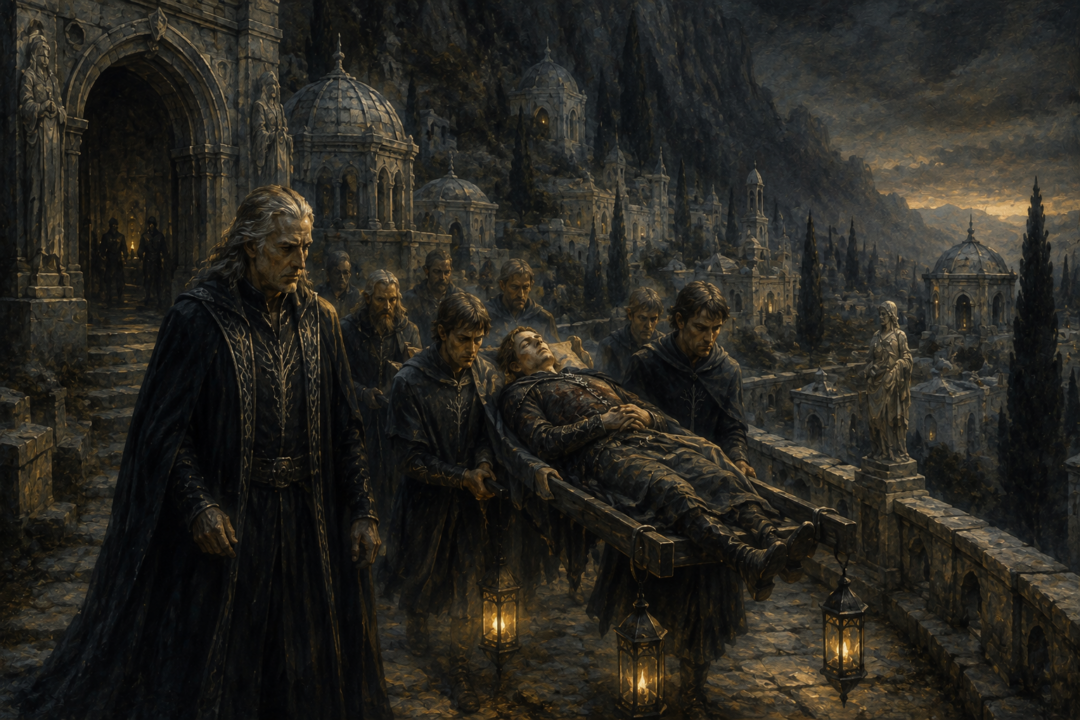
That makes Denethor's decision to bring Faramir there while Faramir is still alive profoundly wrong.
Faramir is gravely wounded and fevered, but he is not dead. Denethor nevertheless orders him carried from the Citadel into the Hallows and placed in the House of the Stewards.
The place intended to receive Gondor's dead is being prepared to consume one of its living heirs.
Denethor Turns a Tomb Into a Pyre
Denethor's despair has been building throughout the siege.
Boromir is dead. Faramir has returned desperately wounded. Mordor's armies surround the City. Denethor has also secretly used the palantír of Minas Tirith, and the things he has seen through it have contributed to his conviction that resistance is hopeless.
His error is not simply that everything shown to him is false. The deeper danger is that true information can still be arranged or understood in a way that produces despair. Denethor sees enough of Sauron's strength to conclude that defeat is inevitable.
By the time he enters Rath Dínen, he no longer behaves as a ruler preparing his people to endure.
He prepares to die.
Worse, he intends Faramir to die with him.
Dry wood and oil are brought into the House of the Stewards. Father and son are placed upon the funeral table, and Denethor orders his servants to prepare the fire.
The symbolism is severe. A Steward exists to preserve something entrusted to him. Denethor instead attempts to end both himself and the son who might survive him.
His despair therefore becomes more than personal.
It threatens Gondor's future.
Pippin Realizes That Obedience Is No Longer Enough
Pippin is placed in an almost impossible position.
He has sworn service to Denethor. The Steward is the lawful ruler of Gondor at this moment, and Pippin is a member of his Guard.
Yet Pippin knows that Faramir lives.
That fact changes everything.
If Denethor were merely choosing his own death, intervention would already be morally difficult. But Denethor intends to burn another living person with him.
Pippin cannot simply obey.
He leaves the Hallows seeking help, and his decision ultimately brings the crisis to Beregond.
Beregond faces an even harsher choice. He is a Guard of the Citadel. His duty is bound to the authority Denethor represents.
But Pippin makes the essential issue clear: Faramir may still be saved.
Beregond must choose between obedience to orders and protecting the life of the Steward's son.
He chooses Faramir.
That choice saves a life, but it does not come without a terrible cost.
The First Blood Is Spilled at the Closed Door
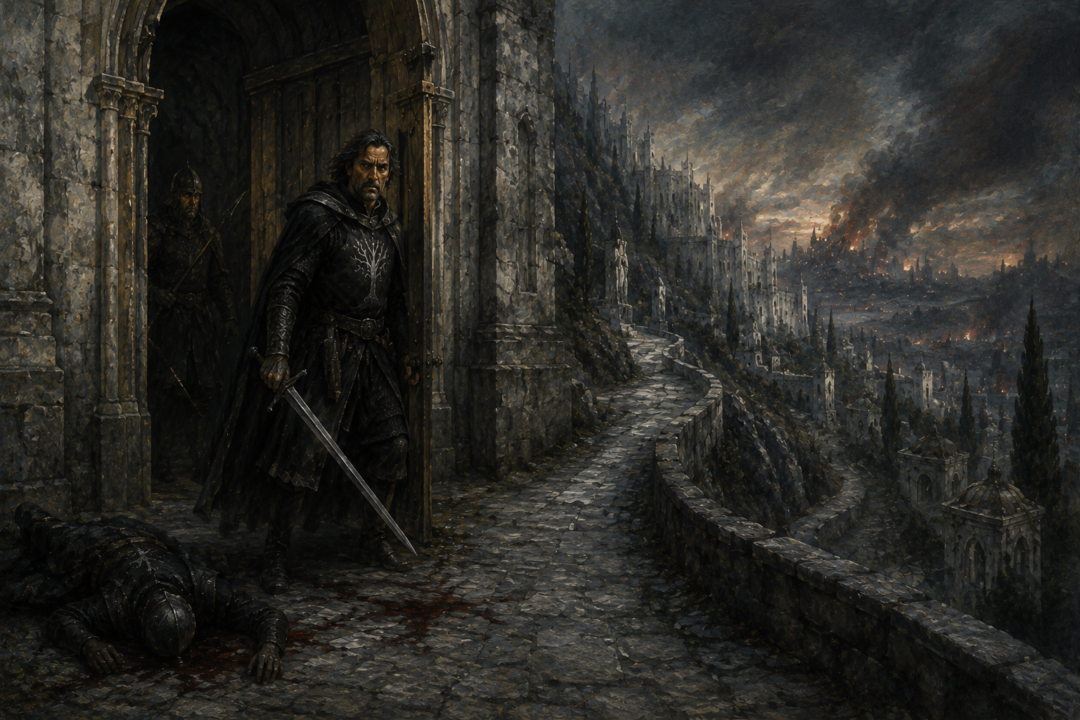
When Beregond reaches Fen Hollen, the porter refuses him passage.
The porter is doing his duty.
This detail matters.
The tragedy is not structured as a simple confrontation between a good man and an evil one. Beregond and the porter are both Gondorian soldiers acting according to competing understandings of duty.
Beregond needs to reach Faramir.
The porter is charged with guarding a restricted entrance.
When the porter draws his sword to prevent Beregond from passing, Beregond kills him and takes the key.
The Closed Door is opened.
The threshold that was meant to protect the sanctity of Gondor's dead has now become the location of bloodshed between Gondor's own defenders.
And Beregond's ordeal is not finished.
He descends to Rath Dínen and reaches the House of the Stewards, where Denethor's servants are attempting to carry out their lord's commands.
Beregond bars their way.
Soon swords are drawn again.
Rath Dínen Hears a Sound It Was Never Meant to Hear
When Gandalf and Pippin return toward the Hallows, the transformation of Rath Dínen is revealed through sound.
This is the Silent Street.
Yet they hear shouting and the clash of weapons.
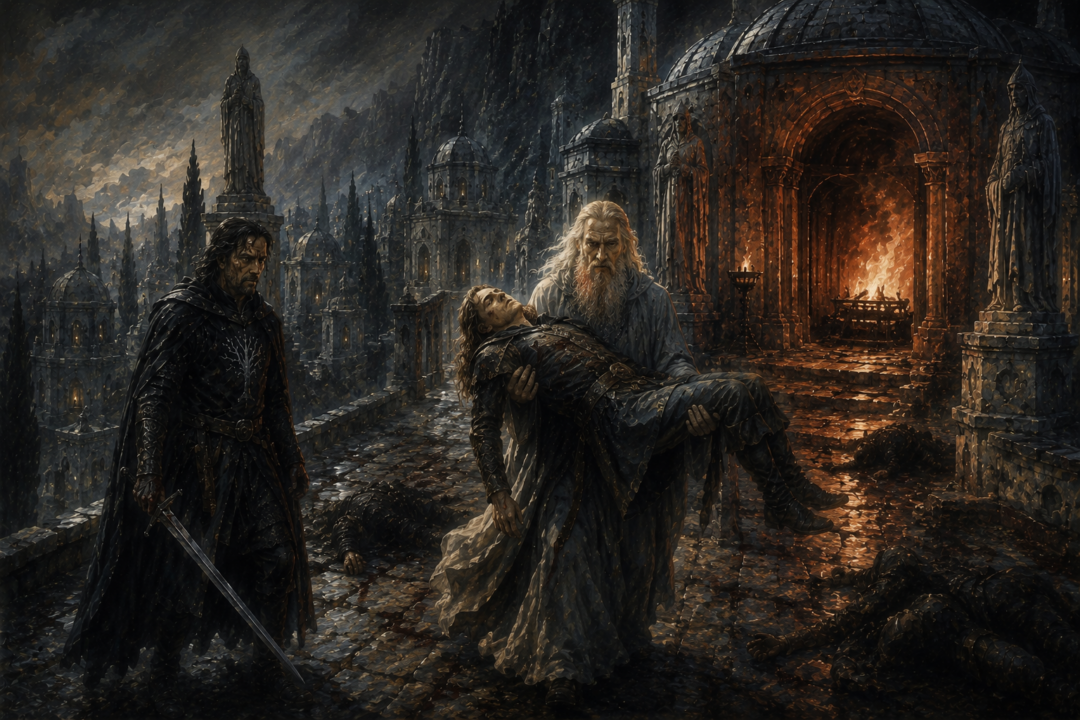
The narrative emphasizes the violation: such sounds of conflict had not belonged in these sacred precincts. A place characterized by stillness, memory, and death now echoes with living men fighting one another.
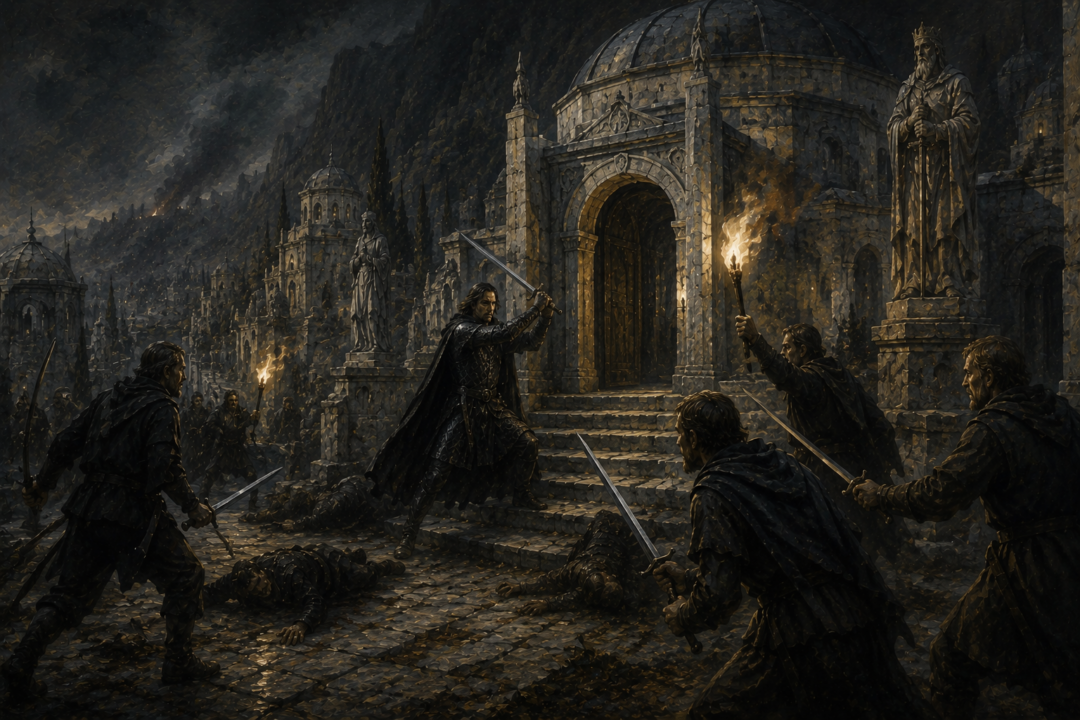
At the steps of the House of the Stewards, Beregond stands alone.
He holds the door while Denethor's servants confront him with torches and swords. Two men have already fallen to Beregond's blade.
Their blood stains the Hallows.
The image is deliberately painful because nobody here belongs to Mordor.
These are Gondorians.
The defenders at the Great Gate are fighting the armies of Sauron while, deep inside Minas Tirith, the Steward's own household has been divided against itself.
Gandalf recognizes the nature of the catastrophe. He asks, in effect, whether the Enemy has reached even Rath Dínen.
Not because Sauron's soldiers have physically entered the Hallows, but because despair and division have produced exactly the kind of destruction the Enemy desires.
Beregond Is Both Traitor and Faithful Servant
Beregond's position is one of the most morally complicated acts of loyalty in The Lord of the Rings.
He undeniably breaks the law.
He abandons his assigned post. He forces his way through Fen Hollen. He kills the porter. He later kills other men while preventing Denethor's commands from being carried out.
These actions cannot simply be erased because his motive is good.
Yet without his disobedience, Faramir may have died before Gandalf arrived.
Beregond therefore exposes a distinction between obedience and loyalty.
Obedience asks: What has my lord commanded?
Loyalty may sometimes require the harder question: What actually preserves the person, realm, or good that my service exists to defend?
Beregond refuses Denethor's immediate will in order to save Denethor's son.
That does not make the killing at Fen Hollen harmless. Later, when Aragorn judges Beregond, his lawbreaking is acknowledged rather than ignored. But his deeds in Faramir's defense are also recognized.
The story does not pretend that moral courage always leaves clean hands.
Gandalf Ends the Battle, But Not the Tragedy
When Gandalf reaches the House of the Stewards, Denethor himself emerges with a drawn sword.
The Steward who should be directing the defense of Minas Tirith is now prepared to fight his own guard beside the tombs of his ancestors.
Gandalf intervenes.
Denethor's sword is struck from his grasp, and the confrontation moves from physical violence to the deeper struggle beneath it: whether despair has the right to decide the fate of the living.
Faramir is removed from the pyre.
Denethor refuses to leave.
He reveals the palantír, breaks the Steward's white rod, and casts the pieces into the fire. He then lies upon the table, takes the Seeing Stone in his hands, and dies in the flames.
The House of the Stewards burns.
Its dome eventually collapses.
The battlefield of Rath Dínen ends not with military victory, but with the destruction of the place in which Denethor expected to lie peacefully after death.
The Enemy Reaches Rath Dínen Without Entering It
The most striking aspect of the episode is that Sauron does not need soldiers inside the Hallows to damage Gondor there.
His pressure has already penetrated the City in another form.
Fear becomes despair.
Despair becomes abandonment of duty.
Authority becomes destructive command.
Loyalty fractures into opposing loyalties.
Finally, Gondorian blood is spilled by Gondorian hands.
This should not be simplified into the claim that Denethor is merely controlled by Sauron. The text does not present him as a puppet. Denethor retains agency, and his decisions remain his own.
But the Enemy has exploited his fear and his vision of overwhelming power.
That is why the Closed Door matters.
Fen Hollen seems like one of the safest thresholds in Minas Tirith. It is high above the main assault, guarded and hidden from the battlefield.
Yet walls cannot defend against despair.
The Great Gate of Minas Tirith can be smashed by Grond.
The Closed Door requires no such weapon.
It is opened from within.
And beyond it, among the monuments of Gondor's ancient greatness, the war briefly becomes something even more dangerous than Men fighting Orcs.
It becomes a struggle over whether the living will surrender themselves to death before the battle has actually been lost.
Faramir survives because Pippin refuses silence, Beregond accepts the terrible consequences of disobedience, and Gandalf arrives before despair can finish what it has begun.
The Silent Street becomes a battlefield precisely because several people refuse to let a living man be treated as though he were already dead.
Sources & Notes
- The Encyclopedia of Arda, “Rath Dínen” — https://www.encyclopedia-of-arda.com/r/rathdinen.html
- The Encyclopedia of Arda, “Beregond” — https://www.encyclopedia-of-arda.com/b/beregond.html
- The Encyclopedia of Arda, “Denethor” — https://www.encyclopedia-of-arda.com/d/denethor.html
Reference entries document the characters, places, events, and textual details discussed in this article.