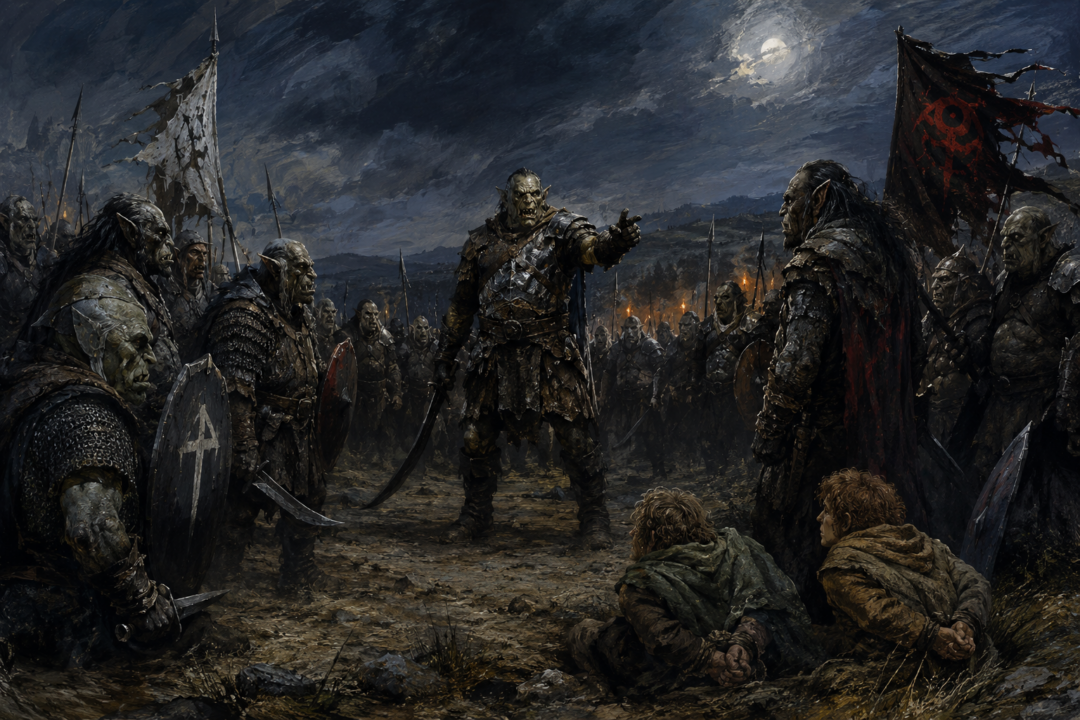
When Merry and Pippin are carried away by Orcs after the breaking of the Fellowship, the captors are not one uniform horde. They belong to different commands, answer to different masters, distrust one another, and argue over where the prisoners should be taken. The famous White Hand of Isengard matters—but before the narrative makes much of insignia, the Orcs are already revealing their loyalties through what they say.
That distinction is easy to overlook because nearly everyone in the scene is an Orc. Yet “The Uruk-hai” in The Two Towers is built around differences inside the Enemy’s forces. Uglúk’s Isengarders, Grishnákh’s Mordor company, and Orcs from the North have temporarily joined together, but they do not form a harmonious army.
Their speech exposes the fracture.
The point is not that Tolkien gives the Isengarders a precisely documented linguistic accent that automatically identifies them. He does not. Rather, their intelligible dialogue—its vocabulary, boasts, loyalties, orders, and contempt for the other companies—reveals who they are before heraldry finishes the job.
The Orc Company Is Already Divided
The capture of Merry and Pippin produces an unusual opportunity: two hobbits are forced to listen to the Enemy talking among itself.
What they hear is remarkably political.
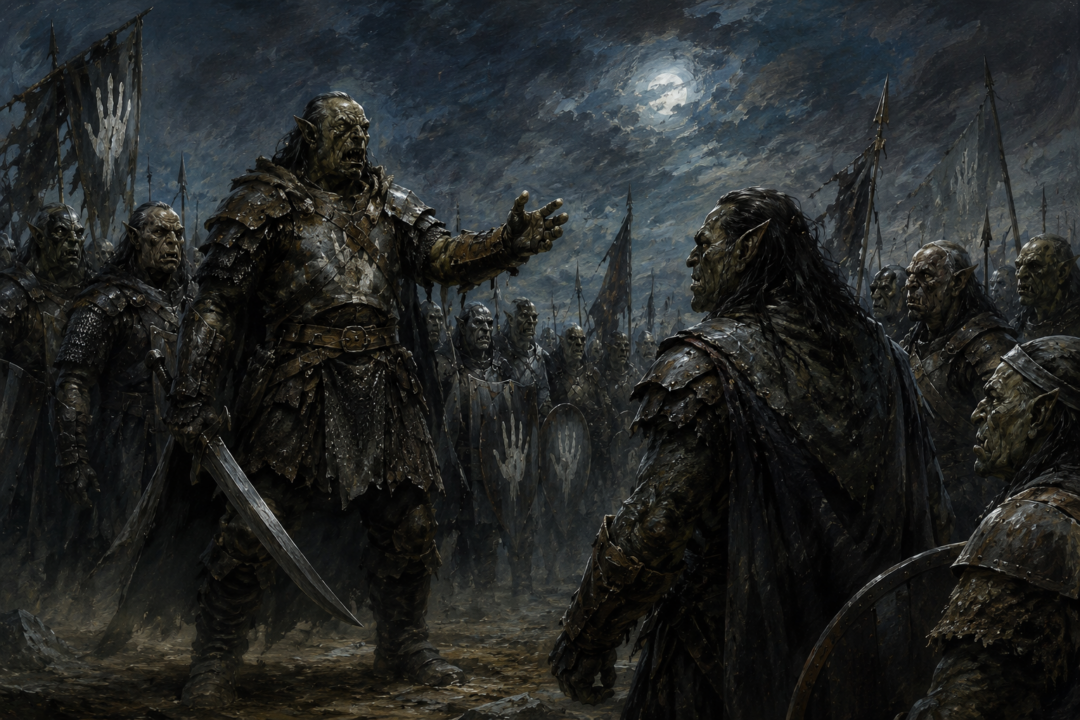
The Orcs disagree over their destination. Uglúk intends to carry the prisoners to Isengard. Grishnákh represents the interests of Mordor and is deeply suspicious of Saruman. The northern Orcs have priorities of their own. Their temporary cooperation exists because their immediate purposes overlap, not because they trust one another.
This matters because Orcish language itself is fragmented.
Appendix F explains that Orcs did not possess a single stable language common to all their kind. They took words from other tongues, corrupted them, and developed numerous dialects. Different groups could therefore have difficulty understanding one another. For communication between tribes, many used the Common Speech, though in a debased form.
That background turns the conversations around Merry and Pippin into something more than villainous chatter.
The Common Speech is effectively the coalition language of a divided army.
The Orcs can communicate across regional and political boundaries, but communication does not produce unity. Instead, it gives their rivalries a language everyone can understand.
Uglúk Announces Himself Through Allegiance
Uglúk does not merely command. He repeatedly defines who “we” are.
During his confrontation with Grishnákh, he identifies his followers as the fighting Uruk-hai and boasts of their role in killing Boromir and capturing the hobbits. More importantly, he declares them servants of Saruman and states that they came from Isengard.
This is self-identification in speech.
His allegiance is therefore unmistakable even without seeing a shield, helmet, or badge. Uglúk constructs a political identity around several linked ideas: his troops are strong, they accomplished the mission, they serve Saruman, and they—not the other Orc companies—deserve to command the march.
His rhetoric is competitive because the coalition itself is competitive.
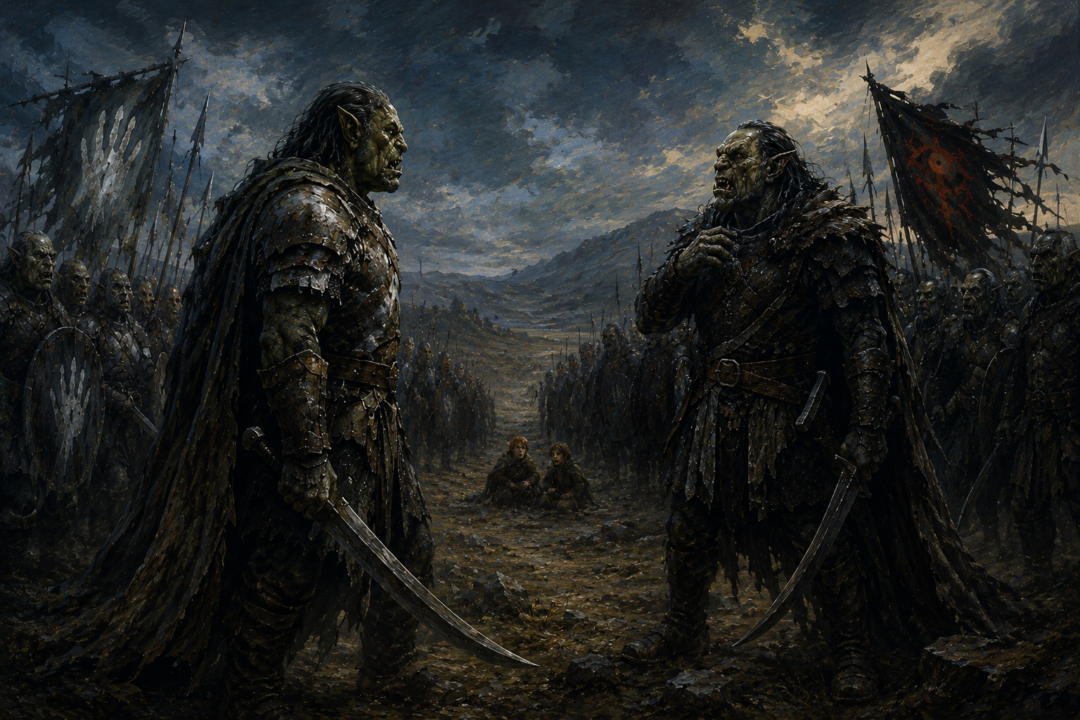
Grishnákh immediately answers from the opposite political position. He mocks Saruman and his followers and invokes the authority of the Great Eye. His contempt makes the division explicit: this is not simply an argument between two unpleasant officers. It is a confrontation between servants of rival powers.
The Orcs have brought the conflict between Isengard and Mordor into their own marching column.
The White Hand Confirms What the Dialogue Has Revealed
The visual symbols are still important.
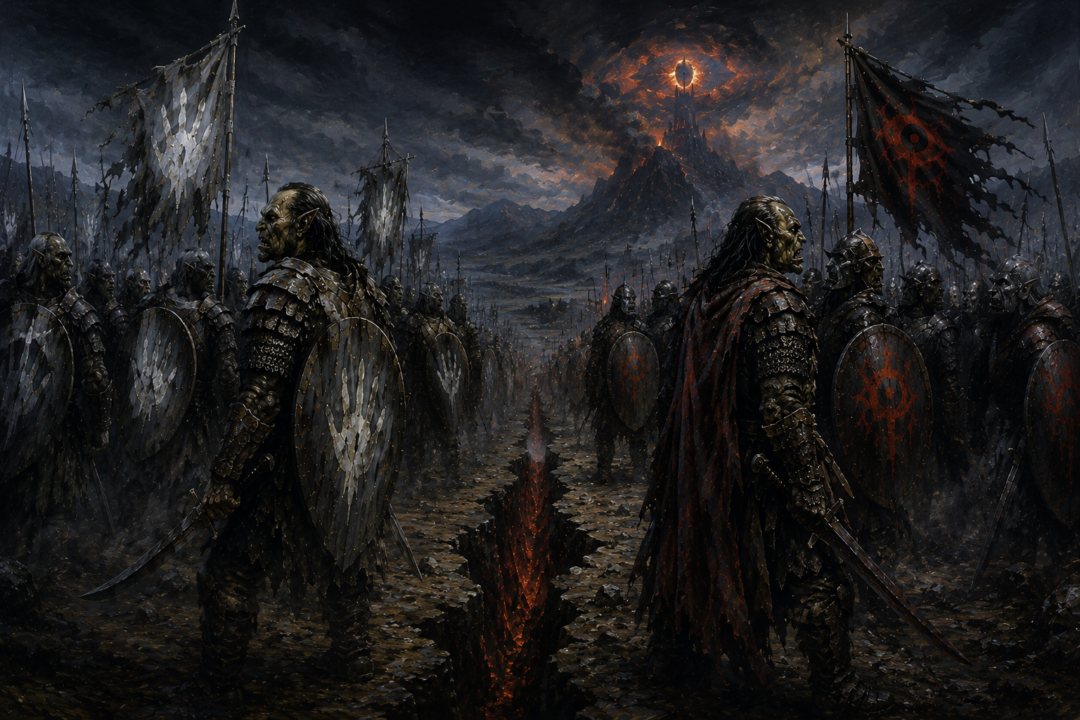
Saruman’s forces are associated with the White Hand, and Grishnákh contemptuously refers to the Isengarders’ white badges while attacking Saruman’s pretensions. Elsewhere the forces of Isengard bear identifying marks connected with the White Hand and the white rune or letter associated with Saruman.
But notice the dramatic order of the quarrel.
Uglúk has already told everyone who he serves. He has already proclaimed his troops’ superiority. He has already said they came from Isengard. Grishnákh has already answered by attacking Saruman’s independence and asserting the watching power of Sauron.
The badge does not create the distinction. It confirms one already made audible.
That is the more interesting detail.
A soldier’s insignia can tell you which command he belongs to. Uglúk’s speech tells you what belonging to that command means to him.
He is proud of it.
Saruman Has Created More Than Another Orc Unit
The Isengarders repeatedly present themselves as an elite fighting body.
Uglúk calls them the “fighting Uruk-hai,” and Orcs of Isengard use similar language at Helm’s Deep. Their boasts emphasize endurance, aggression, and military confidence.
Care is needed here. “Uruk-hai” should not simply be treated as a word meaning “Saruman’s special breed” in every possible context. Appendix F connects uruk with the larger soldier-Orcs and gives Uruk-hai as an Orcish form, while large Uruks also serve Mordor. The terminology is broader and more complicated than a simple Isengard-only racial label.
What is unmistakable in these particular scenes, however, is that Saruman’s Isengarders claim a strong collective identity.
“We” did the fighting.
“We” captured the prisoners.
“We” serve Saruman.
“We” will decide the route.
Their speech sounds like the rhetoric of a military faction conscious of its own status. That does not prove Saruman deliberately trained them to speak in a particular manner, and the text never says that he did. But it does show that his troops have absorbed an identity based on service, strength, and superiority over other Orcs.
Grishnákh Reveals the Other Side of the Rivalry
Uglúk’s pride becomes even clearer because Grishnákh knows exactly where to attack it.
He does not merely insult Uglúk personally. He attacks Saruman.
Grishnákh portrays the wizard as treacherous and foolish, challenges the pretensions of his followers, and reminds the company that the Great Eye is watching. His language exposes the larger political situation behind the Orc quarrel.
Saruman is nominally operating within the war against the West, but he is pursuing the Ring for himself. Sauron has reason to distrust him. The Orc captains do not necessarily know every detail of their masters’ strategies, yet Grishnákh clearly understands that Isengard and Mordor are not straightforward allies.
That knowledge makes the prisoners dangerously valuable.
Merry and Pippin do not know where Frodo has gone, but their captors suspect that the hobbits may possess something important. Grishnákh’s later behavior strongly suggests that he has guessed more than he openly admits about the object being sought.
So the dispute over language, command, and destination is connected to the central struggle for the Ring.
The Enemy is divided because its servants imitate the rivalry of their masters.
Even Orcs Need a Common Speech
There is a further irony in the scene.
The Orcs require a shared language precisely because they are so divided.
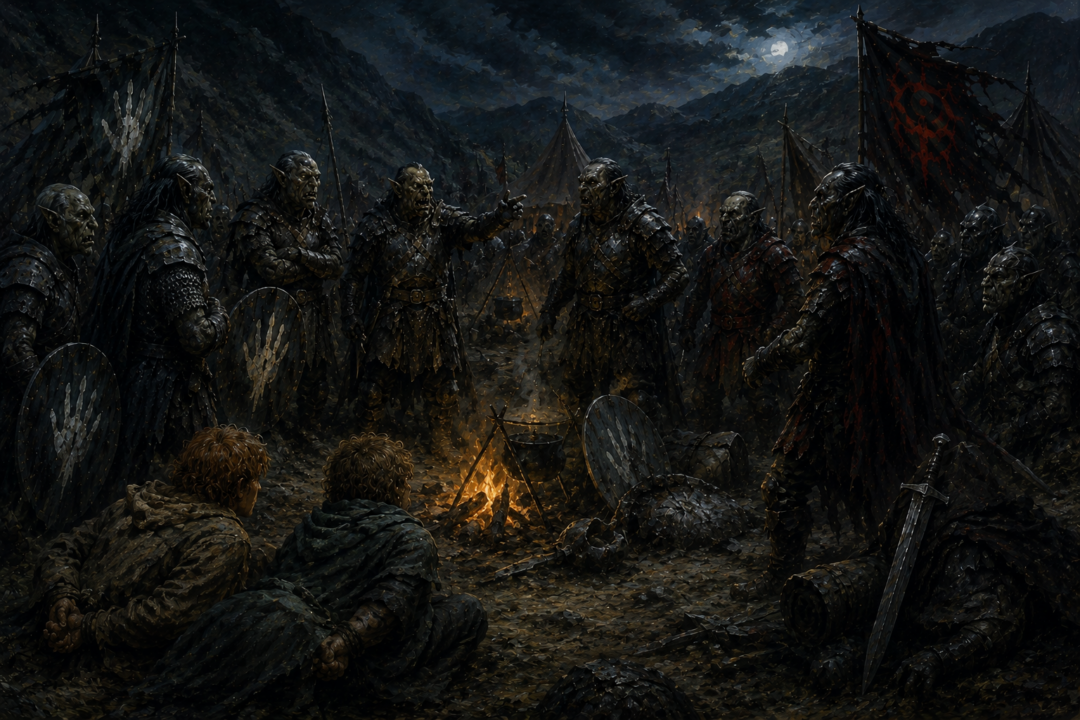
Appendix F describes Orcish speech as splintered into many dialects. The Common Speech therefore becomes useful among groups that otherwise might not understand one another. In the mixed company carrying Merry and Pippin, ordinary speech allows Isengarders, Mordor Orcs, and northerners to negotiate, threaten, insult, and issue orders across tribal boundaries.
The result is almost the opposite of fellowship.
The Free Peoples repeatedly cross linguistic and cultural boundaries through friendship, courtesy, shared purpose, and eventually sacrifice. The Orc companies also cross linguistic boundaries, but their shared speech exposes coercion and distrust.
They can understand each other perfectly well.
They simply do not trust each other.
That difference is one of the darkest features of the episode.
Speech Becomes a Kind of Heraldry
It would go too far to claim that every Isengarder can be identified by a unique accent. The text does not establish such a rule.
But affiliation is nevertheless audible.
Uglúk’s constant insistence upon Saruman, Isengard, the fighting Uruk-hai, his own authority, and the weakness of the other Orcs creates a verbal badge. Grishnákh does the same for Mordor through his invocation of the Great Eye, his hostility toward Saruman, and his competing orders.
Their words function almost like banners.
This is particularly effective because Merry and Pippin are prisoners. They cannot calmly inspect military insignia or study the organization of the army surrounding them. They learn by listening.
And what they discover is strategically important: their captors are divided.
The hobbits hear disagreements over orders, routes, masters, and authority. Those disagreements eventually become violence within the Orc company itself. Uglúk kills rebellious Orcs during one confrontation, and later Grishnákh acts independently in his attempt to discover what the hobbits know.
The fractures announced in conversation become fractures in action.
Saruman Cannot Build Loyalty Without Rivalry
There is a final irony in the Isengarders’ pride.
Saruman has produced servants who proclaim his name with confidence. They distinguish themselves from other Orcs and appear convinced of their own superiority. As instruments of war, that confidence is useful.
But the same identity that binds them to Saruman separates them from Sauron’s servants.
The White Hand competes with the Eye.
Uglúk’s “we” automatically creates a “they.”
This reflects a larger weakness of evil throughout the War of the Ring. Its servants can cooperate, but their cooperation is unstable because domination encourages rivalry. Saruman wants power for himself. Sauron expects obedience to himself. Their Orcs reproduce that conflict on a smaller scale.
That is why the mixed Orc company is so revealing.
Before a reader needs to study badges, the argument has already mapped the political landscape. One captain boasts of Isengard. Another sneers at Saruman and invokes the Eye. Lesser Orcs complain about orders and seek escape. Every voice tells us something about where power actually lies.
The White Hand is painted on the soldier.
But Isengard has already marked the way he speaks.
Sources & Notes
- The Encyclopedia of Arda, “Isengarders” — https://www.encyclopedia-of-arda.com/i/isengarders.html
- The Encyclopedia of Arda, “Half-orcs” — https://www.encyclopedia-of-arda.com/h/halforcs.html
- The Encyclopedia of Arda, “Dunlendings” — https://www.encyclopedia-of-arda.com/d/dunlendings.html
Reference entries document the characters, places, events, and textual details discussed in this article.