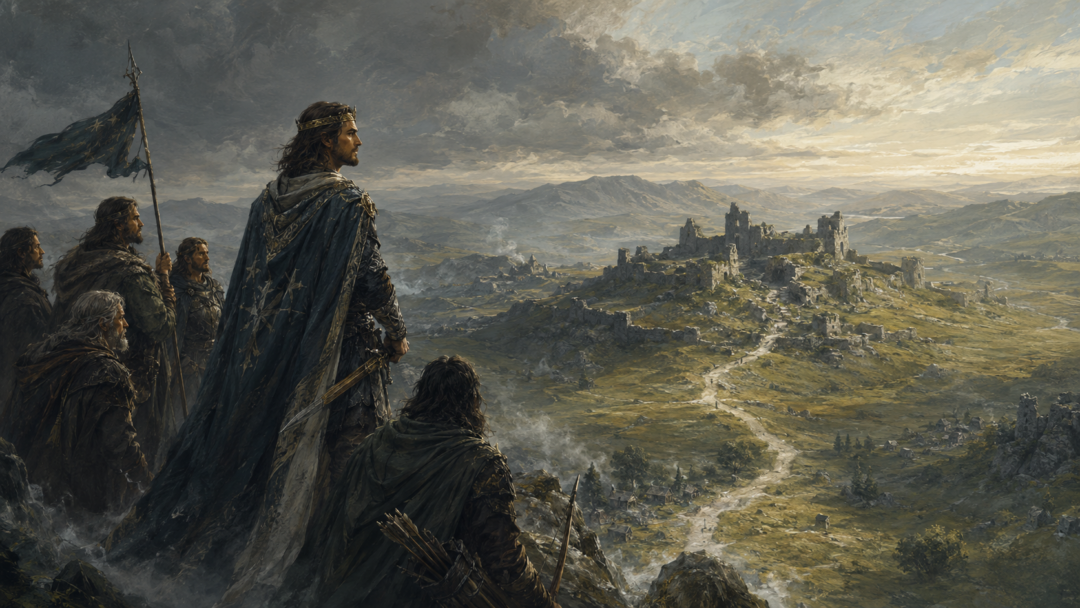
When Aragorn was crowned King Elessar, he did not inherit two functioning kingdoms.
Gondor still had Minas Tirith, provincial lords, armies, roads, a Steward, and an established machinery of government. Arnor had almost none of that. Its ancient capitals were ruins. Its royal line had survived only through the Chieftains of the Dúnedain. Much of Eriador was thinly settled, and places such as the Shire and Bree had spent centuries managing their own affairs.
Yet Elessar was crowned King of both Gondor and Arnor.
That creates an overlooked problem. How do you restore a kingdom whose king has returned before its cities, institutions, and population have returned with him?
The texts never give us a complete administrative blueprint for Fourth Age Arnor. But they do provide enough evidence to see the broad shape of the answer. The North-kingdom appears to have been restored first as a realm of royal authority, protected communities, inherited law, and local government. Its monumental rebuilding came afterward.
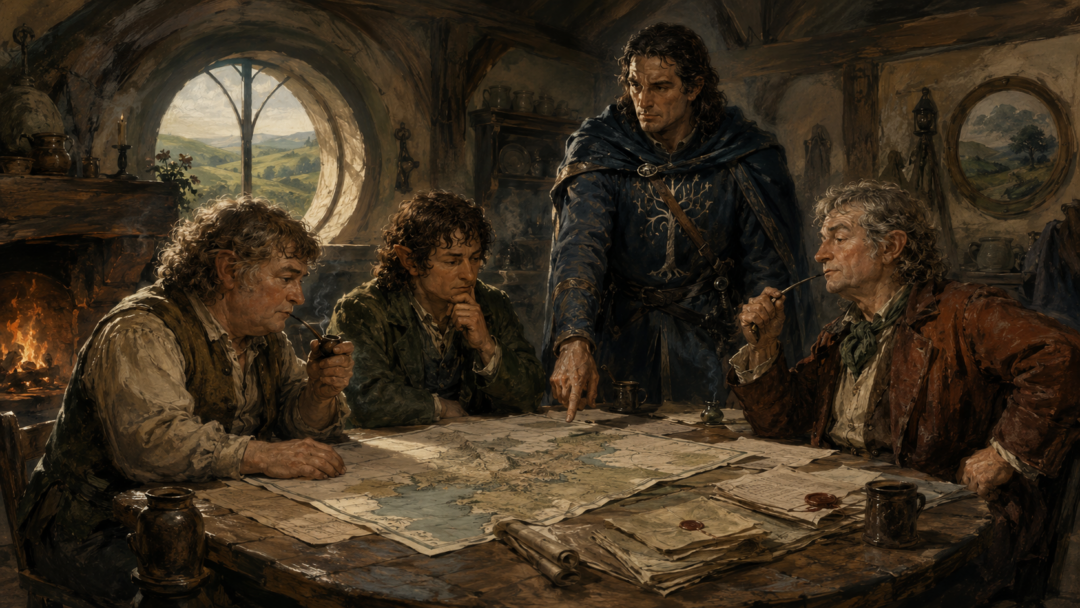
Arnor Was Restored Before Arnor Looked Like a Kingdom Again
The northern realm had been politically dead for roughly a thousand years by the War of the Ring.
The old Kingdom of Arnor had divided into Arthedain, Cardolan, and Rhudaur. Arthedain, the last surviving successor state, fell in T.A. 1974. Fornost became a ruin, later called Deadmen’s Dike. Annúminas had already been abandoned much earlier.
The surviving northern Dúnedain did not establish another city-state. They became a secretive and wandering people led by the Chieftains of the Dúnedain, preserving the line of Isildur while protecting Eriador from dangers that most inhabitants barely understood.
Aragorn therefore inherited a claim, a people, a history, and a territory—but not a functioning northern capital.
His coronation nevertheless restored the kingship immediately. He possessed the hereditary right of Isildur’s line, and Elrond later delivered to him the Sceptre of Annúminas, the chief token of the North-kingdom’s royal authority.
This matters because Arnor did not have to wait for walls and palaces before it could exist again politically.
The king came before the city.
The Northern Dúnedain Were the Obvious First Framework
The most natural human structure available to Elessar in the North was the community he had already led for decades.
Before becoming king, Aragorn had been Chieftain of the Dúnedain. The Rangers of the North were not merely anonymous wanderers. They were the surviving descendants and retainers of the old northern people, operating across Eriador and guarding regions such as the Shire without public recognition.
The texts do not tell us that Aragorn formally converted Ranger companies into royal provincial officials, magistrates, or governors. Claiming that would go beyond the evidence.
But the continuity is difficult to ignore.
The same people who had preserved the heirs of Isildur, patrolled the wilderness, and maintained knowledge of the old realm were already positioned to serve the restored king while northern settlement was still recovering.
One reasonable reading is that the early Reunited Kingdom did not need to invent authority in Arnor from nothing. It regularized authority that had survived in hidden form.
The Chieftain had become King. The wandering Dúnedain were no longer guardians of a vanished kingdom; they were subjects and servants of a restored one.
The Shire Shows What Elessar’s Northern Rule Could Look Like
The clearest evidence for Elessar’s governing style in Arnor comes from the Shire.
The Hobbits had lived under extraordinarily light government even before the War of the Ring. Families largely handled their own affairs. Their principal offices included the Thain, the Mayor, and the Master of Buckland, while Shirriffs provided the closest thing to ordinary policing.
More importantly, the Hobbits still connected their ancient laws with the lost kings of the North.
That old memory suddenly became politically relevant when the King returned.
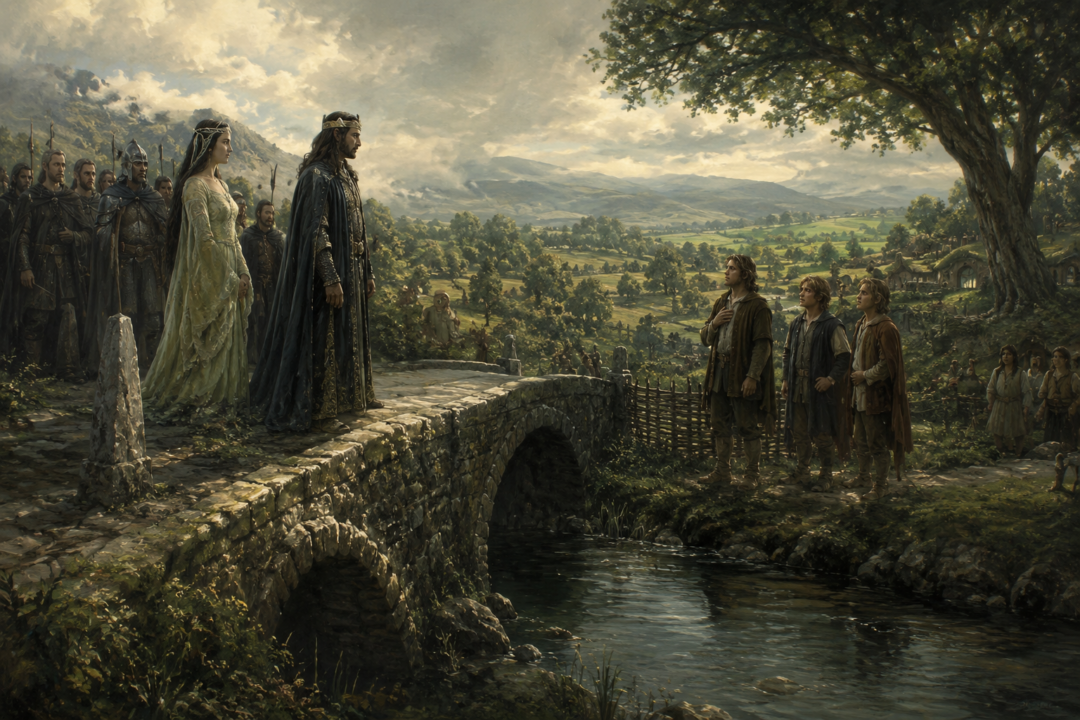
In the sixth year of the Fourth Age, Elessar issued an edict making the Shire a Free Land under the protection of the Northern Sceptre and forbidding Men from entering it.
That decision reveals something fundamental about the restored Arnor.
Elessar did not interpret royal restoration as an excuse to replace local institutions with direct royal administration.
He did almost the opposite.
The Shire received stronger protection while retaining extraordinary internal independence. The king asserted sovereignty and simultaneously limited the practical reach of his own people.
That is a remarkably useful model for understanding early Arnor: central kingship without compulsory centralization.
Royal Authority Could Exist Without Permanent Royal Presence
Elessar’s main seat immediately after the War of the Ring was necessarily in the South.
Minas Tirith was the great functioning capital of Gondor, and the early years of his reign involved enormous southern responsibilities: repairing the realm, settling relations with Rohan and other peoples, dealing with former enemies, restoring Ithilien, and securing territories affected by the war.
There is no evidence that Aragorn immediately abandoned Gondor to establish a permanent northern court.
Indeed, Appendix B only records his major northern journey to dwell for a while near Lake Evendim in the fifteenth year of the Fourth Age.
That creates a period of more than a decade in which Arnor existed under its restored king even though he was not permanently residing in an ancient northern capital.
This was not necessarily unusual by the political standards of Middle-earth. Royal power did not require the king to sit personally in every region he ruled.
What mattered was recognition of the crown, functioning intermediaries, protected roads and settlements, and authorities capable of acting locally.
The surviving communities of Eriador already had many of those structures.
The Council of the North-kingdom Is Our Best Clue
An especially important event occurred in Fourth Age 13.
Elessar made the Thain, the Master of Buckland, and the Mayor of the Shire Counsellors of the North-kingdom.
At that time, these offices were held by Peregrin Took, Meriadoc Brandybuck, and Samwise Gamgee.
This is one of the few explicit glimpses we receive of the political architecture of restored Arnor.
It tells us that there was such a thing as counsel associated specifically with the North-kingdom, and that Elessar was willing to incorporate existing local authorities into it.
The text does not describe the size of this council, its meeting place, its precise jurisdiction, or whether the three Hobbit offices automatically retained their council seats forever.
But the principle is clear.
Arnor was not simply being governed as a distant military province from Minas Tirith. Northern communities could participate in the political life of the restored realm through their own recognized leaders.
This suggests a layered system: the King at the top, regional or local institutions beneath him, and councillors connecting those communities to royal authority.
Bree Was Probably Governed Through Continuity, Not Conquest
Bree-land presents another revealing case, although the evidence is thinner.
Bree and its neighboring settlements had survived for centuries without an active northern monarchy. They had their own social order, trade, property, and local customs. Nothing in the postwar texts suggests that Elessar marched in administrators and replaced these arrangements.
Gandalf’s conversation with Barliman Butterbur in “Homeward Bound” instead emphasizes renewal. He predicts that the King will come north again and that fair folk will once more travel through the region.
The emphasis is on safety, roads, population, and restoration.
The conservative inference is that places such as Bree continued managing ordinary local life while coming once again beneath recognized royal protection and law.
Anything more specific—such as named royal governors, tax collectors, or permanent garrisons—would be invention.
Rebuilding Arnor Meant Rebuilding Population and Roads Too
The phrase “rebuilding Arnor” can create a misleading picture of masons repairing a palace while the kingdom waits outside.
The real challenge was larger.
Northern Eriador had suffered repeated demographic collapse through war, plague, invasion, and centuries of insecurity. The old urban network could not simply be switched back on.
A functioning kingdom required people willing to settle the land, cultivate farms, travel roads, reopen trade, and inhabit places that had become wilderness or haunted ruins.
This makes Gandalf’s prediction concerning Fornost especially important. He says that the King will come there again one day and that fair folk will ride through Bree.
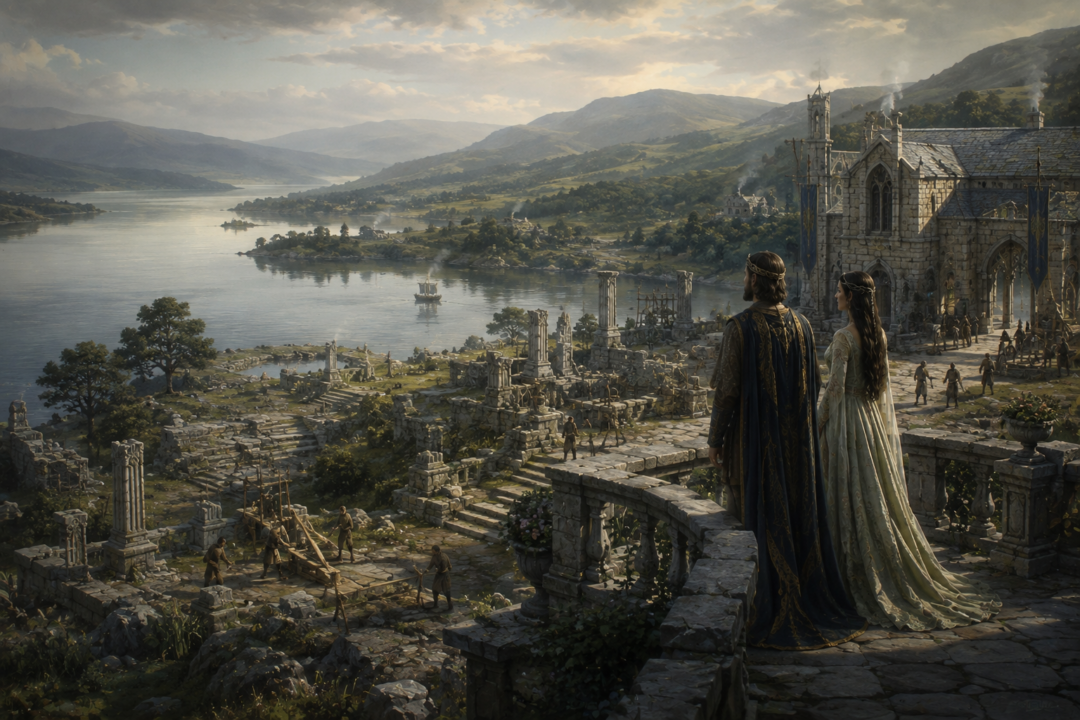
Fornost’s actual reconstruction is never narrated in detail, so its exact Fourth Age history should not be overstated. Annúminas is firmer ground: Elessar is recorded as coming north and dwelling for a while by Lake Evendim, and later tradition associated him with a restored house there.
The surviving chronology therefore suggests gradual revival rather than instant restoration.
First came legitimate kingship.
Then protection and political integration.
Then increased settlement and the return of royal presence.
Only with those foundations could ruined cities become living cities again.
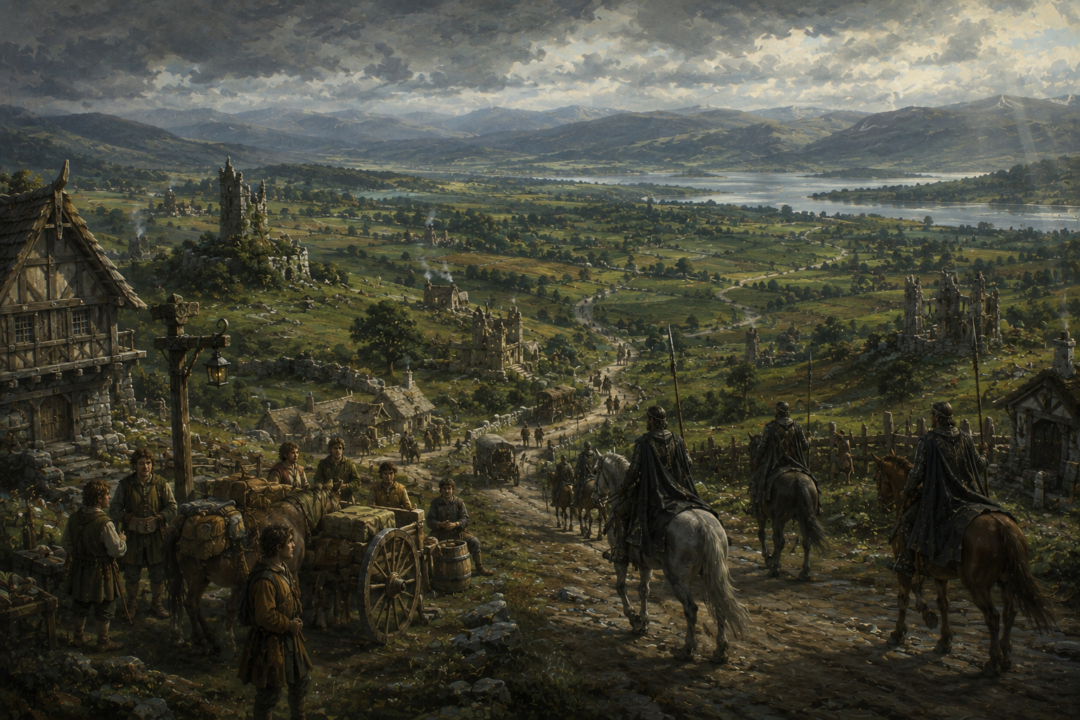
Elessar’s Northern Kingship Was Defined by Restraint
Perhaps the most striking feature of the evidence is what Elessar did not do.
He did not treat the return of the King as justification for erasing the thousand years during which northern peoples had learned to govern themselves.
The Shire remained the Shire. Its internal offices survived. Its borders were protected. Its leaders became royal counsellors. The king even obeyed his own prohibition against Men entering the country.
That example suggests the deeper character of the Reunited Kingdom.
Restoration did not mean pretending the Third Age had never happened.
Arnor returned under the heir of Isildur, but the North that received him was no longer Elendil’s Arnor. Its cities were ruined, its population transformed, and its surviving communities had developed their own traditions.
The success of the restored monarchy depended on recognizing that reality.
The northern kingdom could therefore exist before Annúminas or Fornost fully rose again because its most important structure was not stone.
It was allegiance.
The crown supplied legitimacy, defense, common law, and connection to the wider Reunited Kingdom. Local communities supplied the everyday institutions through which people actually lived.
Only later could the physical landscape catch up with the political restoration.
That may be the most fitting way Arnor could have returned: not through a king forcing the past back into existence, but through the old kingship quietly taking responsibility for a North that had survived without it.
Sources & Notes
- https://www.glyphweb.com/arda/r/reunitedkingdom.html — The Encyclopedia of Arda: Elessar’s reunification of Arnor and Gondor and the political extent of the restored kingdom
- https://www.glyphweb.com/arda/a/arnor.html — The Encyclopedia of Arda: Arnor’s breakup, loss of its royal line in the North, depopulation, and eventual restoration
- https://www.glyphweb.com/arda/a/annuminas.html — The Encyclopedia of Arda: Annúminas as Arnor’s old capital and its rebuilding under King Elessar
- https://www.glyphweb.com/arda/f/fornost.html — The Encyclopedia of Arda: Fornost’s history as a northern royal city, its fall, abandonment, and later restoration
- https://www.glyphweb.com/arda/a/aragorn.html — The Encyclopedia of Arda: Aragorn Elessar’s northern lineage, accession, journeys, and rule of the Reunited Kingdom
Sources document Arnor’s fall and restoration, its old capitals, and Elessar’s accession and rule.