Andúril hardly seems like a sword that needs improving.
It is Narsil remade: the ancient blade of Elendil, broken beneath him in the overthrow of Sauron and preserved through the long centuries by his heirs. Before the Fellowship leaves Rivendell, the sword is forged anew. Its blade bears the Seven Stars between the crescent Moon and the rayed Sun, together with many runes. Aragorn names it Andúril, the Flame of the West.
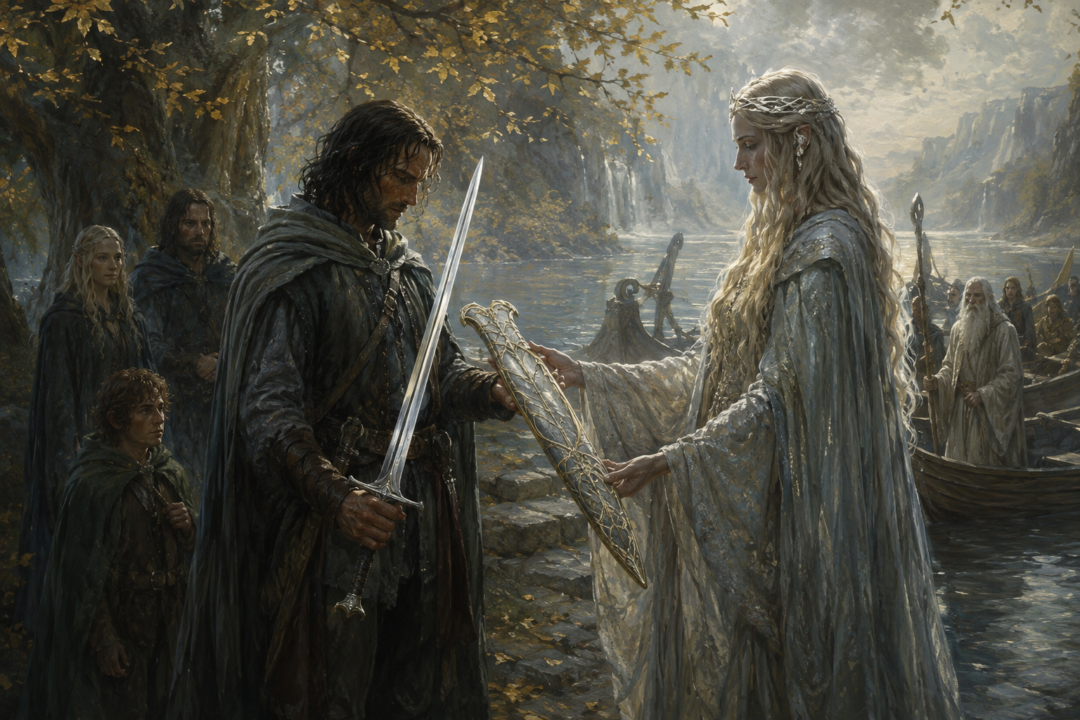
Then, in Lothlórien, Galadriel gives Aragorn something apparently far less dramatic.
A sheath.
Yet the gift does something remarkable. It does not make Andúril sharper. It does not give Aragorn greater strength. It does not replace the sword's history.
Instead, it gives the sword something its own extraordinary pedigree cannot provide: protection against another breaking, an explicit declaration of its lineage, and—on a symbolic level—a transformation from a recovered relic of defeat into an heirloom prepared for the future.
Andúril Is Already a Monument to the Past
To understand the sheath, we first have to notice what Andúril represents before Aragorn reaches Lórien.
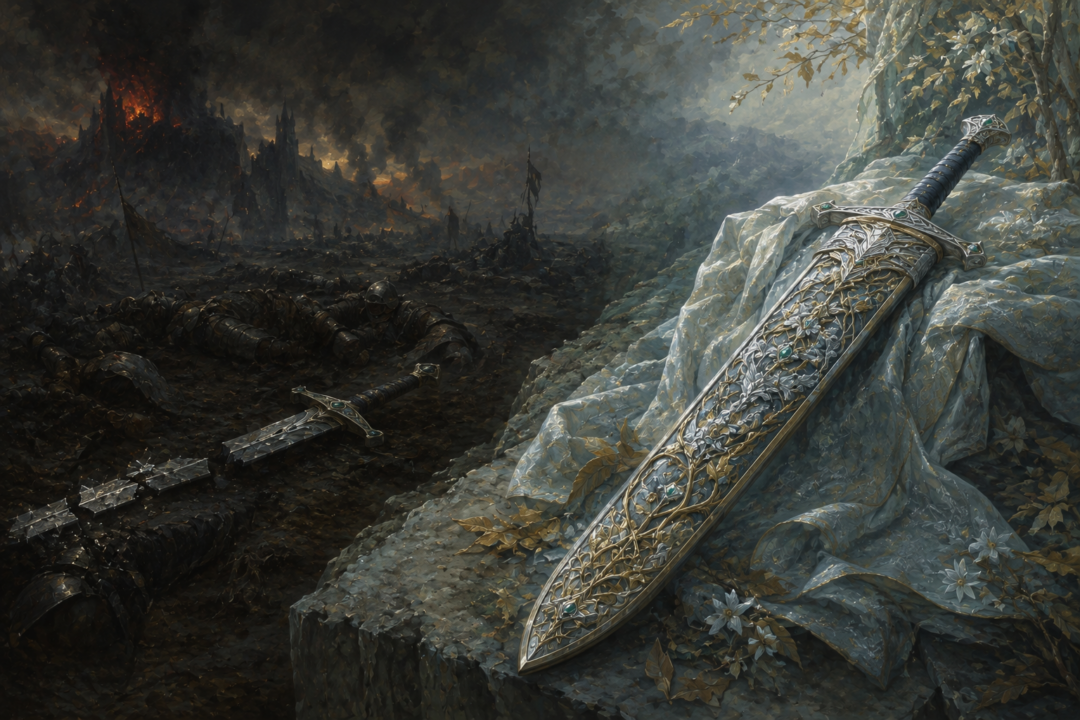
Narsil was forged by Telchar of Nogrod, the famous Dwarven smith of the First Age. Much later it became the sword of Elendil, High King of the Dúnedain in exile.
Its defining moment, however, was also a catastrophe.
Elendil fell in the final struggle against Sauron, and Narsil broke beneath him. Isildur then took the hilt-shard and cut the One Ring from Sauron's hand.
That made the broken sword inseparable from both victory and disaster.
Sauron was overthrown, but not permanently defeated. Isildur claimed the Ring instead of destroying it and was later killed. The northern kingdom eventually fragmented and fell. Elendil's royal line survived, but for centuries its heirs lived not as kings in restored realms but ultimately as the Chieftains of the Dúnedain.
The shards of Narsil therefore carry a strange double meaning.
They prove Aragorn's descent from the ancient kings, but they also embody everything his house has lost.
When Boromir comes to Rivendell, the prophetic words that have driven him north speak of the Sword that was Broken. Aragorn possesses exactly that object.
But possession of an inheritance is not the same thing as fulfilling it.
Rivendell Makes the Broken Sword Whole
That changes before the Fellowship departs.
The Elven-smiths reforge Narsil, and Aragorn renames the restored blade Andúril. The reforging is one of the clearest outward signs that Aragorn's long period of waiting is ending.
He is no longer merely carrying the fragments of his ancestors.
He is going to war with their sword made whole.
Its decoration deliberately preserves dynastic meaning. The Seven Stars, Sun, and Moon connect it with Elendil and his sons, while the new name marks a new stage in the weapon's history.
This matters because Andúril is not simply Narsil repaired.
Its identity contains both continuity and renewal.
The old blade belonged to Elendil. The reforged blade belongs to Aragorn, who must accomplish something that inheritance alone cannot accomplish. He must prove himself capable of assuming the authority represented by the sword.
But one uncomfortable fact remains.
Narsil has been whole before.
And Narsil has been broken before.
Galadriel Addresses the Sword's Oldest Wound
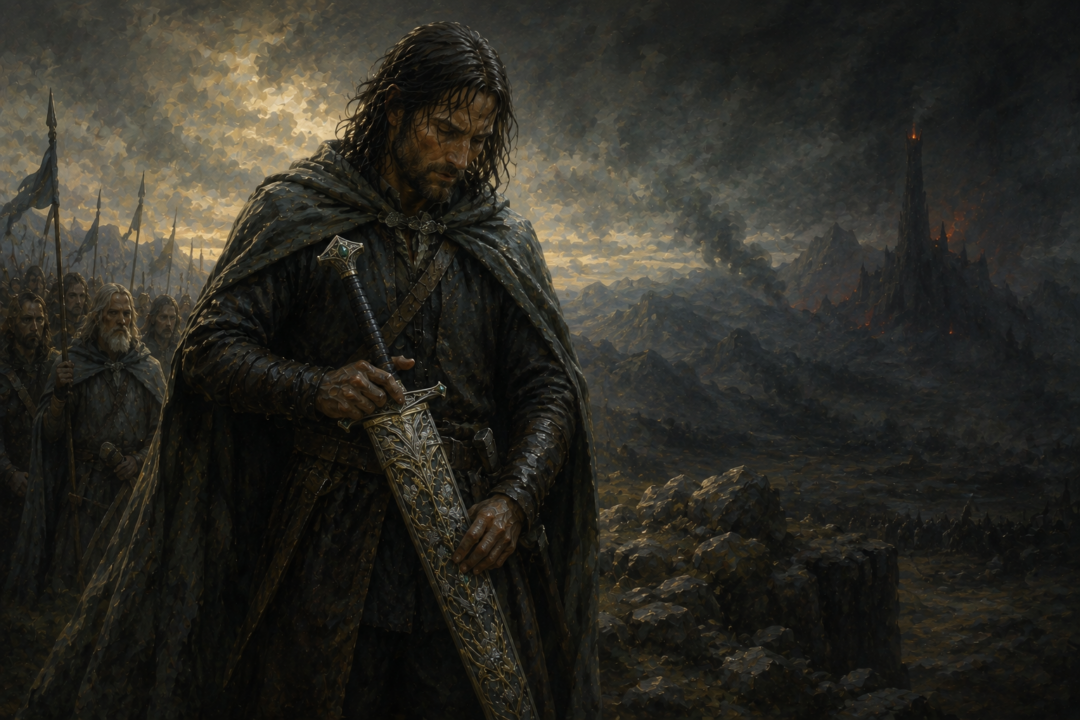
At the parting from Lórien, Galadriel gives Aragorn a sheath specially made for Andúril.
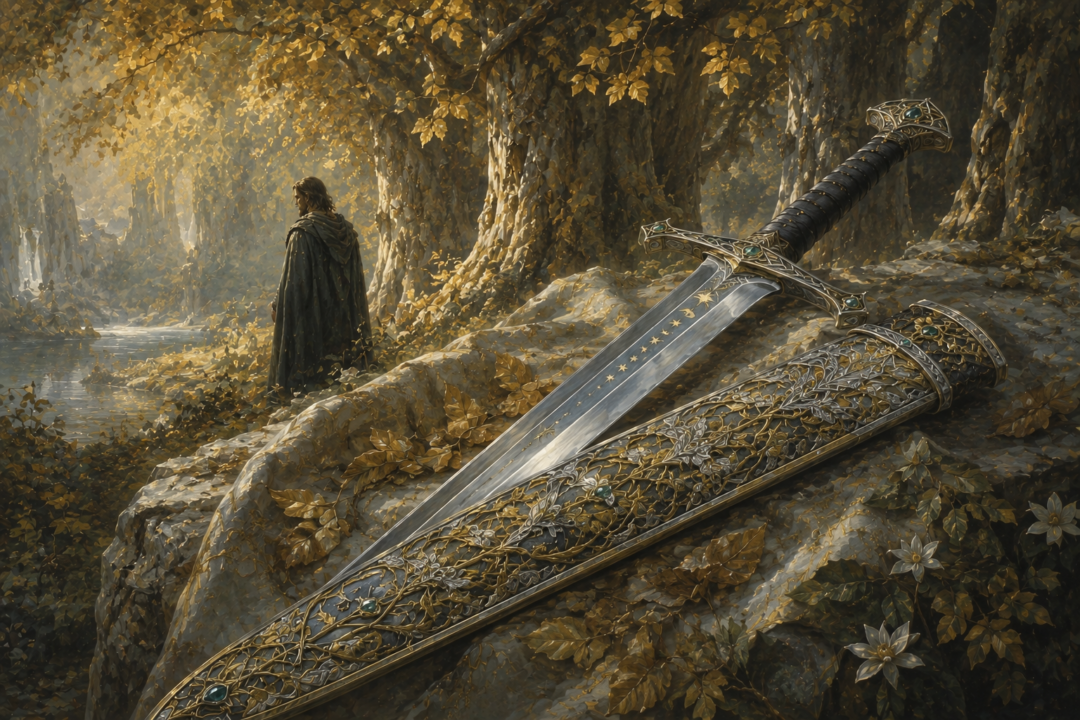
The description is unusually elaborate for an object whose ordinary function would be purely practical. It is decorated with flowers and leaves worked in silver and gold. Gems form Elven runes recording Andúril's name and the lineage of the sword.
Then Galadriel explains its special virtue: a blade drawn from this sheath will not be stained or broken, even in defeat.
That promise strikes directly at Narsil's history.
The sword's most famous physical failure was that it broke when Elendil fell. Galadriel's gift answers precisely that vulnerability.
This does not mean Aragorn has suddenly been promised victory in every battle. Galadriel's wording actually allows for the possibility of defeat.
That distinction is crucial.
The gift does not remove danger from Aragorn's road. It protects the sword within that danger.
Andúril may enter defeat, but it will not repeat Narsil's fate.
The heirloom that once came out of disaster shattered is now protected against being shattered again.
The Sheath Does Not Make Aragorn Invincible
It would be easy to exaggerate the gift into something the text never claims.
Galadriel does not say that Aragorn cannot be wounded or killed while carrying Andúril. She does not promise that he cannot lose a battle. Nor does the sheath appear to grant offensive power to the sword.
Its stated protection concerns the blade.
That restraint makes the gift more interesting.
Middle-earth repeatedly distinguishes between possessing great objects and being personally immune to suffering. Aragorn still has to make decisions under uncertainty. He still takes the Paths of the Dead without a guarantee that his plans will succeed. He still marches to the Black Gate knowing that the military confrontation there cannot defeat Sauron's power by force alone.
The sheath therefore does not cancel Aragorn's courage by removing risk.
It preserves something entrusted to him while leaving the bearer mortal.
That is a very different kind of power.
The Sword Gains a Written Identity
The sheath also adds something that is easy to overlook because the promise against breaking is so memorable.
It names the sword and records its lineage.
Andúril's blade already bears significant devices and runes, but Galadriel's sheath explicitly carries both the name Andúril and the sword's descent.
The object surrounding the weapon becomes a declaration of memory.
That is particularly fitting for Aragorn.
His claim does not rest merely upon being a formidable warrior. He is the heir of a particular line, carrying a particular history. His identity connects the wandering Ranger of the North to Isildur, Elendil, the Númenórean kingdoms in exile, and ultimately the long history of the Dúnedain.
The sheath turns that continuity into something visibly attached to the sword.
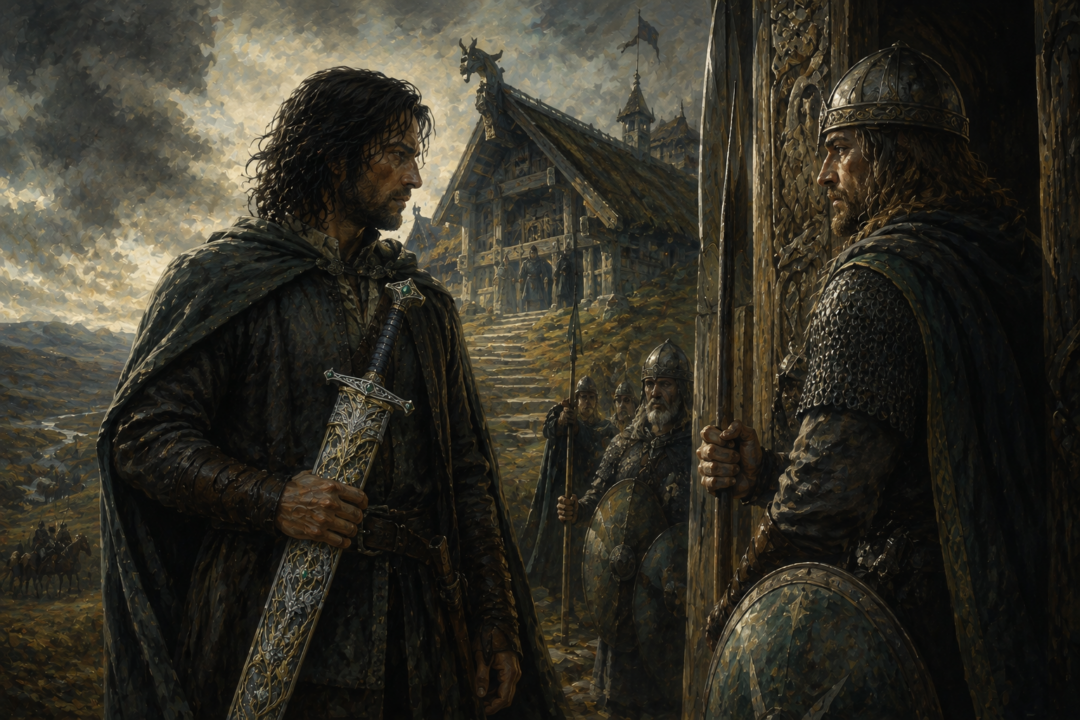
When Aragorn later refuses to surrender Andúril casually at Meduseld, he identifies what rests in the Elvish sheath as the Blade that was Broken and remade. He also invokes its ancient making and declares that no man except Elendil's heir may draw Elendil's sword without deadly consequence.
The sheath and sword together have become almost a portable statement of identity.
Flowers and Leaves Around a Weapon of War
There is another contrast worth noticing, though it should be treated as interpretation rather than explicit authorial explanation.
Andúril is a weapon. Its story is bound to battles, fallen kings, Sauron's overthrow, and Aragorn's coming war.
Galadriel's sheath surrounds it with flowers and leaves of silver and gold.
That imagery belongs naturally to Lórien, a realm repeatedly associated with trees, leaves, preservation, beauty, and memory. The same departure from Lórien includes leaf-shaped brooches and other works in which practical craftsmanship and natural forms meet.
One reading, therefore, is that Andúril leaves Lórien carrying something of Lórien with it.
The sword embodies restored martial power.
The sheath encloses that power within beauty, memory, and preservation.
This does not make the weapon less dangerous. Instead, it visually places violence inside a larger purpose.
Aragorn is not seeking kingship merely so that he can wield a famous sword. His road ultimately points toward restoration: the return of legitimate rule, renewed realms, marriage, healing, and the possibility of peace after war.
The flowers around Andúril do not prove that interpretation by themselves, but they fit remarkably well with the direction of Aragorn's story.
Galadriel Gives Aragorn More Than One Sign of His Future
The timing of the sheath matters because it is immediately followed by another deeply personal gift.
After giving Aragorn the sheath, Galadriel asks whether he desires anything else. Aragorn answers indirectly, referring to the treasure he seeks but which Galadriel cannot give him.
That treasure is Arwen.
Galadriel then produces the green stone that had passed from her to Celebrían and from Celebrían to Arwen. She gives it to Aragorn as a token of hope and names him Elessar, the Elfstone of the House of Elendil.
The two gifts belong together in the scene.
One accompanies the sword of his ancestry.
The other points toward the life and identity he hopes to attain.
And that combination captures Aragorn more completely than Andúril alone ever could.
He is certainly a warrior and Isildur's heir. But his destiny is not completed merely by defeating enemies. He seeks Arwen, kingship, and a restored realm.
Galadriel's gifts acknowledge both the burden inherited from the dead and the future for which Aragorn is willing to pass through darkness.
A Sword Can Prove Descent; It Cannot Complete a King
This may be the deepest thing the sheath adds to Andúril.
The sword looks backward.
Its authority comes overwhelmingly from what it has been: Telchar's work, Elendil's weapon, Narsil broken in the war against Sauron, the heirloom preserved by Elendil's descendants, and finally the Sword Reforged.
The sheath is new.
It is made specifically for Andúril and given specifically to Aragorn as leader of the Company.
In that sense, the sword is inheritance while the sheath is preparation.
One tells Aragorn where he comes from.
The other prepares what he carries for the road ahead.
This interpretation should not be pushed into a rigid magical rule Tolkien never states. The text never says that Galadriel intended the sheath as a formal symbol of kingship or that Aragorn required it to become king.
But narratively the pattern is striking.
Narsil survives for thousands of years as a broken memory. Andúril emerges when Aragorn begins openly moving toward the fulfillment of his inheritance. Then Lórien gives the renewed sword a covering that preserves it from repeating its ancient destruction and openly displays its lineage.
The past has not been discarded.
It has been made ready to survive the future.
What Andúril Lacks
Andúril already possesses almost everything a legendary sword could possess.
Ancient craftsmanship. A heroic lineage. A famous name. Beauty. Sharpness. Historical authority. The memory of victory over the Dark Lord himself.
What it lacks is protection from its own history.
Galadriel's sheath supplies exactly that.
Narsil was the sword that broke when a king fell.
Andúril becomes the sword whose sheath carries a promise that, even in defeat, the blade will not be broken.
That difference captures something essential about Aragorn's entire inheritance. He cannot undo Elendil's death, Isildur's failure, the ruin of Arnor, or the long decline of the Dúnedain. He does not receive a history without wounds.
He receives the wounded history itself.
His task is to carry it forward without allowing it to break again.
And that is why Galadriel's seemingly modest gift matters so much. She does not give Aragorn a greater weapon.
She gives the broken sword's heir something the sword could never give itself:
the promise of wholeness through whatever darkness comes next.
Sources & Notes
- https://www.glyphweb.com/arda/a/anduril.php — The Encyclopedia of Arda: Andúril’s reforging at Rivendell from the shards of Narsil, its name “Flame of the West,” and its identity as Aragorn’s sword.
- https://www.glyphweb.com/arda/n/narsil.php — The Encyclopedia of Arda: Narsil’s making by Telchar, Elendil’s fall and the sword’s breaking, Isildur’s use of the shard, and the blade’s eventual reforging.
- https://www.glyphweb.com/arda/t/telchar.php — The Encyclopedia of Arda: Telchar of Nogrod’s First Age smithcraft and the attribution of Narsil to him.
- https://www.glyphweb.com/arda/g/galadriel.php — The Encyclopedia of Arda: Galadriel’s history, power, and rule in Lórien, contextualizing her authority and her parting gift to Aragorn.
Sources document Narsil’s maker, breaking and reforging as Andúril, and Galadriel’s Lórien context for the sheath’s protective and dynastic significance.