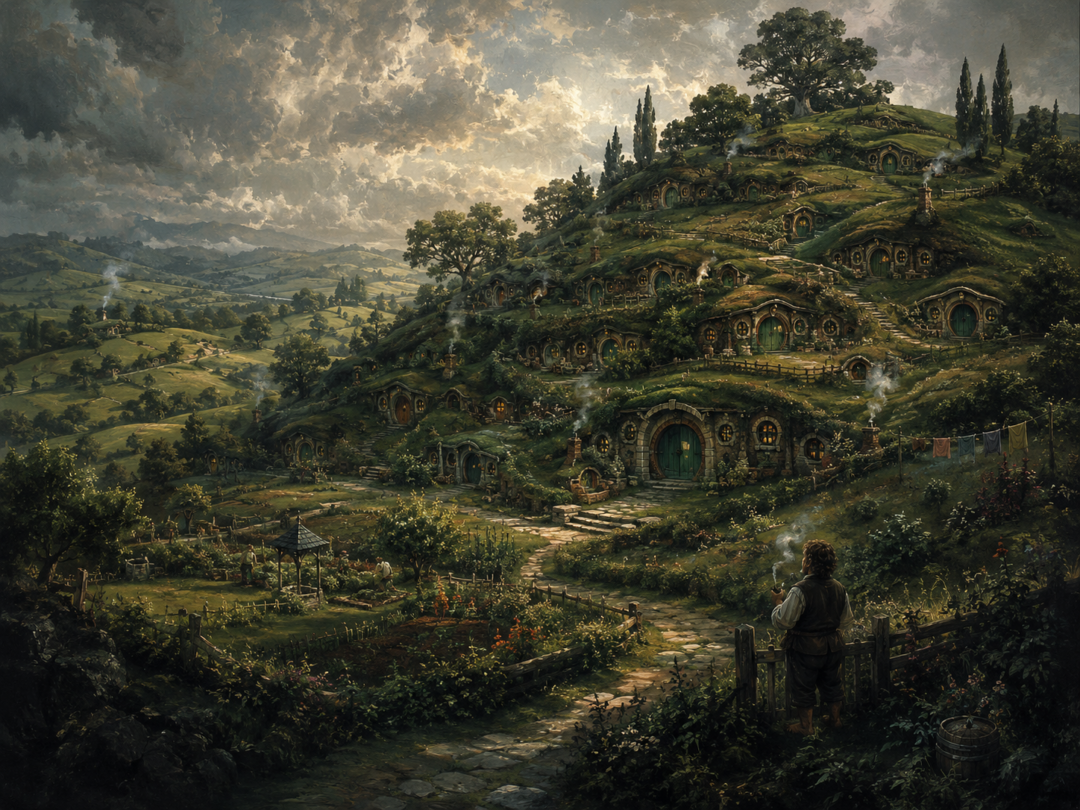
Bag End is famous because it belongs so unmistakably to one hobbit. Bilbo fills it with his books, possessions, meals, grudges, guests, and eventually the consequences of his adventure.
The Great Smials are something different.
Burrowed into the Green Hills at Tuckborough, they are not merely a particularly large hobbit-hole. They are the ancestral seat of the Took family: a place where one of the Shire’s largest and wealthiest clans lives around a hereditary center of authority. The distinction matters, because the Tooks are not simply relatives who happen to share a surname. Their family possesses territory, inherited prestige, a recognized head, and—through the Thainship—one of the oldest offices in the Shire.
The texts never provide an architectural plan of the Great Smials, nor do they tell us which branch of the family occupied which tunnel. Any claim about exact spatial ranking would therefore go beyond the evidence.
But the larger pattern is striking.
At Tuckborough, ancestry is not merely remembered in family trees. It has become a place.
The Tooks Are a Family, but Also an Institution
The Shire has remarkably little government.
Its inhabitants generally manage their own affairs, and the office of Thain has lost much of the practical military importance it once possessed. Yet certain families carry enormous social weight, and none embodies that system more clearly than the Tooks.
The Prologue to The Lord of the Rings describes them as both numerous and exceptionally wealthy. Most of them remained concentrated in Tookland, the family’s traditional territory in the Westfarthing, with the Great Smials at Tuckborough as their ancestral home.
That concentration is important.
Many hobbit families are extensive, and genealogy matters throughout the Shire. But the Tooks combine several different forms of continuity: blood relationship, landed geography, wealth, family leadership, and hereditary public office.
Even the name “Tookland” reveals the degree to which family and place have fused.
The Great Smials stand at the center of that fusion.
They are not described as a palace, and it would be misleading to treat the Tooks as miniature feudal lords. The Shire does not operate like Gondor or Rohan. Yet within its deliberately informal society, the Tooks possess something unusual: a physical seat around which generations of the same powerful clan are organized.
Kinship has acquired an address.
Why the Great Smials Matter More Than an Ordinary Hobbit-Hole
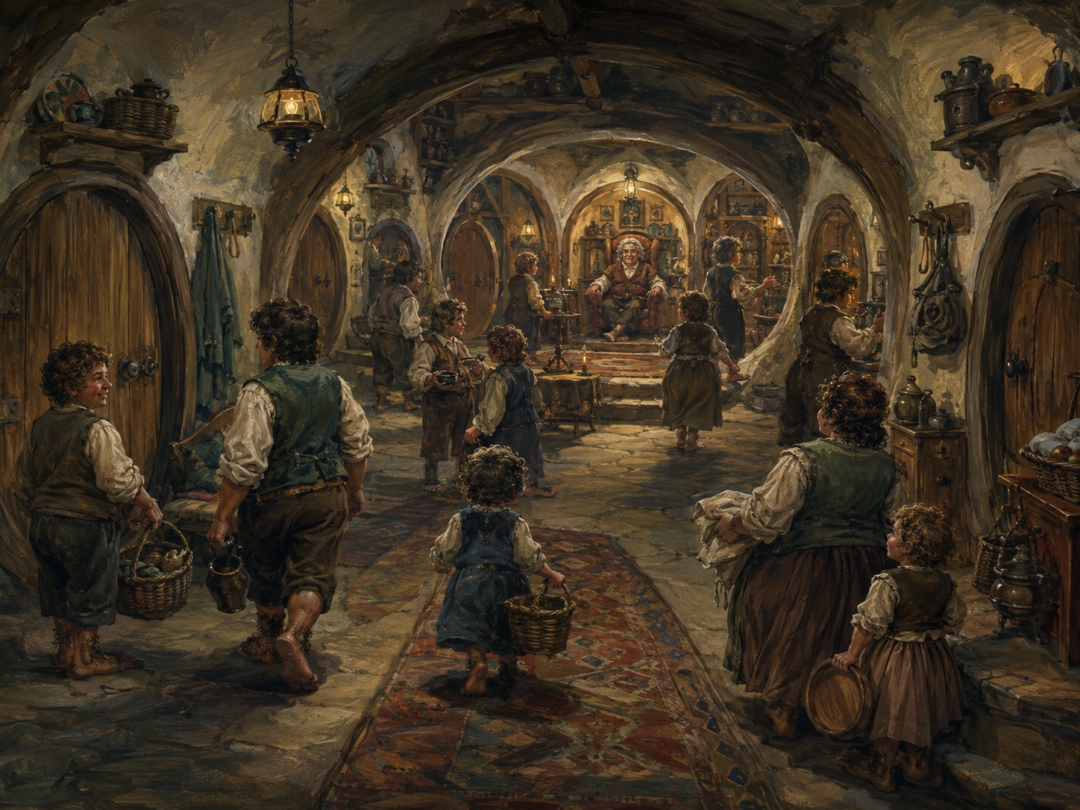
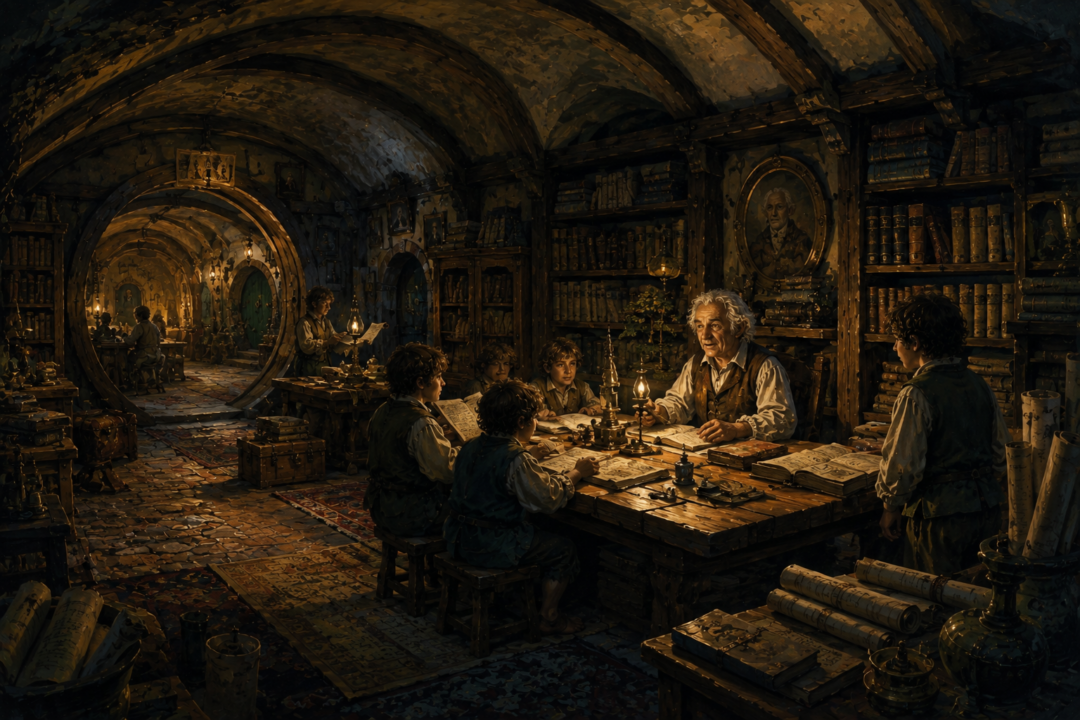
Hobbit-holes began as a normal form of dwelling, but the richer hobbits developed large and elaborate smials containing numerous rooms and branching passages.
The Great Smials represent that tradition on an exceptional scale.
They were begun by Isengrim Took II in Shire-reckoning 1083, or Third Age 2683. Their very survival across generations gives them a different meaning from a house constructed for one nuclear family.
A dwelling such as Bag End can pass by inheritance, but the Great Smials belong to the continuing identity of an entire clan.
That makes their size socially meaningful.
A large ancestral residence can contain grandparents, children, cousins, widows, heirs, dependants, and collateral branches without dissolving the family into separate households scattered across the countryside. The texts do not specify exactly who occupied particular chambers at particular dates, so we should not invent a rigid residential system. But they do establish the Great Smials as the home and seat of the Tooks across many generations.
The effect is to make membership in the clan physically tangible.
A Took does not merely descend from earlier Tooks.
He or she inhabits a world excavated by them.
The Family Has a Head
The clearest evidence that Took kinship contains hierarchy comes not from architecture but from family custom.
The head of the family could be known simply as “the Took.”
That title alone tells us that the clan was imagined as more than a collection of equal households. One person could embody its senior position.
The distinction becomes especially revealing in the case of Lalia Clayhanger, widow of Thain Fortinbras II. After her husband’s death, their son Ferumbras III inherited the Thainship, but Lalia remained the formidable matriarch and head of the Took family until her own death.
This shows that two kinds of authority overlapped at the Great Smials without being identical.
There was the Thain, holder of a hereditary Shire office.
And there was the headship of the Took clan.
Usually these roles could coincide in the same household line, but they were conceptually separable.
That is exactly why the Great Smials are so interesting. They contain not simply “important hobbits,” but several layers of status generated by descent, seniority, inheritance, and office.
The architecture did not create those relationships by itself.
It gave them a permanent setting.
The Thainship Adds Public Rank to Private Kinship
The Thainship predates Took possession of the office.
After the fall of the northern kingdom of Arthedain, the Shire-hobbits chose a Thain to stand in for the absent royal authority, especially in matters of muster and defense. The office was first held by the Oldbuck line. When Gorhendad Oldbuck crossed the Brandywine and established Buckland, the Thainship passed to Isumbras Took I.
From then onward it remained hereditary among the Tooks for centuries.
By the late Third Age, the office was largely ceremonial because the Shire so rarely required military leadership. But ceremonial offices can still shape social structure precisely because they preserve remembered precedence.
The senior Took line was therefore not simply wealthy.
Its succession carried an office associated with the defense and ancient political order of the Shire.
The Great Smials consequently stood at the intersection of household and institution. The place where the leading Took family lived was also the seat associated with the hereditary Thains.
One should not imagine guards, throne rooms, or a bureaucratic court; none is described. The hierarchy is much more hobbit-like than that.
It exists through family expectation, inheritance, reputation, and custom.
Gerontius Took Shows How a House Can Become Memory
One of the most revealing descriptions of the Great Smials comes indirectly through Peregrin Took.
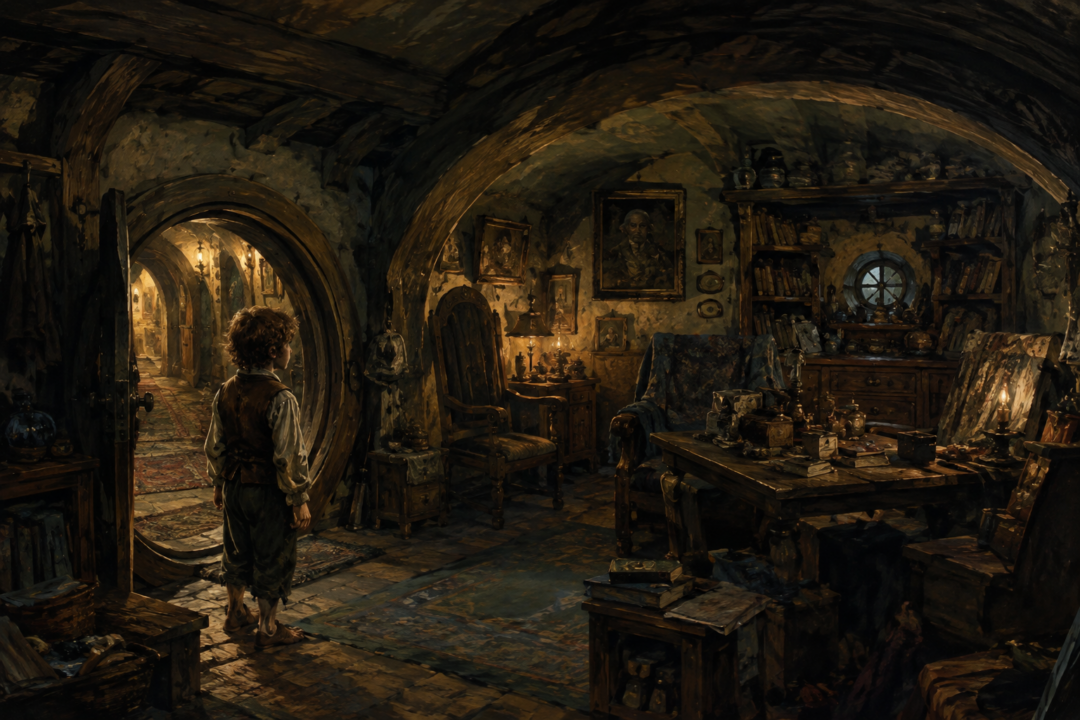
When Pippin encounters the ancient atmosphere of Fangorn, he recalls the room in which his great-grandfather Gerontius, the Old Took, had lived year after year. The room had grown old with him and remained essentially unchanged long afterward.
It is a small detail, but it reveals something fundamental about ancestral houses.
Rooms can outlive their occupants.
Objects remain where earlier generations placed them. Children grow up knowing which spaces belonged to famous grandparents. A family story no longer exists only as speech; it becomes attached to doors, furniture, passages, and chambers.
Gerontius was no obscure ancestor. The Old Took lived to 130, fathered twelve children, and became the center of an enormous network of descendants connecting many prominent Shire families.
His continuing presence in the memory of the Great Smials shows how physical space can preserve ancestry almost as effectively as a genealogy.
The dead remain socially present because their rooms remain.
A Family Tree Dug Into the Hill
Appendix C gives us the genealogical tree of the Tooks of Great Smials.
On paper, it spreads outward through marriages, siblings, descendants, and collateral lines.
The Great Smials suggest a physical counterpart to that genealogical structure.
This should not be taken literally. There is no textual evidence that tunnels were assigned according to genealogical rank or that senior branches occupied architecturally superior quarters. Tolkien gives us no such floor plan.
Yet the analogy remains useful.
A great ramifying smial and a great ramifying family tree perform similar cultural work. Both preserve continuity while allowing expansion.
New generations branch outward without entirely abandoning the ancestral center.
That may help explain why the Great Smials feel so different from merely being a wealthy residence. Their significance lies not just in size but in accumulated occupation.
The hill becomes a container for lineage.
The Scouring Reveals the Political Strength Hidden Inside the Household
The importance of this structure becomes clearest when the Shire finally faces coercion.
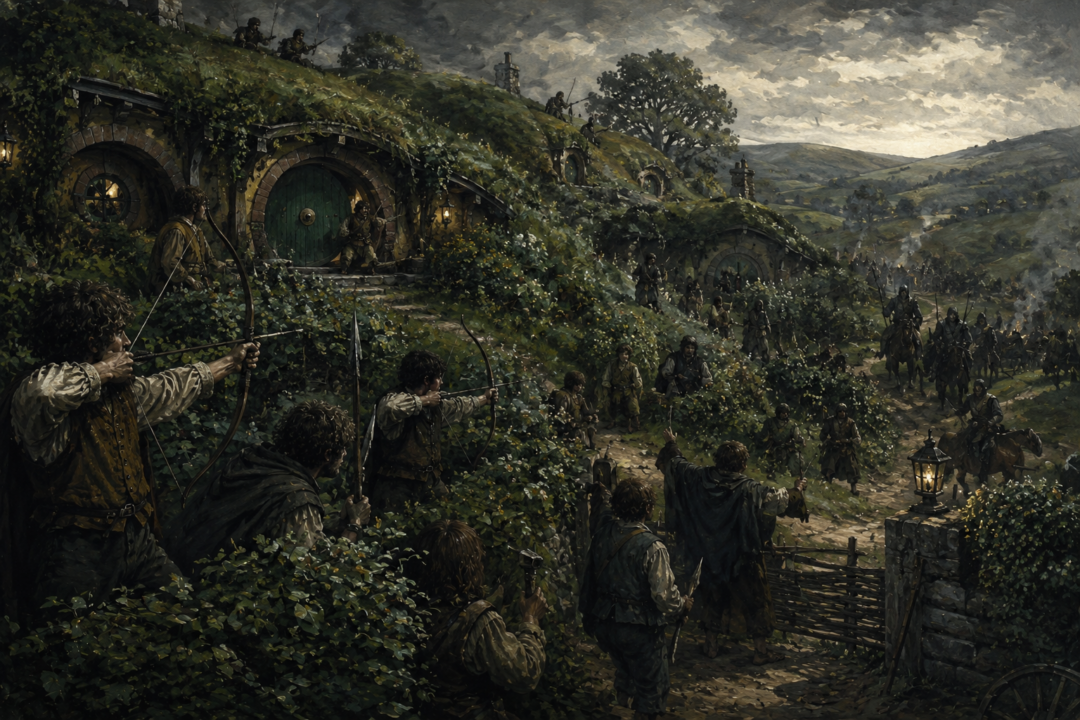
During the occupation by Saruman’s ruffians, the Tooks do not simply submit. They shut themselves into their country, defend the Smials, and resist intruders. Paladin Took II, then Thain, raises Tookland against the invaders.
When Peregrin returns, he rides to Tuckborough and brings back a substantial body of armed hobbits for the confrontation at Bywater.
Suddenly the old structures of clan, territory, and hereditary leadership become practically useful.
The Took family can mobilize because it is not merely a surname scattered across unrelated households. It remains numerous, geographically concentrated, socially organized, and connected to a recognized leader.
The Great Smials are therefore more than shelter in this episode.
They represent the durable center of a kinship network capable of collective action.
An institution that seemed quaint during peace becomes formidable during crisis.
From Ancestral Seat to Archive
After the War of the Ring, the significance of Great Smials changes again.
Peregrin eventually becomes Thain, and the Great Smials develops into one of the Shire’s most important repositories of historical material. Manuscripts and traditions connected with Gondor, Númenor, Elendil, and the wider history of Middle-earth are preserved there. The tradition surrounding the Thain’s Book likewise binds the Took seat to the preservation of memory.
This is an extraordinary final development.
The Great Smials begin as a monument to one family’s continuity and eventually become a place where memories far larger than that family are guarded.
The logic is surprisingly consistent.
First the Tooks preserve ancestors.
Then they preserve history.
Their hereditary center becomes an archive.
The Quiet Hierarchy Beneath the Shire
The Shire likes to imagine itself as a place suspicious of grandeur.
That is true.
Yet it is not socially flat.
Names matter. Wealth matters. ancestry matters. Old families matter. Certain households command more deference than others, even without kings, castles, or formal aristocratic ranks.
The Great Smials make that hidden structure visible.
Their tunnels bind generations to one ancestral center. Their occupants belong to a family with a recognized head. Their senior line inherits the Thainship. Their surrounding country bears the family name. In crisis, the same network can become a defensive force. Afterward, the ancestral seat becomes a repository of historical memory.
None of this requires imagining the Great Smials as a miniature palace.
Its power is subtler.
The Tooks have taken something ordinary in hobbit society—family—and enlarged it until kinship becomes geography, inheritance becomes office, memory becomes architecture, and a collection of relatives begins to resemble an enduring institution.
The Great Smials are therefore not impressive merely because they are large.
They are impressive because the hill itself seems to remember who belongs at its center.
Sources & Notes
- https://www.glyphweb.com/arda/g/greatsmials.html
- https://www.glyphweb.com/arda/t/thain.html
- https://www.glyphweb.com/arda/l/laliaclayhanger.html
- https://www.glyphweb.com/arda/t/tookland.html
- https://www.glyphweb.com/arda/i/isengrimtookii.html
Sources on the Great Smials, Tookland, the Thainship, their founder Isengrim Took II, and the distinct family authority illustrated by Lalia Clayhanger.