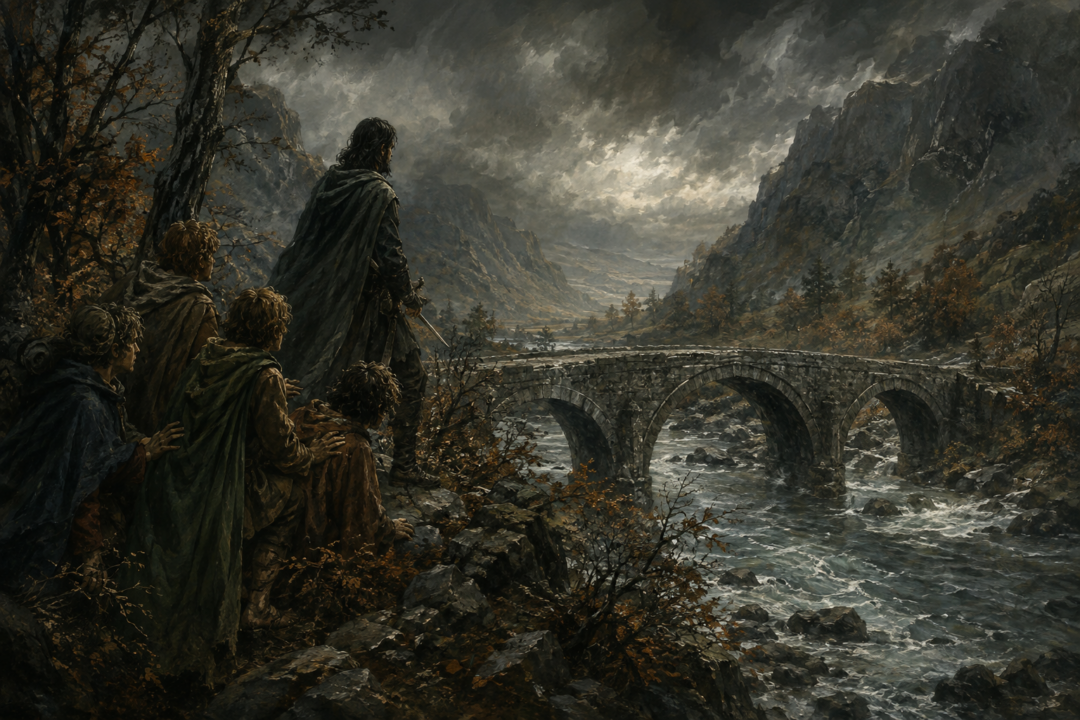
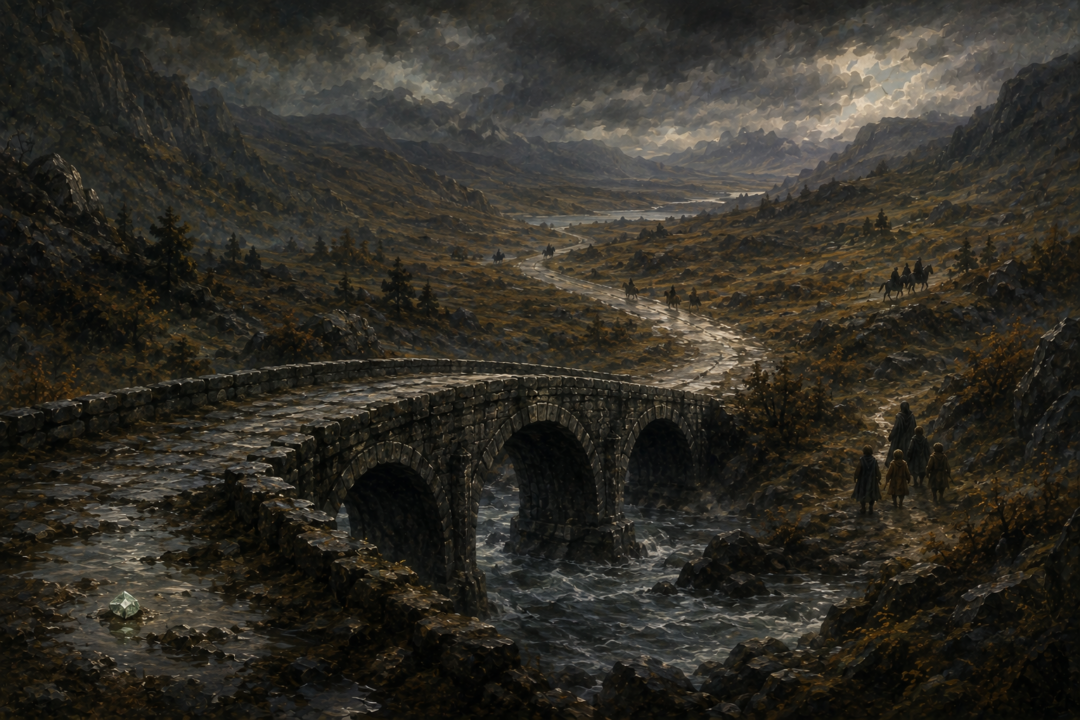
The Last Bridge does not look like one of the great dangerous places of Middle-earth.
There is no ruined watchtower like Weathertop, no gate guarded by an army, no visible enemy waiting beneath a black banner. When Aragorn and the hobbits finally see the bridge ahead of them, their immediate fear is almost strangely simple: they expect to see Black Riders standing on it.
Instead, they see nobody.
That should be reassuring. It is not.
Frodo is already carrying the wound of the Morgul-knife. The Nazgûl are somewhere behind or ahead of them. Rivendell lies eastward, but the safest direct route toward it is also the easiest route for an enemy to anticipate. And the Last Bridge carries the Great East Road across the Hoarwell, the river the Elves call Mitheithel.
So Aragorn does something revealing.
He does not treat an empty bridge as a safe bridge.
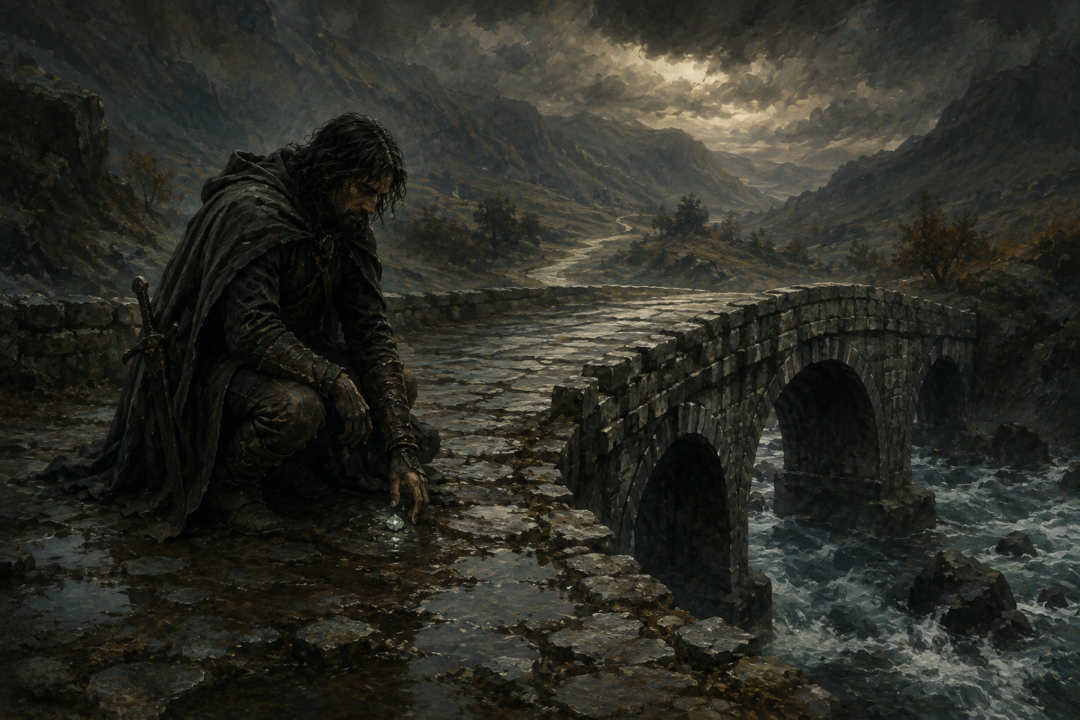
He stops. He hides the others. He scouts it himself. And when he finds a pale-green beryl in the mud, he makes one of the most quietly important decisions of the journey to Rivendell.
The bridge can be crossed.
The Road cannot yet be trusted.
The Danger Is Not the Bridge — It Is the Choice the Bridge Forces
By the time the travellers approach the Last Bridge in The Fellowship of the Ring, Aragorn has already spent days trying to keep Frodo away from the obvious route.
That matters because the Black Riders are not merely pursuing footprints. They know roughly where their quarry must go.
Frodo has been wounded at Weathertop, and Aragorn is trying to reach Rivendell. The East Road is therefore both useful and dangerous: it offers speed and direction, but it also reduces uncertainty for the hunters.
The Last Bridge makes that problem sharper.
A road through open country offers possibilities for leaving it. A major river crossing concentrates movement. If travellers want to continue eastward along the Road, they must deal with the Mitheithel.
That makes the bridge an obvious place for the Nazgûl to watch.
The text confirms that this fear is justified. When Glorfindel later meets the company, he reveals that three of Sauron's servants had indeed been upon the Bridge of Mitheithel when he arrived.
The hobbits' dread was not imagination.
The enemy had understood the same geography Aragorn understood.
Why an Empty Bridge Is Still Suspicious
As they approach, Aragorn and the hobbits find no Black Riders waiting for them.
But absence is not information enough.
The recent rain has made tracking more difficult, and Aragorn cannot simply reconstruct everything that has happened there. He therefore sends the hobbits into cover while he goes forward alone.
This is a small moment, but it shows how he operates as a Ranger.
He does not ask only, "Can I see an enemy?"
He is effectively asking, "What explains why the enemy is not here?"
Those are very different questions.
If the Nazgûl anticipated the crossing, an apparently abandoned bridge could mean several things. They might have moved elsewhere. They might be searching along another route. Some could conceivably be beyond the river. Aragorn does not yet possess the information Glorfindel will later give him.
That uncertainty is the real danger.
The Last Bridge becomes a decision point because Aragorn has reached a place where he must act before he understands the whole situation.
And that is when he finds the elf-stone.
The Pale-Green Beryl Changes the Calculation
In the mud in the middle of the bridge lies a pale-green jewel.
Aragorn identifies it as a beryl and an elf-stone.
Crucially, he does not claim to know exactly how it came there. At that moment he cannot prove that it was deliberately placed rather than accidentally dropped.
But it gives him hope.
He chooses to interpret it as a sign that they may cross.
That distinction matters. Aragorn is not receiving a magical command that removes all uncertainty. He is reading a possible sign in the context of everything he knows about the country, the Elves, and the danger around him.
Later, the interpretation is vindicated.
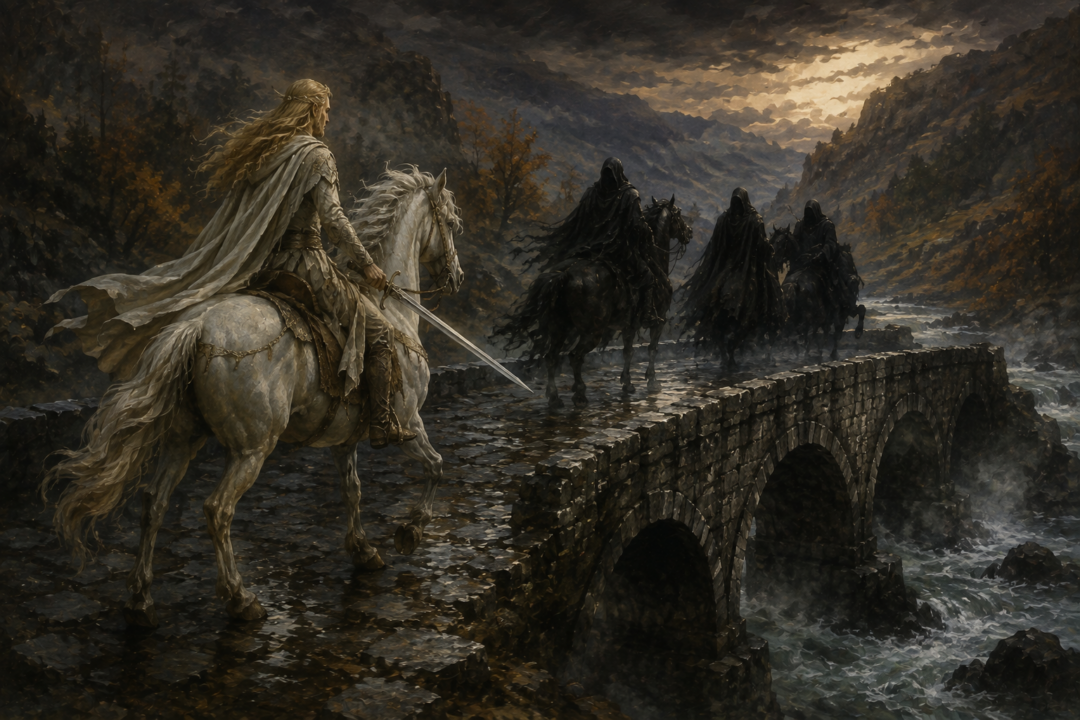
Glorfindel explains that he had travelled to the Bridge of Mitheithel and deliberately left a token there. He had found three of Sauron's servants on the bridge; they withdrew before him, and he pursued them westward.
The empty bridge therefore has an unseen history.
Only days earlier it had been occupied by the enemy. An Elf-lord sent from Rivendell had reached it, displaced the Riders, and left behind a small signal for those who might follow.
Aragorn finds the aftermath, not the confrontation.
That is why the beryl matters so much. It turns emptiness into evidence.
Aragorn Trusts the Sign — But Only as Far as It Speaks
This may be the most revealing part of the episode.
Aragorn accepts the elf-stone as sufficient reason to cross the bridge.
He does not accept it as sufficient reason to remain on the Road.
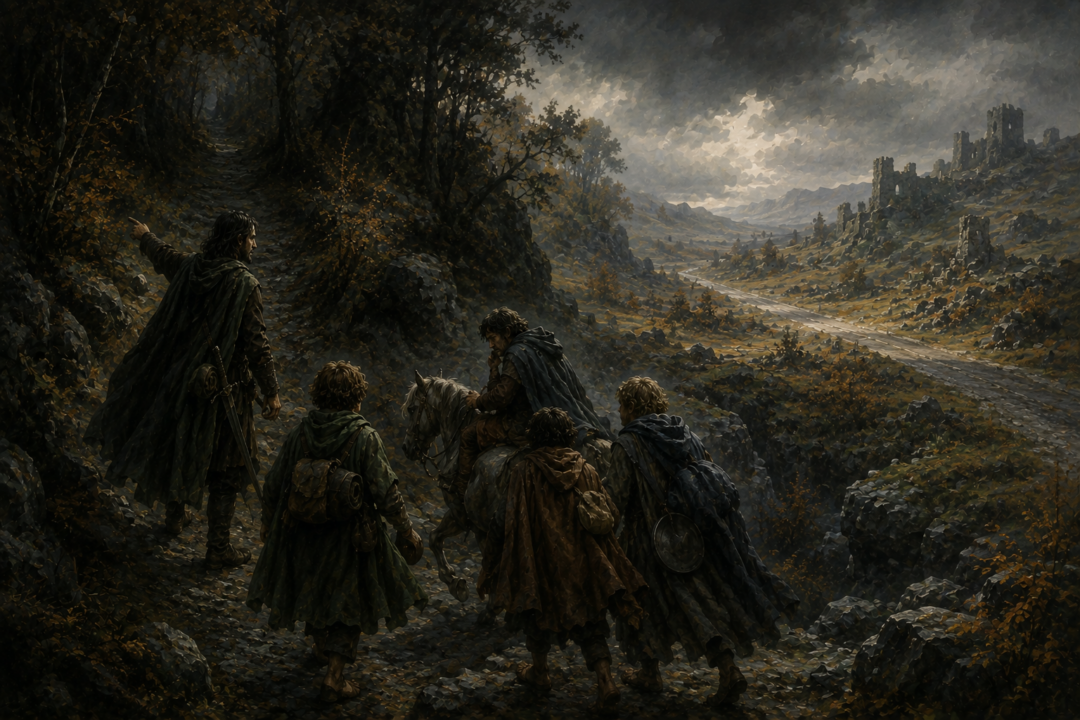
After crossing the Mitheithel safely, the company continues only a short distance before Aragorn turns away from the Road and leads them northward into the difficult country of the Trollshaws.
This is disciplined judgment rather than simple trust or distrust.
The token answers one question:
Is there reason to believe the bridge itself may be crossed?
Aragorn decides yes.
It does not answer another:
Is the East Road from here to Rivendell secure?
He decides he has no evidence for that.
That distinction is easy to overlook because readers already know that Rivendell is their destination. It is tempting to imagine the journey as a line on a map: keep going east until safety.
Aragorn cannot think that way.
Every obvious mile of road also helps the enemy predict where Frodo will be.
So he takes the reassurance he has been given without pretending it guarantees more than it does.
Glorfindel Reveals How Dangerous the Crossing Really Was
When Glorfindel finally finds the travellers, the earlier mystery becomes clear.
Elrond had learned that the Nine were abroad and that Frodo was in danger. Because Frodo might leave the Road and become lost in the wilderness while attempting to evade pursuit, Elrond sent out those capable of searching for him in several directions.
Glorfindel took the Road.
At the Last Bridge he encountered three Nazgûl.
They withdrew, and he pursued them westward. He later encountered two more who turned away southward. By the time he finally meets Aragorn and the hobbits, however, the strategic picture has changed again. Five Riders are behind them, while the location of the remaining four is uncertain.
Glorfindel specifically fears that the Ford of Bruinen may already be held against them.
That fear proves perceptive.
The enemy is not defending a single checkpoint. The Riders are moving, searching and trying to intercept the Ring-bearer along the approaches to Rivendell.
The Last Bridge is therefore not a fortress to be captured once and declared safe.
It is one node in a moving hunt.
The Road and the Wilderness Offer Opposite Dangers
The journey after the bridge exposes the trap facing Aragorn.
The Road is faster, but predictable.
The wilderness is less predictable, but painfully slow.
Once the company leaves the Road after crossing the Mitheithel, they enter steep, difficult country. Their route through the Trollshaws becomes exhausting, and Frodo's condition continues to worsen.
The wilderness protects them from straightforward pursuit, yet every delay costs Frodo time.
That tension becomes increasingly severe because the Morgul wound is not an ordinary injury. Aragorn can help Frodo and slow the immediate effects, but he cannot provide the healing Frodo needs. Rivendell must be reached.
So there is no perfectly safe choice.
Avoiding the Road indefinitely may hide them from the Riders while allowing Frodo to succumb to his wound. Taking the Road may gain speed while making interception easier.
This is why Glorfindel later reverses the logic that had made Aragorn cautious.
Once he joins them and understands Frodo's condition, speed becomes even more urgent. They must risk the Road.
The correct decision changes because the circumstances change.
The Last Bridge Foreshadows the Ford of Bruinen
The Last Bridge and the Ford of Bruinen form a revealing pair.
At the first crossing, the expected enemy is absent.
At the final crossing, the enemy appears in force.
At the Last Bridge, Aragorn receives a quiet token left by an ally he has not yet met.
At the Ford, that ally is physically beside them, and Frodo's escape depends on desperate speed.
The first crossing is controlled by caution. The second becomes a race.
Both places demonstrate the same strategic truth: rivers restrict movement, and restricted movement creates opportunities for interception.
Glorfindel understands this immediately when he worries that the unknown Riders may already be holding the Ford.
The geography itself is shaping the pursuit.
Sauron's servants do not need to search every hill and thicket of Eriador if they can anticipate where their quarry must eventually emerge.
An Empty Place Can Still Be Full of Meaning
Nothing spectacular happens when Frodo crosses the Last Bridge.
That is precisely why the scene is easy to pass over.
There is no battle. Aragorn does not see Glorfindel. The Nazgûl who had occupied the bridge are already gone. The travellers simply cross while the river runs beneath the great arches, and then they leave the Road again.
But the apparent emptiness is deceptive.
The enemy has been there.
An ally has been there.
Aragorn knows neither fact with certainty when he first approaches.
All he has is dangerous geography, missing enemies, a wounded hobbit, an urgent destination, and one pale-green stone lying in the mud.
He crosses because the sign is enough for the bridge.
Then he turns away because it is not enough for the Road.
That may be the deeper significance of the Last Bridge. Middle-earth's great decisions are not always made before armies or thrones. Sometimes they happen where almost nothing can be seen, and the person responsible must distinguish between what he knows, what he suspects, and what he is merely willing to risk.
The Last Bridge looks empty.
Aragorn understands that empty is not the same thing as safe.
Sources & Notes
- https://www.glyphweb.com/arda/l/lastbridge.php — The Encyclopedia of Arda, “Last Bridge”: identifies the bridge over the Mitheithel and summarizes Aragorn’s discovery of Glorfindel’s green beryl token during the journey to Rivendell.
- https://www.glyphweb.com/arda/m/mitheithel.php — The Encyclopedia of Arda, “River Mitheithel”: geographic background for the Hoarwell/Mitheithel, its crossing by the Great East Road, and the Last Bridge’s strategic importance.
- https://www.glyphweb.com/arda/g/glorfindel.php — The Encyclopedia of Arda, “Glorfindel”: contextual reference for the Elf-lord sent from Rivendell who drove the Nazgûl from the bridge and left the token Aragorn found.
- https://tolkiengateway.net/wiki/Flight_to_the_Ford — Tolkien Gateway, “Flight to the Ford”: chapter-level synopsis and references for Aragorn’s scouting of the empty bridge, the beryl sign, and Glorfindel’s later explanation of the Riders’ movements.
Sources cross-check the Last Bridge geography, Aragorn’s caution, Glorfindel’s beryl token, and the Nazgûl’s recent presence at the crossing.