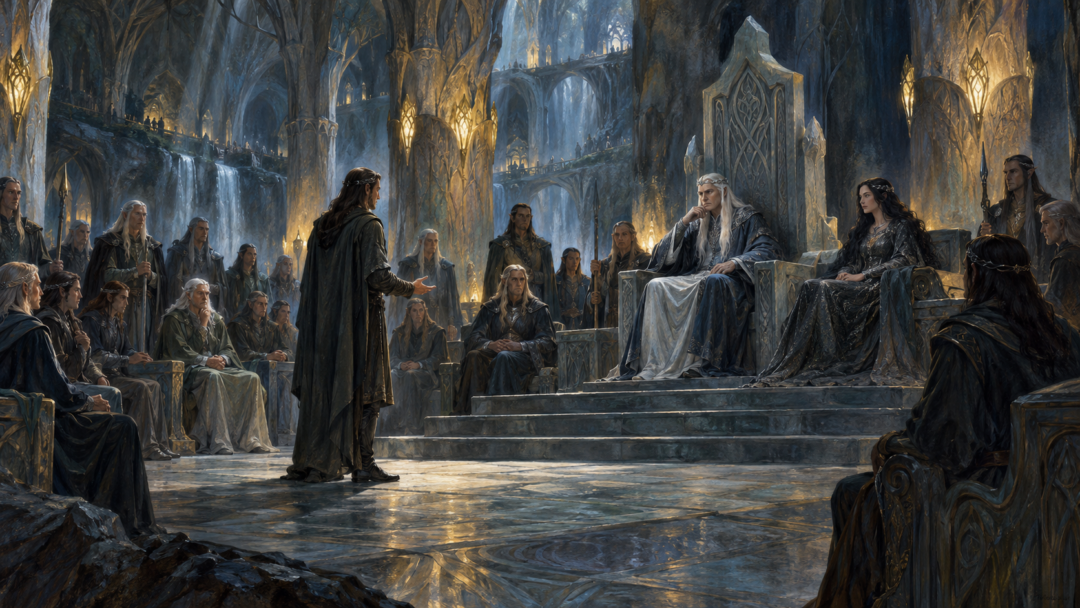
In the great halls of Menegroth, King Thingol faced a terrible question: had Túrin, the mortal warrior he had raised as his own son, driven one of his counsellors to death?
Saeros was dead. Túrin had pursued him through the forests of Doriath, and witnesses had seen enough to make the young man’s conduct appear cruel and unforgivable. Worse still, Túrin had refused to return and answer before the king.
Yet one crucial part of the story remained unknown.
An Elf-maiden named Nellas had witnessed something that the others had missed. When Beleg brought her before Thingol, her testimony transformed the inquiry. What had appeared to be an unprovoked act of persecution was revealed to have begun with an attempt on Túrin’s life.
Thingol would pardon his foster-son and offer to restore him to honour. But by then, Túrin had already fled.
The tragedy was not simply that justice came too late. It was that the truth existed all along, while pride, fear, and incomplete knowledge prevented it from saving the relationship.

The Quarrel That Began in Thingol’s Hall
Túrin came to Doriath as a child after the ruin of his family’s fortunes in Hithlum. His father, Húrin, had been captured by Morgoth, and his mother, Morwen, sent him away for protection.
Thingol received Túrin into his household and treated him as a foster-son. Over time, Túrin became a formidable warrior, fighting alongside Beleg on the northern borders of Doriath.
But his place among the Elves was not without tension.
Saeros, a counsellor of Thingol, resented the honour granted to a mortal Man. His contempt became unmistakable when Túrin returned to Menegroth after a long period of fighting.
At the king’s table, Saeros mocked Túrin’s rough appearance and then insulted the women of his homeland.
For Túrin, whose mother remained in troubled Hithlum, this was an intolerable provocation.
He responded violently, throwing a drinking vessel at Saeros and injuring his face.
The incident exposed the hostility between them. Saeros had deliberately humiliated Túrin, but Túrin’s retaliation also revealed how quickly his anger could overwhelm his judgment.
What followed the next morning would turn an ugly quarrel into a fatal catastrophe.
What Saeros Attempted Before His Death
The decisive detail in the case was not the pursuit through the woods. It was what happened immediately before it.
Saeros lay in wait for Túrin and attacked him while he was walking in the forest.
This was no longer merely a dispute between two members of Thingol’s household. Saeros had attempted to kill the man he had insulted.
But Túrin proved the stronger fighter.
He overcame Saeros and deprived him of his weapons. At that moment, the immediate danger had passed. Túrin could have left his defeated enemy behind.
Instead, he chose humiliation.
He stripped Saeros and forced him to flee naked through the woods, pursuing him as the terrified Elf ran.
Eventually Saeros reached a ravine and attempted to leap across it. He failed and fell to his death.
Túrin had not struck the fatal blow with a sword. Nevertheless, his decision to pursue a defeated and frightened opponent had contributed directly to the disaster.
This distinction matters.
Saeros was the original attacker, but Túrin’s conduct after disarming him was not simply self-defense. The pursuit was an act of anger and degradation, and Thingol would have to consider both truths.
The fullest account of this episode appears in The Children of Húrin, in the chapter “Túrin in Doriath,” with a closely related account in Unfinished Tales.
Why the First Witnesses Could Not Tell the Whole Story
Mablung, one of Thingol’s leading Elves, became involved when the pursuit was already underway.
He witnessed the alarming sight of Túrin driving Saeros through the forest. He also knew of the earlier quarrel in Menegroth.
But he had not witnessed Saeros’s armed attack.
That missing information fundamentally changed the apparent meaning of what he saw.
Without knowledge of the ambush, Túrin’s behaviour looked like an excessive continuation of his anger over the insult at the feast.
Mablung urged Túrin to return and face Thingol’s judgment, assuring him that the king could hear the circumstances and grant pardon.
Túrin refused.
He would not submit himself to judgment for an offence he believed had begun with Saeros. Nor would he accept the possibility of being detained while his case was considered.
He left Doriath instead.
Here the tragedy became more complicated than a misunderstanding between an innocent man and an unjust court.
Túrin knew something that Mablung did not. Yet he did not explain that Saeros had attacked him first.
His refusal to speak left the most important evidence absent from the initial account.
The silence was not caused by ignorance. It arose partly from Túrin’s wounded pride and distrust of what might happen if he returned.

Thingol’s First Judgment: Anger Tempered by Justice
When Thingol learned what had happened, he did not immediately issue a final sentence.
He called for an inquiry in Menegroth, summoning witnesses and hearing their accounts before the assembled leaders of Doriath.
Mablung gave particularly important testimony.
Thingol recognized that Mablung was sympathetic to Túrin, but Mablung insisted upon the importance of truth.
The king’s initial reasoning was more measured than simple condemnation.
He recognized that Saeros’s insults had been malicious and that Túrin had been wronged during the quarrel in the hall. For that first violent response, Thingol was prepared to forgive him.
But the later pursuit seemed different.
As the evidence then stood, Túrin had continued to punish Saeros after his original anger should have cooled. The humiliation and fatal chase appeared to exceed the provocation.
Thingol also had to consider Túrin’s refusal to acknowledge his authority.
The king therefore reached a severe judgment: Túrin would be banished from Doriath, and his standing as Thingol’s son would not be restored until he returned and sought pardon.
This was the sentence Thingol was preparing to pronounce.
But before the judgment became final, Beleg arrived with another witness.
Nellas: The Witness Who Changed Everything
Nellas was an Elf-maiden of Doriath who had known Túrin during his childhood.
At Melian’s bidding, she had befriended him in the woods and helped him learn the ways and speech of the Elves.
Unlike the courtiers of Menegroth, Nellas preferred the forests. She was unaccustomed to the king’s great halls, and entering the court to testify was a frightening experience.
Yet Beleg understood that her knowledge was essential.
Nellas had been sitting in a tree when Saeros attacked Túrin.
From that vantage point, she had witnessed the beginning of the confrontation that Mablung had missed.
She told Thingol that Saeros had been the aggressor and that Túrin had overcome him without killing him when he had the opportunity.
This was the critical evidentiary change.
Nellas did not deny that Túrin had humiliated Saeros. Nor could she prove with certainty everything that Túrin had intended during the pursuit.
Indeed, her belief that Túrin had not wished for Saeros’s death remained an assessment of his intentions rather than direct knowledge of his thoughts.
But her eyewitness account established that the confrontation had begun with Saeros’s attempted violence.
Túrin had not simply hunted down a courtier because of an insult.
He had first defended himself against an armed attacker.
The distinction transformed the case.
Thingol questioned Nellas closely rather than accepting her testimony without examination. He then turned to Mablung, astonished that Túrin had never explained this essential fact.
Mablung confirmed that he had not known.
The king now understood that his original judgment had rested upon an incomplete account.

Why Thingol Reversed His Sentence
Thingol’s revised decision was remarkable because he did more than reduce Túrin’s punishment.
He changed the terms upon which reconciliation would occur.
With Nellas’s testimony established, Thingol recognized Túrin as a man who had been wronged and provoked by one of the king’s own counsellors.
He pardoned whatever fault remained in Túrin’s actions.
More importantly, he abandoned the demand that Túrin first return and petition for forgiveness.
Instead, Thingol would send the pardon to him and invite him back to Menegroth with honour.
This reversal revealed something important about Thingol’s kingship.
He was willing to reconsider a grave decision when new evidence emerged. He did not insist that royal dignity required him to preserve a judgment he now believed mistaken.
Nor did he treat the misconduct of a trusted counsellor as less serious because the victim was mortal.
Saeros had occupied a respected position in the king’s household. Yet his rank did not excuse his behaviour.
Thingol’s responsibility extended to protecting the dignity of the foster-son who had lived under his roof.
The pardon therefore carried a meaning beyond legal forgiveness.
It was an attempt to repair a broken bond.
The king was not merely allowing Túrin to return. He was offering to receive him honourably, without demanding that he first abase himself.
The Pardon That Could Not Bring Túrin Home
The moment Thingol changed his judgment, the practical difficulty became painfully clear.
No one knew where Túrin had gone.
Nellas understood the danger immediately. The world beyond Doriath was vast, and Túrin had departed without revealing his destination.
Beleg undertook to find him.
With Thingol’s permission, he went in search of his friend, carrying the possibility of reconciliation into the wilderness.
His journey would eventually bring him to Túrin among the outlaws.
But the pardon did not accomplish what Thingol intended.
Túrin did not return to Menegroth.
By the time Beleg reached him, Túrin had begun shaping a new existence beyond the protection and authority of Doriath. He refused the opportunity to resume his former place.
The legal obstacle had been removed, but the personal obstacle remained.
Túrin’s pride, his fear of submission, and his determination to live according to his own choices could not be overcome simply by changing the king’s sentence.
The pardon was genuine. Its failure was genuine too.
Was Túrin Innocent, or Merely Forgiven?
It is tempting to describe Nellas’s testimony as proof of Túrin’s complete innocence.
The texts support a more complicated conclusion.
Saeros initiated the physical attack in the forest. Túrin’s resistance was justified by the immediate danger.
But once Saeros had been disarmed, Túrin chose to pursue and humiliate him.
That choice cannot be erased by the discovery of the ambush.
Thingol’s final decision was therefore a pardon informed by the fuller circumstances, not a declaration that every action Túrin took had been blameless.
Likewise, the king’s first proposed sentence was based on incomplete evidence, but it was not a refusal to investigate.
Thingol had listened to witnesses, distinguished the original insult from the later pursuit, and allowed a late witness to alter his conclusion.
The failure lay partly in what the court had not yet heard and partly in Túrin’s unwillingness to trust that the truth could be heard.
This makes the episode especially painful.
The judgment was corrected, but the separation remained.

The Deeper Tragedy of Thingol’s Mercy
Morgoth’s curse hangs over the larger story of Húrin’s children, but this particular episode should not be reduced to a curse mechanically forcing every decision.
Saeros chooses malice. Túrin chooses vengeance after defending himself. Mablung acts upon what he has witnessed. Nellas chooses to speak despite her fear. Thingol chooses to revise his judgment.
Each action matters.
The tragedy emerges from the interaction of these choices with incomplete knowledge, wounded pride, and circumstances already moving beyond anyone’s control.
Nellas’s testimony succeeds in the courtroom. It establishes the missing truth and changes the king’s decision.
Yet it cannot undo the hours and days during which Túrin has believed himself alienated from Doriath.
Nor can it compel him to accept the forgiveness now offered.
That is the bitter irony at the heart of Thingol’s pardon.
A king listens. A witness speaks. An injustice is corrected before the court.
But the man for whom the judgment matters most is no longer there to hear it.
And when the offer finally reaches him, the road home remains open only in law, not in his heart.
Sources & Notes
- Silmarillion Writers’ Guild — Túrin — A text-referenced biography describing Nellas’s testimony and Thingol’s revised pardon. https://www.silmarillionwritersguild.org/node/5690
- The Encyclopedia of Arda — Nellas — The witness whose account earned Túrin the king’s forgiveness. https://www.encyclopedia-of-arda.com/n/nellas.html
- The Encyclopedia of Arda — Saeros — The courtier’s enmity and accidental death that drove Túrin into exile. https://www.encyclopedia-of-arda.com/s/saeros.html
Primary account: The Children of Húrin, “Túrin in Doriath”; compare Unfinished Tales, “Narn i Hîn Húrin.” Nellas’s fuller testimony is not narrated in the published Silmarillion. The pardon does not establish that every act of Túrin’s pursuit was blameless.