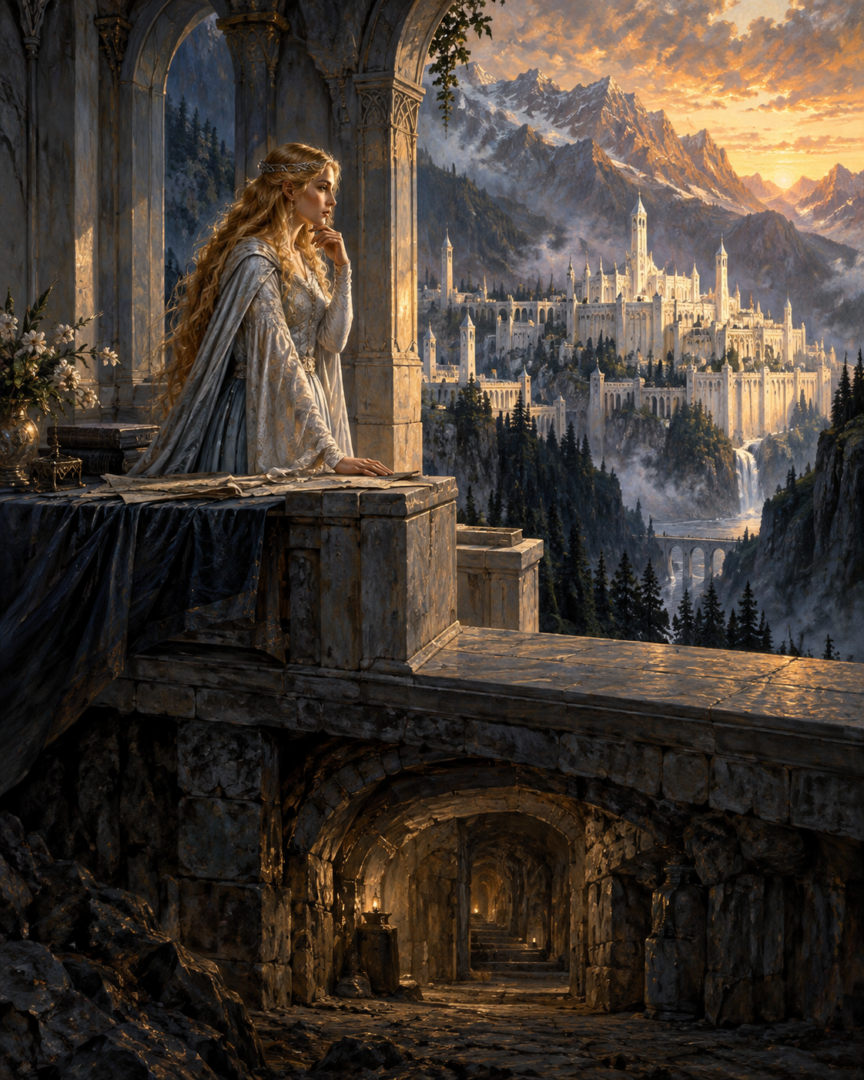
Gondolin had seven mighty gates, a ring of mountains, and warriors prepared to defend its walls. Yet when Morgoth’s armies descended upon the Hidden City, none of those famous defenses could save it.
What saved a remnant of its people was something far less glorious: a secret passage prepared beneath the city by Idril Celebrindal, daughter of King Turgon.
The distinction matters. Gondolin’s gates had been built to prevent enemies from entering. Idril’s hidden way existed so that people could leave when the city could no longer protect them.
Through that passage, Tuor, Idril, their young son Eärendil, and other survivors escaped the destruction. Their flight carried them beyond Gondolin, through the dangerous mountains, and eventually toward the refuge at the Mouths of Sirion.
The tunnel did not save Gondolin. It did not preserve its kingdom, its towers, or most of its inhabitants.
But it helped prevent the city’s destruction from becoming the end of its surviving people.
And in the larger history of Middle-earth, that difference would prove immeasurable.
The Hidden City’s Greatest Strength Became Its Greatest Danger
Gondolin was designed around concealment.
King Turgon established his city within Tumladen, a hidden valley enclosed by the Echoriath, the Encircling Mountains. Its position was difficult to discover, and entry was controlled through a carefully guarded approach.
The normal entrance followed the ancient course of the Dry River and the ravine of Orfalch Echor. Travelers approaching Gondolin encountered a succession of seven guarded gates.
These were extraordinary defenses, but they served a particular purpose: controlling access to the city.
They were not an independent evacuation system.
The difference became critical when Morgoth learned Gondolin’s location through the betrayal of Maeglin.
Rather than simply forcing the established entrance, Morgoth’s forces came over the northern mountains. The protective geography upon which Gondolin depended had been overcome.
A city that had remained hidden for generations suddenly faced an enemy within its supposedly secure valley.
Its isolation now presented a terrible problem.
Once the defenses failed, the inhabitants could not simply scatter across open country. Mountains surrounded them, and the ordinary routes were no longer reliable means of escape.
Gondolin’s secrecy had protected its people for centuries. In its final hours, that same separation from the outside world threatened to become a trap.
Idril Prepared for a Disaster Others Hoped to Avoid
Idril Celebrindal possessed a foresight that distinguished her from many around her.
In *The Silmarillion*, in the chapter “Of Tuor and the Fall of Gondolin,” she becomes troubled as Morgoth’s power grows and the danger to Gondolin increases.
Her foreboding is not presented as a detailed prediction of every event that will follow. She does not know precisely how the city will fall.
But she recognizes that its apparent security cannot be trusted absolutely.
Her response is practical.
She arranges for a secret way to be prepared, taking care that Maeglin does not learn of it.
This secrecy is crucial.
Maeglin, Turgon’s nephew, harbors a forbidden desire for Idril and eventually betrays Gondolin to Morgoth. The passage’s concealment from him means that the traitor who reveals the city’s defenses does not also control the escape route that will preserve some of its people.
The text does not establish that Idril knew the precise future circumstances of Maeglin’s betrayal. Her decision should not be exaggerated into complete foreknowledge.
What it demonstrates is that she acted upon danger before disaster made action impossible.
She prepared an alternative to the kingdom’s established defenses.
That preparation becomes one of the most consequential decisions made within Gondolin.
The Secret Way Was Not the Dry River Entrance
It is important to distinguish Idril’s passage from Gondolin’s famous guarded approach.
The Dry River, Orfalch Echor, and Seven Gates formed part of the city’s normal access system. Their purpose was to conceal, regulate, and defend entry.
Idril’s secret way was a separate escape route.
The fuller early narrative, published in *The Fall of Gondolin* and also found in *The Book of Lost Tales, Part Two*, develops its construction and use in greater detail than the compressed account in *The Silmarillion*.
In that early telling, Idril urges Tuor to arrange the secret work, and the passage leads from their dwelling beneath the city toward an exit beyond its walls.
The received *Silmarillion* account confirms the essential point: Idril prepared a hidden way that enabled survivors to escape when Gondolin fell.
These accounts should not be treated as though every descriptive detail belongs to a single, fully harmonized final version.
Nor does the narrative establish precise dimensions, carrying capacity, or a complete engineering plan for the tunnel.
What matters is its function.
It offers an exit that does not depend on passing through the city’s compromised ordinary defenses.
For the people who reach it, the secret way changes the immediate question from whether Gondolin can withstand the assault to whether they can survive beyond its walls.
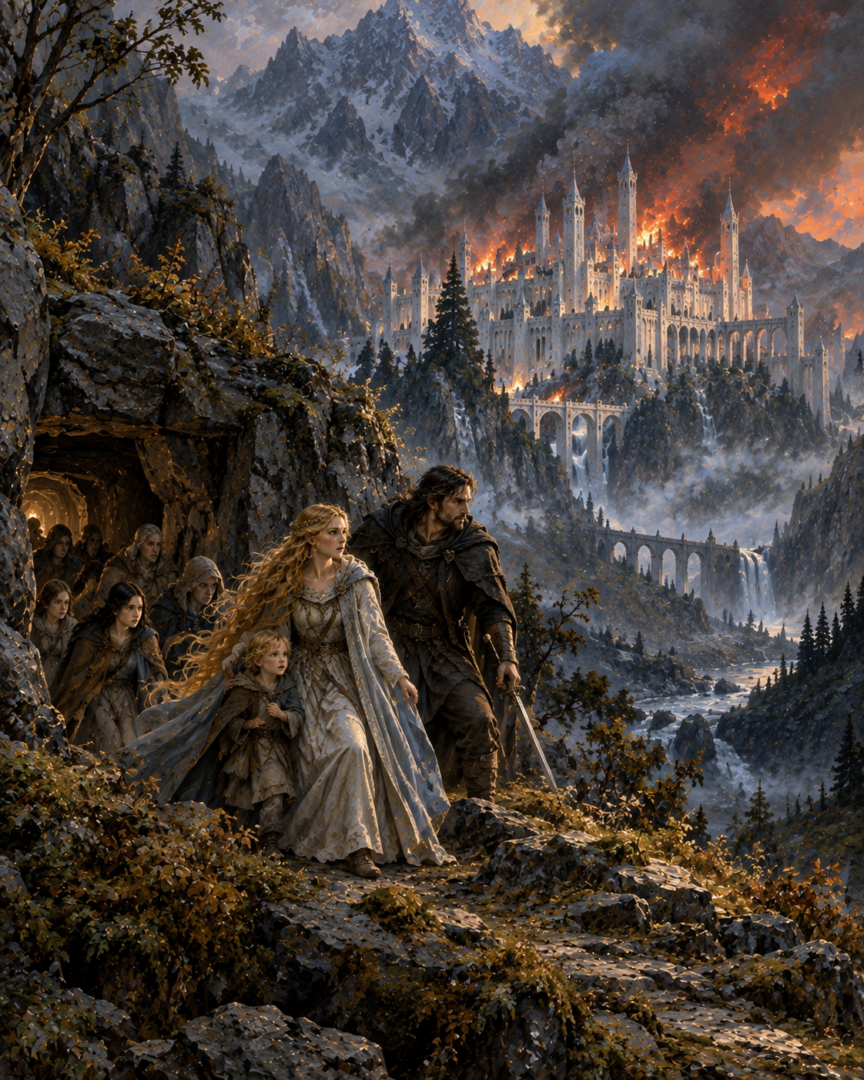
When Gondolin Fell, the Tunnel Became a Lifeline
The attack came during the celebration of the Gates of Summer.
Morgoth’s forces descended upon Gondolin, bringing devastation to the city that had long remained beyond his reach.
Its defenders fought desperately.
Ecthelion confronted Gothmog, lord of Balrogs, and both perished. Other warriors died defending the city. Turgon himself remained in Gondolin and was lost in its destruction.
These acts of resistance belong to the tragedy of the fall.
Yet military courage could not reverse the city’s defeat.
At this point, Idril’s earlier preparation acquired its full significance.
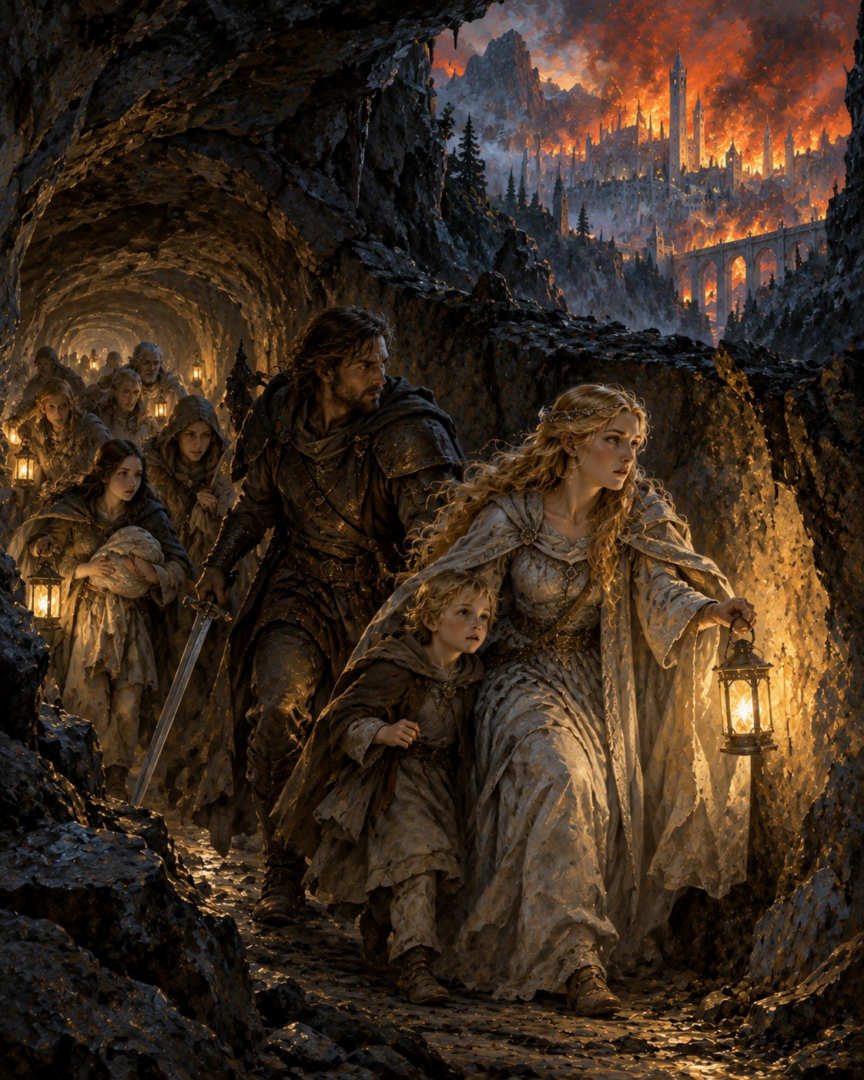
The secret passage made escape possible for Tuor, Idril, Eärendil, and a company of survivors.
The early *Fall of Gondolin* narrative gives this evacuation a more extended dramatic treatment, including the danger surrounding Idril and Eärendil and the movement of people toward the hidden exit.
The shorter account in *The Silmarillion* preserves the decisive result without recounting every episode.
The passage does not miraculously empty Gondolin.
Many inhabitants perish, and the texts do not provide a secure basis for calculating what proportion escaped through the tunnel.
Its achievement is therefore limited but profound.
A remnant survives the destruction of a kingdom that otherwise offers them no secure refuge.
That is the central transformation: not victory instead of defeat, but survival within defeat.
Escaping the City Was Only the Beginning
The tunnel did not carry its travelers directly to safety beyond the mountains.
After leaving Gondolin, the fugitives still faced the valley of Tumladen and the formidable heights of the Echoriath.
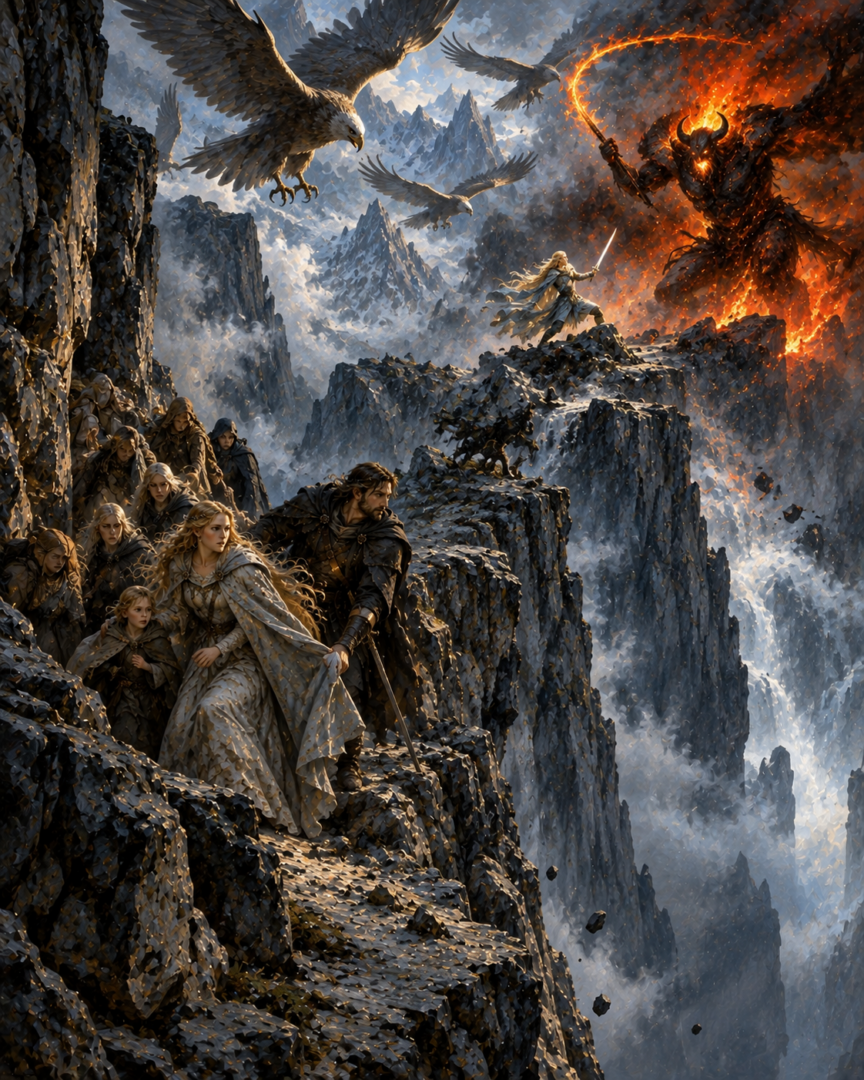
Their escape continued northward through the dangerous pass known as Cirith Thoronath, the Eagles’ Cleft.
There, the remnant encountered another deadly threat.
Morgoth’s creatures, including Orcs and a Balrog, confronted the fugitives upon the mountain route.
Glorfindel fought the Balrog and fell with it into the abyss. His sacrifice, together with the intervention of Thorondor’s Eagles, enabled the surviving company to continue.
This episode prevents the tunnel from being mistaken for a guarantee of rescue.
Idril had prepared a way out of Gondolin, not a protected road across all of Beleriand.
The refugees still depended upon courage, sacrifice, difficult travel, and aid beyond their own strength.
The distinction is essential to understanding the story.
The tunnel created the possibility of survival. It did not remove the dangers that followed.
Without the hidden exit, however, the company would not have reached those mountains by the route described in the narrative.
Its importance lies in making the later journey possible.
From the Ruins of Gondolin to the Waters of Sirion
After surviving the mountains, the exiles traveled into the Vales of Sirion.
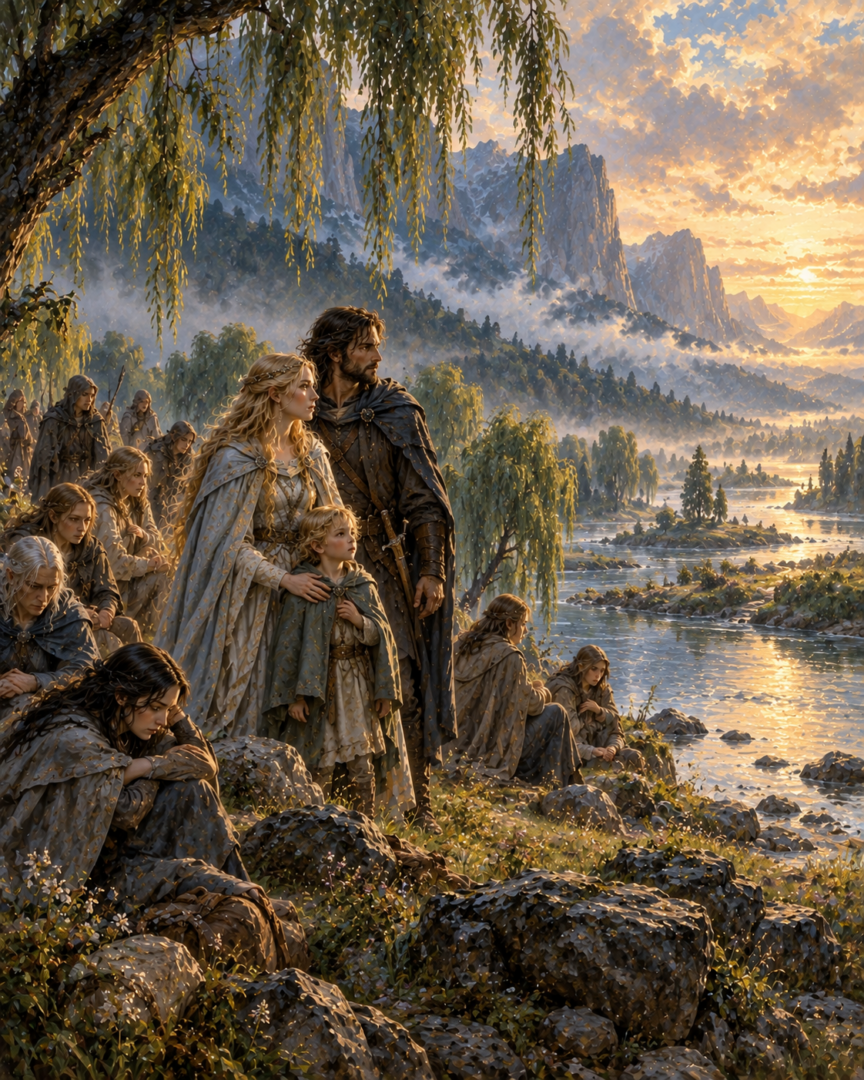
Their journey eventually brought them to Nan-tathren, the Land of Willows, near the meeting of Narog and Sirion.
Here the character of the story changes.
The survivors are no longer defending a city or fighting their way out of immediate destruction. They are displaced people carrying the memory of a home that no longer exists.
In the received narrative, they linger in Nan-tathren and mourn those who have fallen.
The landscape offers beauty, but it cannot restore Gondolin.
The refugees continue southward until they reach the Mouths of Sirion, where other survivors of Beleriand’s catastrophes also gather.
This is not the restoration of Turgon’s kingdom.
There is no second Gondolin awaiting them, with its white towers and guarded gates.
Instead, the people of the fallen city become part of a wider community of exiles.
Their survival is no longer defined by possession of a hidden stronghold, but by their ability to endure its loss.
That movement from fortified isolation to refugee settlement is one of the most significant consequences of Idril’s decision.
The secret way preserves people who can carry their history beyond the destruction of the place where it was made.
Eärendil Makes the Consequences Larger Than Gondolin
Among the fugitives is Eärendil, the young son of Tuor and Idril.
His presence gives the escape a significance extending far beyond the immediate survival of Gondolin’s inhabitants.
Eärendil belongs to the union of Elves and Men. Through his father Tuor and mother Idril, he carries the inheritance of two kindreds whose destinies are deeply entwined.
After the fall of Gondolin, he grows toward the extraordinary role described in *The Silmarillion*.
He will become a mariner, marry Elwing, and ultimately reach the West bearing the Silmaril.
His appeal before the Valar on behalf of Elves and Men becomes a turning point in the struggle against Morgoth.
The survival of Eärendil also matters to the later history of Middle-earth through his sons, Elrond and Elros.
Yet this larger destiny should not obscure the immediate circumstances of his escape.
When Gondolin falls, Eärendil is a child fleeing a burning city with his parents and other survivors.
Idril’s passage is not described as having been constructed solely to secure his future role.
Its stated significance is broader: it enables a remnant to escape.
Nevertheless, Eärendil’s later history reveals how much can depend upon the survival of a single child within a displaced community.
The consequences of the tunnel reach far beyond anything its builders could have measured.
The Difference Between Saving a Kingdom and Saving Its People
Gondolin’s final tragedy contains two very different forms of action.
Its warriors attempt to defend the city against destruction.
Idril prepares for the possibility that the city cannot be defended successfully.
Neither response is meaningless.
The defenders’ resistance belongs to the courage and sacrifice of Gondolin’s last day. Idril’s foresight preserves lives when resistance can no longer save the kingdom.
The narrative does not require us to condemn every defender or suggest that the fall could have been prevented simply by abandoning the city earlier.
Its tragedy is more complicated.
Turgon’s realm had been built as a place of refuge from Morgoth. Its beauty, secrecy, and strength made it precious to those who lived there.
But no fortress in Beleriand could guarantee permanent safety against the growing power of the Enemy.
Idril’s achievement is that she prepared for the failure of something her people dearly wished to preserve.
She did not need to know every detail of the coming catastrophe to recognize that an alternative route might become necessary.
Her hidden passage represents a different kind of protection: one that places the continued existence of people above the survival of walls.
The Refuge That Outlived the Hidden City
The fall of Gondolin remains one of the great disasters of the First Age.
Its towers are destroyed. Its king is lost. Many of its finest defenders perish, and the kingdom never rises again.
Idril’s tunnel does not lessen those losses.
But it changes what follows them.
Through an exit prepared before the assault, Tuor, Idril, Eärendil, and other survivors pass from a doomed city into an uncertain future.
They cross the mountains, endure further danger, mourn their dead, and eventually find refuge beside Sirion.
Their journey preserves a living connection between Gondolin and the world that comes after it.
And among those who survive is the child whose later voyage will help bring the long struggle against Morgoth toward its conclusion.
Gondolin’s gates were built to keep the Enemy outside.
Idril’s secret way was built against the possibility that those defenses would fail.
When the city finally fell, the difference between those two purposes became the difference between a kingdom’s destruction and the survival of a remnant.
Gondolin could not be saved.
But its story did not have to end beneath its ruins.
Sources & Notes
- Silmarillion Writers’ Guild — Idril Celebrindal — A sourced discussion of Idril’s concealed escape route and its development across versions. https://www.silmarillionwritersguild.org/node/4847
- The Encyclopedia of Arda — Gondolin — The fall of the city and the survivors’ eventual refuge at the Mouths of Sirion. https://www.encyclopedia-of-arda.com/g/gondolin.html
- The Encyclopedia of Arda — Cirith Thoronath — The dangerous mountain escape, Glorfindel’s sacrifice and the Eagles’ intervention. https://www.encyclopedia-of-arda.com/c/ciriththoronath.html
Primary passage: The Silmarillion, “Of Tuor and the Fall of Gondolin”; compare the early narrative in The Book of Lost Tales, Part Two, also presented in The Fall of Gondolin. Details from the early and later accounts are not a single harmonized engineering plan. The tunnel made escape possible, not safe passage through every subsequent danger.