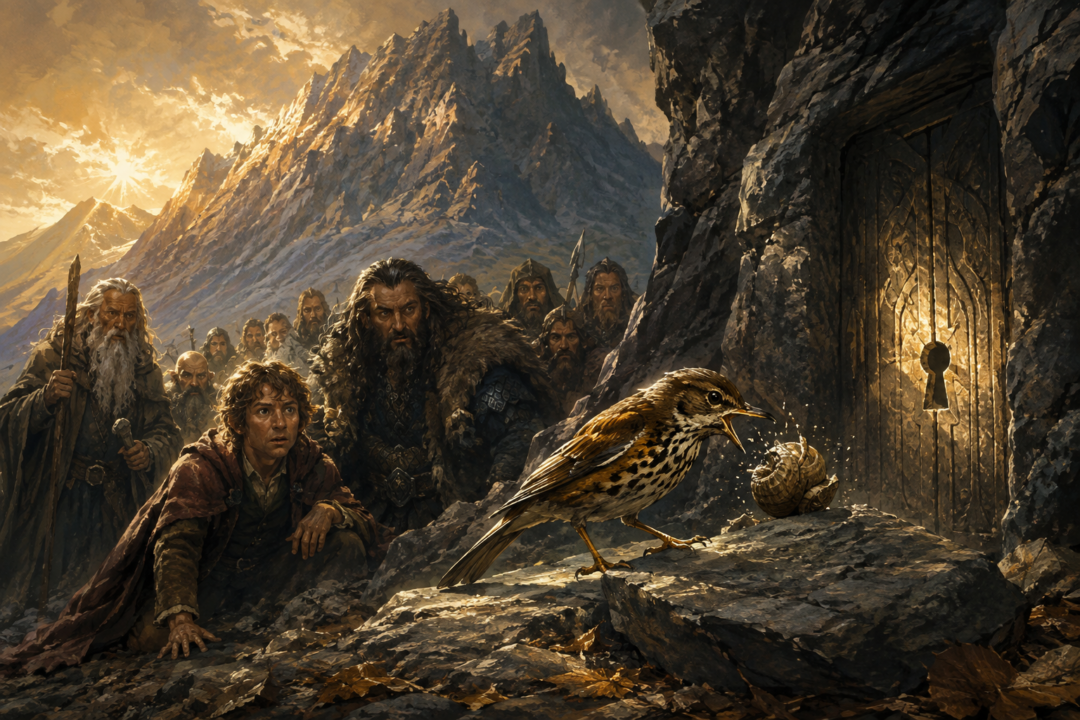
A thrush listens while Bilbo describes the one place where Smaug’s armour fails. Soon afterward, that same small bird crosses the distance to Lake-town, lands beside Bard, and gives him the information that makes the dragon’s death possible.
Taken out of context, this sounds like ordinary fairy-tale machinery: an animal hears human speech, flies away, and conveniently tells the hero what he needs to know.
But The Hobbit establishes something much more specific.
The thrush is not simply a bird that has suddenly acquired human speech because the plot requires it. Its ability belongs to an old relationship among particular birds, the Dwarves of Erebor, and the Men of Dale. Even more importantly, communication is not universal. Some characters understand the thrush and others do not. The thrush itself can understand speech that the Dwarves use, while its own language remains inaccessible to them.
That limitation is what makes the episode feel less like a world full of generic talking animals and more like the survival of an ancient cultural network.
The Thrush Is Strange Before It Ever Speaks
The old thrush is woven into the story before Smaug’s final attack.
Thrór’s map contains the moon-letter instruction to stand beside the grey stone when the thrush knocks on Durin’s Day. At the Lonely Mountain, the company eventually sees a thrush knocking a snail against the stone. The setting sun then reveals the keyhole of the secret door.
The bird is therefore associated with the Mountain’s older order before it becomes an information carrier.
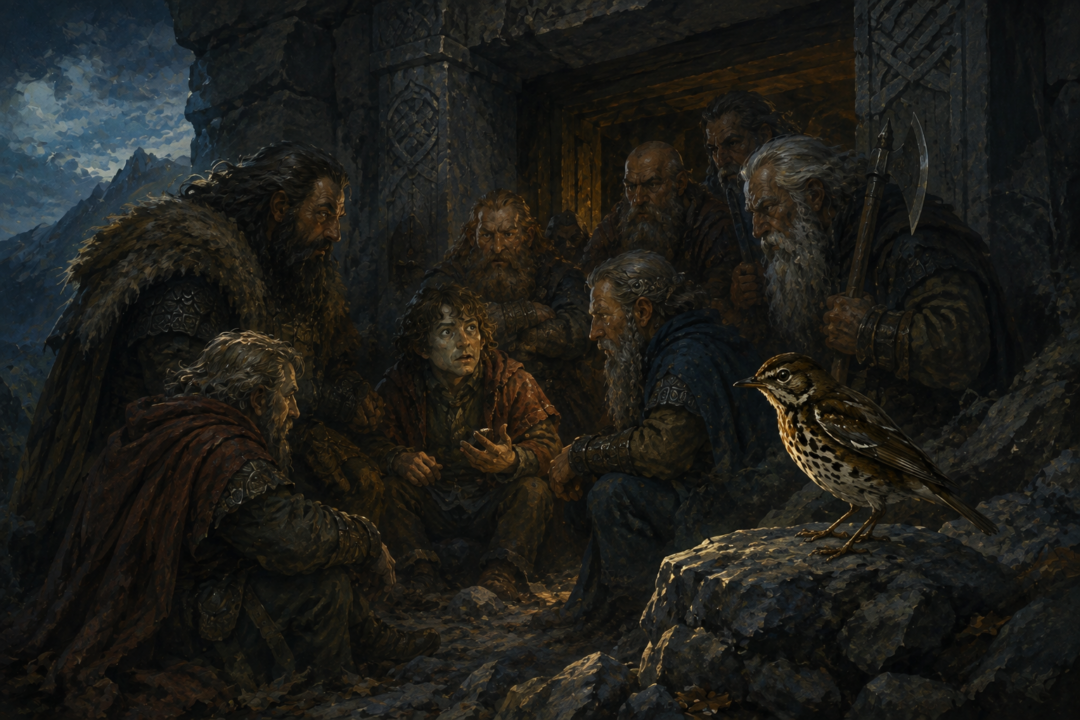
Later, after Bilbo has spoken with Smaug, he recounts what happened. The old thrush sits nearby listening. Bilbo becomes irritated enough to throw a stone at it, but Thorin stops him.
Thorin explains that the thrushes associated with the Mountain were friendly and unusually long-lived, describing them as an ancient and magical race. They had once been tame to the hands of his father and grandfather.
More importantly, Thorin remembers something about Dale.
The Men of Dale once knew how to understand the language of the thrushes and used the birds as messengers, including communication with the Men of the Lake. Flipbuilder
This changes the meaning of everything that follows.
The thrush is not improvising a miraculous relationship with Bard. It belongs to the remnants of an older system.
Communication Depends on Who Is Listening
One of the most important details is that the story does not grant everyone the same linguistic ability.
Bilbo does not understand the thrush.
The Dwarves do not simply converse with it either.
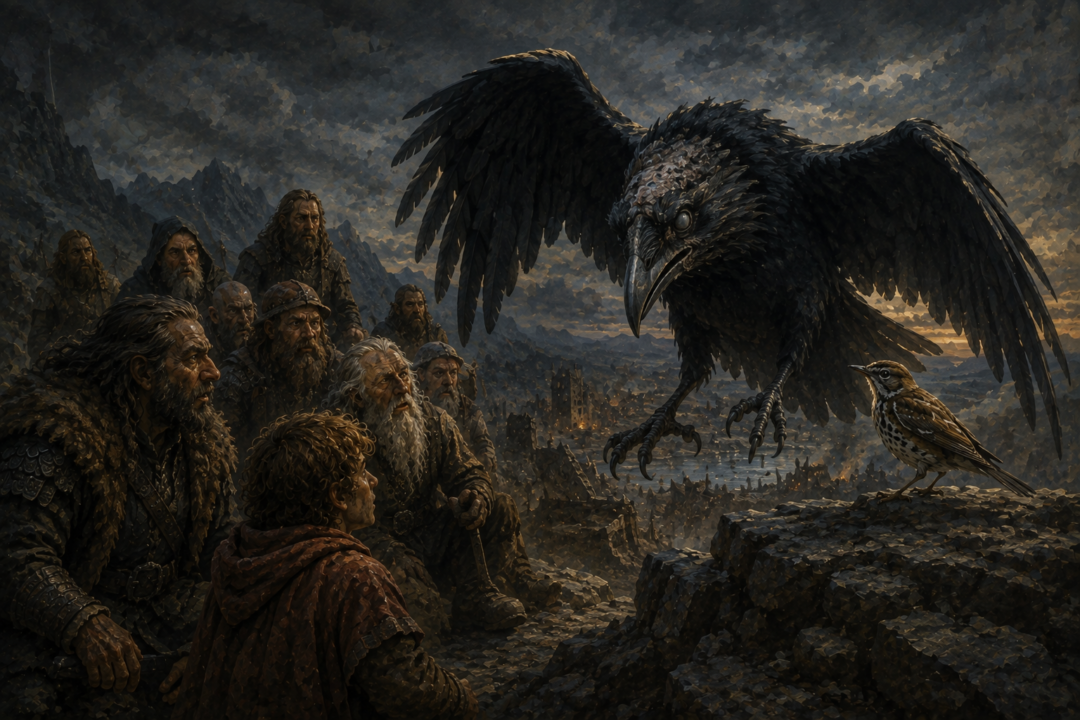
Yet the bird clearly understands them. After the company later reaches Ravenhill, Balin concludes that the old thrush understands their speech even though they cannot understand its reply. The thrush then leaves and returns with Roäc, an ancient raven capable of speaking to them in ordinary language. PubHTML5
That creates several distinct levels of communication.
The thrush can understand the company. The company cannot understand the thrush. Bard can understand the thrush because of his connection to the people of Dale. Roäc can bypass the problem by speaking directly in the language understood by Bilbo and the Dwarves.
These distinctions matter because they prevent animal speech from becoming a universal fantasy convenience.
Language has boundaries.
Knowledge can cross those boundaries, but sometimes it requires the right listener or an intermediary.
Bard Is the Surviving Human Link
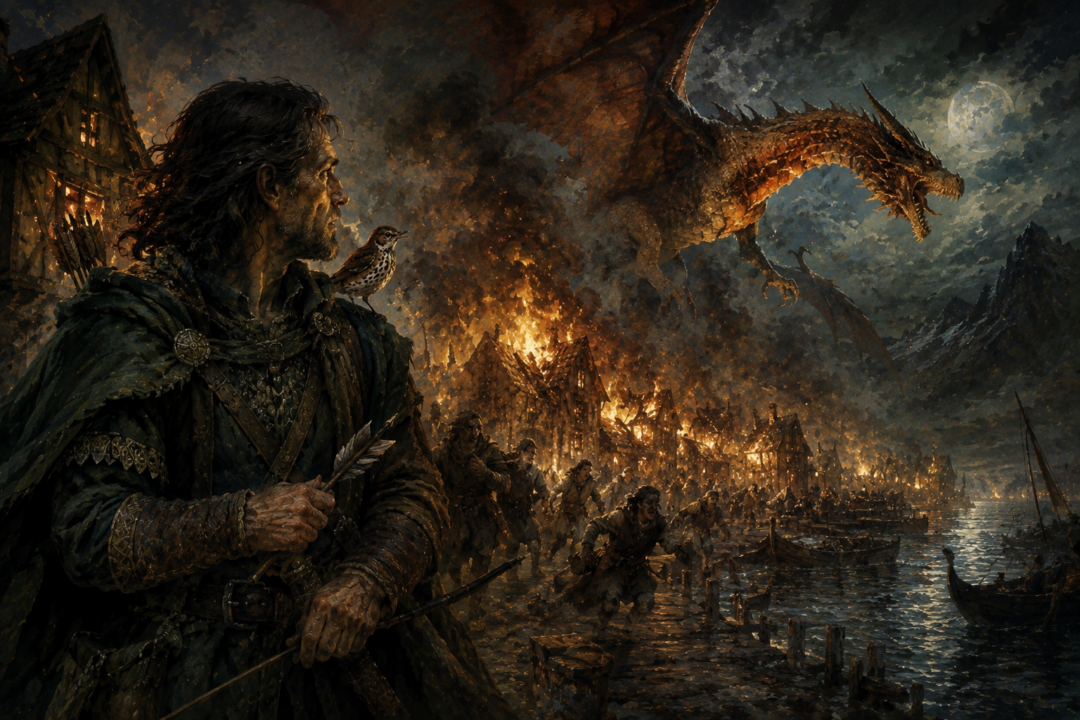
When Smaug attacks Lake-town, Bard does not initially know what Bilbo has discovered.
He has courage, skill, and his final Black Arrow, but none of those things solves the central problem. Smaug’s armoured body has resisted the defenders’ arrows.
Then the old thrush arrives.
Bard is able to understand it because he is descended from the people of Dale. The bird directs his attention toward the unarmoured hollow on Smaug’s left breast and tells him what has been learned at the Mountain. Bard looks, sees the vulnerable place as the dragon turns, and makes the shot. BookRags
The ancestry is crucial.
Bard is not presented as someone with a general magical power to speak with animals. The relevant ability belongs specifically to the old Men of Dale and their relationship with the thrushes.
Bard is the heir of Girion, the last Lord of Dale. In him, a nearly destroyed human tradition survives long enough to meet a surviving member of an ancient breed of birds.
The dragon that destroyed Dale is ultimately killed partly because fragments of Dale’s older world have survived him.
That is one of the episode’s most elegant ironies.
Smaug destroyed the city, scattered its people, and occupied the Mountain for generations. Yet he did not erase every connection that had existed there.
The Thrush Carries Knowledge Rather Than Power
The old thrush never becomes the hero of the battle.
It cannot shoot the arrow.
It cannot force Bard to believe it.
It cannot create Smaug’s weakness.
Instead, its importance comes from transmitting information.
Bilbo first discovers the weakness during his dangerous conversation with Smaug. The thrush overhears Bilbo’s account afterward. It carries that knowledge to Bard. Bard understands the message, observes Smaug for himself, and uses his own skill to act.
The causal chain is therefore:
Bilbo discovers.
The thrush listens.
The thrush carries.
Bard understands.
Bard acts.
No single participant possesses everything required to defeat Smaug.
Bilbo has the information but is nowhere near Lake-town. Bard has the weapon and ability but initially lacks the information. The thrush can bridge the distance but cannot kill the dragon.
That division of roles keeps the bird’s contribution narrow and believable within the established rules of the story.
It is extraordinary, but it is not unlimited.
Roäc Reveals the Other Half of the System
The later appearance of Roäc makes the linguistic structure even clearer.
When the thrush returns to the Dwarves after Smaug’s death, it cannot simply announce the news in words they understand. Instead, it fetches Roäc, son of Carc, an extremely old raven whose family had historical ties to the Dwarves of the Mountain.
Roäc speaks in ordinary language, allowing Bilbo and the Dwarves to understand him directly. He reports that Smaug is dead and explains that the thrush witnessed the dragon’s fall. PubHTML5
The contrast is deliberate within the narrative.
Thrushes and ravens do not operate identically.
The thrush’s relationship is particularly associated with Dale and its old ability to understand thrush-language. Roäc and his kind preserve a different relationship with the Dwarves, including long memory and direct communication.
The Mountain therefore once supported overlapping relationships between peoples and creatures rather than one universal category of “talking animals.”
It resembles an ecology of memory.
Different communities remember different things, speak differently, and maintain different loyalties.
The Birds Preserve a World Smaug Could Not Completely Destroy
This is where the old thrush becomes more than a convenient messenger.
Erebor and Dale are landscapes of broken continuity.
The Dwarves have been driven from the Mountain. Dale has been destroyed. Girion is dead. Much of the old political and cultural order has disappeared. Lake-town survives downstream as a diminished successor community.
Yet fragments remain.
Thorin remembers the thrushes.
Bard inherits the blood of Dale.
The thrush retains its connection with the old inhabitants.
Roäc remembers what his father Carc taught him about the Dwarves.
These memories suddenly become practical.
The restoration surrounding Erebor does not begin because the past returns intact. It begins because scattered survivors still possess pieces of it.
The thrush is one such survivor.
Its significance is therefore closely tied to memory and continuity rather than simply magical speech.
Why This Does Not Make Every Bird a Secret Person
The Hobbit contains several creatures capable of forms of intelligent communication, but it never establishes that every ordinary animal in Middle-earth possesses humanlike language.
The old thrush is explicitly marked as exceptional through its association with an ancient, long-lived, magical breed. The ability of Men to understand thrush-language is likewise presented as a particular skill once possessed in Dale, not as normal human experience. FlipHTML5
The text also leaves some mechanics unexplained.
It does not provide a grammar of thrush-language or explain exactly how the Men of Dale learned to understand it. Nor does it establish a general biological or metaphysical rule governing all intelligent birds.
That uncertainty is important.
The story tells us enough to establish boundaries without turning the wonder into a technical system.
The thrush is intelligible where history has created intelligibility.
Elsewhere, it remains a bird whose speech most characters cannot understand.
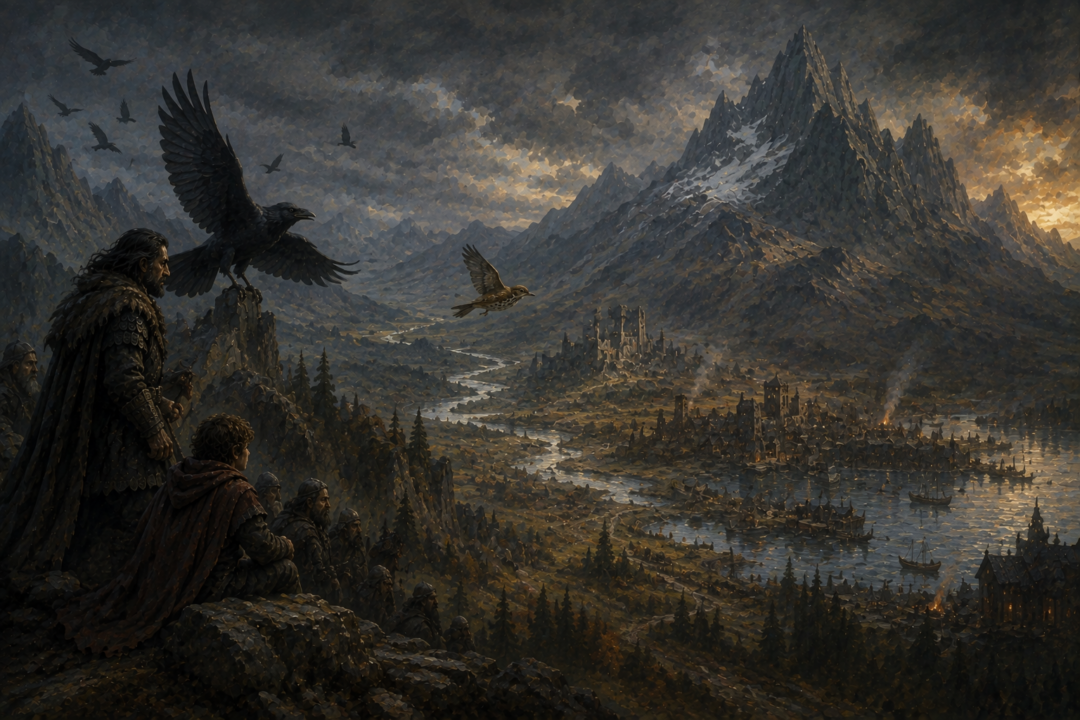
The Hidden Theme Is Not Talking Animals but Broken Communication
Seen this way, one of the strangest moments in The Hobbit becomes one of its most carefully constructed.
Smaug’s downfall depends on information crossing boundaries.
From dragon to Bilbo, unwillingly.
From Bilbo to the listening thrush.
From the Mountain to Bard.
And after Smaug’s death, from the thrush through Roäc back to Thorin.
The old communities around Erebor have been shattered, but their old channels of communication have not disappeared completely.
That matters because the crisis after Smaug’s death is itself largely about communities failing to understand one another. Thorin, Bard, the Elvenking, the Lake-men, and eventually Dáin’s Dwarves converge upon the Mountain with competing claims and fears.
The birds can transmit information.
They cannot make anyone wise enough to use it well.
Roäc himself advises Thorin toward peace and warns him about the strength gathering against him, yet Thorin’s growing fixation on the treasure drives him toward confrontation.
That distinction may be the deepest reason these creatures work so well.
Speech does not make them magical solutions to every problem.
Knowledge can be delivered.
Understanding can survive for generations.
But choice still belongs to those who receive the message.
The old thrush can tell Bard exactly where to look.
Only Bard can draw the bow.
Sources & Notes
- The Encyclopedia of Arda — Thrushes: describes Erebor’s snail-breaking thrushes and identifies a thrush as instrumental in Smaug’s downfall, including its role in revealing the secret entrance. https://www.glyphweb.com/arda/t/thrushes.php
- The Encyclopedia of Arda — Bard I: identifies Bard as a descendant of Girion and the Lake-town bowman who slew Smaug before refounding Dale. https://www.glyphweb.com/arda/b/bard.php
- The Encyclopedia of Arda — Roäc: explains the old Ravenhill alliance between ravens and Dwarves and Roäc’s role carrying news and arranging messages, illustrating the story’s distinct bird communication networks. https://www.glyphweb.com/arda/r/roac.php
- The Encyclopedia of Arda — Black Arrow: documents Bard’s heirloom arrow and its use for the decisive shot against Smaug. https://www.glyphweb.com/arda/b/blackarrow.php
Sources checked for relevance and availability.