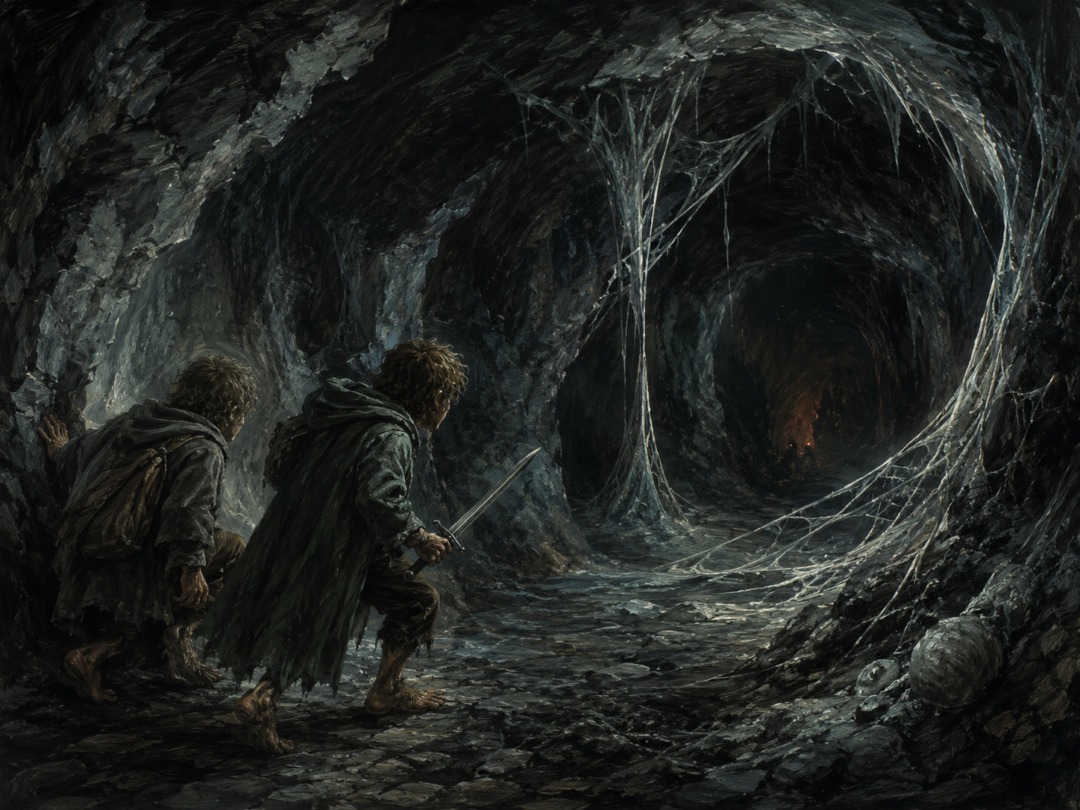
Sting is one of the most useful weapons a hobbit could carry into darkness. Forged by Elves in the Elder Days, the small blade can shine with a cold blue light when Orcs are near. In Moria, that property gives the Fellowship something almost like an early-warning system: if the blade remains dark, they can take some comfort from the absence of nearby Orcs.
So when Frodo and Sam enter the black tunnels beneath Cirith Ungol, there is an obvious question.
Why does Sting not simply warn them that something monstrous is waiting ahead?
The answer reveals an important limit to the blade. Shelob’s tunnel does not appear to magically suppress Sting at all. The deeper problem is that Sting is never clearly established as a universal detector of evil. Its warning is specifically associated with Orcs. Shelob belongs to an entirely different order of danger.
Even more intriguingly, Sting does begin to show blue fire during the encounter—but the text leaves room for doubt about what, exactly, is causing it.
Sting Is Not an Alarm for Every Evil Thing
The clearest explanation of Sting’s warning comes when the Fellowship enters Moria. Sting and Glamdring show no gleam at first, which is explicitly reassuring because Elvish blades of that kind shine when Orcs are near.
That distinction matters.
Nothing in the primary narrative establishes that Sting automatically glows whenever its bearer approaches any dangerous, malicious, or supernatural creature. Its famous warning is associated with Orcs and goblins. Tolkien Gateway likewise summarizes its characteristic as detecting nearby goblins or Orcs rather than evil beings generally.
That prevents us from treating Sting like a magical danger meter.
Frodo could theoretically stand beside something immensely evil without the blade necessarily responding, unless that creature belonged to whatever category activates the weapon.
Shelob is certainly evil, but she is not an Orc.
She is an ancient spider-like monster descended from Ungoliant, dwelling in Torech Ungol long before Sauron occupied Mordor in the form seen during the War of the Ring.
If Sting was primarily made to respond to Orcs, Shelob could approach without giving Frodo the simple warning readers might expect.
The Tunnel Does Something Worse Than Disable Magic
Shelob’s lair is terrifying precisely because it does not need to switch Sting off.
It attacks Frodo and Sam through their ordinary senses.
The tunnels are lightless, foul, confusing, and saturated with the presence of Shelob. Frodo and Sam cannot properly see what lies ahead. Gollum disappears. They know something is wrong, but they cannot identify the shape or position of the danger.
That distinction is crucial.
The lair does not create safety by concealing Shelob from some all-seeing magical weapon. It creates uncertainty.
Sting can still cut. The Phial of Galadriel can still shine. Frodo and Sam can still think and move. But until Shelob reveals herself, they do not understand what they are facing.
The tunnel therefore neutralizes their advantages in a practical rather than clearly magical sense.
A sword that warns of Orcs is much less useful when the enemy stalking you is not an Orc.
The Phial, Not Sting, Reveals the Real Enemy
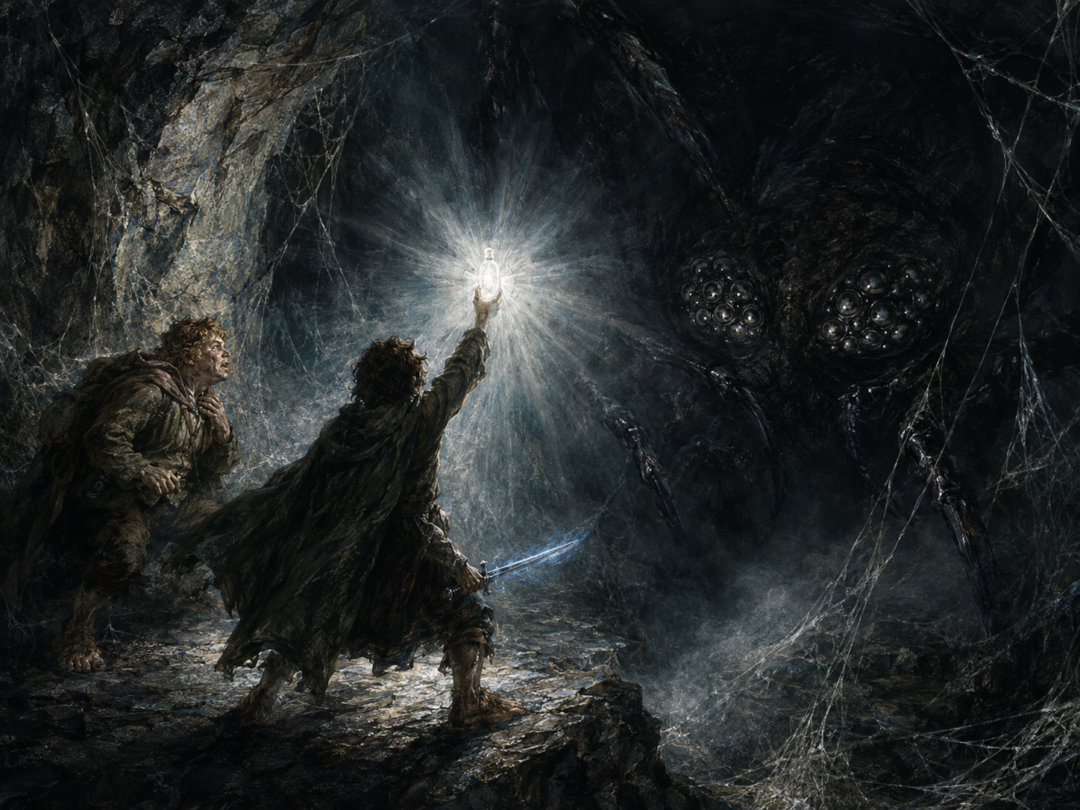
When Frodo finally remembers Galadriel’s gift, the nature of the confrontation changes.
The Phial contains light associated with Eärendil’s star, and its brightness penetrates a darkness in which ordinary sight has failed. Shelob’s clustered eyes become visible, and the ancient creature reacts violently to the light.
This is the true countermeasure to Shelob’s method of hunting.
Galadriel had told Frodo that the Phial would be a light for him in dark places when other lights failed. In Shelob’s lair, that promise becomes almost literal. The Phial does what Sting’s warning cannot: it exposes the creature hiding in the darkness and gives Frodo something before which Shelob recoils.
The contrast between the two Elvish objects is revealing.
Sting is a weapon with a particular warning property.
The Phial is illumination confronting a creature whose greatest advantage is darkness.
Frodo needs both, but they do different jobs.
Then Sting Suddenly Flickers Blue
There is one complication.
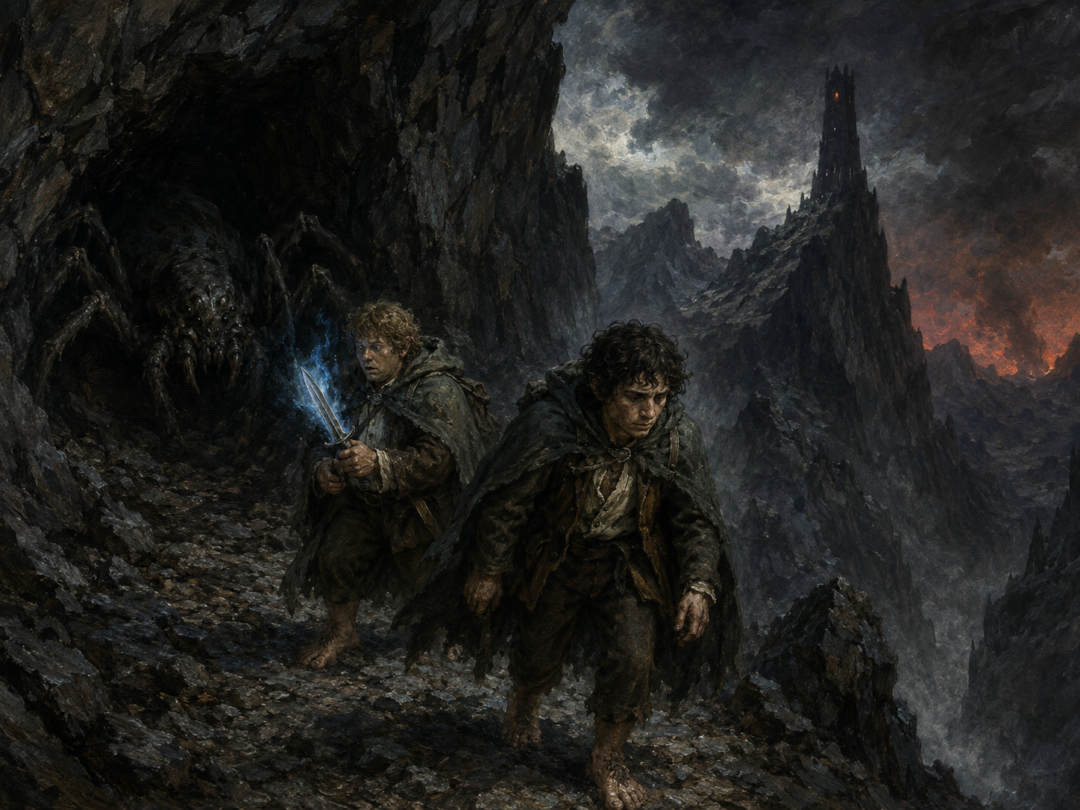
During Frodo’s confrontation with Shelob’s eyes, he draws Sting while holding the Phial. The sword shines in the silver light, and blue fire flickers along its edges. The Road
At first glance, that seems to prove that Shelob activates Sting.
But the text never explicitly says so.
That blue flicker occurs beneath Cirith Ungol, close to an Orc-held fortress. The Tower above the pass is garrisoned by Orcs, and Frodo and Sam are moving steadily nearer to it.
Soon afterward, once they have escaped the tunnel, Sam notices that Sting is glittering strongly with blue flame. He immediately interprets the sign: Orcs are nearby. He can also see the red-lit window of the tower. briefnotes.info
That creates an intentional—or at least unresolved—ambiguity.
Was Sting’s earlier flicker caused by Shelob?
Was it already sensing Orcs stationed near the pass?
The narrative never settles the question.
The safest lore-grounded reading is therefore not that Shelob definitely makes Sting glow, nor that she definitely cannot. The established rule concerns Orcs, while the blue flicker in Shelob’s presence remains open to more than one interpretation.
The Hobbit Makes the Question Even More Interesting
Bilbo had already fought giant spiders long before Frodo reached Cirith Ungol.
In Mirkwood, he uses the Elven blade to free himself, kills a spider with it, and later cuts the threads binding the captured Dwarves. That adventure is where he gives the weapon its name: Sting.
Yet the narrative does not clearly establish the spiders themselves as triggers for its blue warning.
That absence cannot prove that spider-creatures never cause Sting to shine. But it makes it risky to invent a broad rule claiming that Sting detects descendants of Ungoliant.
What the stories demonstrate much more securely is something different: Sting is extraordinarily effective against their webs.
Bilbo cuts Mirkwood spider-silk with it, and generations later Frodo discovers the same advantage inside Shelob’s tunnel.
Shelob’s Web Is Where Sting Becomes Essential
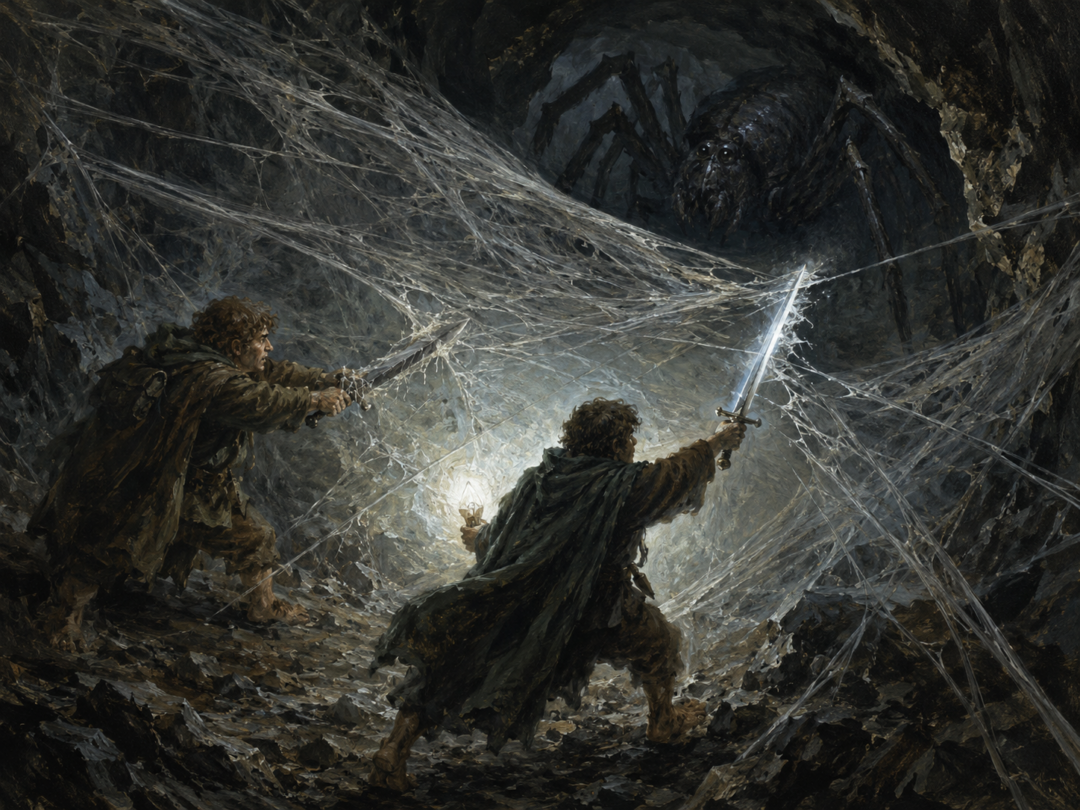
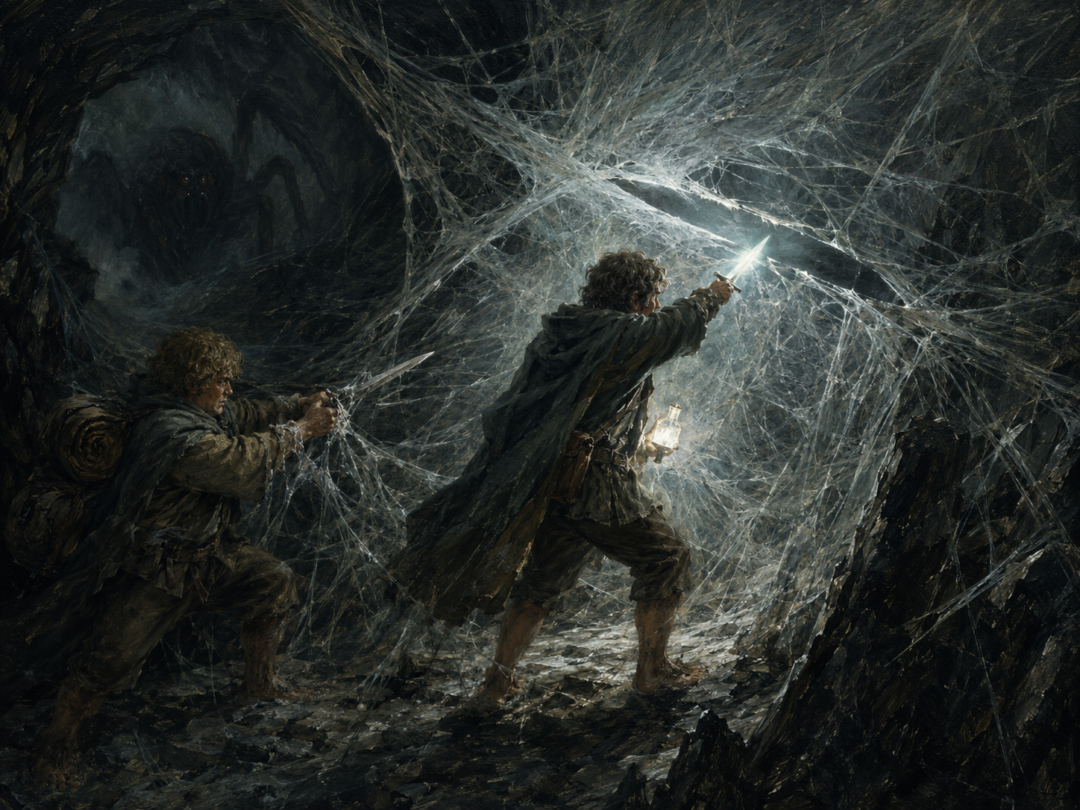
Near the exit, Frodo and Sam encounter a web so formidable that Sam’s blade cannot cut it.
Sting can.
Frodo recognizes the significance of the old Elven weapon and slices through the barrier. Tolkien Gateway notes the contrast directly: Sting cuts Shelob’s web where Sam’s Barrow-blade fails.
This gives Sting a beautifully specific role in the episode.
It does not necessarily tell Frodo where Shelob is.
It does not make the tunnel harmless.
It does not prevent the ambush.
But when Shelob physically seals the road, the blade becomes precisely the tool needed to escape.
Later, in Sam’s hands, it becomes something more.
The Warning Comes Too Late to Save Frodo
Once Frodo and Sam emerge from the tunnels, they experience a dangerous moment of relief.
The worst seems behind them.
But Shelob knows her own country better than they do.
Sam recognizes the blue flame on Sting and thinks immediately of Orcs, yet another threat is already moving through the shadows. Almost as soon as he conceals the revealing light of the Phial, Shelob appears from a dark opening beneath the cliff. briefnotes.info
She does not confront Frodo openly.
She circles around.
Gollum attacks Sam, separating him from his master, while Shelob strikes Frodo. By the time Sam understands what has happened, Frodo has been poisoned and wrapped.
Sting’s warning therefore works almost cruelly well.
There really are Orcs nearby.
They will soon arrive and carry Frodo to the Tower.
But they are not the immediate attacker that Frodo most needs warning about.
Sting Was Never Failing
That is the hidden rule behind the scene.
Shelob’s tunnel does not have a known power that cancels Sting.
The sword is simply being asked to solve the wrong problem.
Its established supernatural warning concerns nearby Orcs. Shelob hunts through darkness, concealment, webs, patience, and surprise. Against her, Frodo’s more important warning system is the Phial—and his own growing awareness that something is hunting him.
Sting becomes essential only when the danger turns physical: cutting the web, threatening Shelob, and finally serving as the weapon Sam holds beneath her massive descending body.
Shelob attempts to crush him with her weight. Sam braces Sting upward, and her own force drives the Elven blade deeply into her. Even her extraordinarily tough hide cannot save her from that combination of ancient craftsmanship, desperation, and her own momentum. Her final fate is deliberately left unstated.
The irony is perfect.
Sting cannot reliably be treated as a warning against Shelob.
But Shelob ultimately discovers exactly why the little blade deserves its name.
And the tunnel never needed to suppress its magic at all. It only needed Frodo and Sam to misunderstand what kind of danger was waiting in the dark.
Sources & Notes
- Array
Sources document Sting’s Orc-specific warning, Shelob’s nature and lair, and the Phial’s distinct role against her darkness.