Why the Rangers Could Travel Light: The Invisible Map They Carried in Their Heads
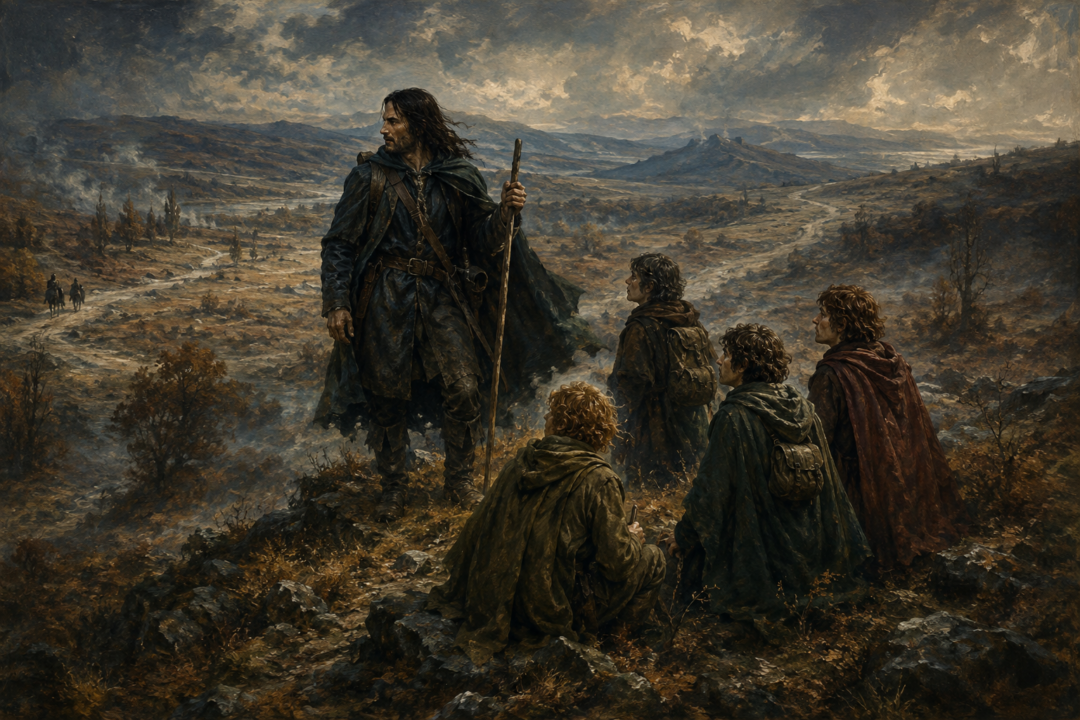
When Frodo first meets Aragorn in Bree, the Ranger does not look like a man equipped for a comfortable journey. His clothes are weather-worn, his boots have seen hard use, and almost everything about him suggests someone accustomed to living beyond roads, inns, and settled country.
Yet within days Strider is leading four inexperienced hobbits through the wild lands east of Bree, avoiding the obvious road, finding defensible ground, recognizing useful plants, choosing crossings, reading danger, and ultimately bringing them toward Rivendell.
That raises an easily overlooked logistical question: how could Rangers operate for long periods in the wilderness without behaving like heavily burdened expeditions?
The texts never give us a standardized Ranger packing list, nor do they explicitly say that Rangers travelled light because they possessed local knowledge. That conclusion must therefore remain an inference. But it is a strong one.
Again and again, Ranger effectiveness depends not merely on wilderness skill in the abstract, but on intimate knowledge of particular landscapes. They know where roads become dangerous, where hidden paths run, where water and shelter can be found, where enemies are likely to move, and where secret refuges lie.
A Ranger did not have to carry an entire wilderness with him.
He already knew how to use the one around him.
Aragorn Does Not Wander Blindly Through Eriador
The journey from Bree to Rivendell gives the clearest example.
After the attack at the Prancing Pony, Aragorn does not simply lead the hobbits east along the Great East Road. That would be the easiest route geographically, but it would also make them easier for the Black Riders to find.
Instead, he takes them into the country south of the road.
This decision immediately reveals the difference between travelling through a map and knowing a landscape.
For Frodo and his companions, leaving the road means uncertainty. For Aragorn, it creates options.
He knows the country well enough to attempt a route through the wilderness toward Weathertop. Even when the terrain proves unpleasant, particularly in the Midgewater Marshes, the choice reflects a Ranger's ability to trade convenience for concealment.
He also knows Weathertop itself.
Aragorn understands the significance of Amon Sûl, knows something of its history, recognizes signs left upon the hill, and interprets traces suggesting that Gandalf may have passed that way. The ruins are not simply a landmark to him. They are part of a mental geography containing history, routes, dangers, and possible allies.
That sort of knowledge reduces what a traveller must solve from scratch.
Local Knowledge Is a Form of Equipment
Modern discussions of wilderness travel often focus on physical equipment: food, water, shelter, navigation tools, medicine, spare clothing.
Middle-earth certainly does not abolish those needs.
Aragorn and the hobbits require provisions. They suffer from difficult terrain and bad weather. Food cannot simply be conjured from the landscape, and the story never suggests that Rangers possess some magical ability to live indefinitely without supplies.
But knowledge changes how much uncertainty a traveller must prepare for.
Someone unfamiliar with a region must carry resources against possibilities: perhaps there will be no water ahead, perhaps the apparent shortcut is impassable, perhaps shelter will not be found before nightfall.
A person who knows the country can make more precise decisions.
Aragorn knows roads that should be avoided and terrain that can be crossed. He recognizes places where danger is likely. He knows the general relationship between Bree, Weathertop, the Last Bridge, the Trollshaws, and the approaches to Rivendell.
The text never calculates how many pounds this saves him.
The more important point is that ignorance itself creates logistical weight.
Rangers carry less uncertainty because much of the landscape is already familiar.
Athelas Shows What Knowledge Can Replace
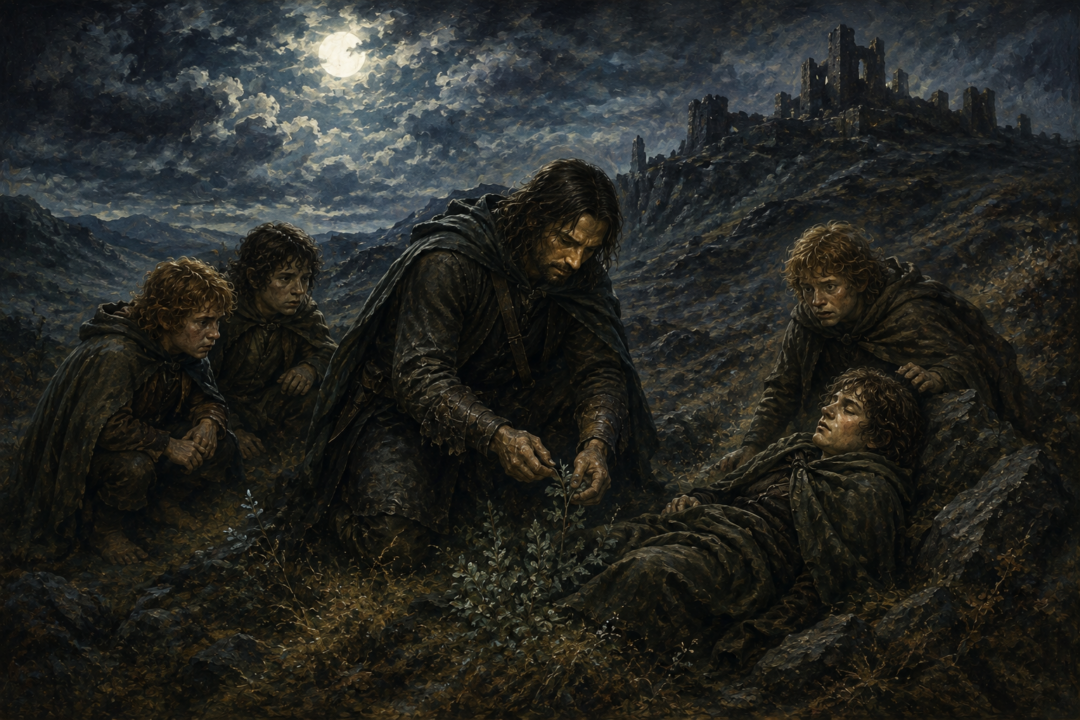
After Frodo is stabbed at Weathertop, Aragorn searches for athelas, or kingsfoil.
The plant does not cure the Morgul wound. Aragorn himself knows that Frodo's injury lies beyond what ordinary treatment can solve. But athelas provides relief, and Aragorn understands its properties when the hobbits do not.
This moment demonstrates another aspect of Ranger knowledge.
A landscape is not merely ground to cross. It contains resources whose usefulness depends upon recognition.
An unknown plant is vegetation.
A known plant can become medicine.
The same principle would apply, cautiously, to water, fuel, shelter, routes, and signs of animal or enemy activity. Tolkien does not provide a catalogue of Ranger survival techniques, so it would be an invention to claim specific practices that are never described. But Aragorn's use of athelas establishes the larger principle directly: knowledge can turn something already present in the environment into a useful resource.
That matters enormously to a traveller who cannot carry everything.
Knowing Where Not to Go May Matter Even More
Ranger knowledge is frequently defensive.
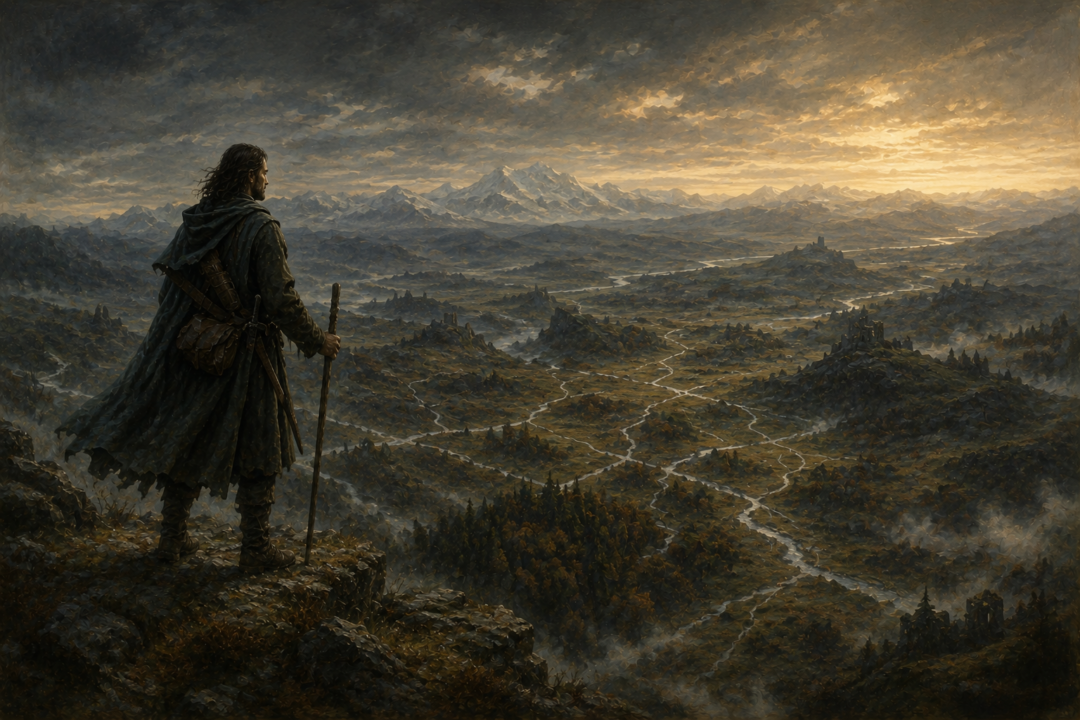
The Nazgûl are using roads, settlements, questioning, and fear to hunt the Ring-bearer. Aragorn's answer is not to outrun them in a straight race. It is to make the landscape more difficult for the hunters to use.
He leaves the road.
He approaches Weathertop cautiously.
After Frodo is wounded, he must balance speed against exposure while moving east.
Later, the company recognizes signs connected with the Last Bridge and continues toward the hidden valley of Rivendell.
None of this makes Aragorn omniscient. He can misjudge circumstances, and the wilderness remains dangerous. The attack on Weathertop itself proves that local expertise does not make a Ranger invulnerable.
But knowledge offers choices unavailable to strangers.
Travelling light is safer when you know which difficulties can be avoided rather than merely endured.
The Rangers of Ithilien Make the Principle Even Clearer
The Rangers of Ithilien belong to a different organization from the Rangers of the North, but they provide an illuminating parallel.
Faramir's men operate inside a land that once belonged securely to Gondor but has become a dangerous frontier beneath the threat of Mordor. Significantly, the Rangers are drawn from descendants of people who had lived in Ithilien.
That connection to place matters.
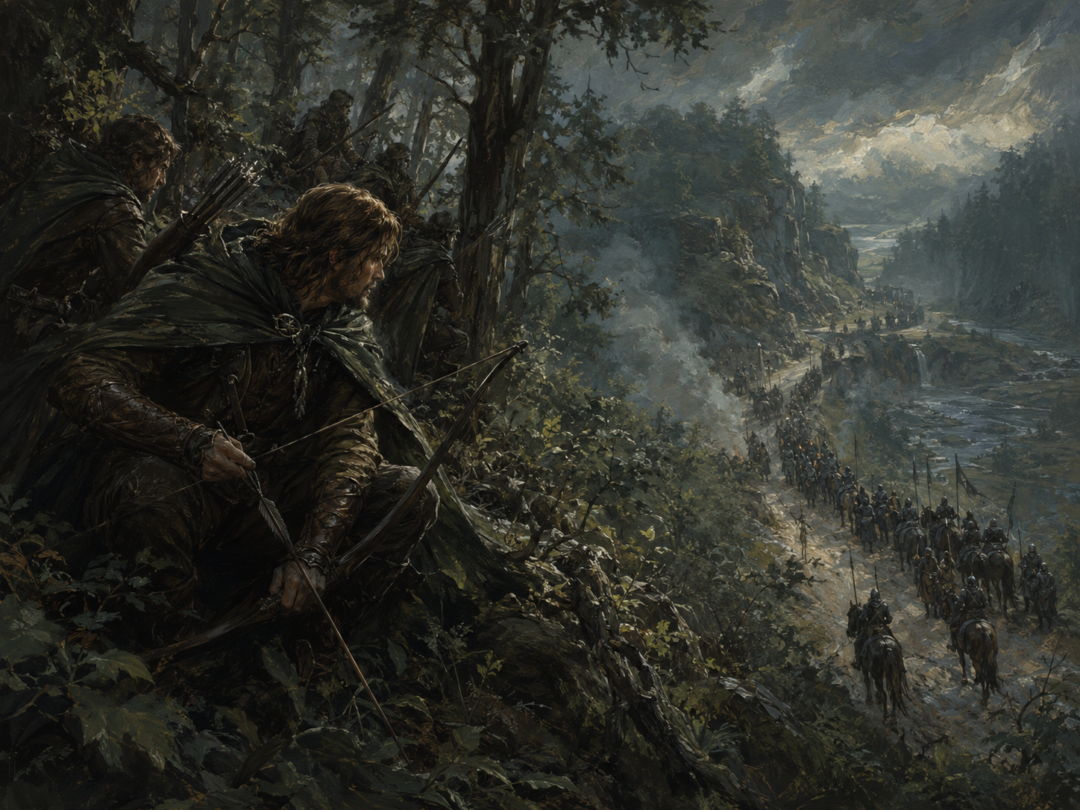
They move through wooded country in green and brown clothing, scout enemy movement, stage ambushes, and disappear again into concealed positions.
Most importantly, they possess prepared refuges.
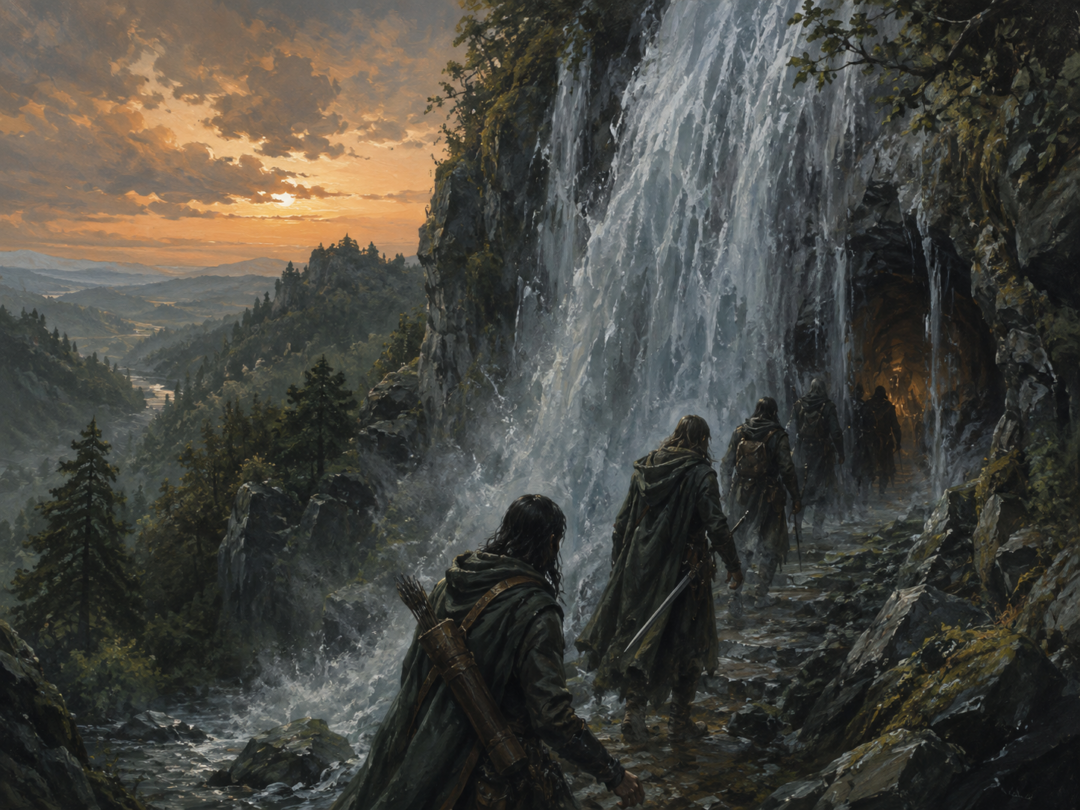
Appendix B records that after attacks from Mordor drove many inhabitants from Ithilien in Third Age 2901, Túrin II maintained secret refuges for soldiers there. Henneth Annûn, the hidden refuge behind a waterfall encountered by Frodo and Sam, is the greatest surviving example described in detail.
This transforms the logistics of operating in hostile territory.
Faramir's Rangers do not need to create a complete camp wherever they stop. They can move between a defended landscape and hidden infrastructure already established within it.
They know how to reach Henneth Annûn.
Outsiders do not.
Frodo and Sam are deliberately prevented from learning its approach, being led there under conditions designed to preserve its secrecy.
The refuge is therefore more than a cave.
It is stored geographical advantage.
A Ranger's Territory Contained Invisible Infrastructure
The Rangers of the North do not receive anything like the detailed description of Henneth Annûn. We should not invent a network of Northern supply depots for which the texts provide no evidence.
What we can say is that the Dúnedain possessed a long relationship with Eriador.
After the fall of the North-kingdom, they continued to guard lands whose inhabitants often did not even realize they were being defended. Aragorn had travelled widely, and his knowledge extended far beyond the Shire and Bree. He had journeyed through many regions of Middle-earth long before the War of the Ring.
The Northern Rangers therefore should not be imagined as tourists entering unknown wilderness every time they left home.
Much of their work occurred in country they or their people had watched for generations.
Paths, ruins, rivers, crossings, settlements, enemy movements, safe approaches, and dangerous districts would form part of that accumulated experience.
Some of this is explicit in Aragorn's demonstrated knowledge. The larger idea of a systematically transmitted Ranger "mental map" is an interpretation, but it fits their described role without requiring invented technology or supernatural skill.
The Grey Company Shows How Fast Experienced Rangers Could Move
When Aragorn finally meets his northern kinsmen in Rohan, Halbarad has brought thirty Rangers south to find him, accompanied by Elladan and Elrohir.
Their appearance is revealing.
They are grim, weathered men equipped for war, bearing cloaks, bows, spears, swords, and horses. They are not presented as lightly armed scouts in the sense of carrying almost nothing.
"Travel light," therefore, should not be confused with "travel unequipped."
A Ranger might need weapons, clothing, provisions, and riding equipment. Tolkien never specifies the exact baggage of the Grey Company.
What is striking is their mobility.
They have crossed a great distance from the North into Rohan during a rapidly developing war. Soon afterward they follow Aragorn through the Paths of the Dead and onward into Gondor.
These are people culturally accustomed to movement.
Their effectiveness lies less in some fantasy absence of logistical needs than in minimizing hesitation and exploiting knowledge.
Aragorn's Greatest Tool Is Often Recognition
Throughout the story, Aragorn repeatedly understands things before his companions do.
He reads tracks.
He notices signs.
He recognizes terrain.
He knows old stories connected with places.
He understands plants.
He can judge routes by more than their apparent directness.
This is what makes Ranger mobility convincing.
The Rangers are not men who have somehow defeated hunger, exhaustion, weather, and distance. The books repeatedly show that even the greatest travellers remain subject to those realities.
Instead, Rangers reduce the number of mistakes that make travel more expensive.
They are less likely to waste a day on the wrong route.
Less likely to expose themselves unnecessarily.
More capable of identifying what the country provides.
More likely to know where a road leads before committing to it.
More capable of interpreting signs that another traveller would simply pass.
Every avoided mistake conserves food, strength, daylight, and time.
They Carried the Landscape Before They Entered It
There is no canonical statement that says, "Rangers travelled light because they knew the land."
Taken literally, that claim would go beyond the text.
But as an explanation of what we actually see Rangers doing, it is persuasive.
Aragorn's journey through Eriador shows a man using remembered geography, historical knowledge, fieldcraft, and natural resources to guide others through dangerous country. Faramir's Rangers show an even more organized version of the same principle: men whose connection to Ithilien allows them to fight from concealed places and secret refuges inside enemy-threatened territory.
Their advantage is not that they need no supplies.
It is that they do not confront the wilderness as strangers.
For most travellers, the wild is a succession of unanswered questions: Where is the water? Which road is watched? Where can we hide? Is that crossing safe? What lies beyond the hill?
A Ranger has already answered many of them.
And in a world where every extra day's delay consumes food and every wrong turn can lead into the hands of the Enemy, knowledge is not merely wisdom.
It is weight you never have to carry.
Sources & Notes
- Tolkien Gateway, “A Knife in the Dark” — summarizes Strider’s decision to take the hobbits off the Road through the Chetwood and Midgewater Marshes, his reading of signs at Weathertop, and his efforts after Frodo is wounded. https://tolkiengateway.net/wiki/A_Knife_in_the_Dark
- Tolkien Gateway, “Athelas” — documents Aragorn’s knowledge and use of kingsfoil to ease Frodo’s Morgul wound, directly supporting the article’s example of local botanical knowledge functioning as practical equipment. https://tolkiengateway.net/wiki/Athelas
- Tolkien Gateway, “Rangers of Ithilien” — describes Faramir’s Rangers as descendants of Ithilien’s people who used camouflage, scouting, ambush, and intimate familiarity with that threatened frontier. https://tolkiengateway.net/wiki/Rangers_of_Ithilien
- Tolkien Gateway, “Henneth Annûn” — details Gondor’s hidden refuge in Ithilien, its concealed waterfall entrance, and the secrecy surrounding its approach, supporting the discussion of invisible local infrastructure. https://tolkiengateway.net/wiki/Henneth_Annun
Sources checked against the article’s Eriador route, athelas example, and the Ithilien Rangers’ use of inherited terrain knowledge and Henneth Annûn.