Why the Army Leaves Men at the Cross-roads Instead of Taking Everyone to the Morannon
When the Captains of the West march toward Mordor, every soldier seems precious.
Their host is already astonishingly small. Only about seven thousand set out from Minas Tirith to challenge Sauron, and everyone involved understands that this army cannot defeat Mordor by ordinary military strength. Yet when Aragorn reaches the Cross-roads in Ithilien, he deliberately leaves a strong guard behind.
Later, still more men are allowed to leave the march rather than continue toward the Black Gate.
At first glance, both decisions seem almost absurd. Why weaken an army that is already marching toward an overwhelmingly stronger enemy?
The answer reveals something important about the entire strategy of the march to the Morannon. Aragorn and Gandalf are not assembling the largest possible army for a conventional assault. They are conducting a desperate diversion whose success depends on appearing dangerous enough to command Sauron's attention while still protecting the roads behind them—and, above all, avoiding anything that might endanger Frodo.
The Cross-roads Guard Is Not the Same as the Men Who Lose Their Nerve
Two separate events are easy to merge together.
The first happens at the Cross-roads of Ithilien. The army has marched from Minas Tirith through ruined Osgiliath and reached the place where the north-south road meets the road running east toward Minas Morgul.
The Captains have an immediate problem.
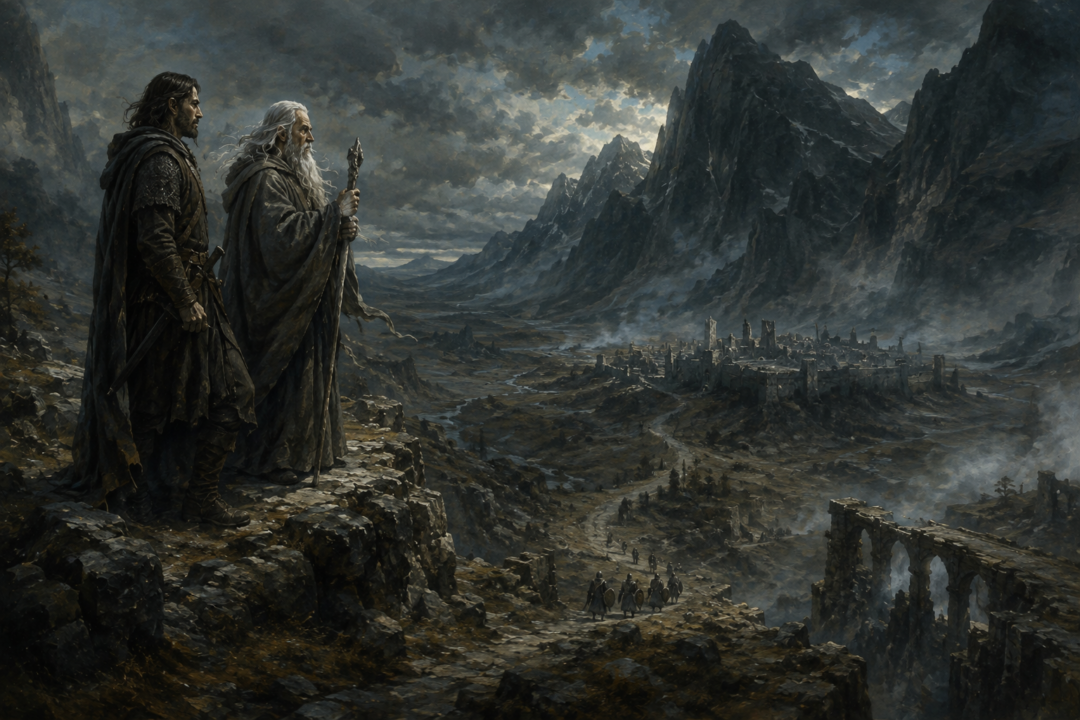
They believe that Frodo may have attempted to enter Mordor by the Morgul route. Because of that possibility, they deliberately avoid drawing Sauron's attention toward the pass. Gandalf and Aragorn inspect the Morgul Vale, destroy the bridge leading toward Minas Morgul, and then withdraw.
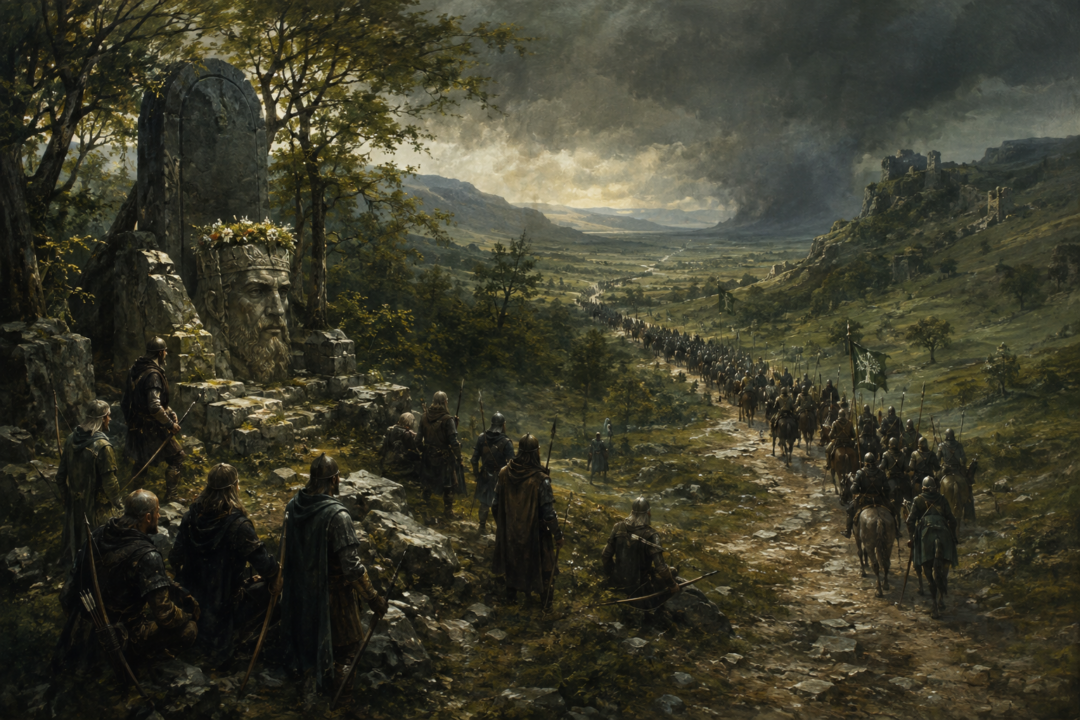
Before continuing north, however, they establish a strong guard at the Cross-roads.
These soldiers have not failed in courage. They have been assigned a military task.
Only several days later, as the army approaches the desolation before the Morannon, do some younger soldiers become unable to continue. Aragorn releases those men and redirects them toward Cair Andros.
So the army is reduced for two quite different reasons: strategic deployment at the Cross-roads and human fear nearer Mordor.
Why the Cross-roads Matter So Much
The Cross-roads are exactly what their name suggests: a strategic junction.
One road leads north through Ithilien toward the Morannon. Another runs south toward the lands from which Sauron's allies have marched. The eastward road leads toward Minas Morgul and its pass into Mordor.
An army advancing north while leaving that junction completely unprotected would expose its rear.
The text specifically explains the danger. A force might emerge over the Morgul Pass, or additional enemies might come north from the South. The guard therefore exists to provide some defence against either possibility.
The men selected are largely archers familiar with Ithilien, positioned to conceal themselves among its woods and slopes. That detail matters. Aragorn is not merely abandoning several hundred soldiers at a road sign. He is establishing a defensive screen in terrain suitable for troops who know how to use it.
It is a sensible precaution even during an extraordinarily reckless campaign.
The Army Was Never Supposed to Capture Mordor
The deeper explanation comes from the Last Debate after the Battle of the Pelennor Fields.
The leaders of the West know that military victory over Sauron is beyond them. Even after the spectacular victory outside Minas Tirith, Gondor and Rohan have not destroyed Sauron's main power.
Gandalf's strategy therefore rests on deception.
The Captains will march openly against Mordor. Aragorn will behave like a challenger confident enough to confront Sauron directly. Their heralds will proclaim the coming of the King. Everything is designed to make the Dark Lord look westward.
Their real purpose is to give Frodo and Sam a chance.
If Sauron's attention and armies can be drawn toward the Morannon, the Ring-bearer may cross Mordor with less scrutiny. The march is therefore not an invasion in the ordinary sense. The army itself is, in effect, the bait.
That changes the calculation at the Cross-roads.
If Aragorn needed every available soldier because he genuinely intended to storm the Black Gate, leaving troops behind would appear self-defeating. But the Captains already know that even seven thousand cannot conquer the Morannon.
Indeed, when they finally stand before it, the hopelessness of an assault is unmistakable. The fortifications alone are beyond anything their small army can realistically overcome, while Sauron's hidden forces enormously outnumber them.
The difference between roughly seven thousand and somewhat fewer than six thousand does not transform an impossible conquest into a possible one.
Their purpose is to be seen.
Why Not Simply Abandon the Road Behind Them?
Because deception does not make logistics and geography disappear.
The Captains may be marching toward what they expect could become their deaths, but they cannot assume that every other responsibility has ceased to matter.
The Cross-roads remain a gateway through Ithilien.
Enemies coming from the south could threaten the recovering territories behind the army. A force emerging from the Morgul region could also fall upon their communications or move westward.
The guard therefore serves a genuine defensive purpose while the main host continues its larger strategic gamble.
There is also a crucial connection to Frodo.
The Captains suspect that the Ring-bearer may have used the Morgul route. Their actions near Minas Morgul are consequently cautious. They do not want to concentrate attention there. Guarding the Cross-roads allows them to watch the dangerous approaches without launching a major operation toward the pass through which Frodo might have travelled.
Their strategy must simultaneously threaten Sauron and avoid exposing the very mission they are trying to save.
Then Some Men Cannot Go Any Farther
The second reduction in Aragorn's army is far more personal.
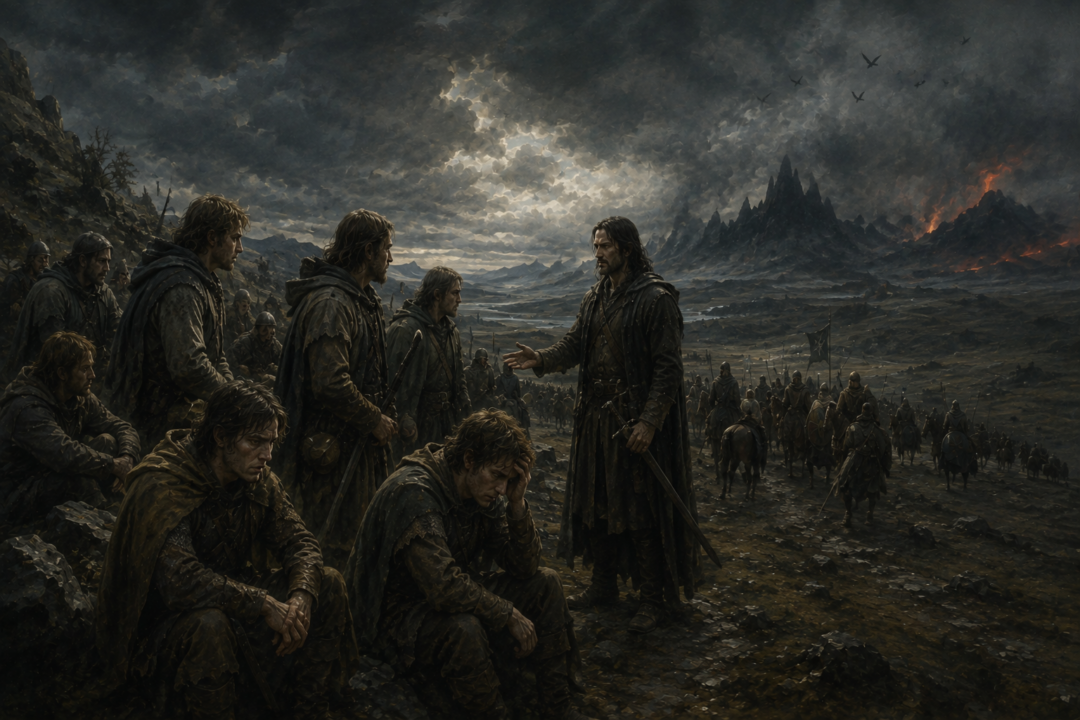
On the fourth day after leaving the Cross-roads, the host begins to enter the dreadful wasteland before the Morannon. The psychological weight of Mordor becomes overwhelming for some of the soldiers.
These are not portrayed as seasoned heroes suddenly deciding that the campaign is inconvenient. The narrative specifically draws attention to young Rohirrim from distant Westfold and husbandmen from Lossarnach.
For much of their lives, Mordor has been something almost legendary: a distant name associated with terror.
Now that nightmare is physically before them.
Some can no longer walk or ride forward.
Aragorn's response is revealing. He does not rage at them or force them onward. He looks on them with pity.
But neither does he simply send them home.
He gives them another task.
Cair Andros Gives Fearful Men a Way to Remain Soldiers
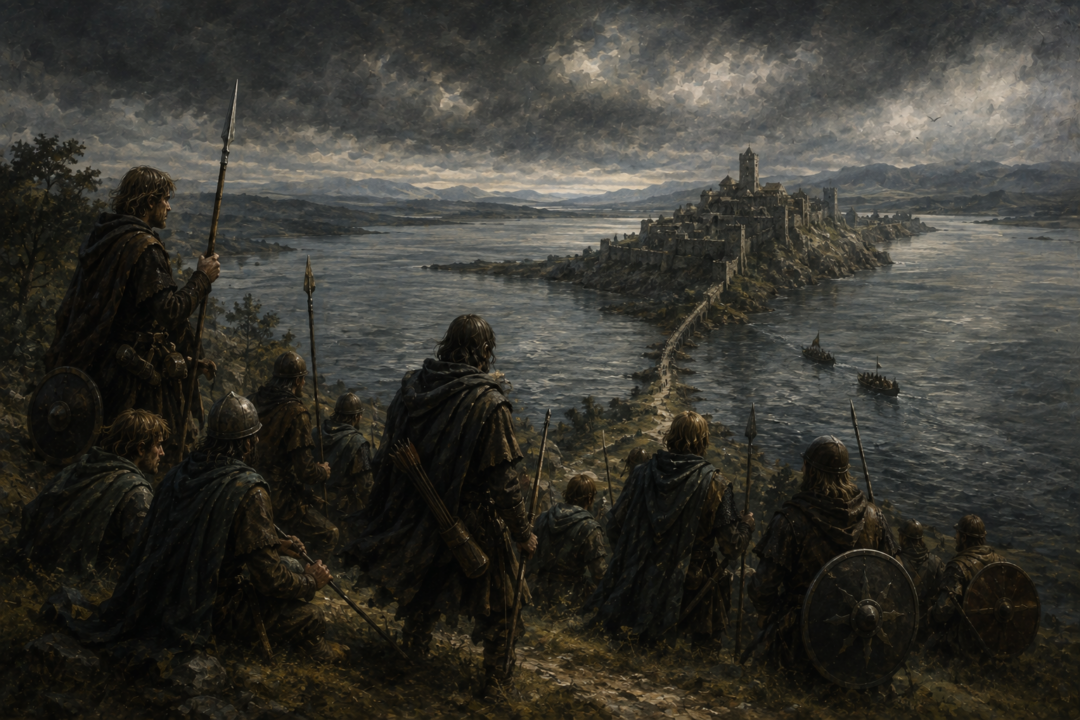
Aragorn orders those unable to continue toward the Morannon to go southwest toward Cair Andros. If enemies still hold the island, they are to attempt to retake it and then defend it.
This is not presented as an equal substitute for marching to the Black Gate. Aragorn speaks plainly about preserving what honour they can.
Yet his mercy has an unexpected effect.
Some of the frightened men master their fear and continue toward Mordor after all. Others gain courage from being given a difficult duty that lies within what they can bear.
The episode makes an important distinction between cowardice and the limits of courage.
Aragorn does not pretend that their fear is meaningless. Neither does he conclude that frightened men are useless.
A soldier unable to march beneath the shadow of the Nazgûl toward the gates of Mordor may still fight fiercely for a fortress on the Anduin.
Leadership here means understanding the difference.
Why Aragorn Does Not Force Them Forward
There is also a practical reason not to drag terrified soldiers toward the Morannon.
The final army has almost no conventional hope of survival.
The Captains are knowingly placing themselves where Sauron can surround and destroy them because every moment the Enemy concentrates upon them may purchase another moment for Frodo.
Men who are psychologically incapable of continuing add little to that mission if they must effectively be driven forward.
By redirecting them toward Cair Andros, Aragorn turns a weakness into useful resistance elsewhere.
The decision also fits the strange arithmetic of the entire campaign. More soldiers at the Morannon would certainly be valuable in the coming battle, but numbers alone cannot save the Captains. Once Sauron's armies emerge, the West is hopelessly outmatched.
Their true weapon is not numerical strength.
It is Sauron's misunderstanding of their intentions.
Less Than Six Thousand Reach the Black Gate
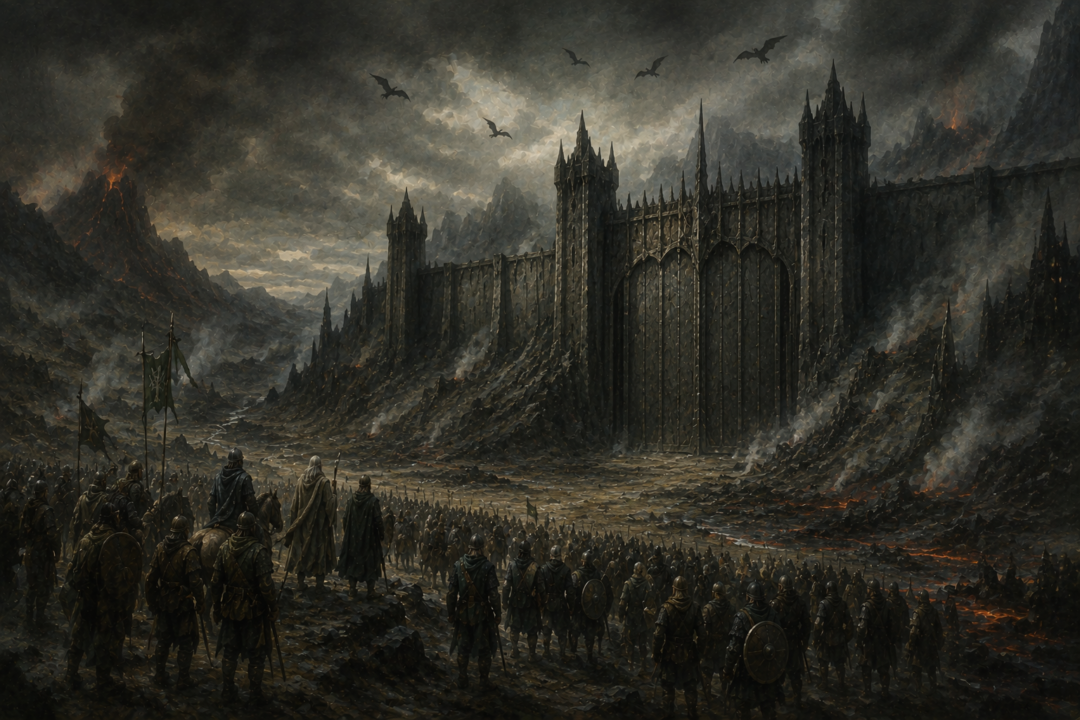
By the time the Captains finally arrive before the Morannon, fewer than six thousand remain.
The reduction comes partly from the guard already left at the Cross-roads and partly from those redirected toward Cair Andros.
And now the logic of the march becomes completely visible.
They stand before a fortress they cannot realistically storm. Sauron's forces wait in overwhelming strength. The Nazgûl circle overhead. The Captains have knowingly marched into a trap.
But the trap is also theirs.
They want Sauron to believe that Aragorn's challenge matters more than anything happening inside Mordor.
The small army must look like the center of the war precisely because it is not.
The Men Left Behind Reveal What the March Really Is
The Cross-roads episode can look like a minor logistical detail, but it exposes the structure of the entire endgame.
Aragorn does not strip every road, fortress, and defensive position merely to add another few soldiers to his banner. He knows that the march to the Morannon cannot succeed through conventional force.
So he leaves men where they can still accomplish something real.
Archers remain hidden around the Cross-roads to watch approaches from the south and east. Men unable to endure the road to Mordor are redirected toward Cair Andros. Fewer than six thousand continue toward the Black Gate.
And somewhere beyond them, two hobbits crawl toward Mount Doom.
That is the great contradiction of the final campaign. The army standing openly before Sauron is not the force expected to defeat him. Its task is to convince him that it might.
The men left behind are therefore not evidence that Aragorn underestimated the coming battle.
They are evidence that he understood it perfectly.
The West does not need every available sword at the Morannon because swords cannot win the real battle.
What the Captains need is enough strength, courage, and spectacle to hold the Eye of Sauron upon themselves for just a little longer.
Sources & Notes
- Tolkien Gateway, “Cross-roads” — records the Army of the West reclaiming the junction and stationing a strong force of archers there to guard against attacks from the Morgul road or the South. https://tolkiengateway.net/wiki/Cross-roads
- Tolkien Gateway, “The Last Debate” — summarizes Gandalf’s argument that Mordor could not be defeated by force and that the assault on the Black Gate was intended to divert Sauron’s Eye from the Ring-bearer. https://tolkiengateway.net/wiki/The_Last_Debate
- Tolkien Gateway, “The Black Gate Opens” — gives the Host’s initial strength of seven thousand and describes Aragorn allowing fear-stricken younger troops to turn back as the army approached Mordor. https://tolkiengateway.net/wiki/The_Black_Gate_Opens
- The Encyclopedia of Arda, “Cair Andros” — explains the island’s strategic importance and notes that Aragorn detached a small group from the main army to retake and hold it during the march on Mordor. https://www.glyphweb.com/arda/c/cairandros.php
Sources checked against the article’s distinction between the Cross-roads guard, the fear-stricken troops redirected near Mordor, and the Host’s diversionary purpose.