When Túrin reaches Nargothrond, he carries a sword he has every reason to hate.
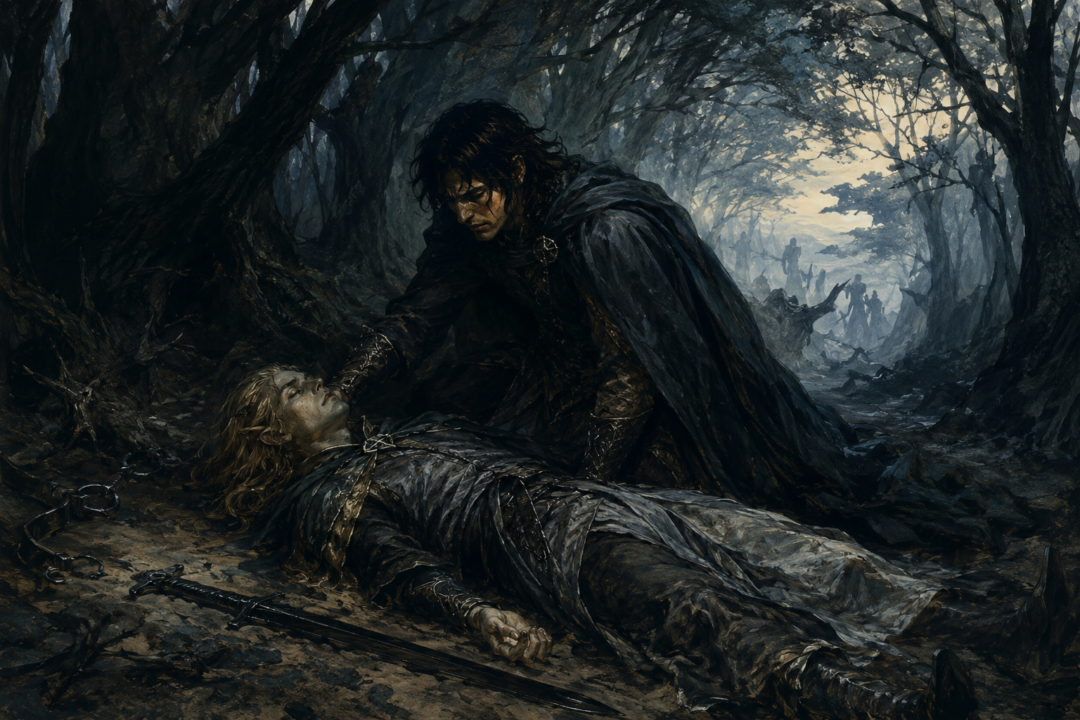
Anglachel is no ordinary weapon. Forged by Eöl from iron that fell from heaven, it is one of the most remarkable blades of the First Age. Yet for Túrin its importance has become brutally personal. It is the sword with which he accidentally killed Beleg Cúthalion, the friend who had crossed wilderness and danger to rescue him.
And Túrin does something striking with it.
He does not throw Anglachel away.
He has it reforged.
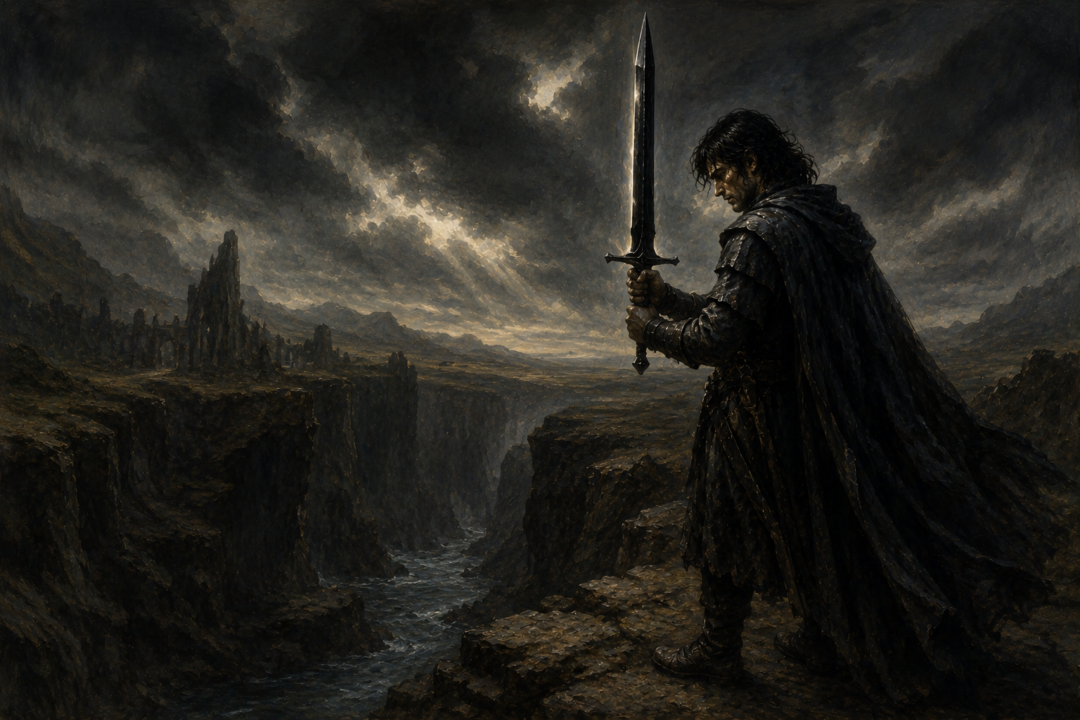
Then he gives it a new name: Gurthang, “Iron of Death.”
On the surface, this is simply the transformation of a damaged sword into Túrin’s famous black blade. But within Túrin’s larger story, the act fits a recurring pattern. Again and again he tries to escape unbearable parts of his past by changing names, identities, places, and roles.
The reforging of Anglachel can therefore be read as more than weapon maintenance. The texts never explicitly say that Túrin renames the sword as a psychological attempt to overcome Beleg’s death. But the surrounding pattern makes that interpretation compelling: Túrin is trying to make something associated with catastrophe usable again.
The tragedy is that neither Túrin nor the sword truly escapes what came before.
Anglachel Was Troubled Before Túrin Ever Touched It
Anglachel’s darkness does not begin with Beleg.
The sword was forged by Eöl, the Dark Elf, from extraordinary iron that had fallen from the sky. Its name is generally understood as “Iron of the Flaming Star,” preserving the memory of that celestial origin.
Eöl made two such swords, Anglachel and Anguirel. Anglachel eventually passed to Thingol, and much later Beleg chose it when he went out from Doriath to seek Túrin.
Melian immediately perceived something disturbing about the weapon.
She warned Beleg that the sword contained the malice of its maker and would not love the hand it served. That warning matters because it prevents Anglachel from being treated as a morally neutral object that becomes sinister only after tragedy strikes.
Its history is troubled from the beginning.
Yet it is also Beleg’s weapon during one of the greatest acts of friendship in Túrin’s story. Beleg follows the Orcs carrying the captive Túrin northward and, with Gwindor’s help, attempts to rescue him.
That is where Anglachel becomes inseparable from Túrin’s deepest grief.
The Sword That Kills the Man Trying to Save Him
Beleg finds Túrin unconscious and bound.
During the rescue, he uses Anglachel to cut his bonds. The blade slips and wounds Túrin. Awakening suddenly in darkness and terror, Túrin believes himself attacked and seizes the sword.
He kills Beleg.
Only afterward does he understand what he has done.
The horror is particularly severe because Beleg has not merely been Túrin’s companion. He has repeatedly chosen Túrin despite every opportunity to abandon him. He sought him after his flight from Doriath, lived among his dangerous outlaw company, fought beside him, and finally pursued his captors into the wilderness.
Beleg dies while freeing him.
Anglachel therefore becomes the physical object at the center of an unbearable reversal: the instrument of rescue becomes the instrument of death.
The sword itself is described as changing after Beleg’s death. Its blade becomes black and dull. The narrative gives Anglachel an uncanny responsiveness that matches Melian’s earlier warning, though readers should be cautious about defining exactly how literally its apparent awareness should be understood.
What matters beyond dispute is that the weapon is no longer simply Beleg’s sword.
For Túrin, it is now the sword that killed Beleg by his own hand.
Túrin’s Response Is Not to Destroy Anglachel
This is where the story takes an unexpected turn.
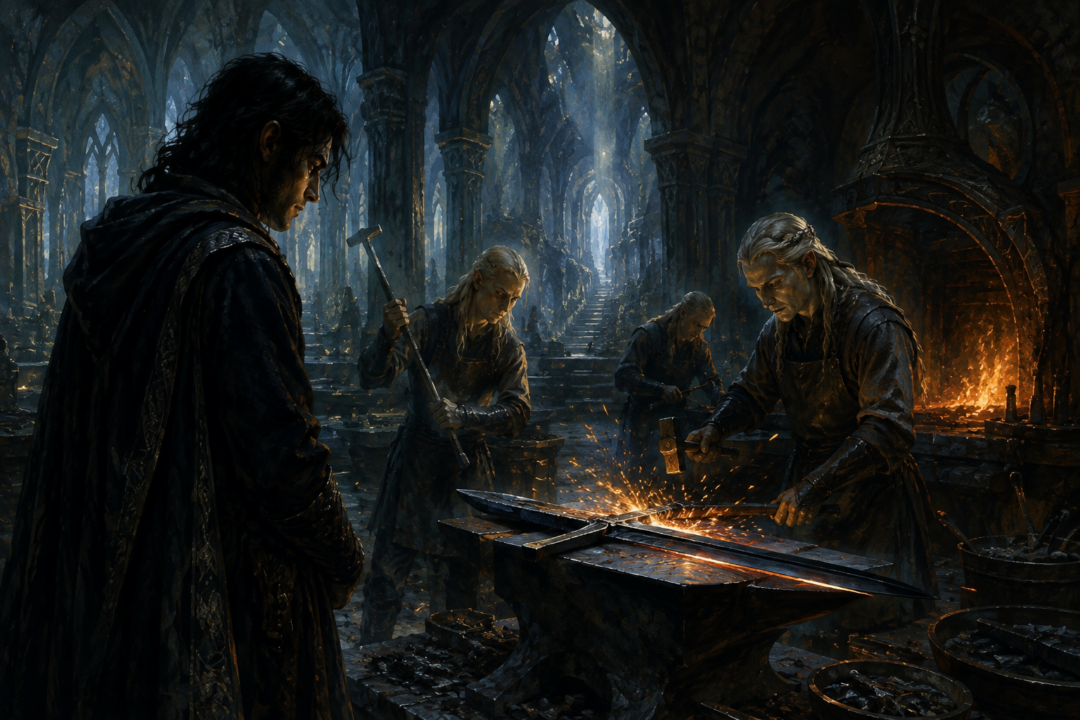
Gwindor leads the devastated Túrin to Nargothrond. There Anglachel is reforged, and although its blade remains black, its edges shine with pale fire. Túrin gives the renewed weapon another name.
Gurthang.
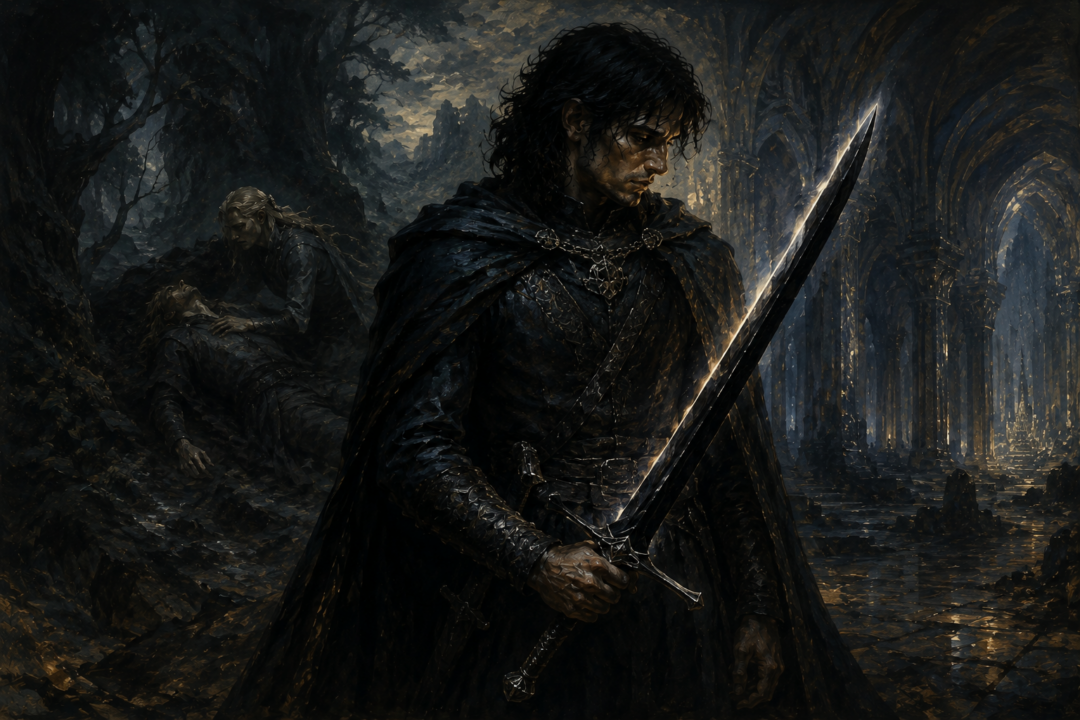
“Iron of Death.”
The texts do not provide an explicit interior monologue explaining why Túrin chooses to keep and rename the weapon. It would therefore go too far to claim that he consciously performs a ritual of psychological recovery.
But the sequence is significant.
Anglachel has been physically altered by catastrophe. It is then physically remade and linguistically renamed.
The old sword becomes a new sword.
Or at least Túrin behaves as though it can.
That distinction becomes crucial because Túrin is attempting something remarkably similar with himself.
Túrin Keeps Renaming Himself Too
Túrin’s life is filled with names.
Some are given by others. Some arise from reputation. Others are identities he deliberately adopts.
At Nargothrond, unwilling to reveal who he truly is, he calls himself Agarwaen, son of Úmarth: “Bloodstained, son of Ill-fate.”
The name is almost a confession disguised as concealment.
He refuses his true lineage while defining himself through guilt and doom.
Later he becomes famous as the Mormegil, the Black Sword of Nargothrond. Elsewhere his shifting identities continue, most famously when he takes the name Turambar, “Master of Doom.”
There is a recurring tension here.
Túrin repeatedly tries to control his story through naming.
Names allow him to enter a new community without bringing the full weight of his previous identity with him. A new place produces a new Túrin: outlaw leader, hidden stranger, captain, Black Sword, Turambar.
Yet the past continually returns.
Gwindor exposes his true identity at Nargothrond and warns that changing the name does not change the doom attached to the man. Later, in Brethil, Túrin again tries to establish a life separated from what came before.
This makes Gurthang especially revealing.
Túrin renames himself.
He also renames his sword.
Both transformations attempt, in different ways, to place a boundary between past and present.
Neither boundary holds.
Gurthang Turns Trauma Into Power
There is another reason Túrin may be able to continue bearing the blade.
Once reforged, the weapon associated with his worst accidental killing becomes the instrument through which he gains enormous martial power.
With Gurthang, Túrin becomes one of the greatest warriors of his generation.
His fame spreads from Nargothrond. Enemies fear the Black Sword. His identity increasingly merges with the weapon itself until “Black Sword” can mean not merely Gurthang but Túrin.
That transformation has a grim psychological logic.
The object that embodies helplessness becomes an object of mastery.
Beleg’s death occurred amid confusion, captivity, darkness, and terror. Túrin had virtually no control over the circumstances that produced the catastrophe.
Gurthang, by contrast, becomes the weapon he deliberately wields.
Again, the text never explicitly states that Túrin thinks in these terms. This is interpretation. But it aligns closely with his broader behavior: when confronted by powerlessness, Túrin repeatedly responds by attempting to seize control of his identity and fate.
Even the name Turambar, Master of Doom, expresses that desire at its most audacious.
Yet mastery remains incomplete.
He Eventually Tries to Put the Black Sword Away
The most revealing evidence may come later.
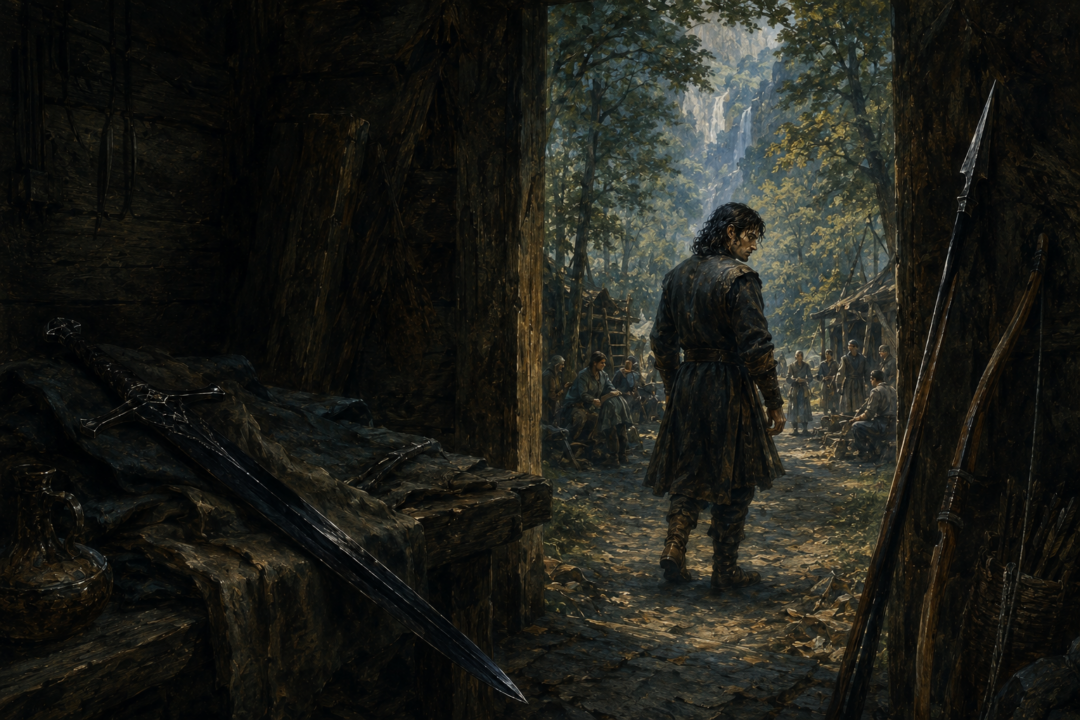
When Túrin reaches Brethil and attempts yet another beginning, he initially puts Gurthang aside. He fights with bow and spear rather than the famous black blade.
That choice suggests that the sword has become inseparable from the identity he is trying to escape.
Gurthang is no longer merely a weapon.
It is the Black Sword.
And Túrin himself has been the Black Sword.
To put Gurthang away is therefore symbolically close to putting away an earlier version of himself.
But danger returns, and Túrin eventually takes up the weapon again.
This is the pattern of his tragedy in miniature. He can change his name. He can move into another land. He can conceal his lineage. He can sheath the sword.
But he cannot make his history cease to exist.
The Final Conversation With Gurthang Completes the Pattern
At the end of Túrin’s life, the distinction between man and weapon becomes almost disturbingly thin.
After Glaurung is slain and the truth concerning Nienor is revealed, Túrin finally understands the scale of the catastrophe surrounding him. He turns once more to Gurthang.
But now he addresses the sword.
He asks whether it will kill him swiftly.
And Gurthang answers.
The precise nature of the sword’s voice belongs to the strange, mythic quality surrounding Anglachel from the beginning. What matters thematically is the terrible completion of the relationship.
Túrin had renamed the sword.
He had made it the instrument of his fame.
He had carried it through attempts to outrun his identity.
Now the sword recalls the blood it has already tasted—including Beleg’s—and agrees to take Túrin’s life.
He falls upon Gurthang, and the blade breaks beneath him.
The weapon that was reforged after Beleg’s death finally breaks at Túrin’s death.
Renaming Cannot Erase Memory
That is what makes Anglachel’s transformation into Gurthang so powerful.
Reforging works materially. The damaged sword can be made whole.
Renaming works socially. Anglachel can become known throughout Beleriand as Gurthang.
But neither process erases history.
Gurthang remains the blade that killed Beleg.
And Túrin, whatever name he adopts, remains Túrin son of Húrin.
This does not mean his attempts at reinvention are meaningless. They reveal something deeply human within the tragedy. Túrin desperately wants the possibility that a ruined thing can be remade, that identity can be chosen rather than merely inherited, and that the next chapter need not be determined by the last.
For a time, the reforged sword seems to prove him right.
Anglachel becomes Gurthang. The weapon of his greatest grief becomes the weapon of his greatest victories. With it he eventually accomplishes the extraordinary feat of killing Glaurung.
Yet the old history survives inside the new identity.
That is the cruel irony.
Túrin can rename the sword that killed Beleg.
He can even rename himself.
What he cannot do is rename the past.
Sources & Notes
- Tolkien Gateway, “Anglachel” — documents the sword’s meteoric origin, Eöl’s making of it, Melian’s warning, Beleg’s death, its blackening in mourning, and its reforging and renaming at Nargothrond. https://tolkiengateway.net/wiki/Anglachel
- Tolkien Gateway, “Gurthang” — traces the reforged black blade from Anglachel through Túrin’s deeds and death and gives Gurthang’s meaning as “Iron of Death.” https://tolkiengateway.net/wiki/Gurthang
- Tolkien Gateway, “Túrin” — summarizes Túrin’s repeated adoption of new names and identities, including Agarwaen, Mormegil, and Turambar, and records his reforging and renaming of Anglachel. https://tolkiengateway.net/wiki/T%C3%BArin
- The Encyclopedia of Arda, “Anglachel” — independently identifies Eöl’s sword, its meaning as “Iron of the flaming star,” its passage to Beleg, and its later reforging as Túrin’s Gurthang. https://www.glyphweb.com/arda/a/anglachel.php
Sources checked against the article’s account of Anglachel’s origin and history, Beleg’s death, the reforging and renaming as Gurthang, and Túrin’s wider pattern of adopting new identities.