The most extraordinary tree in the Shire grows where another tree was deliberately destroyed.
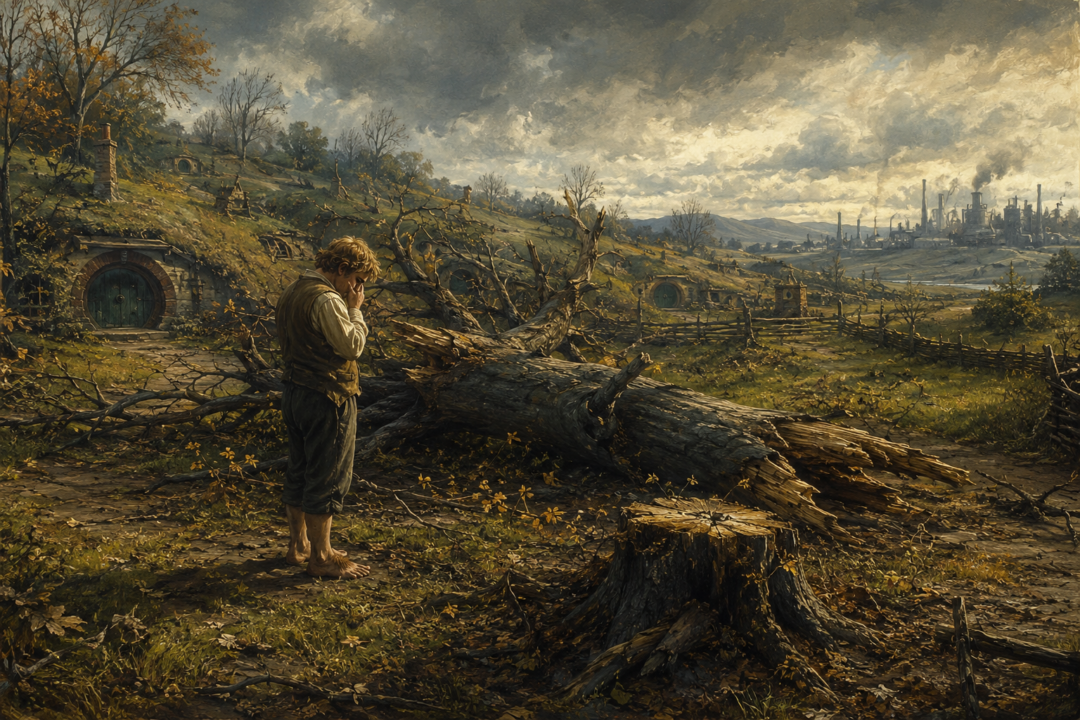
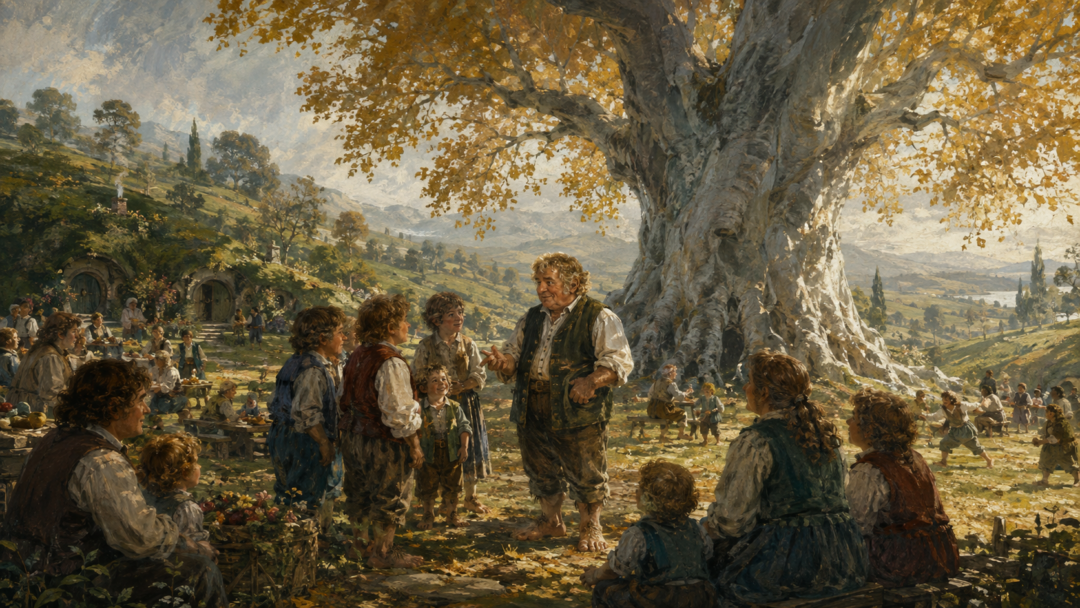
Before the War of the Ring, the Party Tree at Hobbiton was simply part of ordinary hobbit life. Bilbo Baggins gave his famous farewell speech beneath it during his eleventy-first birthday celebration. When Samwise Gamgee returned home after the destruction of the Ring, however, he found the tree cut down and left dead in the Party Field. The sight reduced him to tears.
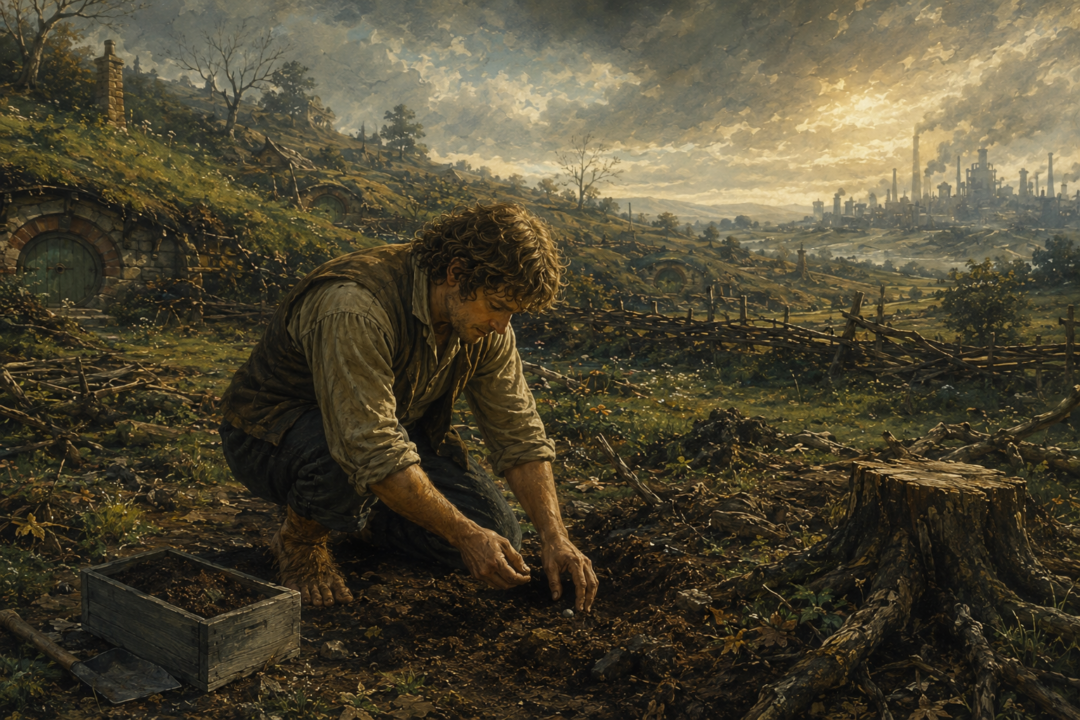
Later, Sam planted in that same place the silver nut Galadriel had given him. It became a mallorn, the extraordinary golden-leaved tree associated above all with Lothlórien.
Nothing in the text says Sam intended to make a political statement.
Yet the tree inevitably becomes one.
Not because it represents a party, ruler, or program, but because of what had happened to the Shire before it was planted. Sharkey's regime had tried to reorganize hobbit society through coercion, rules, confiscation, destruction, and centralized control. Sam answered that experience not by erecting a monument to victory, but by making something beautiful grow where ugliness had been imposed.
That makes the mallorn one of the quietest political symbols in Middle-earth.
The Party Tree Was Destroyed Because the Shire Itself Was Being Remade
The importance of the mallorn begins with the tree it replaces.
When the four Travellers return to the Shire, they do not merely discover ordinary wartime damage. They encounter a society that has been deliberately altered. There are new rules, armed Men, restrictions on movement, shortages amid hoarded supplies, ugly new construction, and the destruction of familiar places.
The Party Tree is one casualty of that transformation.
Its felling matters precisely because it apparently serves no great strategic purpose. The old tree stood in the place associated with Bilbo's famous birthday gathering and with communal celebration. When Sam sees it lying cut down, it becomes the final emotional proof that the assault on the Shire has reached beyond property into memory itself.
That is an important distinction.
Saruman's domination of the Shire is not dangerous merely because bad people temporarily hold authority. It is dangerous because ordinary life is being reshaped around their appetites. Trees, mills, food, roads, homes, and customs are subjected to a system that values control and usefulness more highly than inherited affection.
The Party Tree therefore becomes politically significant before the mallorn ever appears.
It is evidence of what arbitrary power destroys.
Sam Does Not Respond Like a Conqueror
After the Battle of Bywater and Saruman's death, the victorious hobbits could have filled the Shire with memorials to the uprising.
They do not.
Instead, much of the final chapter concerns repair.
New buildings erected during the occupation are pulled down, materials are reused, homes are restored, and Sam travels through the Shire replacing trees that had been destroyed. He uses the earth from Galadriel's garden sparingly, putting a little beside the roots of his plantings. The special silver nut he saves for the Party Field.
The distinction is revealing.
Sam does not plant the mallorn because he wants everyone to remember that Sam Gamgee helped defeat Sharkey. He does not name it after the Battle of Bywater. He does not turn the Party Field into a shrine to the Travellers.
His instinct is restorative rather than commemorative.
That is exactly why the resulting symbolism becomes so powerful.
A deliberate political monument tells people what an authority wishes them to remember. Sam's tree grows out of an act of gardening. Its meaning emerges naturally from the contrast between what was done to the Shire and what the hobbits choose to do afterward.
One regime cuts down.
The restored Shire plants.
Galadriel's Gift Brings an Older World Into Hobbiton
There is another layer to the tree's meaning.
The mallorn is not an ordinary replacement.
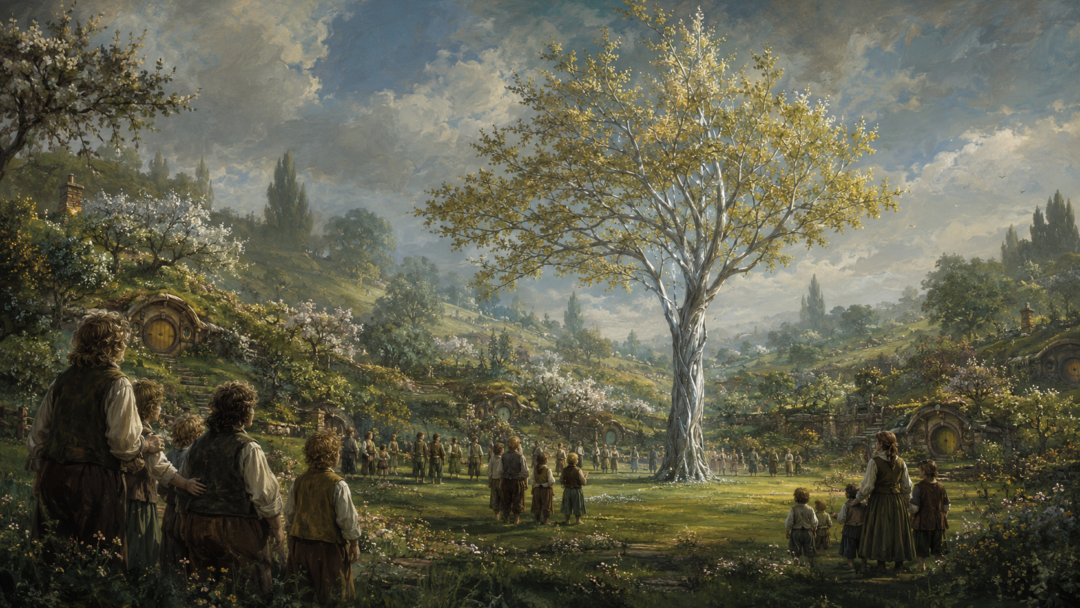
Mellyrn are deeply associated with Lothlórien, whose golden woods constitute one of the Fellowship's most memorable encounters with the surviving beauty of the Elder Days. Traditions concerning the trees reach farther back through Númenor and ultimately toward the Undying Lands, although the exact botanical history comes through later writings rather than the central narrative of The Lord of the Rings.
Galadriel gives Sam a box of earth from her orchard with a silver nut inside it. Her advice is directed toward Sam's deepest concern: his love of growing things.
The gift therefore crosses several boundaries.
Something belonging to the great history of Elves and the West enters the tiny world of Hobbiton. Yet Sam does not use it to make the Shire less hobbit-like. He does not build another Lórien.
He plants one tree.
That restraint matters.
The Shire is renewed through contact with something greater without being culturally conquered by it. The foreign gift takes root in local soil and becomes part of local life.
Politically, that offers a striking contrast with Sharkey's imported regime. Saruman's outsiders impose structures upon the Shire. Galadriel's gift is freely given, and Sam decides for himself how to use it.
One form of outside influence diminishes the Shire.
The other helps the Shire become itself again.
The Tree Restores Continuity Without Pretending Nothing Happened
Sam could have attempted to replace the lost Party Tree with exactly the same kind of tree.
Instead, the new tree is unmistakably different.
That makes the restoration more interesting.
The Shire does not simply return to an untouched version of its past after the Scouring. It cannot. Frodo has been wounded too deeply to remain. Merry and Pippin have returned as experienced leaders. Sam has crossed Mordor and stood in Lórien. The King has returned. The Third Age itself is ending.
The mallorn expresses that changed world remarkably well.
It stands in the same place as the Party Tree, preserving continuity with Hobbiton's communal memory, but it is not an imitation of what was lost. It contains the history of the journey that made restoration possible.
The Shire has survived, yet it has not emerged unchanged.
That is why the tree can be read as more than a symbol of nostalgia. Its meaning is not simply, "We restored the old days."
It is closer to: the old home can live again because those who loved it carried something back from beyond its borders.
It Becomes Public Without Becoming Propaganda
The mallorn eventually becomes famous.
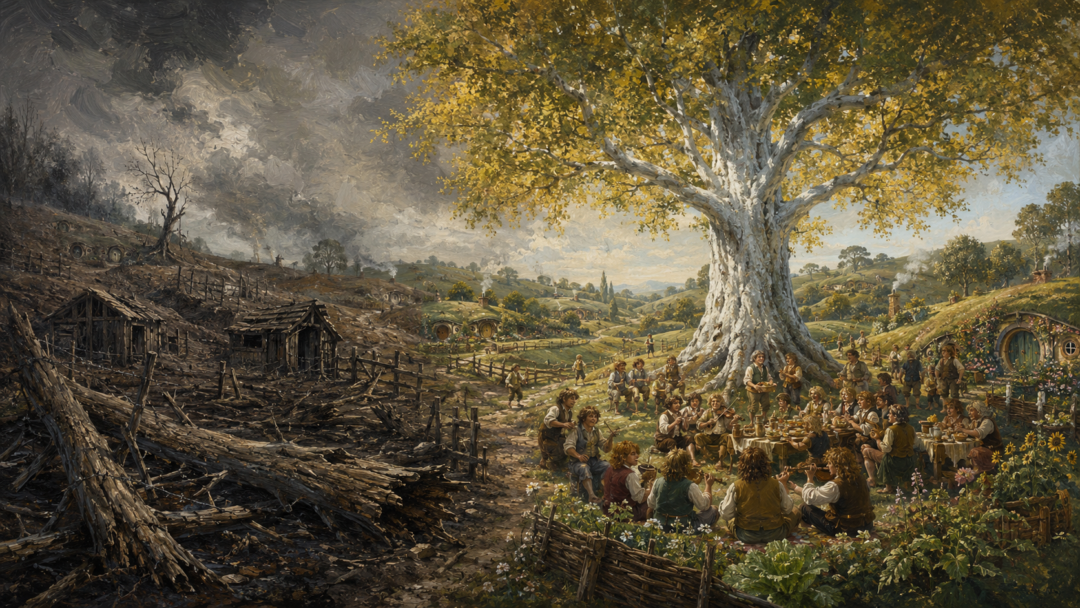
The text describes it as unique in the lands between the Mountains and the Sea, and people come from considerable distances to see it. Later Shire celebrations are associated with the tree and with the date of its flowering.
The remarkable thing is that the tree becomes communal property in the cultural sense.
Sam planted it, but the story does not treat it as Sam's private monument.
This becomes even more interesting in light of Sam's later career. Years after the restoration, Sam is elected Mayor of Michel Delving and serves seven consecutive seven-year terms, an extraordinary record in the Shire's otherwise modest political system. The Mayor was essentially the Shire's principal elected official, though traditional hobbit government involved relatively little formal administration.
But the sequence matters.
Sam plants the mallorn before becoming Mayor.
The tree is therefore not an emblem created by a politician to legitimize his rule. His later public authority cannot retroactively turn the original planting into a political campaign.
If anything, the relationship runs in the opposite direction.
The qualities embodied in Sam's restoration of the Shire—care, patience, stewardship, preference for ordinary flourishing over domination—are compatible with the kind of public trust that later leads hobbits repeatedly to elect him.
The texts never explicitly state that the mallorn explains Sam's political success. That would go too far.
But his gardener's work and his later civic role belong to the same portrait of his character.
The Strongest Political Symbol in the Shire Is Not a Throne
Middle-earth contains political symbols far grander than a tree.
There are crowns, swords, towers, banners, thrones, ancestral tombs, and royal cities.
The Shire gets a mallorn.
That is appropriate because hobbit society traditionally possesses very little interest in grand government. The Mayor of Michel Delving is described in the Prologue as effectively the Shire's only real official, while the Thain's authority has largely become ceremonial by the end of the Third Age.
The central public symbol produced by the Scouring is therefore not a monument to stronger government.
It is living evidence that government need not dominate everything.
The hobbits overthrow a system obsessed with rules and enforcement, then return responsibility to households, communities, traditional offices, and ordinary life. The mallorn stands in the middle of that recovered world without commanding it.
It provides shade.
It flowers.
People gather around it.
That is almost the opposite of Saruman's conception of power.
Sam Plants a Tree, and History Gives It Meaning
Calling the Party Field mallorn a political symbol requires one important qualification.
The narrative never says Sam planted it for political reasons.
He plants because he is a gardener, because he loves the Shire, because a beloved tree has been destroyed, and because Galadriel entrusted him with something capable of extraordinary growth.
Its political meaning comes afterward—or, more precisely, comes from context.
The mallorn occupies the scar left by an authoritarian occupation. It replaces destruction with cultivation. It joins Elvish beauty to hobbit independence without imposing either upon the other. It becomes a place of public wonder without becoming a monument to a ruler. And it is planted by a hobbit whose later political career rests not on conquest but on extraordinary communal trust.
The dead Party Tree showed what the Shire could lose.
The mallorn shows what survived.
That is why the Golden Tree can carry political meaning without ever having been planted as politics.
Saruman tried to leave his mark on the Shire by controlling it.
Sam left his mark by helping it grow.
Sources & Notes
- Tolkien Gateway — The Party Tree: the original tree’s role in Hobbiton, its felling during Sharkey’s occupation, and Sam’s replacement of it with Galadriel’s silver mallorn nut. https://tolkiengateway.net/wiki/Party_Tree
- Tolkien Gateway — Mallorn: the trees’ association with Lothlórien and the history of the mallorn grown by Sam in the Party Field. https://tolkiengateway.net/wiki/Mallorn
- Tolkien Gateway — Battle of Bywater / Scouring of the Shire: the coercive occupation, destruction, uprising, and restoration that give the new Party Tree its political context. https://tolkiengateway.net/wiki/Scouring_of_the_Shire
- The Encyclopedia of Arda — Party Tree: an independent reference for the tree’s place in Bilbo’s party, its destruction by Saruman’s Men, and Sam’s planting of the mallorn. https://www.glyphweb.com/arda/p/partytree.html
Sources document the Party Tree’s destruction and replacement, the mallorn’s Lothlórien associations, and the occupation-and-restoration context behind the tree’s political symbolism.