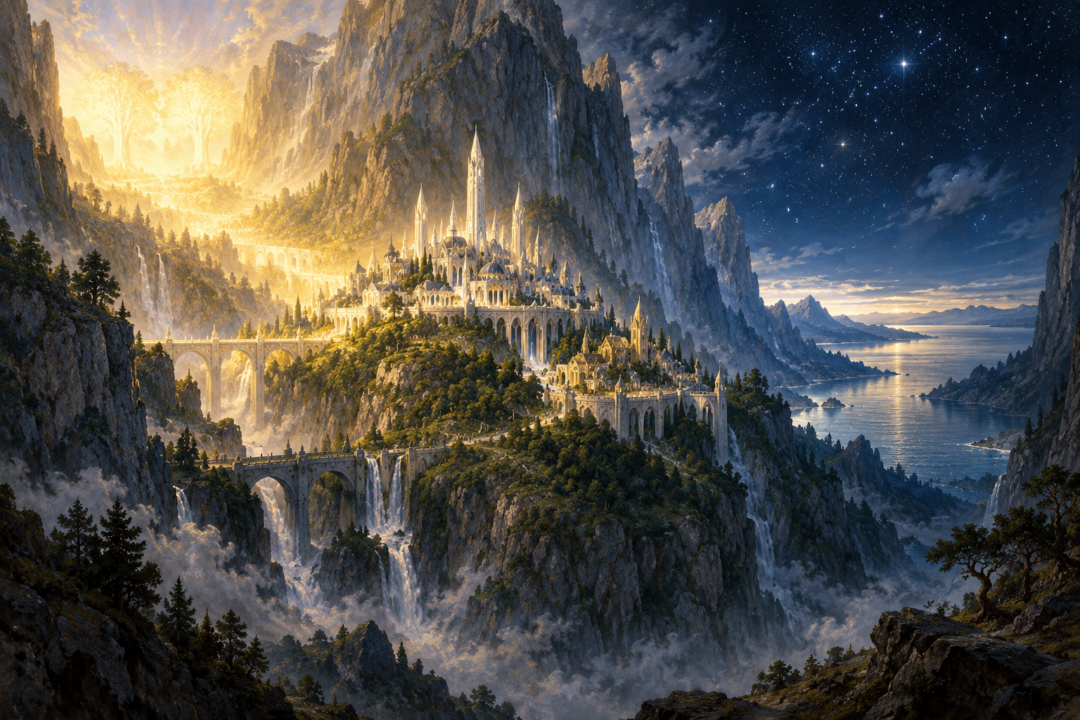
Tirion is one of the great cities of the Elves, yet its location is surprisingly strange. The Vanyar and Noldor had crossed the Sea and reached Aman, where the light of the Two Trees illuminated the land of the Valar. They might have settled deep within that blessed country, surrounded completely by its radiance.
Instead, their first great city rose on the green hill of Túna in the Calacirya: the immense cleft cut through the Pelóri, the mountain wall on the eastern border of Valinor. Tirion therefore stood at a threshold, with the light of the Trees behind it and Eldamar and the sea before it.
That placement was no accident. It preserved something the Elves had loved before they ever knew Aman: the stars, the sea, and a connection with the world outside Valinor.
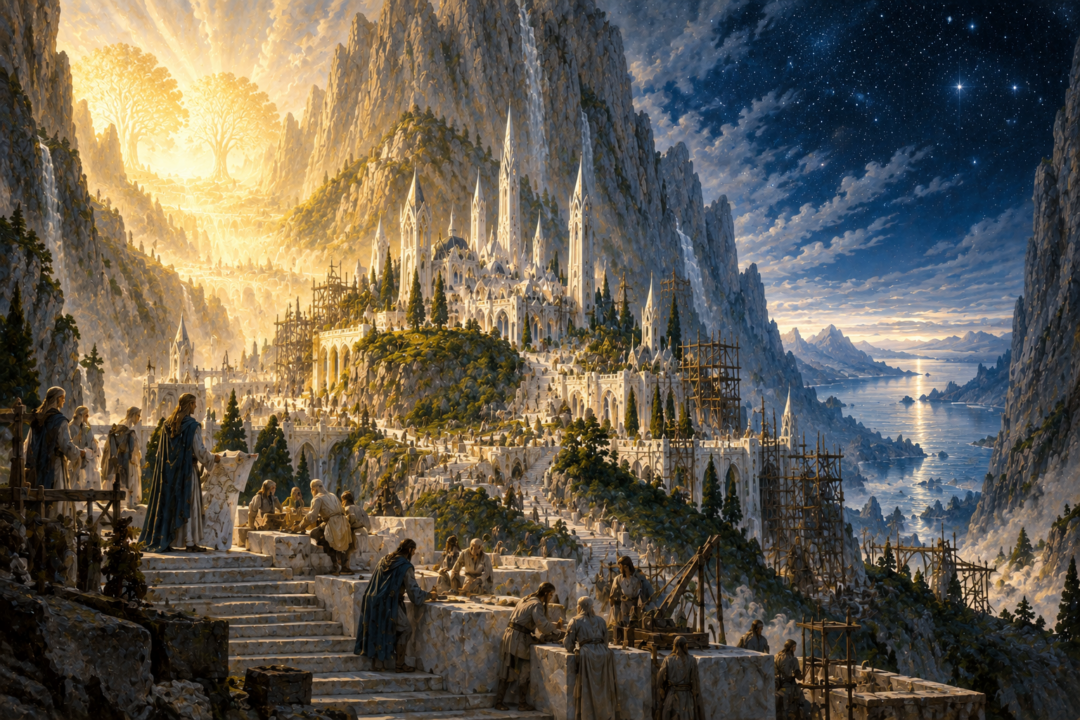
The Problem Created by Paradise
The Eldar did not awaken beneath the Two Trees.
Their first home was Cuiviénen in Middle-earth, beneath a sky illuminated by stars. The Sun and Moon had not yet arisen. Starlight therefore belonged to their earliest experience of the world, and their love for the stars—especially those associated with Varda—remained deeply rooted in Elvish memory.
When the Valar brought the Eldar westward, this created a subtle problem.
Valinor was protected by the Pelóri, the enormous mountain range raised along its eastern border. Inside lay the brilliance of the Two Trees. Outside were Eldamar, the sea, and the wider starlit world.
The Blessed Realm offered extraordinary beauty and security, but settling the newcomers wholly within its interior would have placed them behind the mountain wall and away from the shores facing Middle-earth.
The solution was geographical.
A passage was opened through the Pelóri: the Calacirya, the Cleft or Pass of Light. Within that passage rose Túna, and upon Túna the Elves built Tirion.
Tirion was consequently not merely a city in Aman. It occupied the meeting point between two environments.
Calacirya Let the Light Escape
The name Calacirya is itself revealing. It means the “Light-cleft,” referring to the light that passed through the opening in the Pelóri.
The Two Trees stood westward in Valinor, but their radiance could stream east through this single great breach. Tirion stood upon Túna within the pass, where that light reached toward Eldamar and the sea.
The imagery is almost architectural on a continental scale.
The Pelóri formed a wall. Calacirya became its opening. Túna stood within that opening, and Tirion crowned the hill.
The western side of Túna received the light of the Trees, while its shadow stretched eastward toward Eldamar.
This meant Tirion was neither simply outside Valinor nor buried within its protected heart. Its inhabitants lived where the radiance of Valinor encountered the world beyond the mountains.
That distinction explains why placing Tirion deep inside Aman would have defeated part of the purpose of its location.
The city was designed around connection.
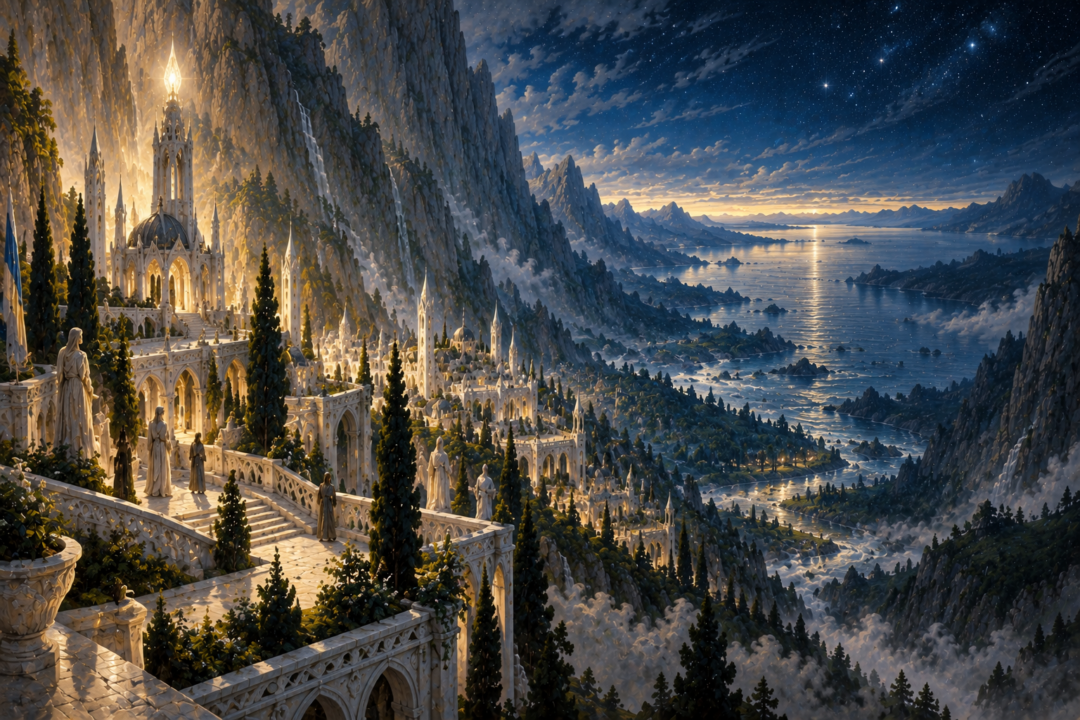
The Elves Had Not Ceased to Love the Stars
The Calacirya also answered a deeper attachment.
The Elves had awakened beneath the stars, and the tradition preserved in the texts emphasizes that they continued to desire sight of them. The opening through the mountains allowed the outside air and the starlit world to remain accessible rather than sealing the Eldar entirely within the illuminated interior of Valinor.
This is important because the move to Aman did not erase what the Elves had been before reaching it.
They had acquired a new home, but not a new origin.
Tirion's position therefore embodies a compromise between two kinds of beauty: the created radiance of the Two Trees and the ancient stars under which the Firstborn had awakened.
It would go too far to claim that Tirion was deliberately designed as a philosophical symbol. The texts do not state that. Yet geographically the symbolism is difficult to miss.
Its people lived at a boundary between memory and fulfillment.
Behind them was Valinor.
Before them were sea and stars.
Why Túna Mattered
Tirion was not simply built on the floor of the pass. It crowned Túna, a green hill raised within the Calacirya.
That elevation made the city one of the defining sights of Eldamar.
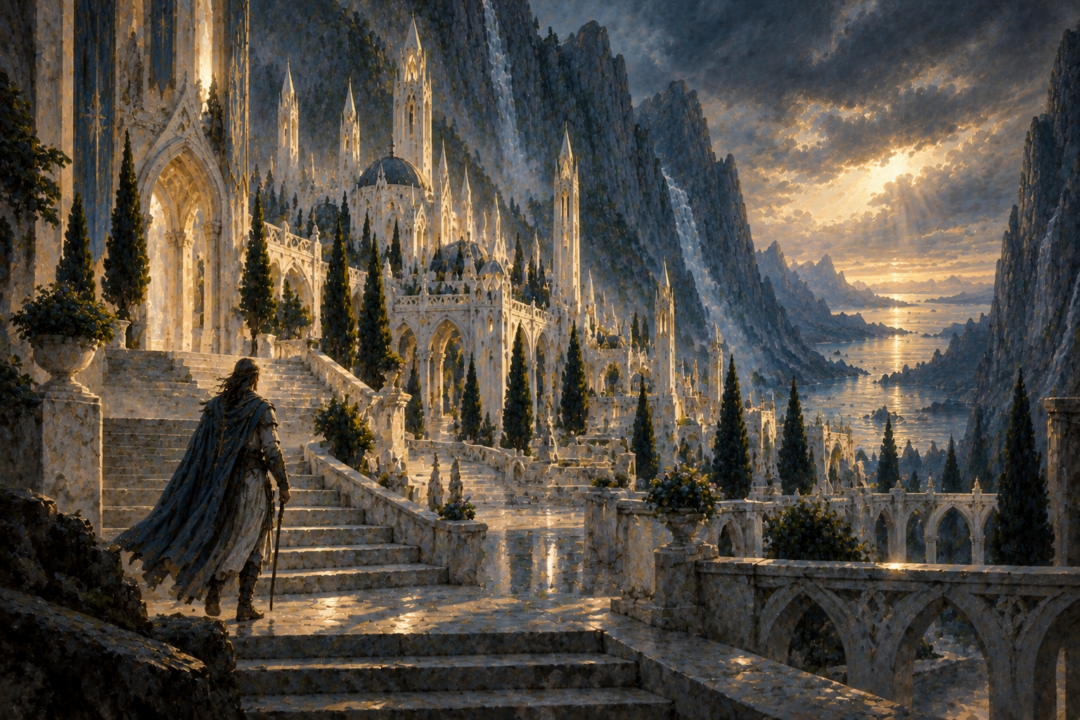
Its walls and terraces were white. At its summit stood the Mindon Eldaliéva, the tower associated with Ingwë, bearing a silver lamp that shone far across the sea. In the city also grew Galathilion, the White Tree made by Yavanna in the likeness of Telperion.
The result was a city visually oriented outward as well as inward.
From its elevated position, Tirion belonged to the geography of the coast even while standing at the entrance to Valinor.
This mattered especially because not all three kindreds of the Eldar ultimately lived in the same place.
The Vanyar and Noldor initially inhabited Tirion together. In time, the Vanyar moved closer to the Valar, while Tirion became principally the city of the Noldor. The Teleri, after their own delayed arrival, remained associated with the coast and eventually built Alqualondë beside the Bay of Eldamar.
The Calacirya kept these worlds geographically connected rather than placing the Noldor entirely behind the Pelóri.
Tirion Was a Threshold City
Calling Tirion a “threshold city” is an interpretation rather than a canonical title, but it describes its geography unusually well.
Its inhabitants could participate in the life of Aman without abandoning their relationship with Eldamar.
This makes Tirion fundamentally different from a hypothetical city constructed deep in the interior.
Deep Valinor offered proximity to the Valar and the Two Trees. The Vanyar eventually preferred precisely that closeness. Tirion, however, retained an eastern orientation toward the sea.
The distinction quietly anticipates the different paths of the Elven kindreds.
The Vanyar became the Eldar most closely associated with the Valar. The Noldor remained in Tirion, where their knowledge, craftsmanship, and internal history developed until the unrest surrounding Fëanor and the Silmarils shattered their peace.
That later history should not be read backward as though the location of Tirion somehow caused the rebellion. Nothing in the texts supports such a claim.
But the geography becomes tragically resonant once the Noldor depart.
The very opening that allowed Tirion to remain connected to the outer world also pointed toward the world into which many of its people would eventually return.
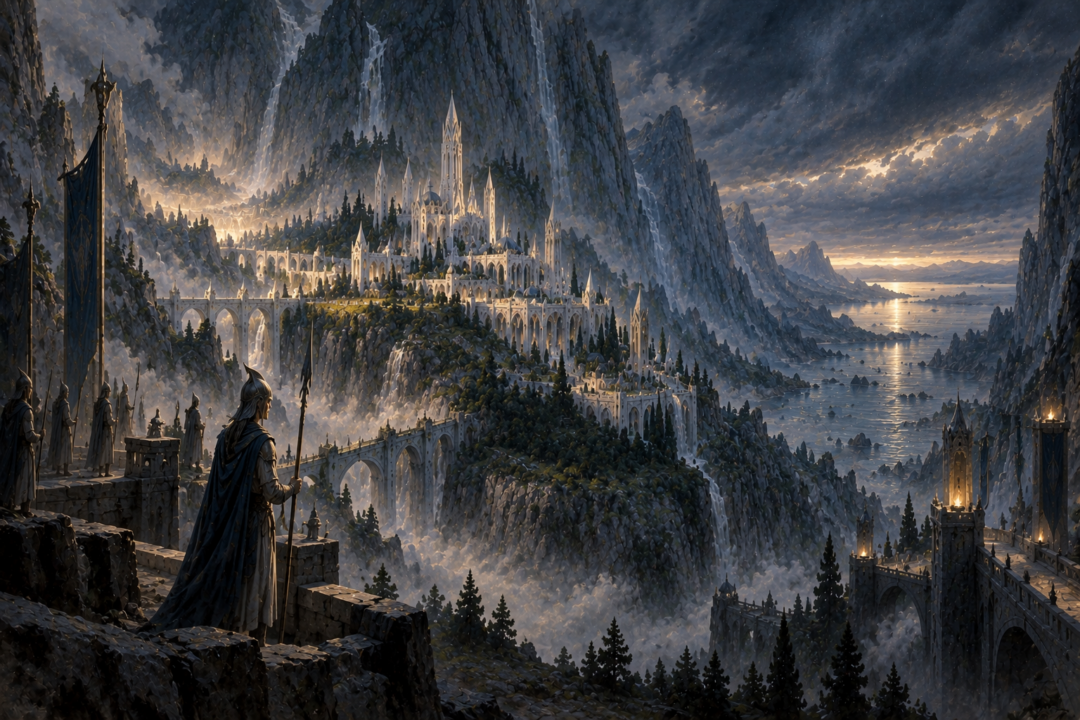
The Pass Became More Important After the Rebellion
After the Darkening of Valinor and the Flight of the Noldor, Aman was further protected.
The Pelóri were raised to greater heights, and the shores became guarded and difficult to approach. Yet the Calacirya was not simply erased. The passage remained, although it was guarded.
That survival is significant.
The Pass of Light had become the exceptional opening in an increasingly closed realm.
Its original purpose had been connection: allowing light to pass outward and preserving the Eldar's relationship with the world beyond the mountains. After the catastrophe of the Noldorin rebellion, the same geography acquired the character of a guarded gateway.
The place had not changed its fundamental nature.
Its circumstances had.
That transformation—from open connection to watched passage—is one of the quiet geographical consequences of the First Age's great rupture.
Eärendil Reveals Tirion's Geography Again
Much later, Eärendil reached Aman seeking aid against Morgoth.
His arrival provides one of the clearest narrative reminders of Tirion's position. Coming from the sea, he passed into the region of the Calacirya and reached Tirion upon Túna. The city was empty at that moment because its people were elsewhere at a festival, producing the haunting image of a mortal-born mariner walking through the deserted city of the Eldar.
The episode only works geographically because Tirion stands where it does.
It is effectively the great Elven city encountered on the approach from the eastern shore through the opening in the mountains.
The ancient decision to place Tirion at the threshold of Valinor therefore remains relevant thousands of years after its foundation.
A city built for Elves looking outward eventually becomes the place reached by the mariner who comes from the suffering lands outside.
Tirion's Location Explains What Aman Was—and Was Not
It is tempting to imagine Aman as a completely separate paradise, with the Elves simply withdrawing behind its mountains.
Tirion complicates that picture.
The earliest settlement of the Vanyar and Noldor was deliberately associated with the one great opening through the Pelóri. The light of Valinor could travel outward through that opening, while the Elves could retain access to the sea, stars, and air beyond the mountain wall.
Their new life did not require them to forget their first one.
That is the overlooked importance of Tirion's location.
The city was not placed in the Calacirya because Aman lacked safer or more beautiful places. It stood there because the Eldar themselves belonged to more than one landscape.
They had awakened beneath stars in Middle-earth. They had crossed the sea. They had seen the light of the Trees. Now their city stood between those experiences.
On one side lay the radiance of Valinor.
On the other lay Eldamar, the sea, and the stars beyond.
And upon a green hill between them stood Tirion.
Sources & Notes
- Tolkien Gateway — Tirion: the city on Túna within the Calacirya and Eärendil's arrival — https://tolkiengateway.net/wiki/Tirion
- Tolkien Gateway — Calacirya: the cleft through the Pelóri allowing the Trees' light outward — https://tolkiengateway.net/wiki/Calacirya
- Tolkien Gateway — Túna: the hill, its western illumination and eastward shadow — https://tolkiengateway.net/wiki/T%C3%BAna
Primary reading: The Silmarillion, 'Of Eldamar and the Princes of the Eldalië', 'Of the Sun and Moon and the Hiding of Valinor', and 'Of the Voyage of Eärendil and the War of Wrath'. These are secondary geography guides. 'Threshold city' is the article's interpretive description, not a canonical title or a claim that the location caused the Noldorin rebellion.