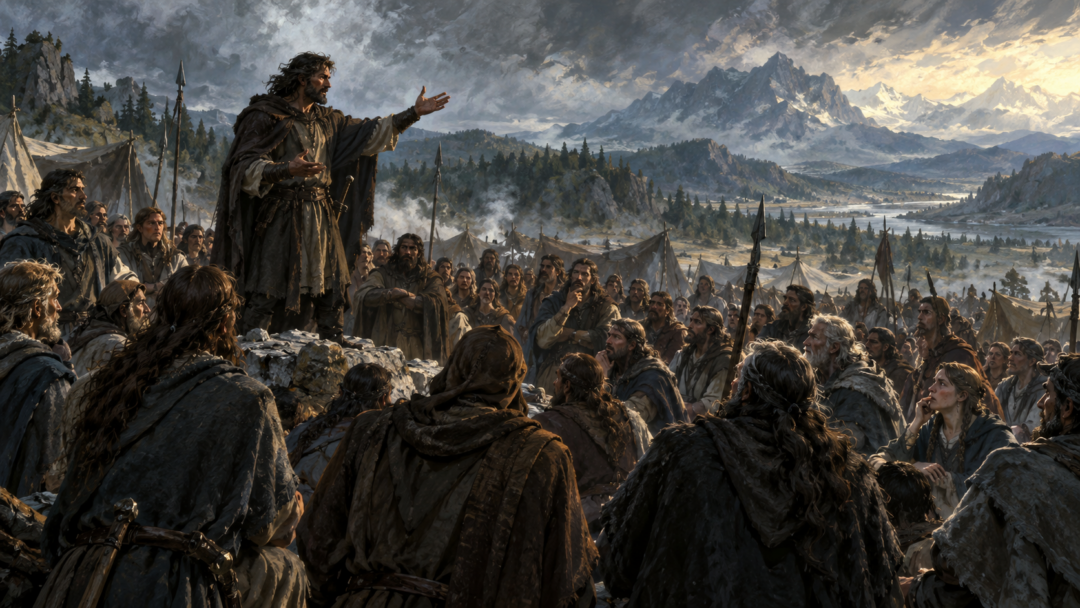
Among the Men gathered at Estolad, Amlach had every reason to look north with suspicion.
He was one of the leaders of a very human disagreement among the newly arrived Edain. They had crossed into Beleriand seeking something better than the darkness behind them, only to discover that the West was already divided by an immense war. Morgoth remained in the North. The Eldar opposed him. And mortal Men, whose lives were painfully brief beside those of the Elves, now had to decide whether that struggle should become theirs.
Amlach initially stood among those who resisted that idea.
Yet the extraordinary thing about his story is not simply that he changed his mind. It is what caused the change.
Morgoth's deceit did not merely threaten Amlach. Someone appearing to be Amlach used his identity and political voice before an assembly of Men. When the real Amlach discovered what had happened, the attempt to keep Men out of the northern war produced exactly the opposite result in him.
Amlach went north and entered the service of Maedhros.
The enemy had tried to speak through him. Amlach answered by choosing to act for himself.
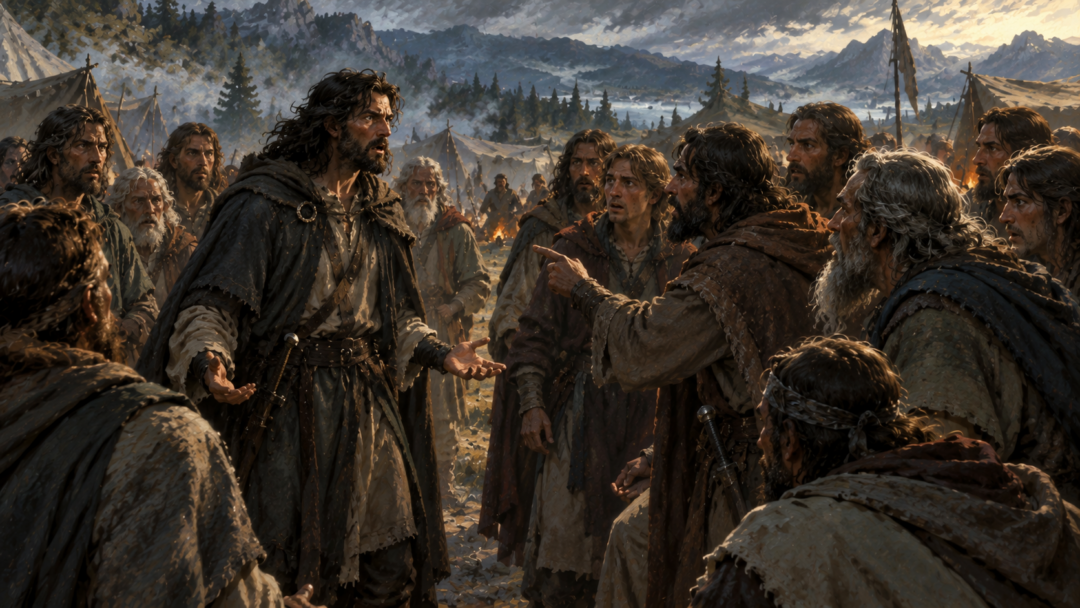
The Men of Estolad Had a Real Reason to Hesitate
The dispute at Estolad was not simply a choice between courage and cowardice.
The Edain had travelled far into the West, and many had hoped to escape the dangers that haunted Middle-earth. Instead they found that the Light they had heard of lay beyond the Sea, while Morgoth was very much present in Beleriand.
Some Men were already entering the service of Elven lords, and the friendship between Elves and Men was growing. But others remained deeply uneasy.
Amlach, a descendant of Marach, was among the leaders of this discontent, together with Bereg of the House of Bëor. Their objection was understandable even if the larger narrative reveals how dangerous withdrawal could be: why should mortal Men involve themselves in an apparently endless conflict between the Eldar and the Dark Lord?
The Elf-friends offered the opposite argument. Morgoth's ambitions were not limited to defeating the Eldar. Escaping the conflict would therefore not necessarily mean escaping Morgoth.
That disagreement matters because the real Amlach was not originally an unquestioning friend of the Eldar. His later decision has force precisely because it represents a reversal.
Then the council changed everything.
Someone Else Stood Up as Amlach
At the assembly, a figure appeared whom everyone took to be Amlach son of Imlach.
This apparent Amlach delivered a far more corrosive argument than simple reluctance to fight. The speech attacked the credibility of Elvish teaching, questioned the reality of what Men had been told about the West, and portrayed the Eldar themselves as seekers of domination.
The effect was powerful.
Those listening were shaken and became afraid. The false Amlach had taken existing uncertainty and pushed it toward alienation from the Eldar.
But afterward, the real Amlach returned.
He denied that he had attended the debate at all.
He denied speaking the words attributed to him.
Suddenly the political disagreement at Estolad contained evidence of something darker. Whatever the precise nature of the deception, the narrative associates these divisions with Morgoth's efforts to estrange Elves and Men. The text does not identify the impersonator by a familiar name, and there is no need to invent one. Nor does it explain the mechanism by which Amlach's appearance was counterfeited.
What matters is the result.
Amlach's identity had been used without his consent to influence his own people.

Morgoth Had Turned Amlach's Argument Into a Weapon
This is where Amlach's story becomes much more than a curious episode of impersonation.
Before the council, Morgoth's war could be treated as someone else's problem. Amlach could oppose travelling north precisely because he did not accept that Men needed to enter the Eldar's struggle.
Afterward, that distance became much harder for him to maintain.
The enemy had intervened directly in a debate among Men and had done so using Amlach's own likeness.
It is important not to claim more than the text provides. We are not told Amlach's private thoughts in detail. We are not told that he developed a theory about political manipulation or that the theft of his identity alone determined every part of his decision.
But the sequence is unmistakable.
Amlach discovers the deception, repents of his former position, declares that he now has his own quarrel with the "Master of Lies," and goes north.
The language of having a quarrel "of my own" is the key to the episode.
The conflict is no longer merely the quarrel of the Eldar.
It has become Amlach's.

The Deception Does Not Convince Everyone
Perhaps the most revealing contrast is that the exposure of the false Amlach does not produce one universal reaction.
The Elf-friends see the incident as confirmation that a Dark Lord truly exists and that his agents are already operating among Men. From their perspective, Morgoth's interference demonstrates why neutrality offers no reliable protection.
Others reach almost the opposite conclusion.
If Morgoth is already targeting Men because they have become entangled with the Eldar, then perhaps they should leave. Many prepare to depart from Estolad. Bereg leads a thousand of the people of Bëor southward, after which they pass out of the recorded history of those days. Those among Amlach's own people who share Bereg's outlook choose another leader and return east over the mountains into Eriador.
That contrast prevents an overly simple reading of the episode.
Discovering Morgoth's deceit does not logically force every Man to fight him. Some interpret the danger as a reason for withdrawal.
Amlach interprets it differently.
For him, deception produces commitment.
Why Maedhros?
The text is very specific about what Amlach does next: he travels north and enters the service of Maedhros.
It is less specific about why he chooses Maedhros in particular.
That distinction matters.
There is no stated scene in which Maedhros persuades Amlach, no recorded personal meeting that explains the choice, and no explicit claim that some particular quality of Maedhros attracted him. Filling that gap with an invented motive would make the story more detailed but less accurate.
What can safely be said is that Amlach's response takes him toward active participation in the northern resistance to Morgoth, and that participation assumes the concrete form of service under Maedhros.
This makes his reversal stronger than a mere change of opinion.
He does not simply become more sympathetic to the Elf-friends. He acts.
The man who had resisted being drawn north into the Eldar's war goes north himself.
Morgoth's Success Contains a Failure
There is a grim irony here.
The deception works.
The false Amlach frightens people. The assembly is shaken. Men do depart. Suspicion between Men and Elves is strengthened rather than instantly erased when the fraud is discovered.
Morgoth's effort therefore cannot simply be called a failure.
But it fails spectacularly with the man whose identity was stolen.
By impersonating Amlach, Morgoth's side gives the real Amlach something he did not previously possess: a personal reason to oppose the source of the deception.
This does not mean Morgoth deliberately intended that outcome. Quite the reverse is implied by the larger context, in which lies and deceits are being used to estrange Men from Elves.
The manipulation creates its own enemy.
Amlach had once helped articulate the case for staying away from the northern conflict. After his likeness is turned into an instrument of deception, he becomes a servant of one of the great Elven lords maintaining resistance in the North.
The stolen voice leads to chosen service.

Amlach Reclaims His Name Through Action
Amlach's story is brief because the surviving narrative gives us little more.
We are not told the battles he later fought. We are not given a death scene or a detailed account of his years with Maedhros. Inventing such things would weaken what is already remarkable about the episode.
His significance lies in the transformation we actually see.
At Estolad, somebody else appears as Amlach and publicly defines what "Amlach" supposedly believes.
The real man returns and rejects those words.
But denial alone is not the end of his answer.
He makes a different choice.
That is why his movement north matters so much. The false Amlach uses his identity to argue that Men should separate themselves from the Eldar's conflict. The real Amlach ultimately places himself in the service of Maedhros.
One reading, therefore, is that Amlach reclaims more than his reputation. He reclaims his agency.
Morgoth's deceit tries to turn a man's name into a weapon.
The man who owns that name answers by deciding for himself what he will do with it.
Sources & Notes
- Tolkien Gateway — Amlach: the false speech, discovery of the impersonation and service under Maedhros — https://tolkiengateway.net/wiki/Amlach
- The Encyclopedia of Arda — Amlach: his personal response to Morgoth's deception — https://www.encyclopedia-of-arda.com/a/amlach.html
- Tolkien Gateway — Bereg: the contrasting withdrawal of a thousand Bëorians from Beleriand — https://tolkiengateway.net/wiki/Bereg
Primary reading: The Silmarillion, 'Of the Coming of Men into the West'. The linked reference guides cover the impersonation and contrasting responses. The text does not identify the impersonator by name, explain the mechanism, or give a specific reason for choosing Maedhros rather than another lord. Reclaimed agency is an interpretation of the recorded sequence.