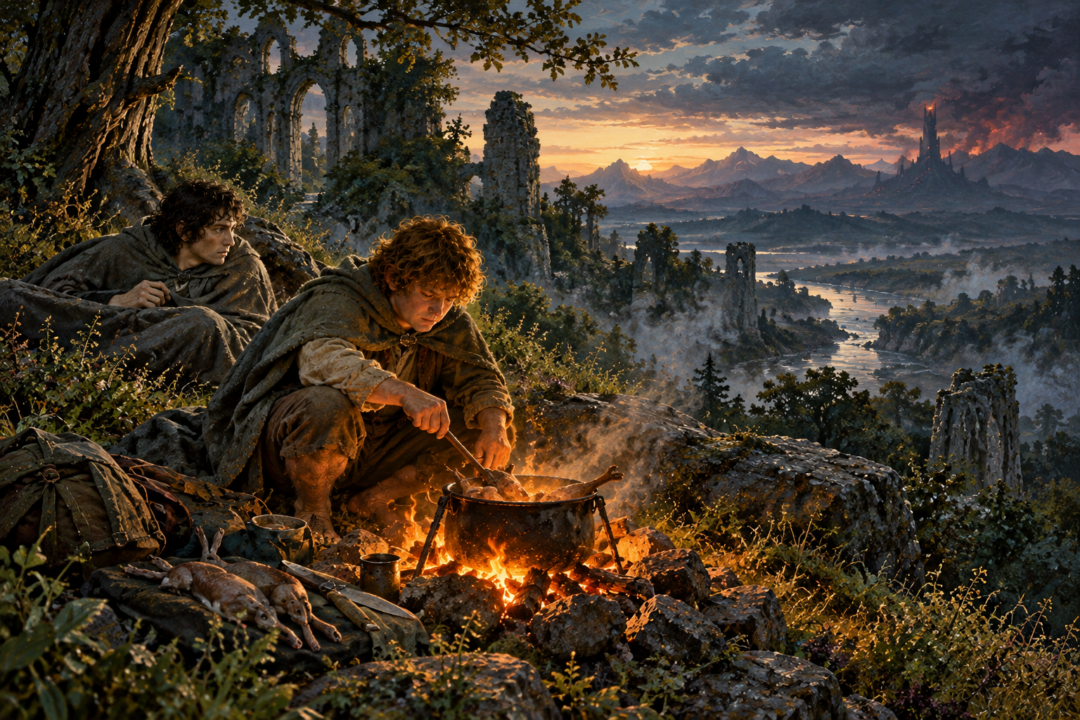
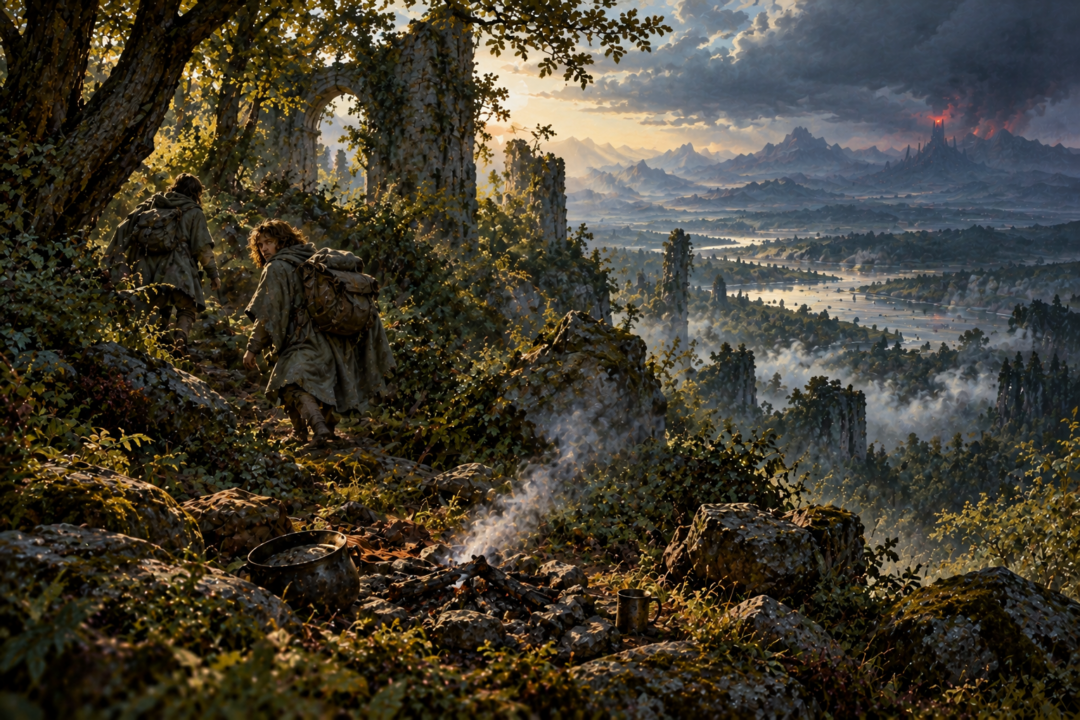
There is something almost absurdly comforting about Sam Gamgee making rabbit stew in Ithilien.
Frodo and Sam are creeping toward Mordor on a mission whose survival depends upon secrecy. They travel mostly at night. They avoid the open road. Gollum guides them through country increasingly dominated by the Enemy. Yet when Gollum brings back two young rabbits, Sam does what a hobbit naturally wants to do with good food: he cooks it.
That means making a fire.
And in The Two Towers, the fire does not remain the harmless little domestic thing Sam intends. Frodo immediately recognizes the danger. The smoke becomes visible. Sam tries to deal with it, but by then the travellers have introduced something into the landscape that secrecy cannot easily tolerate.
Soon afterward, Men appear.
The episode in “Of Herbs and Stewed Rabbit” is easy to remember for its humor and food. Beneath that warmth, however, is a sharp lesson about Frodo and Sam's journey: as they approach Mordor, ordinary habits become dangerous. Sam's fire costs them something precious—not their lives, but control over their concealment.
Ithilien Makes Sam Lower His Guard
The mistake matters partly because of where it happens.
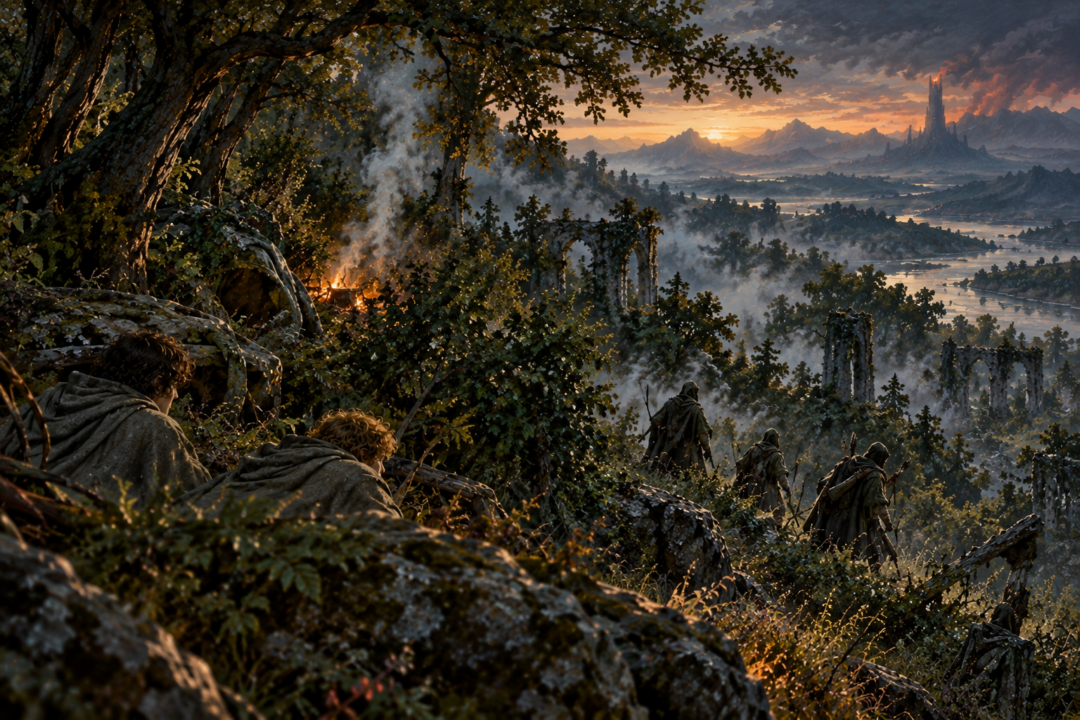
Before reaching Ithilien, Frodo, Sam, and Gollum have crossed bleak and exhausting country. Ithilien is startlingly different. It is a land of woods, streams, herbs, flowers, and lingering beauty, lying between the Anduin and the Mountains of Shadow.
The contrast is powerful. Mordor is close, yet Ithilien still contains signs of an older and fairer world.
For Sam especially, this abundance awakens familiar instincts. He notices plants. He thinks about food. He worries about provisions and even continues thinking about the possibility of a return journey when Frodo's hopes are darker.
When Gollum catches two rabbits, Sam sees the opportunity for a proper meal.
That impulse is not foolish in itself. Frodo and Sam genuinely need food, and lembas is precious. Sam's desire to cook for Frodo is also part of the practical care that sustains his master throughout the journey.
But Ithilien's beauty creates a dangerous contradiction. It looks more hospitable than the lands they have just crossed, while actually being a contested frontier watched by armed forces.
The travellers have entered beautiful country without entering safe country.
Frodo Understands the Problem Immediately
When Frodo wakes and discovers what Sam is doing, his reaction is revealing.
He does not object to the meal. He objects to the fire.
Frodo points out that fire is dangerous in those lands. Sam has already thought about the risk, but his calculation is characteristically practical: he wants to cook the rabbits properly, and he hopes the small fire can be managed.
Then comes the crucial problem.
The fire begins producing smoke.
Sam attempts to cover it, but the result only makes the smoke worse before he finally extinguishes it. The text therefore turns a tiny campfire into a visible signal rising from travellers whose entire strategy depends upon passing unseen.
This is not merely a theoretical danger. Shortly afterward, Frodo and Sam become aware that someone is nearby.
That does not justify overstating the chain of events. The narrative does not give us a formal statement from Faramir saying, in effect, “We found you because we saw Sam's smoke.” The Rangers of Ithilien are already operating in the area because they are preparing an ambush against the Haradrim.
But the chapter does connect Sam's smoking fire with the danger of discovery. At minimum, the fire compromises the careful concealment on which the hobbits have depended.
Sam has made them easier to notice.
The Elven Cloaks Cannot Hide Smoke
That is particularly ironic because Frodo and Sam possess excellent equipment for concealment.
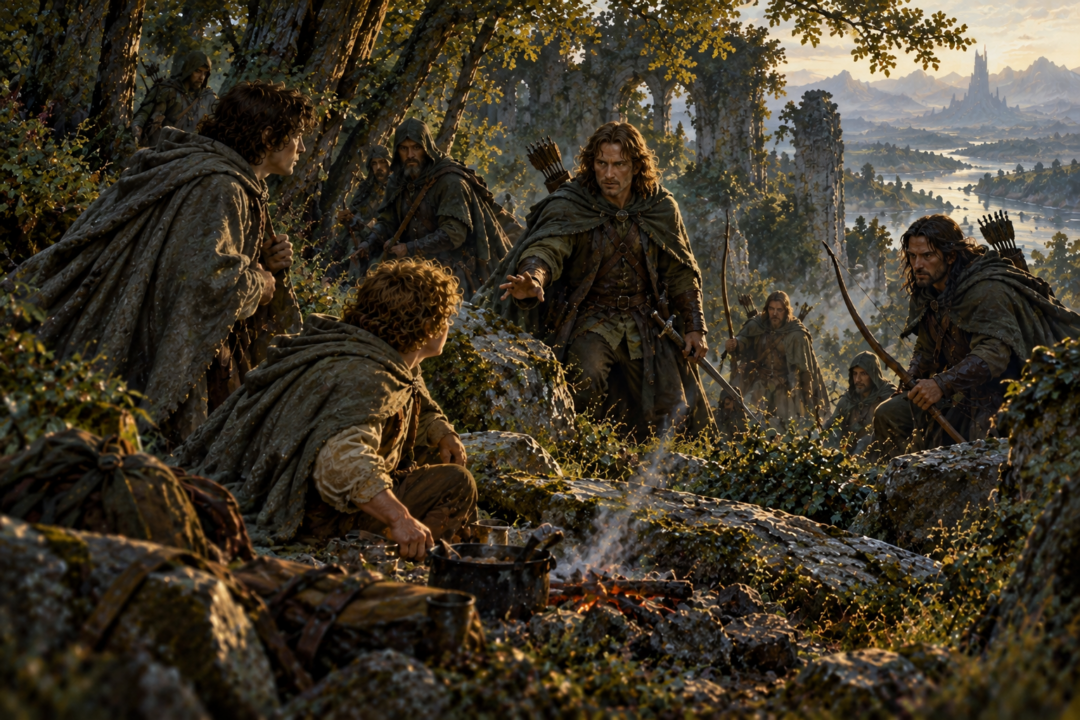
The cloaks given to the Fellowship in Lórien are not magical invisibility garments in the simple sense. Their virtue is subtler. They help their wearers blend into natural surroundings, taking on hues that make them difficult to distinguish against rock, tree, grass, or shadow.
This advantage matters repeatedly during the journey.
But a cloak can conceal a hobbit.
It cannot conceal a column of smoke.
The Ithilien episode therefore exposes an important rule of stealth in Middle-earth: concealment depends not merely upon what you wear, but upon what you do. Frodo and Sam may blend into the landscape while resting motionless, yet their actions can still betray them.
Fire creates light, smell, disturbance, and—most dangerously here—smoke.
Sam's error temporarily defeats one of the Fellowship's greatest advantages without damaging the cloaks at all.
The problem is behavioral rather than magical.
Why Sam Takes the Risk
It would be easy to reduce the episode to “Sam foolishly lights a fire,” but that misses what makes the scene significant.
Sam is trying to care for Frodo.
Food is one of Sam's languages of loyalty. He carries cooking gear long after other travellers might have discarded it. He worries about supplies. He thinks about meals because meals belong to the ordinary life he is trying to preserve.
That ordinary life matters enormously.
The Quest is steadily stripping Frodo of comfort, strength, appetite, and eventually almost every ordinary pleasure. Sam repeatedly pushes in the opposite direction. He tries to keep Frodo eating, drinking, sleeping, and moving.
The rabbit stew belongs to that effort.
So the fire presents a genuine trade-off rather than a simple mistake. Concealment says: remain cold, quiet, scentless, and invisible.
Sam's care says: Frodo needs a hot meal.
For a little while, Sam chooses the meal.
The danger arises because the closer they come to Mordor, the less room remains for ordinary hobbit life.
The Cost Is Not What Sam Expects
The immediate result is not an Orc patrol descending upon the campsite.
Instead, Frodo and Sam encounter Faramir and the Rangers of Ithilien.
This distinction matters.
Faramir's company is operating secretly in its own land, watching movements from the south and preparing to strike the Enemy's allies. These Rangers are themselves experts in concealment. Their green and brown clothing is adapted to the woodland country, and they know how to move unseen through Ithilien.
The hobbits have therefore wandered into an environment where another hidden group is already observing the landscape.
That makes Sam's smoke especially dangerous.
Yet discovery produces an unexpected consequence. Faramir's encounter with Frodo and Sam eventually becomes one of the great tests of the Quest. He learns enough to understand that Frodo carries something extraordinarily dangerous, and Sam inadvertently reveals more about Isildur's Bane than Frodo intended.
Faramir nevertheless refuses the temptation to seize the Ring.
So Sam's compromised concealment leads, indirectly, not to catastrophe but to an encounter with a man who proves capable of letting the Ring-bearer continue.
That fortunate outcome does not make the fire safe. It shows instead how narrowly danger and providential good can stand beside one another in the story.
A Tiny Fire Reveals the Scale of Their Vulnerability
There is another reason the scene matters.
Frodo and Sam have survived dangers far greater than a cooking fire. They have escaped the Black Riders, crossed Moria, endured the breaking of the Fellowship, descended the Emyn Muil, and crossed the Dead Marshes.
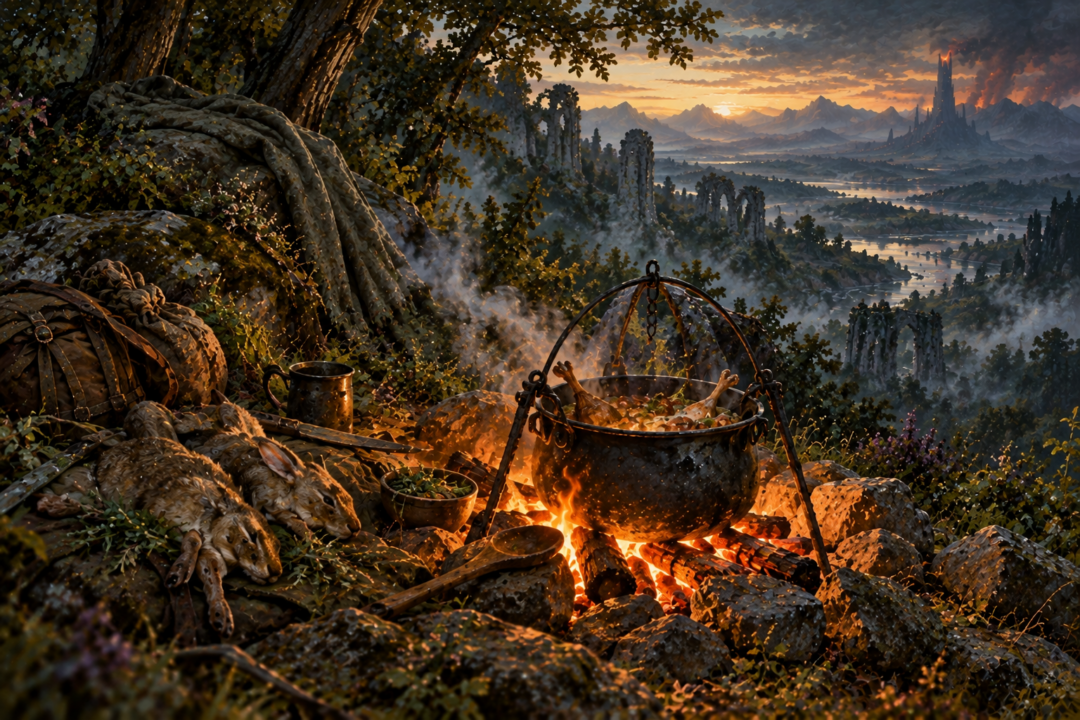
Yet in Ithilien, something as small as breakfast threatens secrecy.
That shrinking margin for error tells us how their situation is changing.
They are no longer simply travelling across Middle-earth toward danger. They are entering the military approaches to Mordor during wartime. Enemy forces move through the region. Gondor's Rangers conduct ambushes there. Roads and crossings matter strategically. Unknown travellers attract suspicion.
The closer Frodo comes to his objective, the more ordinary actions acquire consequences.
A footprint matters.
A voice matters.
A fire matters.
Later, inside Mordor itself, this pressure becomes even more severe. Frodo and Sam must move through a land filled with roads, fortresses, patrols, and armies. Their survival increasingly depends upon going unnoticed amid forces vastly greater than themselves.
The smoking fire in Ithilien is an early warning of that reality.
Sam Is Still Carrying the Shire
There is also something deeply characteristic in the fact that Sam is the one who takes this risk.
He has carried the Shire with him in countless small ways.
He remembers his Gaffer. He thinks about gardening. He values plain food. He carries cooking equipment. He measures extraordinary places against the standards of home.
These qualities can seem almost comic beside the grandeur and terror of the Quest, but they are also among Sam's greatest strengths. His attachment to ordinary life gives him something concrete to defend.
The rabbit stew is therefore both dangerous and beautiful.
It is dangerous because a cooking fire has no place in a mission requiring near-total concealment.
It is beautiful because Sam has not yet accepted that Mordor gets to dictate every condition of existence. For a brief moment in Ithilien, he insists that rabbits should be cooked, Frodo should be fed, and life should contain something better than cold rations eaten in darkness.
The world of the Shadow demands that they become furtive creatures concerned only with survival.
Sam keeps trying to remain a hobbit.
The Fire Foreshadows What the Journey Will Take Away
Eventually even these comforts disappear.
As Frodo and Sam penetrate Mordor, their possessions become burdens. Food diminishes. Water becomes a desperate concern. Rest becomes dangerous. Sam has to make increasingly severe decisions about what can still be carried.
The journey gradually reduces their world to essentials.
That makes the Ithilien cooking fire poignant in retrospect.
Sam can still stop beside clean water. He can still think about herbs. He can still prepare fresh food. He can still imagine cooking as something worth doing properly.
Soon there will be almost no space for such things.
The fire therefore marks a threshold. Behind them lies a world where hospitality, meals, gardens, and hearths are normal parts of life. Ahead lies Mordor, where even the smallest comfort may cost strength, time, or secrecy.
Sam's fire does not destroy the Quest.
But it demonstrates exactly what the Quest increasingly demands.
To approach the place where the Ring must be destroyed, Frodo and Sam must surrender more than safety. They must surrender ordinary habits that tell them who they are.
And that may be the deepest cost hidden in the smoke above Sam's little fire: for a moment, the hobbits try to live normally in a land where normal life has become dangerous.
The closer they come to Mordor, the harder that becomes.
Sources & Notes
- Tolkien Gateway — Of Herbs and Stewed Rabbit: cooking, Frodo's warning and the encounter with Faramir — https://tolkiengateway.net/wiki/Of_Herbs_and_Stewed_Rabbit
- Tolkien Gateway — Elven cloaks: camouflage, concealment and the limits of the gift from Lórien — https://tolkiengateway.net/wiki/Elven_cloaks
- Silmarillion Writers' Guild — Sam's birthday celebration, food essay: close reading of the Ithilien cooking scene — https://www.silmarillionwritersguild.org/node/4252
Primary reading: The Two Towers, Book IV, chapter 4, 'Of Herbs and Stewed Rabbit', and The Fellowship of the Ring, 'Farewell to Lórien'. The links are secondary guides and a close-reading essay. Smoke increases exposure, but the text does not explicitly establish it as the sole reason Faramir's Rangers found the hobbits.