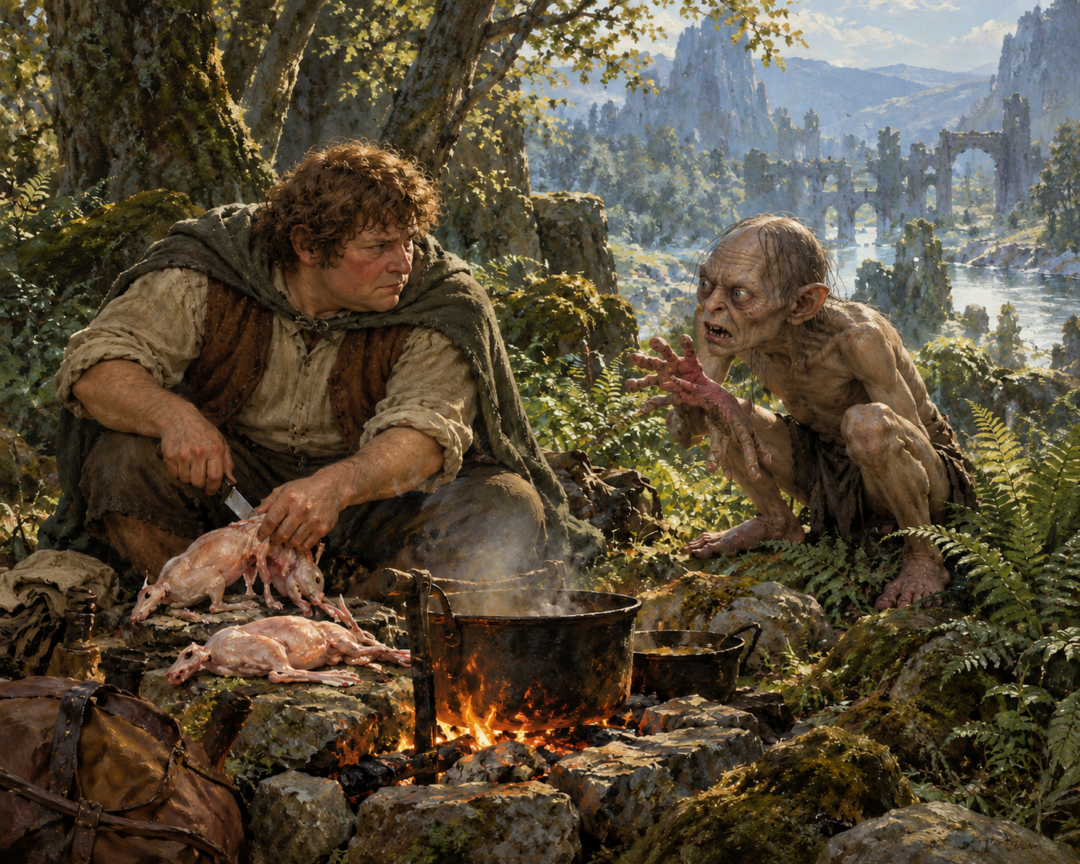
In the green wilderness of Ithilien, Samwise Gamgee attempts something wonderfully ordinary in the middle of an almost impossible journey: he cooks a proper meal.
Gollum has caught two rabbits. Sam has his cooking pans. Frodo is resting, and for a little while, the horrors of Mordor seem distant enough that a hobbit can think about herbs, vegetables, and a hot supper.
Yet what Sam considers a welcome improvement to their miserable travelling fare, Gollum regards as the destruction of perfectly good food.
The disagreement is amusing, but its meaning runs deeper than a quarrel over cooking.
For Sam, preparing food makes it better. Cooking transforms raw ingredients into something comforting, nourishing, and worth sharing. For Gollum, the transformation ruins precisely what made the rabbits desirable.
The extraordinary thing about this scene is that neither character is simply refusing food. They disagree about what makes food good in the first place.
And because neither fully understands the other's experience, an opportunity for cooperation becomes another moment of irritation.
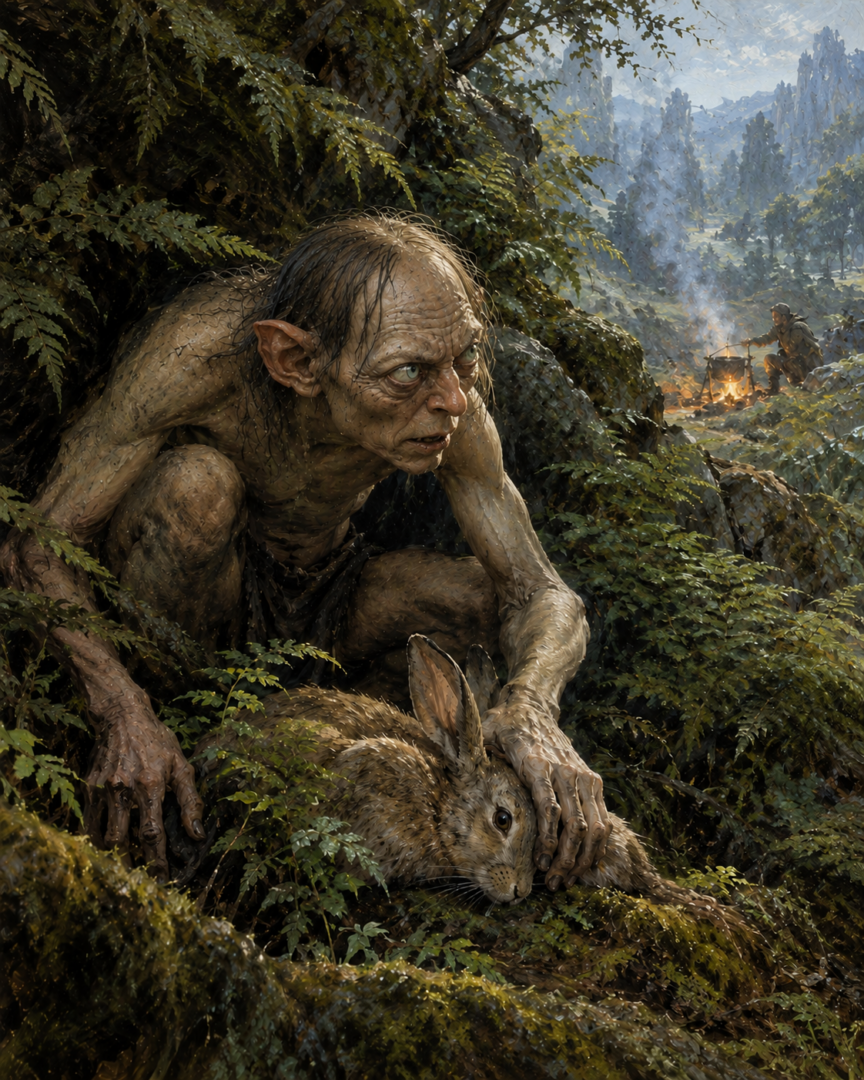
The Two Rabbits That Begin the Argument
The episode occurs in The Two Towers, Book IV, Chapter 4, "Of Herbs and Stewed Rabbit."
Frodo, Sam, and Gollum have entered Ithilien, a land that still possesses remarkable natural beauty despite the growing shadow of Mordor.
Their provisions are limited. The Elvish waybread has sustained the hobbits, but Sam longs for something different.
Gollum, meanwhile, knows how to obtain food from the wilderness.
When Sam asks him to find something suitable, Gollum eventually returns with two small rabbits.
This is an important detail.
Although Gollum is frequently hostile toward Sam, he has nevertheless performed a useful service. He has caught food for the hobbits rather than simply feeding himself.
The rabbits therefore represent a small instance of practical cooperation between companions who deeply distrust one another.
Sam immediately begins thinking like a cook.
He has carried cooking equipment throughout the journey, and here is an opportunity to use it.
But Gollum does not anticipate what Sam intends.
When he discovers that Sam plans to stew the rabbits, his reaction is one of genuine dismay.
He protests that Sam will spoil the beautiful meat he has obtained.
The disagreement begins because Gollum believes he has already provided something excellent, while Sam believes the real improvement is still to come.
Why Gollum Thinks Cooking Ruins the Rabbits
Gollum's objection is not that the rabbits are unsuitable for eating.
Quite the opposite.
He considers them especially desirable because they are young and tender.
He wants them eaten as they are.
Sam, however, intends to cut them up and simmer them in water with herbs.
To understand Gollum's disgust, it is necessary to consider his established eating habits.
During his long existence beneath the Misty Mountains, Gollum became accustomed to catching and eating fish. The Hobbit, particularly "Riddles in the Dark," establishes his predatory habits and his association with the dark underground lake.
By the time he accompanies Frodo and Sam, his preferences are profoundly different from those of ordinary hobbits.
He enjoys raw flesh and dislikes many foods that Sam considers desirable.
Cooking therefore does not necessarily represent an improvement to him.
It changes the food away from the condition he prefers.
Sam sees raw rabbit as an ingredient requiring preparation. Gollum sees raw rabbit as the desired result.
That distinction explains the intensity of his reaction.
The meat has not become physically poisonous. Nothing in the text establishes that Gollum is biologically incapable of eating cooked rabbit.
His response is presented as disgust, anger, and a clash of preferences.
For Gollum, the qualities Sam wishes to change are precisely the qualities that make the food appealing.
Sam is improving the rabbits according to hobbit standards. Gollum believes Sam is destroying their value.
Sam's Cooking Is an Expression of Home
For Samwise Gamgee, food means much more than satisfying hunger.
He comes from the Shire, where growing things, preparing meals, and enjoying ordinary comforts are central parts of life.
His father is a gardener. Sam himself understands plants and takes pleasure in practical domestic work.
Even far from home, he retains those habits.
He does not merely want to eat the rabbits. He wants to prepare them properly.
His thoughts turn to herbs, roots, bread, and especially potatoes.
These details matter because they reveal how Sam carries the Shire with him.
He cannot bring its fields, kitchens, or peaceful evenings into Ithilien, but he can preserve something of their familiar routines.
A cooking pot becomes a small reminder of ordinary life.
The contrast with Gollum is striking.
Sam's preferred meal involves preparation, patience, and familiar ingredients.
Gollum wants immediate access to the raw food.
One character associates a good meal with the work that transforms its ingredients. The other associates it with retaining the qualities he already desires.
There is also a meaningful distinction between the rabbits themselves and the meal Sam prepares.
Gollum catches the rabbits for the hobbits. Sam's cooking is not explicitly described as a formal gift to Gollum.
Indeed, the finished stew is prepared for Frodo and Sam.
Nevertheless, the exchange exposes a broader difficulty with generosity: something intended as an improvement may not be received as one.
Sam cannot easily imagine that his carefully prepared food might be less desirable to someone else than the uncooked meat.
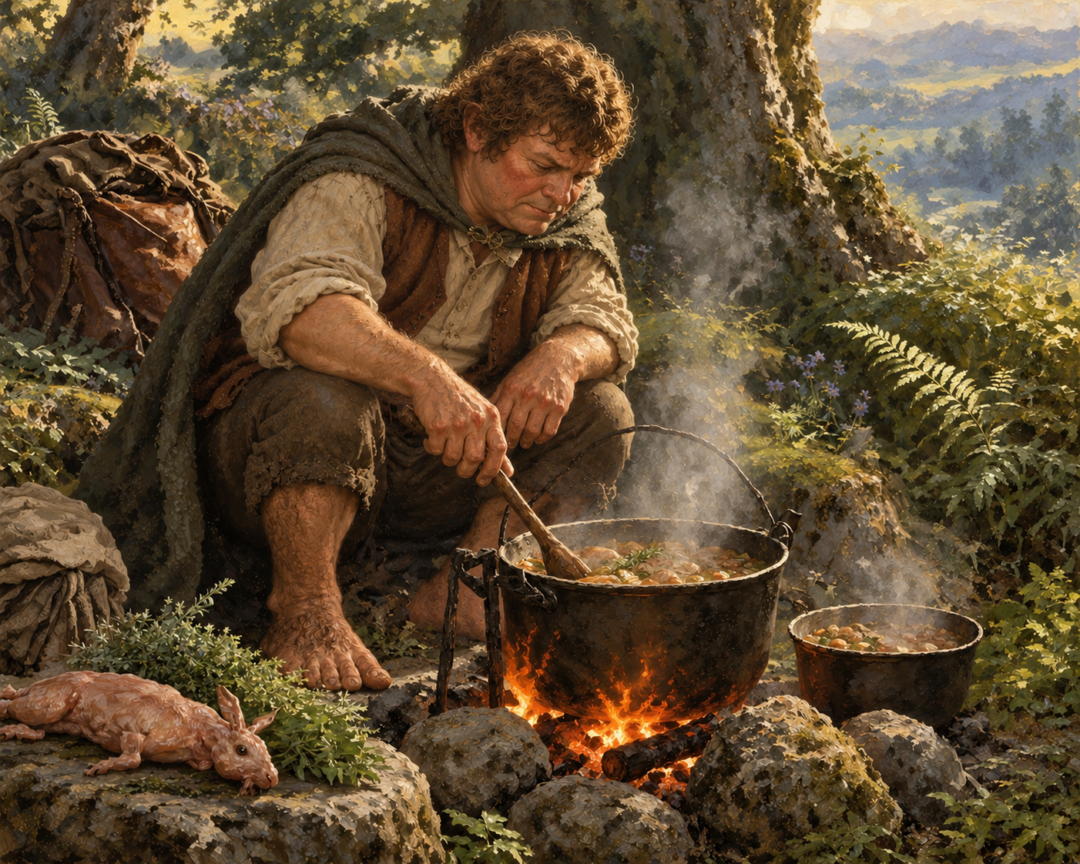
The Bread That Gollum Cannot Bear
One of the most revealing moments comes when Sam explains their different preferences.
He acknowledges that the hobbits' bread is objectionable to Gollum, just as raw rabbit is objectionable to himself.
This is not merely a joke.
It shows that Sam recognizes a genuine difference between them.
The bread in question belongs to the travellers' existing provisions, most notably the lembas given to the Fellowship in Lórien.
Gollum's aversion to this Elvish food is established elsewhere in their journey.
For Frodo and Sam, lembas is precious nourishment. For Gollum, it is something he cannot comfortably accept.
Here again, food that sustains one person is repellent to another.
The parallel helps explain the rabbit argument.
Sam understands that Gollum dislikes his food, but he still treats his own culinary preferences as the obvious standard of a good meal.
Gollum similarly cannot appreciate why Sam would reject raw meat.
Neither character needs to be pretending.
Their disagreement can be sincere on both sides.
This makes the episode more interesting than a simple demonstration of Gollum's unpleasantness.
The same food can carry radically different meanings depending on the person receiving it.
Why Herbs and Potatoes Make Everything Worse
Sam's next instinct is to improve the stew further.
He asks Gollum to find herbs, including bay leaves, thyme, and sage.
For Sam, these are sensible additions.
They will give the broth flavour and make the meal more satisfying.
For Gollum, however, the request is another absurdity.
He dislikes the idea of eating leaves and roots and resents being sent to gather them.
Sam's preferred ingredients are not necessarily appetizing to him simply because they grow naturally.
This distinction is particularly clear when the conversation turns to potatoes.
Gollum does not understand Sam's familiar word "taters," prompting Sam to explain what he means.
Potatoes represent hearty, comforting food to Sam.
He associates them with his father's tastes and with the substantial meals of home.
He even imagines a future occasion when he might prepare fried fish and chips for Gollum, provided Gollum improves his behaviour.
That imagined meal is revealing.
Sam regards fried fish as something so appealing that even Gollum ought to appreciate it.
Gollum immediately rejects the suggestion.
His objection is not simply to the potatoes.
He also believes that frying would spoil the fish.
This second disagreement confirms that the rabbit dispute is not an isolated misunderstanding.
Gollum consistently values raw food in situations where Sam assumes cooking will make it better.
Sam's imagined treat is therefore no treat at all to its intended recipient.
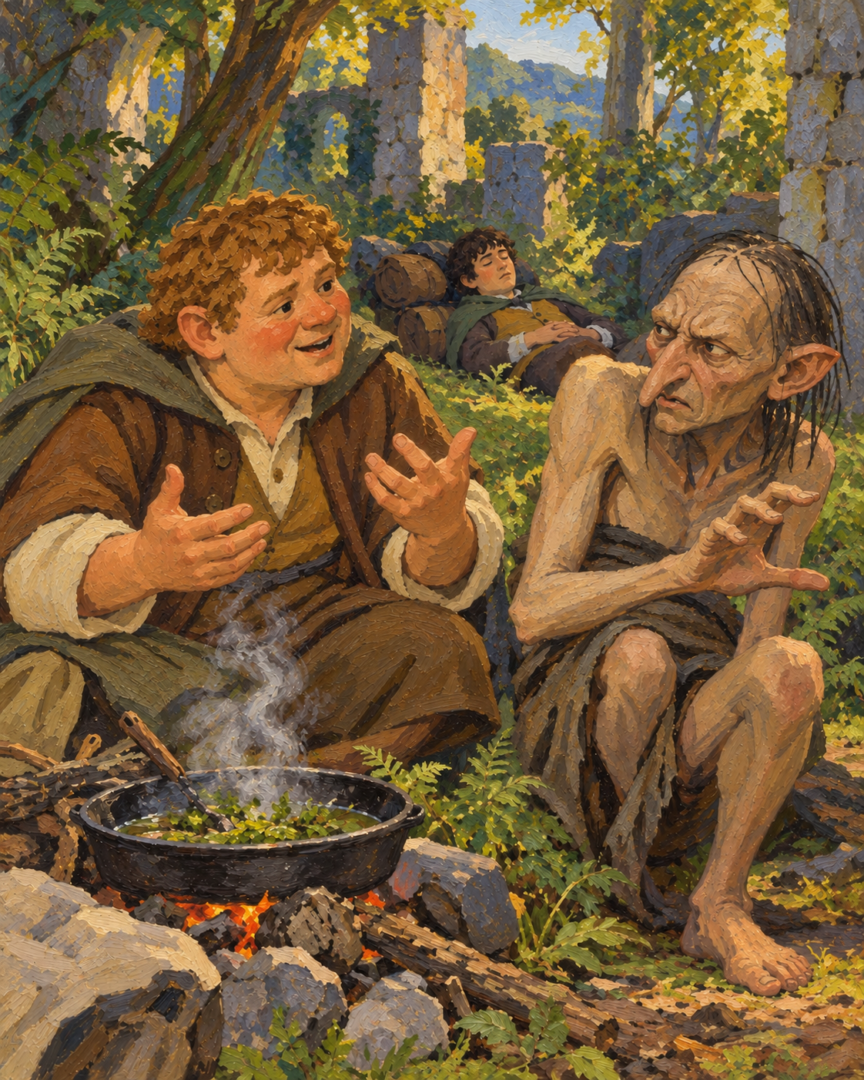
A Gift Can Fail Without Being Insincere
The most interesting question is not whether Sam is a good cook.
The narrative makes clear that he is.
Nor is it whether Gollum has contributed something useful.
He has.
The question is why their contributions fail to create mutual appreciation.
Gollum provides rabbits that he considers excellent.
Sam prepares them in a way that he considers excellent.
Yet the two understand excellence differently.
From Gollum's perspective, Sam has taken something valuable and spoiled it.
From Sam's perspective, Gollum is being unreasonable about an ordinary and desirable meal.
This is the central irony.
Both characters possess something the other could benefit from: Gollum's ability to find food and Sam's ability to prepare it.
But their incompatible expectations turn cooperation into conflict.
Sam does make a limited accommodation.
He tells Gollum that he may catch another rabbit and eat it according to his own preference, provided he does so away from Sam.
That response recognizes their differences without requiring either character to change his appetite.
Yet it also establishes distance.
Rather than sharing one meal, they must eat separately.
The exchange demonstrates how difficult fellowship becomes when even a basic pleasure such as eating cannot be experienced together.
What Gollum's Disgust Reveals About His Lost Life
Gollum's eating habits also belong to the larger tragedy of his existence.
He was not always the isolated creature encountered by Bilbo beneath the Misty Mountains.
In "The Shadow of the Past," Gandalf explains that Sméagol belonged to a people related to hobbits.
His early life was connected with a community, family relationships, and the ordinary world of living things.
After acquiring the Ring and committing murder, he became increasingly separated from that life.
Eventually he retreated beneath the mountains, where his existence centred upon darkness, secrecy, the Ring, and the search for food.
The rabbit episode shows the distance between Gollum's present habits and those of Sam, who still represents an ordinary hobbit household.
But caution is necessary.
The text does not establish that the Ring directly caused a specific inability to enjoy cooked meat.
Nor does it say that Gollum's dietary preferences are permanent or medically irreversible.
What the story does show is a creature whose long isolation has left him profoundly estranged from familiar hobbit comforts.
Sam's cooking belongs to a world of homes and shared tables.
Gollum's preferred way of eating belongs to the solitary existence he has come to know.
The contrast is suggestive without requiring a supernatural explanation for every detail.
Why Frodo and Sam Enjoy the Meal Without Gollum
Eventually Sam prepares the rabbits with the herbs he can find.
He tends the pans, tests the food, and waits until the stew is ready.
Then he wakes Frodo.
The meal gives the two hobbits a welcome change from their travelling provisions.
For a brief period, Sam succeeds in creating something resembling domestic comfort in the wilderness.
Gollum does not share that pleasure.
This outcome matters because it shows exactly where the attempted cooperation has led.
Gollum's contribution helps feed the hobbits, but the finished meal is not something he wants.
The rabbits have fulfilled Sam's purpose, not Gollum's.
The cooking fire also introduces danger, and the wider chapter soon brings the travellers into contact with the Rangers of Ithilien.
Yet the significance of the food disagreement does not depend upon those later events.
Its meaning is already complete before the meal ends.
A useful act has become a quarrel because the people involved cannot agree on what constitutes a desirable result.
Does the Argument Mean Gollum Cannot Accept Kindness?
It would be tempting to interpret Gollum's disgust as proof that he is incapable of appreciating generosity.
But the larger story does not support such a simple conclusion.
Gollum responds differently to different people and circumstances.
His relationship with Frodo demonstrates that he can react to pity, restraint, and gentler treatment, even while remaining dangerously attached to the Ring.
Sam's relationship with him is more openly antagonistic.
The rabbit scene belongs within that tension, but it does not determine Gollum's eventual choices.
Nor does refusing cooked food make him morally beyond recovery.
A person can reject a particular offering because it is genuinely unpleasant to him, regardless of the giver's intentions.
The more revealing limitation is one of understanding.
Sam recognizes that Gollum has different tastes, yet struggles to imagine the depth of his aversion.
Gollum, in turn, cannot appreciate why Sam considers cooking an act of improvement.
Their disagreement is therefore not simply a failure of gratitude.
It is a failure to share the meaning of the food itself.
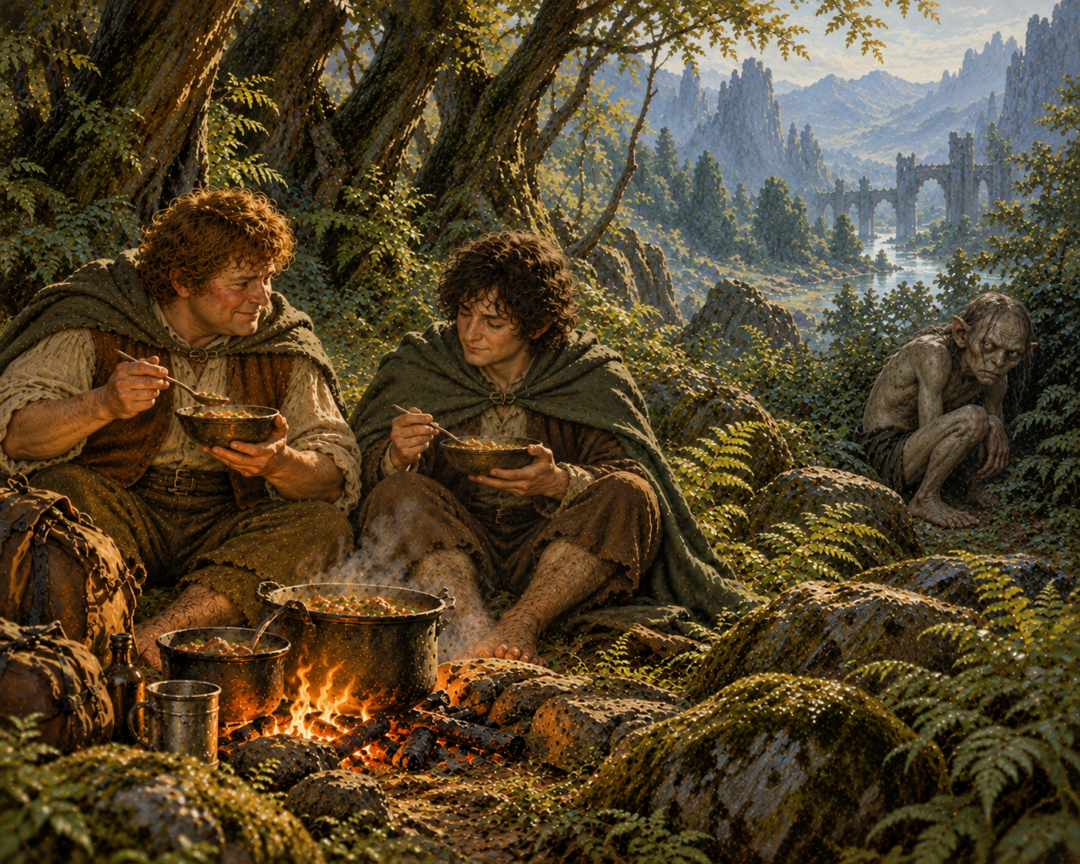
The Sad Irony of Sam's Rabbit Stew
The rabbit stew is one of the most ordinary episodes in a story filled with ancient powers, terrible choices, and the fate of kingdoms.
Yet its smallness is precisely what makes it memorable.
Sam wants a decent meal.
Gollum has found good meat.
Both have contributed something useful.
Nevertheless, their efforts do not produce a shared pleasure.
The food that reminds Sam of home reminds Gollum of everything he does not want to eat.
Cooking, which Sam regards as an improvement, destroys the qualities Gollum prizes.
And the imagined future treat of fried fish and potatoes only deepens the misunderstanding.
The tragedy is not that Gollum refuses an objectively perfect gift. It is that Sam's idea of generosity and Gollum's idea of enjoyment cannot meet.
For Sam, a rabbit becomes better when it is cooked with care.
For Gollum, the rabbit was already good before Sam put it into the pot.
That is why the stew cannot become a shared comfort.
The two travellers are looking at the same food, but they are not seeing the same thing.
And in a story where friendship, pity, and understanding matter so deeply, even a humble cooking pot can reveal how far apart two companions remain.
Sources & Notes
- J.R.R. Tolkien, The Two Towers, Book IV, chapter 4, ‘Of Herbs and Stewed Rabbit’; the Tolkien Estate’s recording presents the author reading the Sam–Gollum cooking dialogue. The same page includes ‘Riddles in the Dark’ from The Hobbit, chapter 5. https://www.tolkienestate.com/audio-visual/audio/
- J.R.R. Tolkien, letter to Eileen Elgar, September 1963: authorial context for Sam’s limited understanding of Gollum, Frodo’s pity, and Gollum’s possibility of repentance. https://www.tolkienestate.com/letters/letter-to-eileen-elgar-september-1963/
- Lindariel, ‘Samwise Gardner’s Birthday (Part 1)’, Silmarillion Writers’ Guild, ‘Rabbit Stew’ and ‘Fish and Chips’ sections: a chapter-cited reading of Sam’s cookery, desired herbs and roots, and proposed cooked-fish treat for Sméagol. https://www.silmarillionwritersguild.org/reference/celebration-day/sams-birthday1.php
The stew and dietary contrast are grounded in The Two Towers, Book IV, chapter 4. Tolkien’s letter supplies wider context for pity and misunderstanding; the Writers’ Guild essay is secondary culinary commentary. The idea of a gift failing through incompatible tastes is this article’s interpretation, not an explicit claim by Tolkien that cooked food is biologically impossible for Gollum.