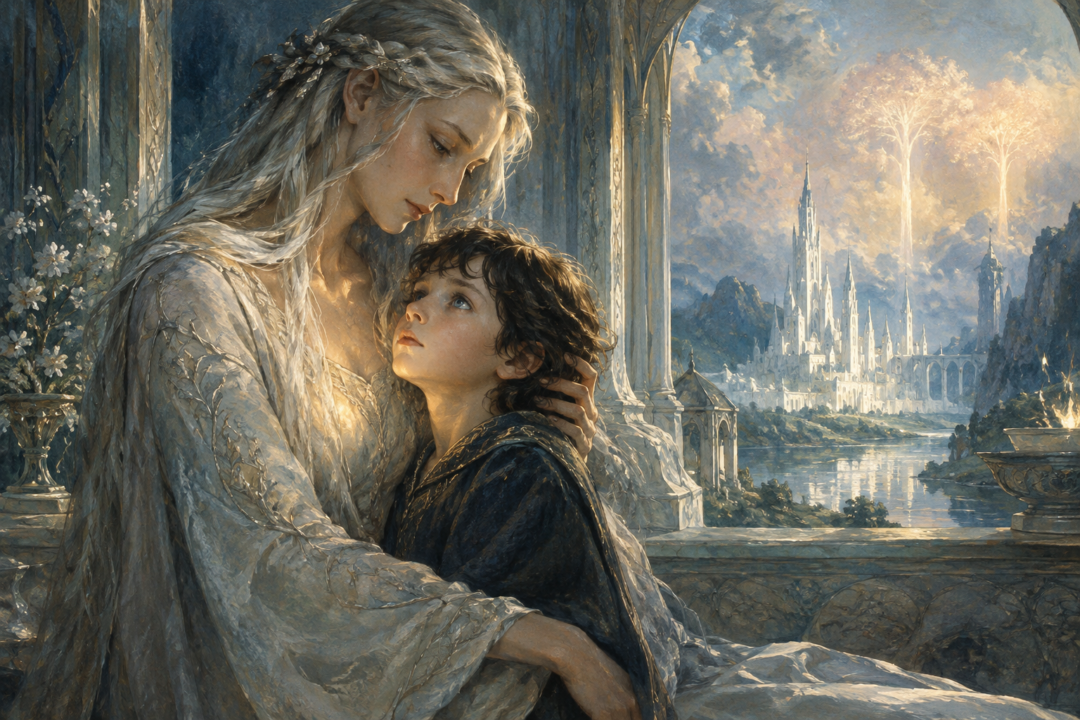
Fëanor is one of the most recognizable names in the history of Middle-earth. It belongs to the greatest craftsman among the Noldor, the maker of the Silmarils, and the prince whose pride helped drive his people toward catastrophe.
Yet Fëanor was not the name his father gave him.
Finwë, High King of the Noldor, named his firstborn son Curufinwë. His mother, Míriel, gave him another name: Fëanáro, meaning “Spirit of Fire.” It was this mother-name, rather than his father-name, that became the name by which he was chiefly known.
That distinction is more than a linguistic curiosity.
In a royal household later divided by death, remarriage, and competing lines of descent, Fëanor's preference for the name associated with Míriel carries an emotional significance that is easy to overlook.
It identifies him not only through his extraordinary nature, but also through the mother whose loss shaped his earliest history.
The question is not whether the name describes Fëanor. Clearly, it does.
The deeper question is why the name given by Míriel became more central to his identity than the one bestowed by Finwë.
Two Names, Two Different Inheritances
Among the Eldar, names could carry different kinds of significance.
The naming traditions discussed in The Shibboleth of Fëanor, published in The Peoples of Middle-earth, distinguish between the father-name and the mother-name.
A father-name commonly connected a child with the paternal family. A mother-name could express the mother's insight into her child's character or destiny. Such names were not equivalent to modern surnames, and the distinction should not be confused with a legal choice between two family identities.
Fëanor's two names nevertheless create a striking contrast.
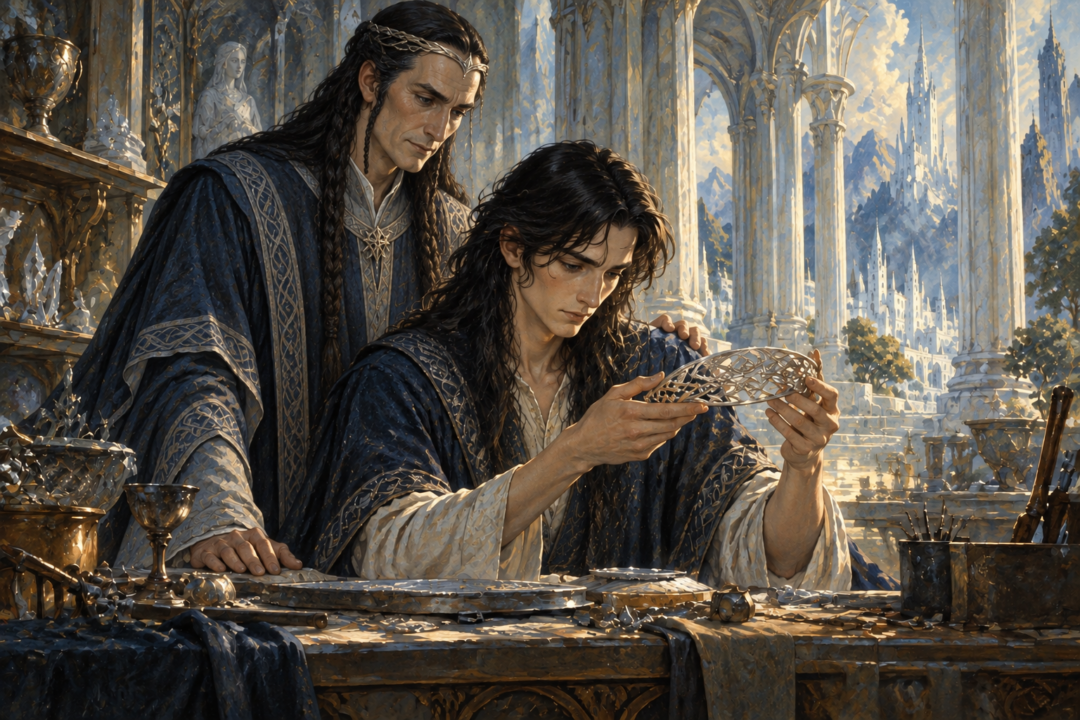
Curufinwë connects him directly to Finwë. The name incorporates his father's name and an element associated with skill or craft. It places the young prince within the royal house while also acknowledging the exceptional ability that would define him.
Fëanáro, by contrast, comes from Míriel.
Its meaning, “Spirit of Fire,” speaks to the extraordinary intensity of her son. It is a name that describes something inward rather than simply identifying his paternal descent.
Both names suit him.
But they emphasize different aspects of who he is.
Curufinwë connects him to his father's lineage and the craft for which he would become renowned. Fëanáro preserves his mother's description of his nature.
His preference therefore invites a reading in which personal identity and maternal attachment become inseparable.
Why Fëanáro Became Fëanor
There is an important linguistic distinction behind the familiar form of the name.
Fëanáro is Quenya, the language of the High Elves in Aman. Fëanor is the form that became established in the later linguistic setting of Middle-earth.
In The Shibboleth of Fëanor, the familiar name is treated as a form adapted to Sindarin rather than a straightforward translation of its original Quenya elements.
This matters because the widely recognized name Fëanor should not be mistaken for an entirely separate name given to him later in life.
It ultimately preserves Míriel's mother-name.
The form changed, but the underlying identification endured.
This also prevents a common misunderstanding: there is no need to imagine a dramatic public ceremony in which Fëanor rejected Curufinwë and officially renamed himself.
The naming evidence establishes the importance and preference of the mother-name without requiring such an event.
The significant fact is quieter.
Of the names associated with his parents, the one that became dominant was the one Míriel had given him.
Míriel's Name for the Son Who Cost Her So Much
The emotional weight of that choice becomes clearer when placed beside Míriel's fate.
Fëanor's birth was extraordinary even among the Eldar.
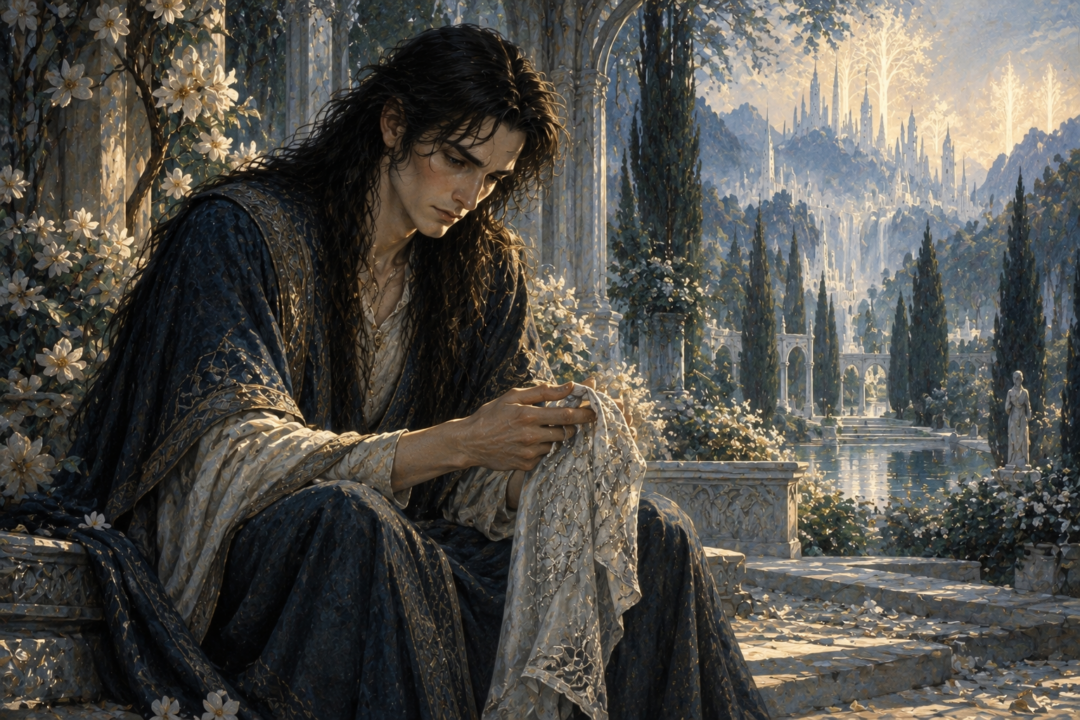
As related in The Silmarillion, Míriel was greatly diminished by bearing him. Her strength was spent to an extent that ordinary recovery did not restore.
She eventually departed from her body, and her spirit went to the halls of Mandos.
For the Elves, whose natural destiny was to remain within the world for its duration, this was a profound rupture in the life of a family.
Fëanor was left without his mother.
The name she had given him, however, remained.
Here the mother-name acquires a significance beyond its descriptive meaning.
Míriel had recognized something exceptional in her son. Her naming of him was one of the enduring expressions of her relationship with him.
To prefer Fëanáro could therefore mean more than embracing a flattering description of personal brilliance.
It could also preserve the authority of Míriel's own understanding of her child.
That is an interpretation rather than an explicitly recorded statement of Fëanor's motives. The texts do not provide a confession in which he explains his naming preference as an act of remembrance.
Nevertheless, the connection is grounded in the naming tradition itself and in the exceptional importance of Míriel's loss.
The name she gave him survived where her presence in his childhood did not.
A Royal Household Divided by Remarriage
The distinction between father-name and mother-name becomes still more meaningful after Finwë's second marriage.
Following Míriel's departure, Finwë eventually married Indis of the Vanyar.
Their children included Fingolfin and Finarfin, who became important figures in the history of the Noldor.
For Fëanor, this second marriage created a painful division within his father's household.
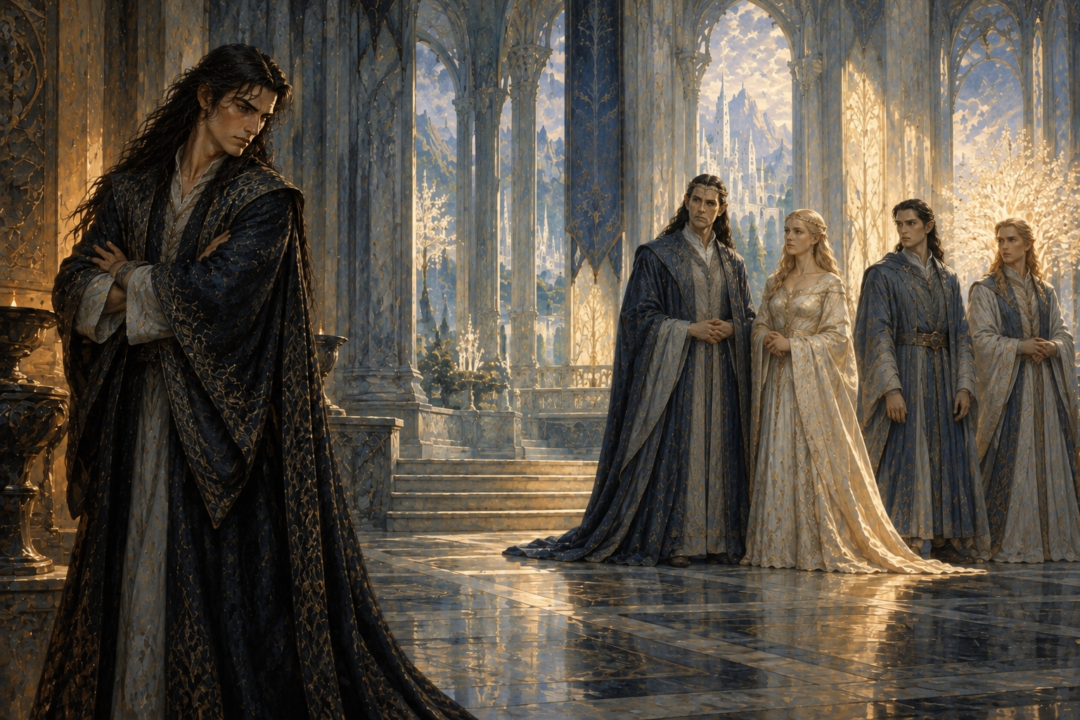
He did not accept Indis and her sons with the affection that Finwë might have wished. His alienation from his half-brothers became one of the enduring tensions within the royal family.
The later hostility between Fëanor and Fingolfin cannot be reduced to their names, and the texts do not state that Fëanor chose his mother-name as a formal protest against Finwë's remarriage.
But the family context changes how the preference can be understood.
Curufinwë emphasizes the father shared, through descent, with the newer branches of Finwë's household.
Fëanáro identifies him through Míriel, the mother whom none of those half-brothers shared.
It marks a relationship that cannot be duplicated by Finwë's second marriage.
In that sense, the preferred name can be read as an expression of household allegiance: not a constitutional declaration, but a deeply personal attachment to the first marriage and the mother whose place Fëanor believed had been lost.
Why His Father's Name Was Not Enough
It would be misleading to interpret Fëanor's preference as simple rejection of Finwë.
Fëanor loved his father deeply.
Finwë's death at Formenos later became a decisive personal blow, intensifying the crisis surrounding the Silmarils and Morgoth's violence.
The father-name Curufinwë was not an insult or an unsuitable designation. It acknowledged both royal descent and exceptional skill.
The more interesting possibility is that Fëanor's identity contained two loyalties that were never easily reconciled.
He was Finwë's firstborn son and heir to a powerful tradition among the Noldor.
He was also Míriel's only child, born at an extraordinary cost and left to carry the memory of a mother absent from his life.
The mother-name did not erase the paternal relationship.
Instead, its prominence may suggest that Fëanor refused to let his mother's connection become secondary to the expanded household established after her departure.
This is why the name-choice tradition is more revealing than a simple explanation that Fëanor preferred an impressive title.
“Spirit of Fire” certainly suited his temperament.
But the person who named that spirit mattered too.
The Name Was Also a Portrait of His Character
There is another reason not to separate Fëanor's personality from his attachment to Míriel.
The mother-name itself describes his nature.
Fëanor's restless intellect, creative power, intensity, and fierce independence made him exceptional among the Noldor.
The fire suggested by Fëanáro can be understood through both his achievements and his destructive passions.
He made works of astonishing beauty, above all the Silmarils. Yet his possessiveness, suspicion, and refusal to yield helped transform personal injury into collective disaster.
The name therefore carries a tragic double meaning for readers.
What begins as a mother's recognition of extraordinary vitality becomes associated with a figure whose greatness cannot be separated from his capacity for ruin.
But this should not be mistaken for a prediction that Míriel foresaw his rebellion.
The mother-name tradition allows names to reflect insight, sometimes even prophetic perception, but the surviving account does not establish that Míriel foresaw the Oath of Fëanor, the Kinslaying, or the disasters of the Noldorin rebellion.
Her name describes the fire.
It does not make her responsible for everything that fire would consume.
What the Linguistic Tradition Can—and Cannot—Prove
The most important evidence for this subject lies in the late linguistic and genealogical writings collected in The Peoples of Middle-earth, particularly The Shibboleth of Fëanor.
These writings provide the distinction between Curufinwë and Fëanáro and help explain the importance of the mother's naming.
They also belong to a body of material in which names, linguistic forms, and aspects of the Elvish histories underwent development.
That requires care when drawing conclusions.
The central identification is secure: Curufinwë is Fëanor's father-name, Fëanáro his mother-name, and Fëanor the familiar adapted form.
The emotional interpretation is less explicit.
There is no recorded formal declaration that choosing Fëanáro meant renouncing the paternal line. Nor is there evidence that the preference by itself established a political faction, determined succession, or compelled his sons to share an identical attitude toward the wider family.
Indeed, Fëanor later gave his own eldest son the father-name Nelyafinwë, continuing the Finwë naming tradition.
His naming history is therefore not a simple rejection of paternal identity.
It reveals something subtler: an Elf could carry the inheritance of both parents while allowing one particular name to become the defining expression of himself.
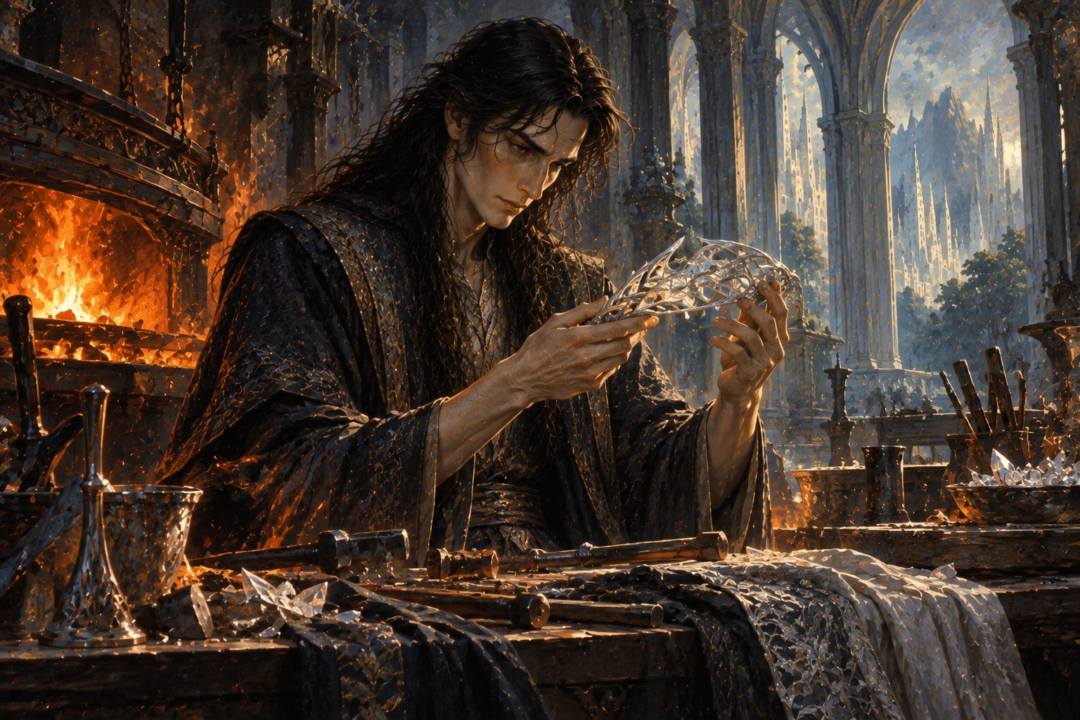
The Mother Who Remained in His Name
There is a final irony in Fëanor's preferred name.
He became a figure whose determination to preserve what he valued could harden into possessiveness and defiance.
Yet one of the most intimate things he preserved was not a jewel, a weapon, or a work of craft.
It was a name.
Curufinwë would always identify him as Finwë's son. His descent and position within the royal house did not disappear.
But Fëanáro carried something that Curufinwë could not express in the same way: Míriel's personal recognition of the child she had brought into the world.
The preference cannot be proved to have been a deliberate protest against Indis or a consciously articulated memorial to Míriel.
It can, however, be read as a meaningful convergence of character and attachment.
Fëanor chose to be known chiefly by the name that described his inner fire, and that description came from his mother.
In a household divided by her absence and Finwë's second marriage, the significance is difficult to ignore.
The name remembered not only what Fëanor was.
It remembered who had first named him.
Sources & Notes
- Oshun, Silmarillion Writers’ Guild — Míriel Þerindë: cites Laws and Customs among the Eldar (Morgoth’s Ring, p. 217) on choosing Fëanáro to honour Míriel, and The Shibboleth of Fëanor on mother-names and differing accounts of her life — https://www.silmarillionwritersguild.org/node/4426
- Paul Strack, Eldamo — Fëanor: the partial Sindarin adaptation of the Quenya mother-name Fëanáro, with references to Morgoth’s Ring, p. 217, and The Peoples of Middle-earth, p. 343 — https://eldamo.org/content/words/word-1623363781.html
- Oshun, Silmarillion Writers’ Guild — Indis: Finwë’s remarriage, the divided royal household, Fëanor’s attachment to Míriel, and Nelyafinwë’s paternal name, with references to Tolkien’s published texts — https://www.silmarillionwritersguild.org/reference/characterofthemonth/indis.php
Textual clarification: Laws and Customs among the Eldar (Morgoth’s Ring, p. 217) explicitly associates Fëanor’s chosen name with honouring his mother; a protest against Finwë’s remarriage remains an interpretation. Accounts of Míriel’s death also differ: The Shibboleth of Fëanor has her live until he is full-grown, unlike the earlier account in which he never saw her. These linked references document the variants and the name’s linguistic history.