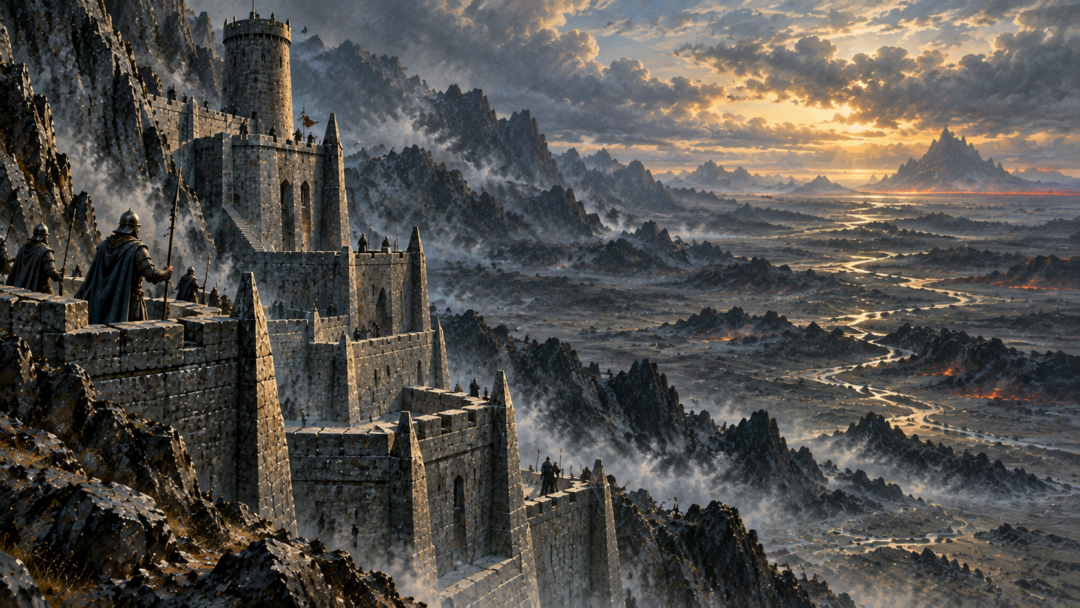
The Tower of Cirith Ungol stands above one of the most dreadful passages into Mordor. Its dark walls, narrow windows, and forbidding gate seem perfectly suited to Sauron’s realm. When Samwise Gamgee reaches it in The Return of the King, the fortress is occupied by Orcs, and Frodo lies imprisoned somewhere within.
Yet there is a remarkable contradiction hidden in its history.
The Tower of Cirith Ungol was not built by Sauron. It was built by Gondor, and its original purpose was to watch Mordor itself.
The fortress that eventually served the Dark Lord had first been raised to guard against his return. Its commanding position, its eastward-facing defences, and its place among Gondor’s frontier strongholds preserve the memory of an age when Mordor was a territory to be contained rather than a kingdom to be feared.
That reversal explains something easily overlooked about the tower: its most important direction of watch was not simply toward strangers approaching Mordor, but toward the dangers already within it.
A Fortress Built After Sauron’s Defeat
The origins of the Tower of Cirith Ungol lie in the aftermath of the War of the Last Alliance.
At the end of the Second Age, Sauron was overthrown by the alliance of Elves and Men. His stronghold of Barad-dûr was broken, and the victorious powers had reason to believe that his immediate dominion had ended.
But victory did not make Mordor harmless.
Sauron’s servants had not all vanished, and the land remained associated with the power he had established there. Gondor therefore faced a difficult problem: how could it prevent Mordor from becoming a centre of renewed danger?
Part of the answer was a system of fortified positions guarding the approaches to the Black Land.
The Tower of Cirith Ungol was constructed after Sauron’s overthrow as an eastern outpost of the defences of Ithilien. Its purpose was to watch Mordor and guard against the movement of evil things out of that land.
This background is established in The Return of the King, Book VI, Chapter 1, “The Tower of Cirith Ungol.”
The distinction matters. Gondor was not merely defending an existing frontier against an active neighbouring kingdom. It was maintaining a watch over the territory of a defeated enemy whose power might return.
The tower belonged to a strategy of containment.
Why Its Defences Faced Into Mordor
The geography of Cirith Ungol makes the original purpose of the fortress especially revealing.
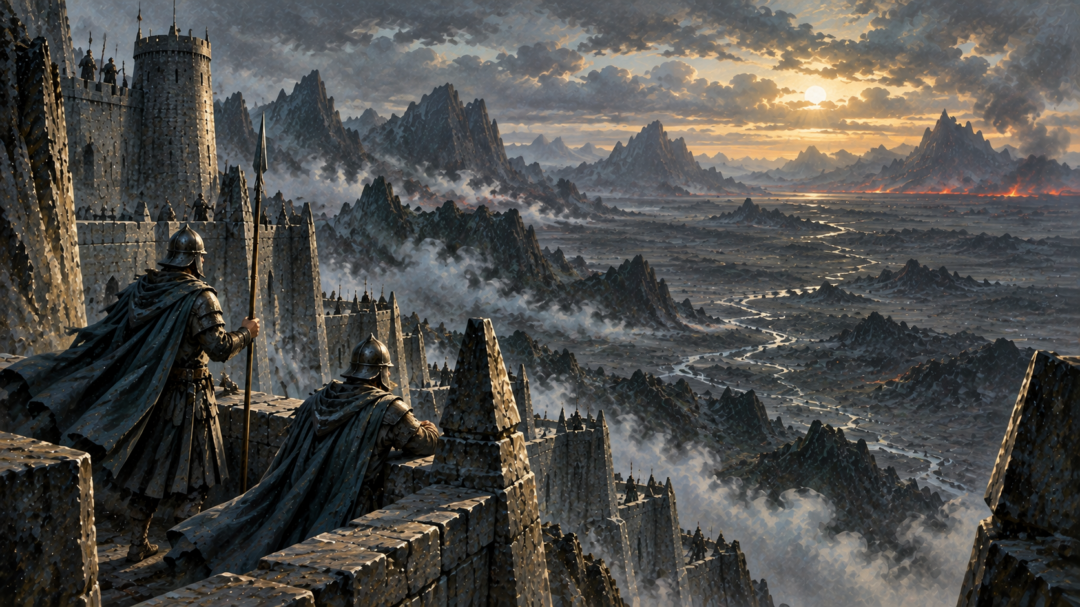
The pass cuts through the Ephel Dúath, the Mountains of Shadow forming Mordor’s western boundary. To the west lay the approaches from the Morgul Vale and Ithilien. To the east lay the interior of Mordor.
The tower stood on the eastern side of the mountain wall, below the high cleft of the pass.
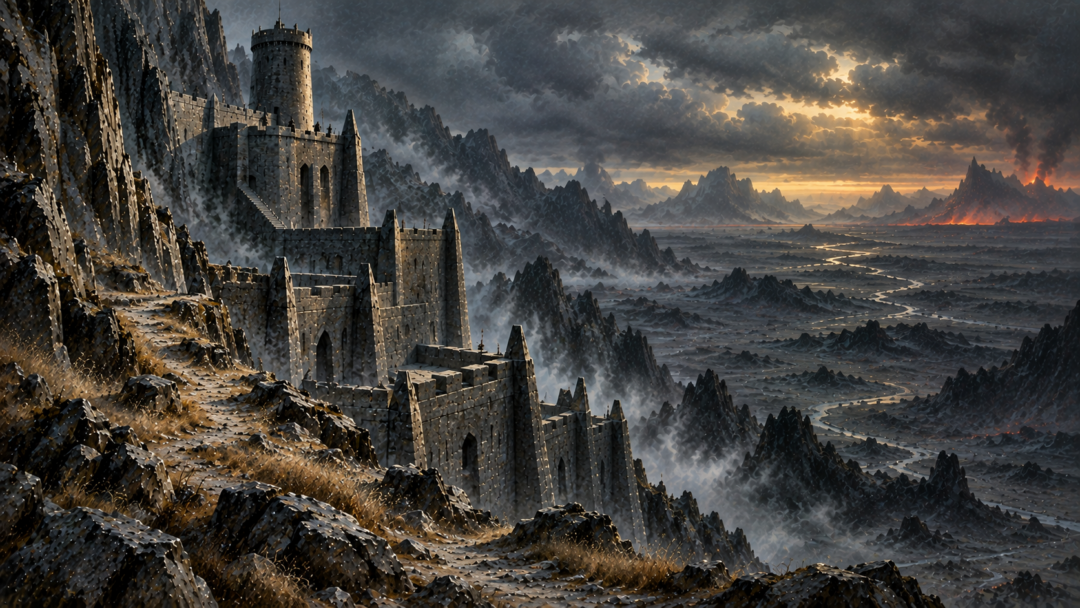
Its construction was substantial. The fortress rose in three great tiers, with projecting bastions and a high turret. Its lower defences occupied a shelf against the mountainside.
Most significantly, the great pointed bastions looked northeast and southeast into Mordor.
This was not an accidental feature of the description.
The arrangement allowed the fortress to command approaches and observe the land on the eastern side of the mountains. Its position above the roads and slopes made it valuable to whoever controlled the passage.
The tower was therefore not simply a wall facing outward from Gondor. It was an observation post overlooking the dangerous territory beyond Gondor’s frontier.
That explains the apparent contradiction in its design.
A Gondorian fortress could stand on the Mordor side of the mountains because its builders were attempting to prevent the dangers of Mordor from emerging westward.
The fortress faced the land it was intended to contain.
Its later appearance as a stronghold of Sauron conceals that original purpose.
The Difference Between Guarding a Border and Guarding a Threat
There is an important distinction between defending a country and keeping watch over a defeated enemy’s territory.
A conventional frontier fortress protects the land behind it. Its defenders expect danger to approach from beyond the boundary.
Cirith Ungol had that defensive purpose, but it also formed part of a broader watch over Mordor.
The Men of Gondor had learned that the overthrow of a ruler did not necessarily destroy every danger associated with his dominion.
Mordor’s mountains offered formidable natural barriers, but those barriers contained passages. Cirith Ungol was one of them.
If hostile forces could cross the mountains, the lands west of Mordor might again be threatened.
By guarding the pass and observing the interior approaches, Gondor could seek to prevent such movement.
This helps explain why the tower belonged to the defences of Ithilien, even though its most revealing outlook was eastward.
Its location served the security of the western lands precisely because it commanded an eastern approach.
The tower’s design therefore embodies a political and military reality of the early Third Age: Gondor had enough strength to maintain fortified positions around the land of its defeated enemy.
That strength would not last.
The Long Failure of Gondor’s Watch
The fall of the Tower of Cirith Ungol was not simply the consequence of one lost battle.
It belonged to the much longer decline of Gondor’s ability to maintain its eastern defences.
For centuries, Gondor possessed the military strength to keep watch over Mordor. But its fortunes changed through internal troubles, warfare, disease, and the gradual weakening of its resources.
The Great Plague of Third Age 1636 was particularly destructive. The historical material in Appendix A of The Lord of the Rings records how Gondor’s losses contributed to the abandonment of the forts guarding Mordor.
The watch that had once restrained the return of evil was no longer maintained with its former strength.
This is essential to understanding Cirith Ungol.
A fortress may remain physically formidable even after the political power supporting it has diminished. Stone walls do not guarantee that soldiers will continue to occupy them.
The Tower of Cirith Ungol survived, but Gondor’s control did not.
The narrative associates its eventual loss with the growing power of the Lord of the Ringwraiths and with treachery. The text does not supply a detailed account of every stage by which the fortress changed hands.
What matters is the result.
A position built to guard against the return of Sauron’s servants became a position held by those servants.
The architecture remained, but its allegiance was reversed.
How Sauron Turned Gondor’s Fortress Against Its Builders
By the time Frodo and Sam reached Cirith Ungol, the fortress had become part of Sauron’s military dominion.
Its original builders had intended it to keep danger within Mordor from threatening the western lands.
Under Sauron’s power, that function was inverted.
The tower now helped control movement into and out of Mordor, serving the authority of the Dark Lord rather than resisting it.
This reversal is more disturbing than the simple capture of a strategic position.
Sauron inherited a fortress whose original design already made it useful for controlling passage through the mountains. He did not need to create its commanding location or its eastward outlook.
Those advantages had been supplied by his enemies.
The original Gondorian watch had been directed against the return and movement of evil. Under Sauron, watching the interior of Mordor could also serve the purpose of keeping his own servants under control and preventing escape.
That latter purpose is especially revealing.
Mordor was not a realm held together by affection or voluntary loyalty. Its armies operated under coercion, fear, and harsh authority.
A fortress controlling a passage out of the Black Land could therefore be useful not only against intruders but also against those seeking to leave.
The tower’s physical position suited both purposes.
This does not mean that its Gondorian builders anticipated Sauron’s later use of it. Rather, the same geography could serve opposing powers.
The difference lay in who controlled the fortress and what they wished to prevent.
The Tower’s Roads Reveal Its Strategic Importance
The Tower of Cirith Ungol was more than an isolated lookout on a mountain peak.
Its position connected the high pass with routes descending into Mordor.
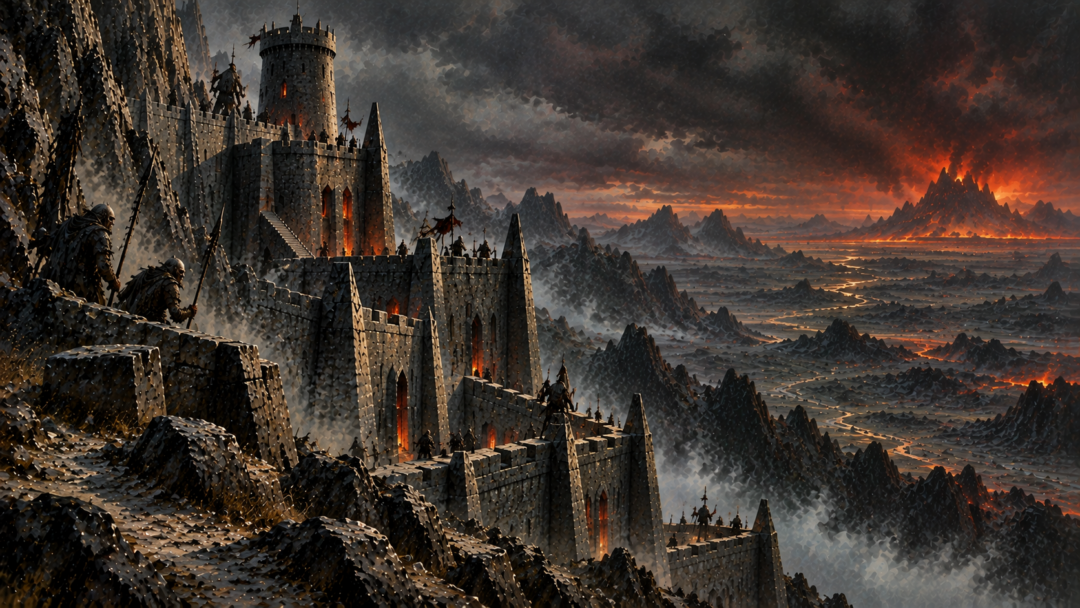
A road from the tower’s outer gate wound along the mountainside and eventually joined the road coming over the Morgul Pass.
This connection made the fortress relevant to movement through the western approaches of Mordor.
The narrow path from Cirith Ungol also descended toward the tower, bringing travellers approaching through the higher passage into the area commanded by its defences.
For Gondor, control of this position meant guarding a potentially dangerous route out of the Black Land.
For Sauron, the same location offered a way to supervise a passage through his western boundary.
There is a subtle irony here.
The fortress did not need to be rebuilt into an entirely different kind of structure to become useful to its new masters.
Its commanding walls, its position above the roads, and its access to the pass remained valuable.
What changed was the direction of political power.
A stronghold established to restrain Mordor became one of the instruments by which Mordor maintained control.
The Two Watchers and the Corruption of the Gate
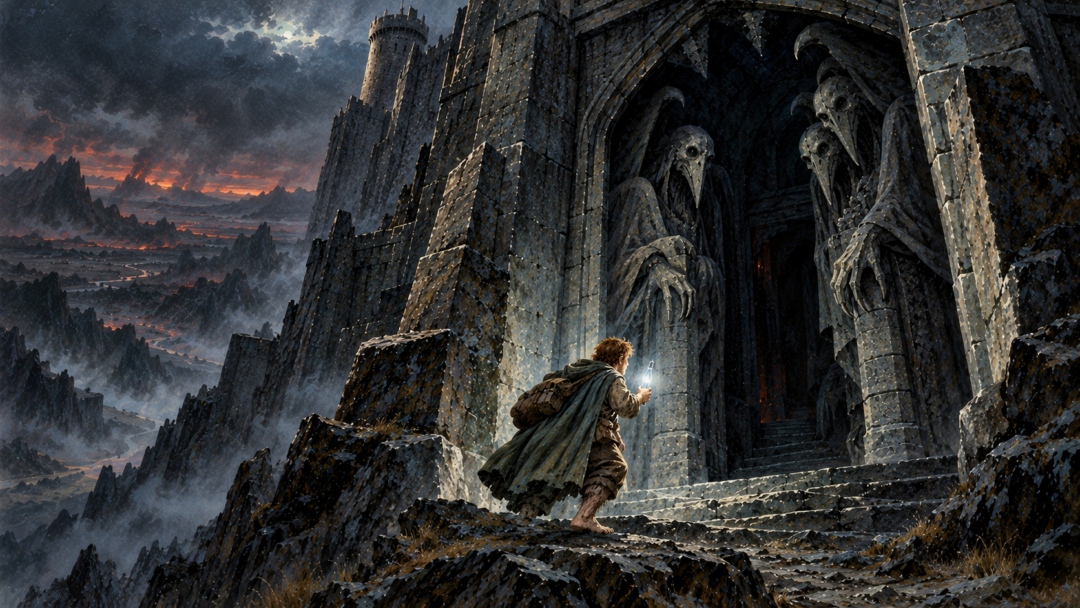
When Sam enters the Tower of Cirith Ungol, he encounters one of its most sinister features: the Two Watchers.
These dreadful figures stand at the gate, possessing a supernatural power that obstructs passage. Sam eventually overcomes their resistance with the aid of the light of Galadriel’s phial.
Their presence makes the entrance seem almost alive with hostility.
But an important distinction must be preserved.
The text describes the Watchers as part of the tower Sam encounters under Sauron’s dominion. It does not establish that they belonged to the original Gondorian construction.
They should not therefore be treated as evidence of Gondor’s original methods of guarding the fortress.
Instead, they demonstrate the dreadful character of the stronghold in its later condition.
The contrast is striking.
Gondor’s builders constructed a military position to watch over a dangerous frontier. By the end of the Third Age, its gate was defended by powers associated with the darkness that Gondor had once sought to contain.
Even the act of entering or leaving had become a struggle against the will imposed upon the place.
The Watchers are not necessary to explain the tower’s original architecture. They reveal how thoroughly its later character had changed.
Why Frodo’s Imprisonment Matters to the Tower’s History
For many readers, the Tower of Cirith Ungol is remembered chiefly as the place where Frodo is imprisoned after Shelob’s attack.
That episode is central to the story, but it is not the whole meaning of the fortress.
The Orcs who discover Frodo carry him into a stronghold originally constructed by the enemies of their master.
Sam’s desperate journey into the tower takes him through the surviving architecture of an older Gondorian defence.
The fortress’s internal passages, stairs, and upper chambers become the setting for his search.
The fighting among the Orcs leaves much of the garrison destroyed, creating the opportunity for Sam to reach Frodo.
Yet the tower’s original purpose adds another layer to the episode.
Frodo and Sam have entered Mordor through a passage that Gondor once guarded against the movement of Sauron’s servants.
Now the same stronghold threatens to prevent their journey from continuing.
Their task requires them to pass through a frontier whose guardians have changed sides.
The rescue is therefore not merely an escape from an Orc prison. It takes place inside one of the surviving monuments to Gondor’s failed watch over Mordor.
A Frontier Reversed
The Tower of Cirith Ungol preserves an unusually clear example of how power changes the meaning of a place.
Its builders intended to guard Ithilien and watch the dangerous land beyond the Mountains of Shadow.
Its later masters used the same fortress to secure Sauron’s western boundary and control movement through the pass.
The tower’s eastward-facing defences are the key to understanding this history.
They are not evidence that Gondor accidentally built a fortress facing the wrong direction. They show that Gondor once possessed the strength and determination to watch Mordor from positions overlooking its interior.
The tragedy is that this watch failed.
By the War of the Ring, the fortress remained standing, but the purpose for which it had been built had been overturned.
That is why the Tower of Cirith Ungol is more than the setting of Sam’s rescue of Frodo.
It is a surviving monument to a frontier that changed sides.
The stones still commanded the same mountains and roads. The danger they had been built to contain had become their master.
Sources & Notes
- Tolkien Gateway — Tower of Cirith Ungol. https://tolkiengateway.net/wiki/Tower_of_Cirith_Ungol
- Tolkien Gateway — The Tower of Cirith Ungol. https://tolkiengateway.net/wiki/The_Tower_of_Cirith_Ungol
- Tolkien Gateway — Mordor. https://tolkiengateway.net/wiki/Mordor
Primary text: The Return of the King, Book VI, “The Tower of Cirith Ungol,” and Appendix A. These references explain Gondor’s original watch, the fortress, and its later capture. The containment analysis follows that history rather than attributing its construction to Sauron.