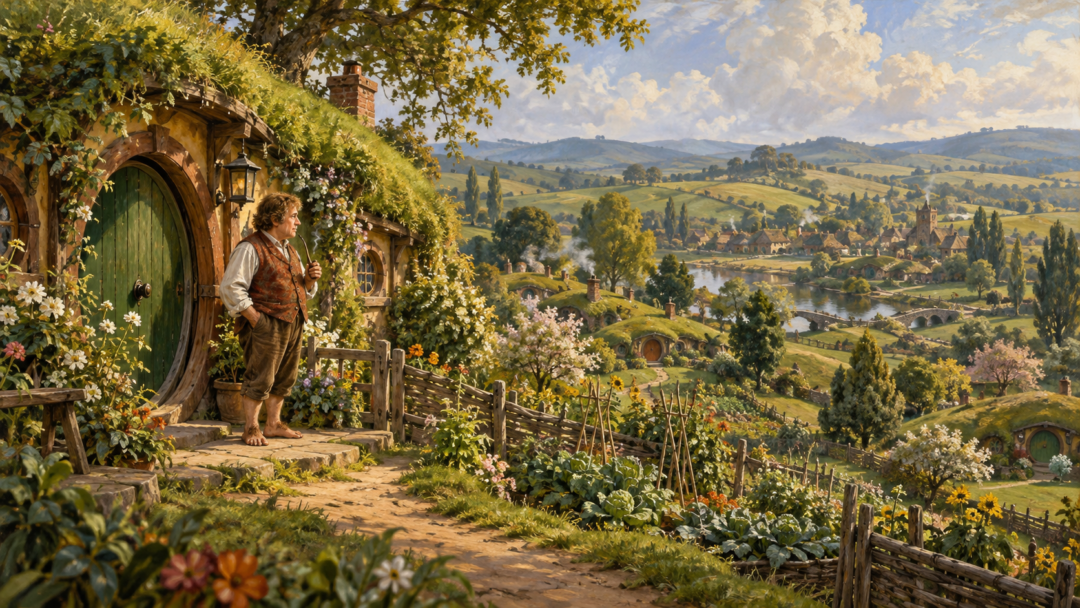
Bilbo Baggins lived at Bag End, Peregrin Took belonged to the family of the Thain, and Meriadoc Brandybuck came from a household whose authority extended across Buckland. Their surnames were more than convenient ways to tell one Hobbit from another.
Each carried a different kind of history.
In the Shire, family names could preserve memories of places, ancestral connections, old reputations, and positions within the community. A name might recall where a family had settled, suggest the expectations attached to its members, or connect someone to a household whose importance stretched back generations.
Yet there was a complication. A distinguished surname did not automatically confer an estate, and belonging to a prominent family did not mean inheriting its leading position.
The difference between family identity and actual inheritance is one of the most revealing features of Hobbit society.
Why Family Names Mattered So Much in the Shire
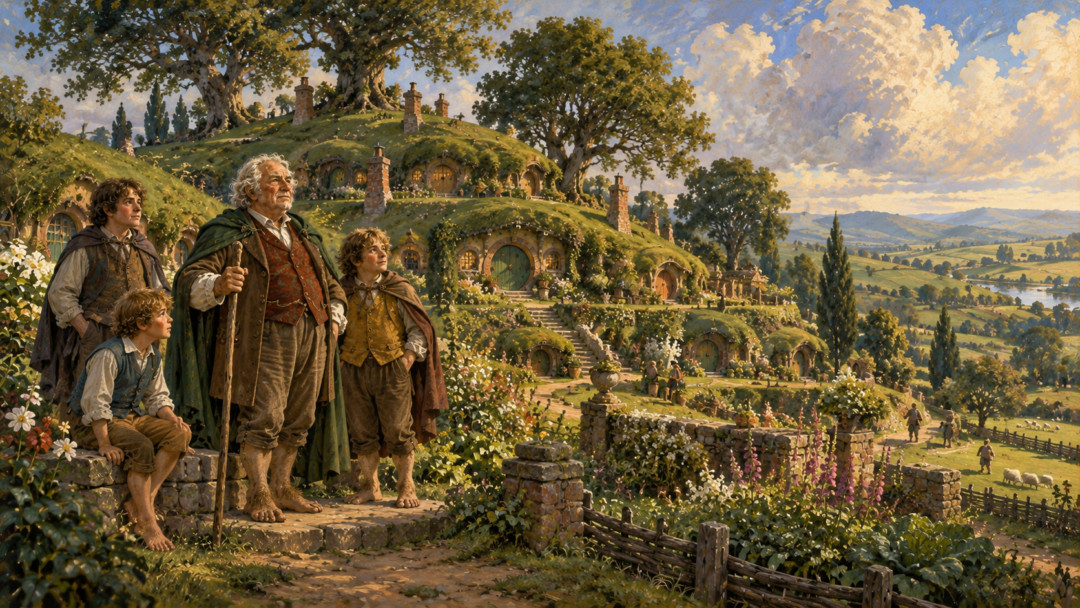
The Shire was a society deeply interested in kinship.
Its inhabitants remembered relations, marriages, birthdays, and family connections with remarkable enthusiasm. The genealogies preserved in Appendix C of The Lord of the Rings show how extensive these relationships could become.
The Bagginses, Tooks, Brandybucks, Bolgers, Boffins, and other families were not isolated households. Their histories overlapped through marriage and descent.
These connections mattered because the Shire was governed less by elaborate institutions than by established customs, local relationships, and inherited offices.
The Thainship belonged to the Took family, while the Mastership of Buckland belonged to the Brandybucks. Other families possessed recognizable local standing without necessarily holding comparable offices.
A surname therefore helped locate a Hobbit within the community.
It could suggest where someone came from, which relatives they might have, and what kind of conduct their neighbors expected.
But those associations were social knowledge, not a universal system of hereditary ranks.
Baggins: A Name Associated With Respectability and Home
The Baggins family offers perhaps the clearest example of how a surname could acquire a recognizable social reputation.
At the beginning of The Hobbit, Bilbo’s family is presented as respectable, comfortable, and thoroughly predictable.
The Bagginses had lived around the Hill at Hobbiton for generations. Their reputation rested partly on the expectation that they would avoid unexpected behavior.
That expectation becomes important when Bilbo leaves home with Thorin Oakenshield and his companions.
His adventure is startling precisely because it contradicts what people think a Baggins should do.
The family’s association with Hobbiton is also preserved through Bag End, the famous residence built by Bilbo’s father, Bungo Baggins, with the wealth of his wife Belladonna Took contributing to the family’s comfortable circumstances.
There is, however, an important distinction between the surname and the residence.
Appendix F presents Baggins as an English rendering of a Hobbit family name, while the fuller linguistic material associates the original form, Labingi, with a word meaning bag. The precise historical origin is not established with complete certainty.
Bag End, meanwhile, was built long after the Baggins name was already established.
The family was not simply named after Bilbo’s particular house.
Instead, the relationship between Baggins and Bag End illustrates how family identity and a familiar place could reinforce one another over time.
To neighbors, the name suggested a settled household with an established reputation.
Bilbo’s departure threatened that reputation long before it threatened his property.
Took: A Surname Connected to an Inherited Office
The Took family carried a different kind of significance.
The Tooks were associated with the Great Smials in Tookland, and the head of their family traditionally held the office of Thain.
The Prologue explains that the Thainship originated after the end of the northern kingdom, when the Hobbits began choosing a leader to exercise authority formerly associated with the king.
The office eventually passed from the Oldbuck family to the Tooks.
By the end of the Third Age, the Thain’s responsibilities were largely ceremonial in ordinary times, although the office retained historical importance.
This gave the Took surname a particular connection to the Shire’s political past.
But not every Took was the Thain.
The office belonged to the recognized head of the family, not automatically to everyone who carried the surname.
Peregrin Took illustrates the distinction.
During the War of the Ring, his father Paladin II was Thain. Pippin belonged to the ruling family but did not yet hold the office himself. He succeeded his father later.
The Took name also carried a reputation for unusual behavior.
The Hobbit describes the adventurous tendencies sometimes associated with the Tooks, especially when contrasting Bilbo’s Took ancestry with the conventional expectations of his Baggins relatives.
Appendix F adds another layer: a family tradition connected the name Took with an old word suggesting boldness or daring, but that explanation is not established as reliable etymology.
The important distinction is between what the family believed about its name and what can be demonstrated about its origin.
A Took might be expected to show a certain boldness, but the surname was not a guarantee of character.
Brandybuck: The Family Name That Preserved a Migration
The Brandybuck surname reveals an even more direct relationship between family identity and geography.
The family had originally been known as the Oldbucks.
Their earlier history was associated with the Marish and the office of Thain. That changed when Gorhendad Oldbuck crossed the Brandywine and settled in the country that became Buckland.
There he established the family seat at Brandy Hall, near Bucklebury, and adopted the name Brandybuck.
This was more than a change of address.
It marked a new geographical and political identity.
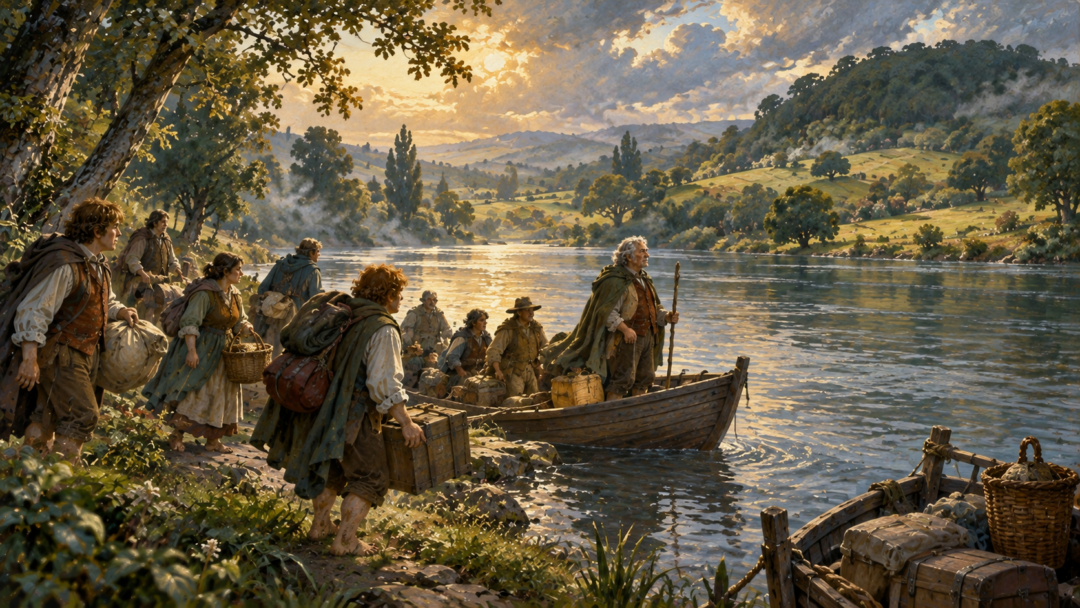
Buckland lay east of the Brandywine, beyond the original boundaries of the Shire. Its inhabitants developed customs that seemed unusual to many Hobbits living farther west.
They used boats, some could swim, and they locked their doors at night.
These habits reflected their surroundings, especially their proximity to the Old Forest.
The Brandybuck name consequently became associated with a particular territory and its distinctive community.
The head of the family held the title Master of Buckland, an office rooted in the settlement established by Gorhendad.
Meriadoc Brandybuck was born into this tradition.
His father, Saradoc, was Master of Buckland during the War of the Ring, and Merry later succeeded him.
Appendix F makes the naming history especially interesting. Brandybuck represents a translated form of a name associated with the family’s new frontier identity, rather than a surname that merely happened to resemble the river’s familiar English name.
Among the great Hobbit families, the Brandybucks provide one of the clearest examples of a name recording an actual movement of people and a lasting change in their social position.
Why Marriage Made Hobbit Family Identity More Complicated
The great families were connected by marriage so extensively that a single Hobbit could belong to several important lines of descent.
Bilbo was a Baggins through his father, Bungo, but his mother was Belladonna Took.
Frodo’s father was Drogo Baggins, while his mother was Primula Brandybuck.
These relationships help explain why Frodo had close connections to Buckland even though he bore the Baggins surname.
After his parents died, he lived at Brandy Hall before Bilbo brought him to Bag End.
His name identified his paternal family, but his upbringing connected him to another important household and place.
That distinction matters.
A surname could indicate a principal family line without describing every relationship that shaped a Hobbit’s life.
The genealogies of Appendix C preserve these connections through marriages and descendants, showing how the Shire’s major families formed an interwoven network.
A Hobbit’s identity could therefore be broader than the name appearing after their given name.
The Sackville-Bagginses: When Family Names Met Inheritance
The Sackville-Baggins family demonstrates why lineage and inheritance must be considered separately.
The compound surname arose through the marriage of Longo Baggins and Camellia Sackville. Their son Otho bore the combined family name.
This preserved connections to two family lines.
But it did not automatically settle the question of who would inherit Bag End.
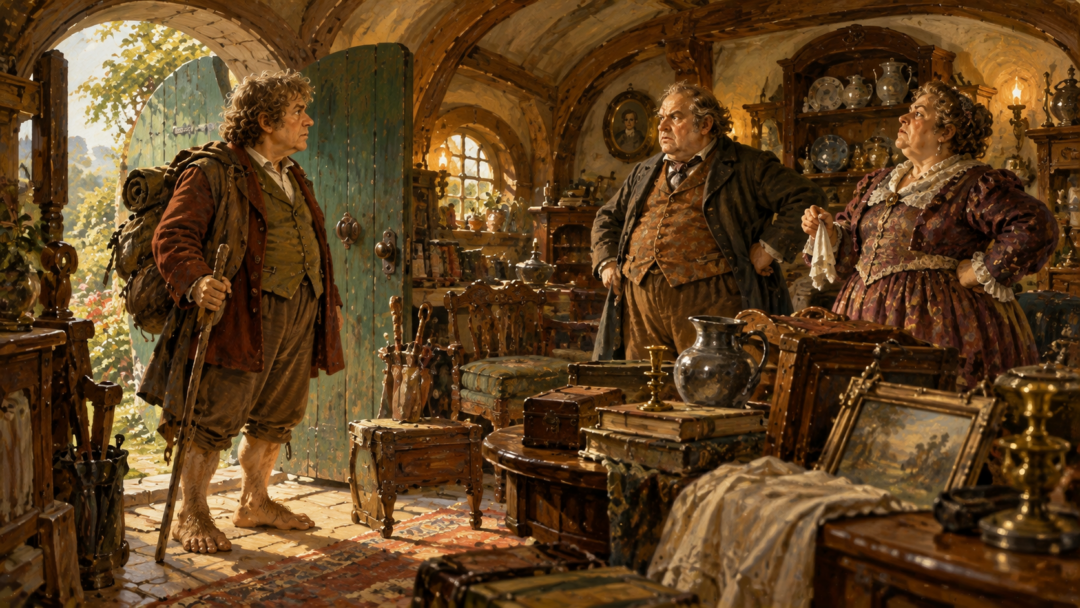
In The Hobbit, Bilbo’s prolonged disappearance leads to his being presumed dead. When he returns, the Sackville-Bagginses are involved in the attempted disposal of his possessions.
The incident reveals that inheritance was not merely a matter of having a familiar surname.
Legal recognition, the identity of the heir, and the circumstances of the owner’s disappearance all mattered.
The issue becomes sharper in The Lord of the Rings.
Bilbo has no children. Instead, he adopts Frodo as his heir, and Frodo inherits Bag End when Bilbo departs after his farewell party.
The Sackville-Bagginses resent this arrangement.
Their disappointment reflects a real family expectation, but their relationship to Bilbo does not override his choice of Frodo as heir.
Later, Frodo sells Bag End to Lobelia Sackville-Baggins before leaving the Shire.
This is another important distinction: the property changes hands through a sale, not because the Sackville-Baggins surname itself grants ownership.
The texts show particular inheritance arrangements and disputes, but they do not provide a complete, universally applicable legal code for Hobbit estates.
It would therefore be misleading to reconstruct a rigid inheritance system from these examples alone.
Gamgee and Gardner: How a Family Name Could Change With History
Not every significant Hobbit surname belonged to an ancient office-holding family.
Samwise Gamgee’s family provides a contrasting example.
The Gamgees were associated with the ordinary working life of Hobbiton. Sam’s father, Hamfast Gamgee, was a gardener, and Sam followed the same occupation in Bilbo’s household.
Yet the family history does not end with the name Gamgee.
After the War of the Ring, Sam becomes Master of Bag End and later serves as Mayor of the Shire.
His descendants come to be known as the Gardners of the Hill.
Appendix C records the family line extending from Samwise and the emergence of the Gardner name.
This is particularly revealing because it demonstrates that Hobbit family identities were not frozen permanently.
A new family designation could become established and acquire its own associations.
The Gardner name recalls a form of work central to Sam’s life, while his family’s later standing reflects a remarkable transformation in circumstances.
It is not evidence that all Hobbit occupational surnames followed the same process.
Rather, it is a specific example of how a family history could continue to develop beyond its inherited name.
What Hobbit Surnames Did Not Tell You
There are limits to what can safely be inferred from a Hobbit surname.
A name did not necessarily reveal a person’s wealth, occupation, or exact residence.
Not every Baggins lived at Bag End. Not every Took held office. Not every Brandybuck was Master of Buckland.
Nor can every Hobbit surname be confidently traced to a single place or original meaning.
Appendix F makes clear that many familiar English forms are translations or approximations of names used within Middle-earth.
Some preserve meanings; others preserve sounds or associations.
Even where an apparent meaning is suggestive, it should not be treated as proof of a particular ancestral occupation or social rank.
What matters is the combination of name, family history, residence, and actual circumstances.
The Shire’s society was traditional, but it was not immovable.
Families moved, married, acquired property, lost opportunities, inherited offices, and developed new reputations.
Their names preserved parts of that history without explaining everything.
The Hidden Map Inside the Shire’s Family Trees
The most revealing feature of Hobbit surnames is how much geography and history they carry together.
Baggins evokes the settled households of Hobbiton and their reputation for respectability.
Took connects a family to the Great Smials, the Thainship, and a tradition of unusual boldness.
Brandybuck records the transformation of an older family through migration across the Brandywine and the establishment of Buckland.
Sackville-Baggins preserves joined family lines while exposing the tensions that could arise over inheritance.
Gardner shows how a newer family identity could emerge from a life that changed the fortunes of an entire household.
None of these names tells the whole story by itself.
But together they reveal something essential about the Shire.
Its families were not simply collections of people sharing surnames. They were connected histories, rooted in particular places and carried forward through generations.
That is why a Hobbit’s family name can feel so familiar even before the character has done anything remarkable.
Behind it may stand a hill, a hall, an inherited office, an old migration, or a disputed home.
And behind those things are the expectations that make the Shire feel like a society with a past rather than merely a peaceful place on a map.
Sources & Notes
- Tolkien Gateway — Baggins family. https://tolkiengateway.net/wiki/Baggins_family
- Tolkien Gateway — Took Family. https://tolkiengateway.net/wiki/Took_Family
- Tolkien Gateway — Brandybuck family. https://tolkiengateway.net/wiki/Brandybuck_family
Primary text: The Hobbit, “An Unexpected Party”; The Lord of the Rings, Prologue and Appendices C and F. These references cover family residence, kinship, and hereditary offices. Surname membership is not treated as automatic entitlement to property or office.