To most readers of Middle-earth, a name seems simple. Fëanor is Fëanor. Galadriel is Galadriel. Maedhros is Maedhros.
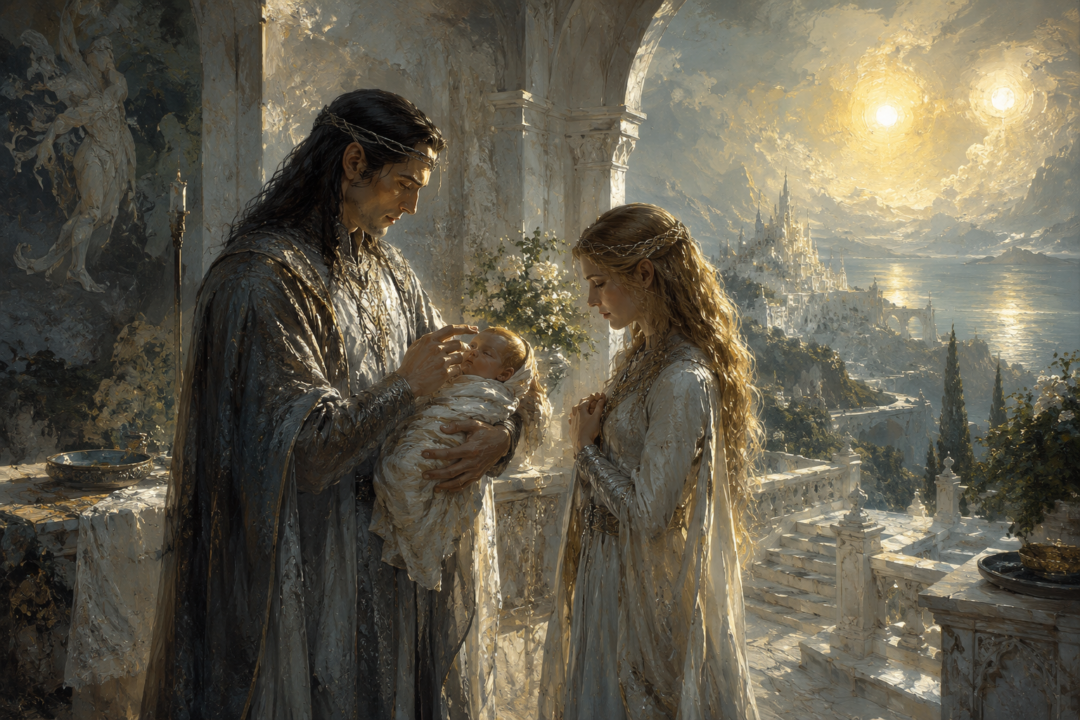
But among the Noldor of Aman, identity could be expressed through several names at once. A father might name a child according to ancestry and family continuity. A mother might give another name shaped by insight into the child's nature—or, in exceptional cases, by foresight. Later, other names could arise through reputation, circumstance, translation, or personal association.
The result was not merely a collection of aliases. A single Noldo could carry different truths about the same person.
Few examples show this better than the house of Fëanor. The names of Fëanor and his sons preserve ancestry, physical appearance, temperament, talent, expectation, and even tragedy. Galadriel offers another striking case: the woman remembered throughout The Lord of the Rings by one famous name possessed older names that revealed very different aspects of who she was.
To understand Noldorin naming is therefore to discover something deeper about Elvish identity: one person could be seen through several meaningful names without any one of them necessarily exhausting who that person was.
The Father-name Placed a Child Inside a Family
The later writings on Elvish naming describe the Eldar in Valinor as commonly possessing two names, with the father-name and mother-name occupying especially important places in their identity. An earlier account in “Laws and Customs among the Eldar” presents a somewhat more elaborate naming system, including a name chosen by the individual.
These accounts should not simply be forced into one perfectly uniform system. The conception developed over time. But both make clear that names among the Noldor could carry far more significance than convenient labels.
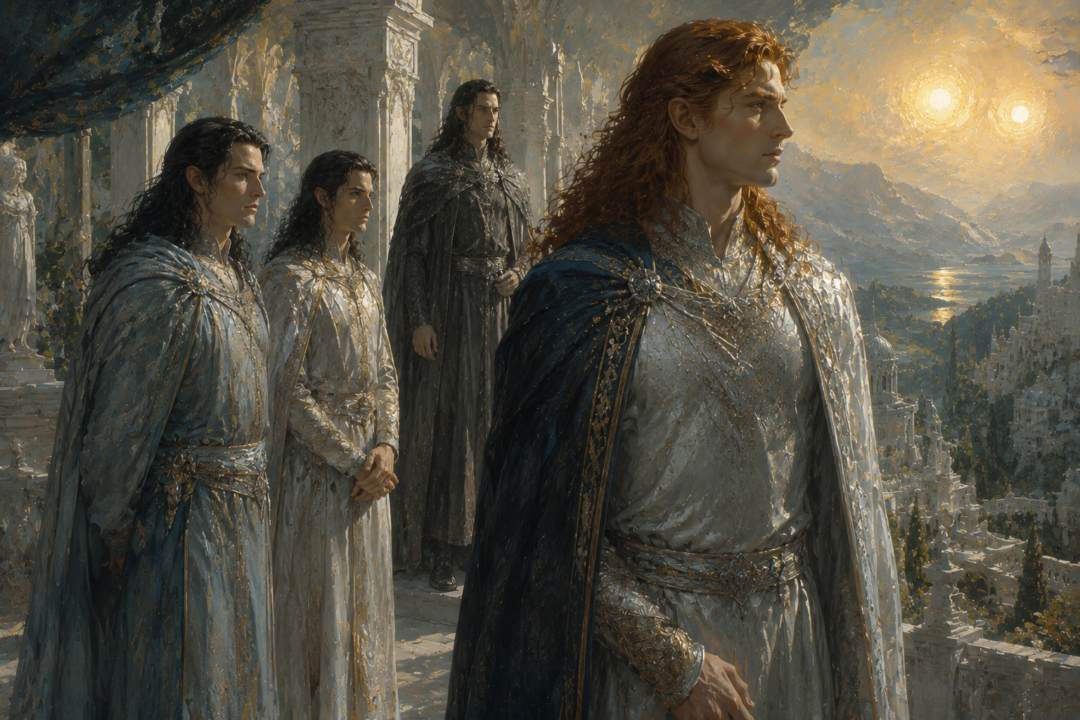
The father-name, or ataressë, was bestowed by the father. It frequently reflected family descent, sometimes resembling the father's own name in sound or meaning.
The descendants of Finwë provide the clearest examples.
Fëanor's father-name was Curufinwë, meaning essentially “Skilled Finwë.” Fingolfin's Quenya father-name was Ñolofinwë, while Finarfin's was Arafinwë. The repeated Finwë element was not accidental. Their names situated them within the royal house founded by Finwë.
Fëanor continued the pattern with his own sons.
Maedhros received the father-name Nelyafinwë, “Finwë Third,” because he belonged to the third generation in the succession from Finwë. Maglor was Kanafinwë, associated with a strong or commanding voice. Celegorm was Turkafinwë, conveying physical strength or power. Curufin received Curufinwë itself—the same father-name borne by Fëanor.
That last choice is particularly revealing.
A father-name could say, in effect: this child belongs to this lineage. In Curufin's case, the connection was exceptionally close. Fëanor passed his own father-name to one of his sons.
Yet Curufin's mother saw something more.
The Mother-name Could Reveal What the Mother Perceived
The mother-name, or amilessë, operated differently.
The later account in “The Shibboleth of Fëanor” places particular importance on a mother's insight into her child. Mother-names could reflect characteristics she perceived, and some could be prophetic. “Laws and Customs among the Eldar” distinguishes names of insight from names involving foresight.
This does not mean every mother-name predicted destiny. That would overstate the evidence. Many describe qualities already visible in the child.
But they could be remarkably personal.
Curufin's mother-name was Atarinkë, “Little Father.”
Nerdanel gave it because of his physical resemblance to Fëanor, a resemblance later found also in his mind.
Consider what his two parental names therefore did together.
Curufinwë tied him directly to Fëanor's own name and the lineage of Finwë. Atarinkë identified him as strikingly like his father as an individual.
Neither name cancels the other. Together they intensify the same relationship from different directions.
One expresses inheritance.
The other expresses resemblance.
For a character whose identity becomes deeply entangled with the house of Fëanor, that combination is almost unsettlingly appropriate.
Maedhros Was More Than the Name We Remember
Maedhros provides an even clearer demonstration of layered identity.
His father-name, Nelyafinwë, identified his position within Finwë's descendants: he was “Finwë Third.”
His mother-name was Maitimo, “Well-shaped One,” referring to his notable physical beauty.
He was also called Russandol, an epessë or after-name associated with his reddish-brown hair. The shortened form Russa was used by his brothers and other kin.
These names describe three different dimensions of the same person.
Nelyafinwë is genealogical.
Maitimo is personal and physical.
Russandol is descriptive.
And yet the name by which readers usually know him—Maedhros—is the Sindarin form that became established in the linguistic world of Beleriand.
His changing names therefore mirror a changing life without requiring us to imagine that one identity simply replaced another. The prince born in Aman, the son of Fëanor, the eldest of seven brothers, and the great Noldorin lord of Beleriand are the same person, but different names illuminate different relationships around him.
That is one of the most fascinating effects of Noldorin naming: identity accumulates.
Nerdanel's Names for Her Sons Could Be Uncomfortably Accurate
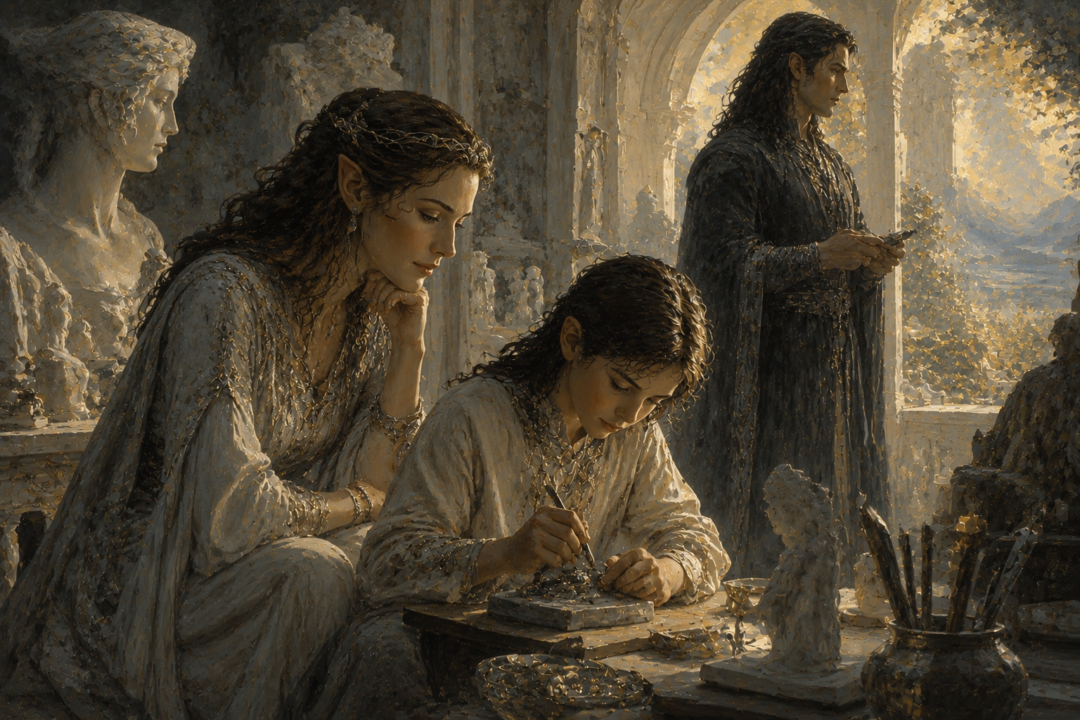
The mother-names of Fëanor's sons repeatedly reveal qualities not expressed in their father-names.
Celegorm's mother-name was Tyelkormo, “Hasty-riser.” The explanation associates it with his quick temper and his tendency to spring up when suddenly angered.
Caranthir was Carnistir, “Red-face,” referring to his ruddy complexion.
Maglor's mother-name, Makalaurë, is more difficult. Its precise interpretation is uncertain, but the surviving discussion associates it with his skill as a musician rather than literal metalworking. It should therefore not be treated as a straightforward translation such as “Gold-smith.”
Then come the twins, where naming becomes genuinely tragic.
Fëanor gave them the father-names Pityafinwë, “Little Finwë,” and Telufinwë, “Last Finwë.”
Nerdanel initially called both Ambarussa.
Later she wished to distinguish them and gave one the ominous name Umbarto, associated with doom or fate. Fëanor objected and altered it to Ambarto.
The later narrative connected with this naming exists in a late and difficult textual form, and it does not align neatly with every version of the published Silmarillion. In that account, Nerdanel's foreboding becomes horrifyingly relevant when one of the twins is burned with the ships at Losgar.
The safest conclusion is not that Noldorin mothers invariably knew their children's futures. They did not.
Rather, the texts allow mother-names sometimes to contain genuine foresight.
A name could therefore carry a possibility that its bearer did not yet understand.
Galadriel Shows How Several Names Could Express Different Truths
Galadriel may be the most familiar example of a Noldo whose identities are preserved in multiple names.
Her father-name was Artanis, commonly interpreted as “Noble Woman.”
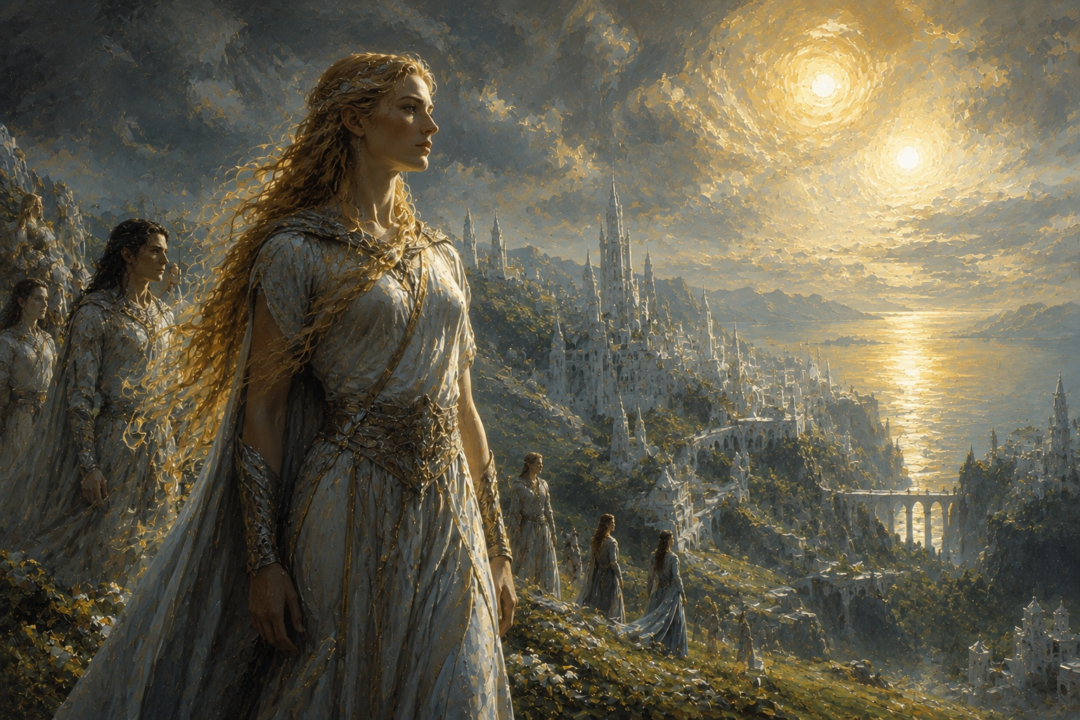
Her mother-name was Nerwen, “Man-maiden.”
The latter referred to her exceptional height and physical strength. The late account of her youth describes her as strong in body, mind, and will, capable of competing with the athletes of the Eldar.
Neither Artanis nor Nerwen, however, is the name by which Middle-earth remembers her.
Galadriel derives ultimately from the name Alatáriel, an epessë given to her by Celeborn in the late account in “The Shibboleth of Fëanor,” referring to her radiant hair.
Here the layers are striking.
Artanis expresses noble identity.
Nerwen expresses something her mother perceived in her nature and physical character.
Alatáriel/Galadriel arises from how she was seen by another person and becomes the name under which her legend survives.
Calling one of these the “real” Galadriel and the others mere aliases misses what the naming tradition permits. They are different perspectives upon the same person.
Fëanor's Own Names Reveal the Difference Between Inheritance and Nature
The most famous Noldo of all demonstrates the system in an especially powerful way.
His father-name was Curufinwë.
His mother-name was Fëanáro, from which the familiar Sindarin Fëanor ultimately derives.
The name is associated with “Spirit of Fire.”
That contrast is almost a miniature portrait of his life.
Curufinwë places him within Finwë's house and emphasizes skill. Fëanáro points toward the extraordinary inner fire for which he became renowned.
The Silmarillion describes the fire and intensity of his spirit repeatedly, while the later naming tradition gives that characteristic a place in the name bestowed by his mother, Míriel.
Again, this should not be turned into deterministic prophecy. A meaningful name does not make its bearer a prisoner of destiny.
Fëanor still chooses.
That distinction matters enormously because his tragedy depends upon moral agency. His brilliance, pride, grief, possessiveness, wrath, and catastrophic decisions cannot simply be blamed on a name given in childhood.
The name reveals.
It does not excuse.
Names Could Also Become Political
Noldorin names were so bound to identity that even pronunciation could acquire emotional and political significance.
Fëanor's mother Míriel bore the name Þerindë, usually rendered Serindë after the Quenya sound represented by þ shifted toward s among much of the Noldor.
Fëanor resisted that linguistic change.
What might have remained a question of pronunciation became entangled with his devotion to his dead mother, his hostility toward Indis and her children, and his sense of inheritance. In the late linguistic account, he deliberately maintained the older pronunciation and made the issue politically charged.
This is an extraordinary reminder that among the Noldor, a name was not merely a sound attached to a person.
Pronouncing a name could declare memory.
It could declare family loyalty.
Eventually, it could even declare faction.
The people most celebrated for their love of language were also capable of turning language into another battlefield.
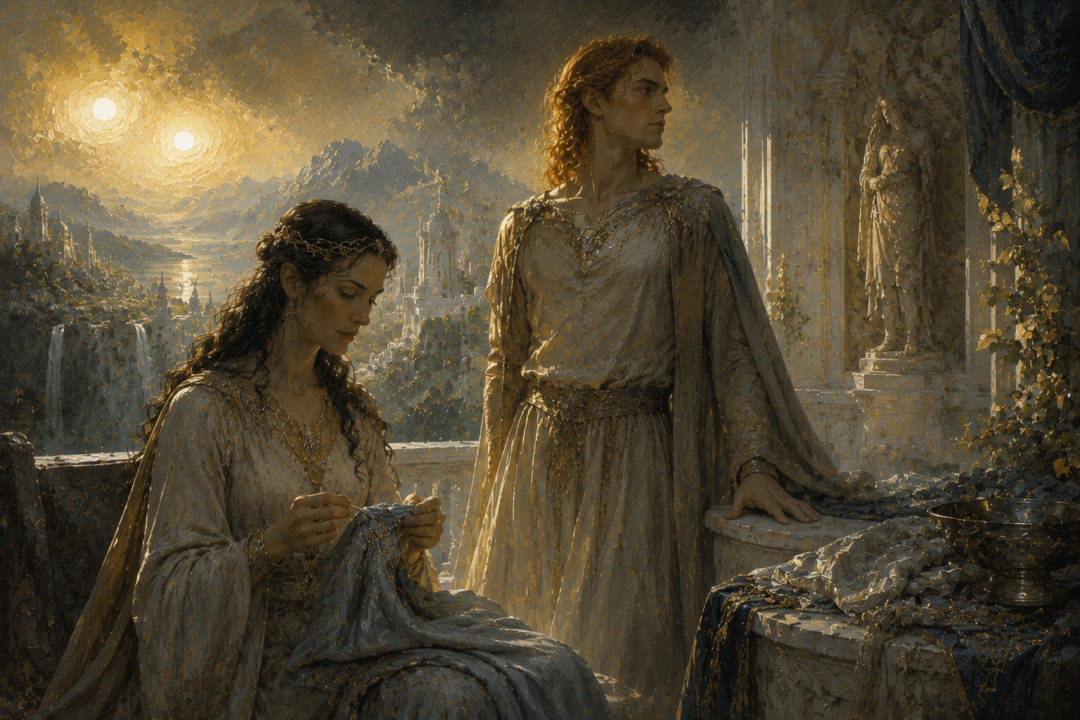
One Person Could Carry a History in Their Names
The Noldorin naming tradition resists the modern assumption that every person must possess one definitive name while all others are secondary aliases.
A father-name might preserve lineage.
A mother-name might express insight.
An after-name might arise from appearance, achievement, or the perception of another person.
And migration from Aman into Beleriand could produce Sindarin forms by which figures became better known in later history.
These identities could coexist.
That is why the names of the Noldor reward such close attention. Nelyafinwë, Maitimo, Russandol, and Maedhros do not merely give four ways to label one Elf. They preserve different ways of understanding him: descendant, son, beautiful young prince, red-haired kinsman, and eventually a figure remembered in the histories of Beleriand.
The same is true of Artanis, Nerwen, and Galadriel.
And of Curufinwë and Fëanáro.
For the Noldor, a life could gather meaning faster than a single name could contain it.
So they carried several.
Sources & Notes
- https://www.glyphweb.com/arda/n/noldor.html
- https://www.glyphweb.com/arda/f/feanor.html
- https://www.glyphweb.com/arda/m/maedhros.html
- https://www.glyphweb.com/arda/g/galadriel.html
- https://www.glyphweb.com/arda/n/nerdanel.html
- https://www.glyphweb.com/arda/c/curufin.html
Sources on the Noldor and the layered names and identities of Fëanor, Maedhros, Galadriel, Nerdanel, and Curufin used as the article’s central examples.