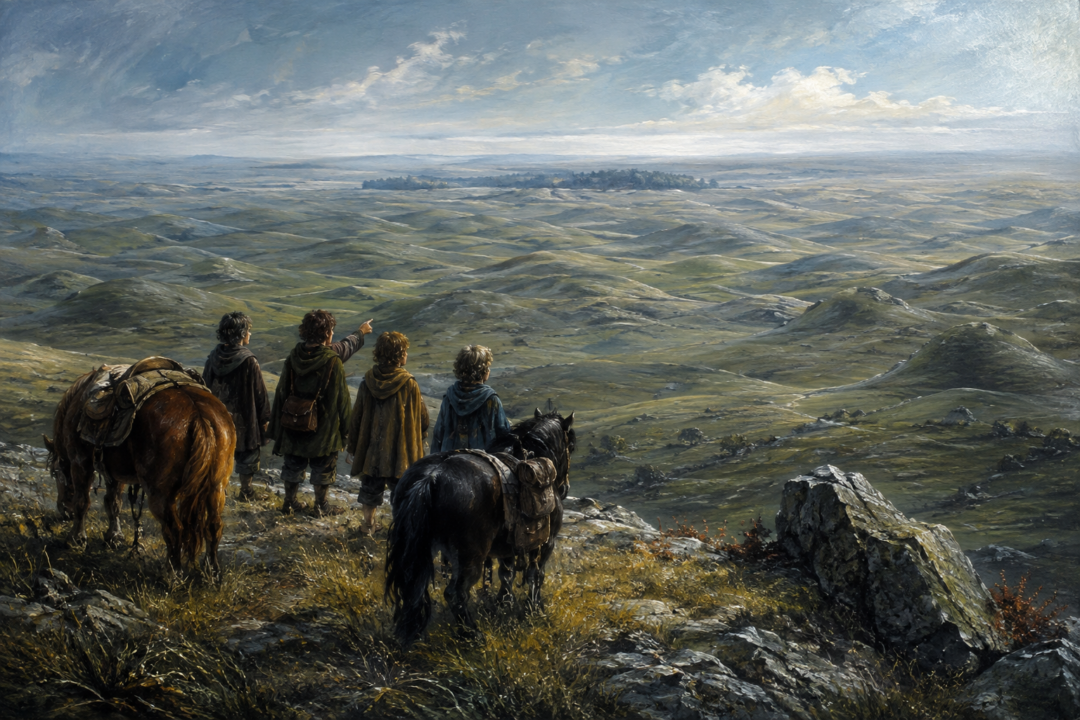
The Barrow-downs do not first appear as a place where anyone should become hopelessly lost.
When Frodo, Sam, Merry, and Pippin leave Tom Bombadil’s house, the morning is extraordinarily clear. From the heights they can look west toward the Old Forest, north across the dwindling downs, and east over ridge after ridge toward the distant country of the Misty Mountains. Goldberry even gives them a simple direction: go north, keep the wind in the left eye, and make haste while daylight lasts.
Yet before that day is finished, four hobbits who have seen their destination from a hilltop cannot reliably tell where they are.
The obvious explanation is the fog that later engulfs them. But that misses something important. Their trouble begins earlier, under a bright sky. The Barrow-downs defeat their sense of distance before they obscure their sight.
That distinction makes the episode far stranger—and reveals why the landscape itself is such an effective trap.
They Begin With an Excellent View
The hobbits are not blindly wandering into unknown country.
Goldberry deliberately makes them look around before they depart. The morning is clear enough to give them an unusually broad view, and their intended strategy is straightforward. They want to reach the East Road, which lies north of the downs.
The problem is that seeing a landscape from above is not the same thing as navigating through it.
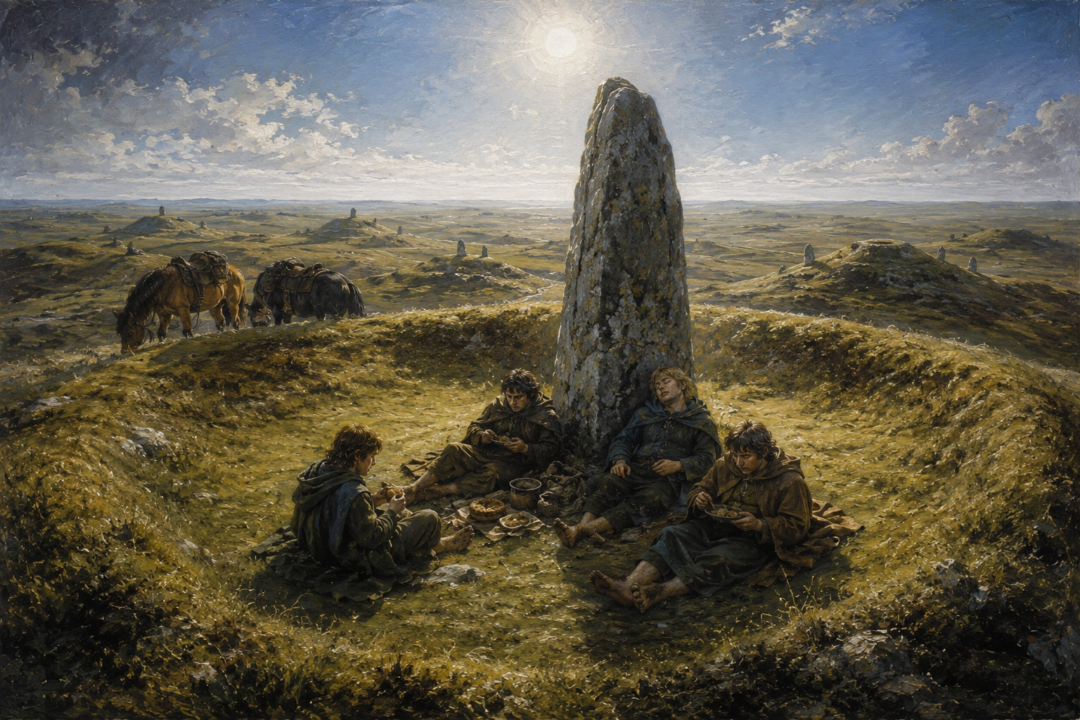
Once they descend, the Barrow-downs become a succession of hollows, slopes, shoulders, ridges, and smooth hilltops. There are no ordinary features by which Shire-folk might comfortably measure progress. The narrative specifically emphasizes the absence of trees and visible water. Instead there is grass, short turf, strange birds, and hill after hill.
That matters.
A distant mountain, river, woodland edge, road, village, or prominent tree can remain visible while a traveler moves. Rolling ground repeatedly removes such reference points. A direction that seems obvious from one summit can disappear completely after descending into the next hollow.
The hobbits therefore possess a general direction without possessing a continuously visible route.
The Downs Distort Their Sense of Distance Before the Fog
Around midday, they reach a high hill and look north.
There they see what appears to be a dark line of trees. Merry believes it marks the East Road. This surprises them because it suggests that they have already travelled farther than expected.
The text then makes a crucial observation: distances have become hazy and deceptive.
This happens before the supernatural crisis fully closes around them.
The hobbits have already discovered that their mental estimate of the country does not match what they see. The smooth repeating terrain gives them few reliable ways to judge scale. One grassy ridge resembles another; valleys open into further valleys; every new summit seems as though it ought to reveal the end.
Their mistake is therefore not simply that they choose the wrong compass direction.
They cannot accurately judge how the shapes around them relate to the larger landscape.
This is why the Barrow-downs are unsettling even in sunshine. They offer visibility without dependable orientation.
The Standing Stone Is the Turning Point
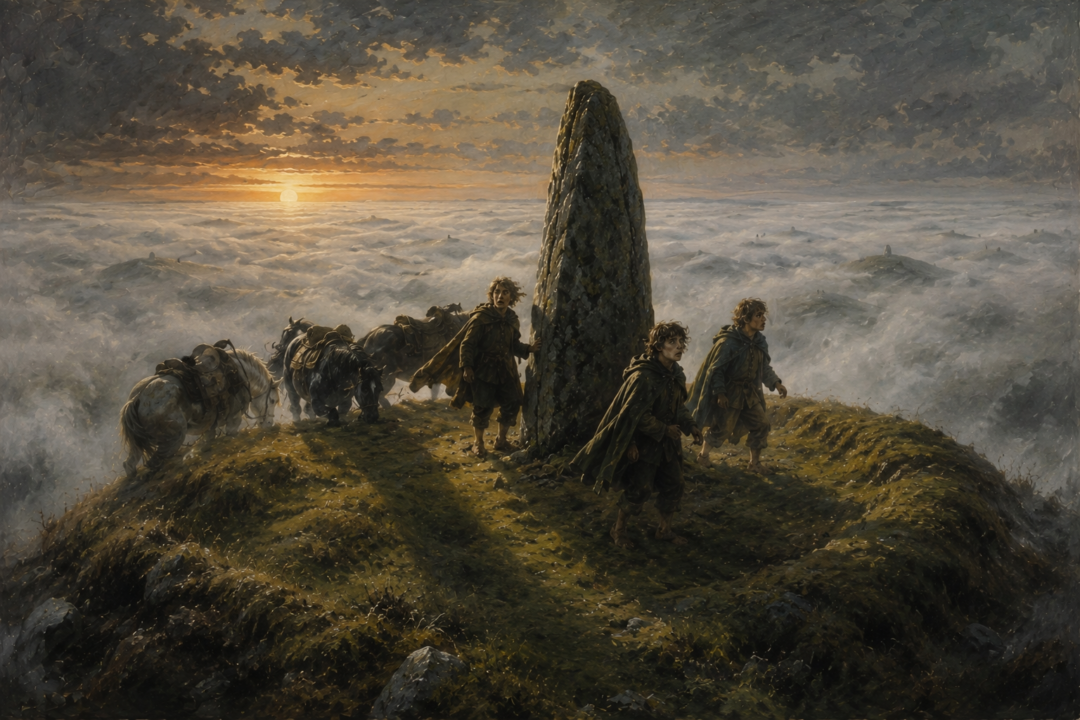
At midday the hobbits stop on a peculiar hill.
Its summit forms a shallow, saucer-like hollow surrounded by a raised green rim, with a single standing stone in the middle. Similar green mounds and stones can be seen on the hills farther east.
The stone is immediately unnatural in feeling, although the text does not explicitly explain what agency, if any, it exercises at this moment. At noon it casts no shadow, but when the hobbits sit against its eastern side they find it cold despite the sunlight.
They eat.
Then they fall asleep.
The narrator does not simply declare that a Barrow-wight magically puts them to sleep. Instead, the account leaves deliberate uncertainty. They have been riding over hills, they have eaten well, and they lie down longer than intended; perhaps that is sufficient explanation.
“However, that may be” is essentially the narrative position.
That uncertainty should be preserved. Tolkien never requires us to choose between ordinary exhaustion and supernatural influence.
What is certain is the consequence.
The hobbits surrender the one resource Goldberry explicitly told them to use: daylight.
They Wake on an Island in the Fog
When they awaken, the geography has transformed.
The sun is low. Fog surrounds the hill to the north, south, and east, while the west remains temporarily visible toward the setting sun. As they watch, even that last reference disappears.
Their hill becomes effectively an island above a white sea.
This is where the earlier navigational weakness becomes catastrophic. Had they maintained a reliable landmark during the day, fog would still have been dangerous, but they might have possessed a stronger mental route. Instead their navigation depends largely upon remembering the view they had before sleeping.
They decide to head north toward the opening they had previously seen.
That choice is reasonable.
It simply does not save them.
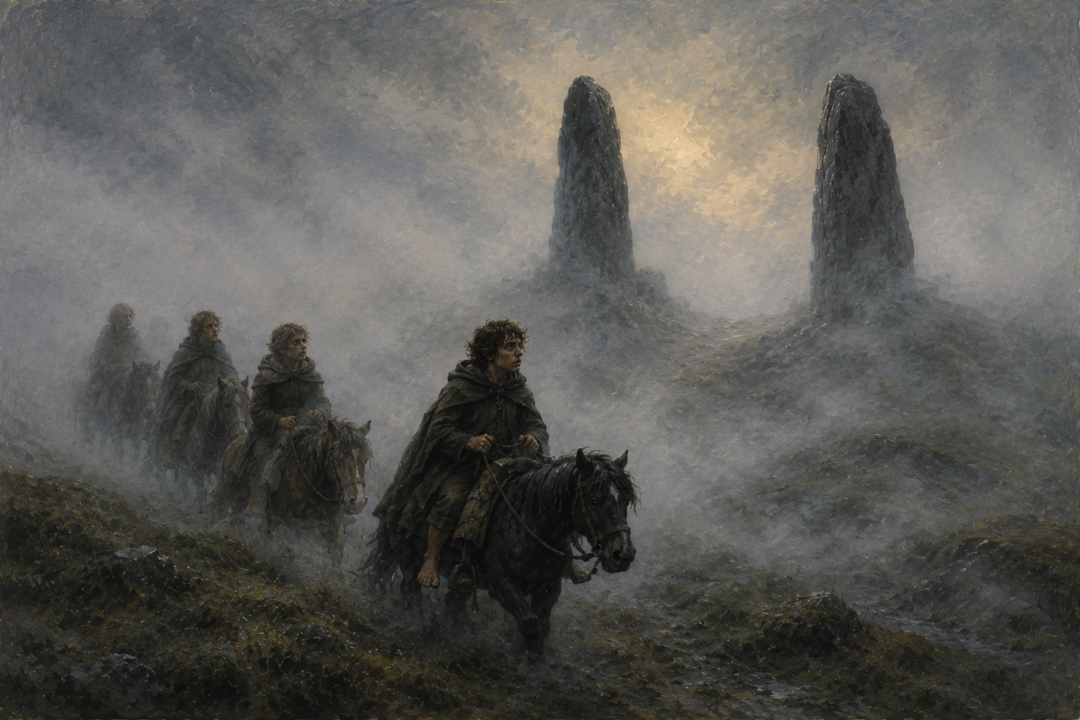
The fog grows colder and the darkness deepens. They ride in single file specifically because they fear becoming separated. Frodo leads, with Sam, Pippin, and Merry following.
The tragedy is that they understand the danger perfectly and still cannot overcome it.
The False Gate Shows That This Is More Than Bad Visibility
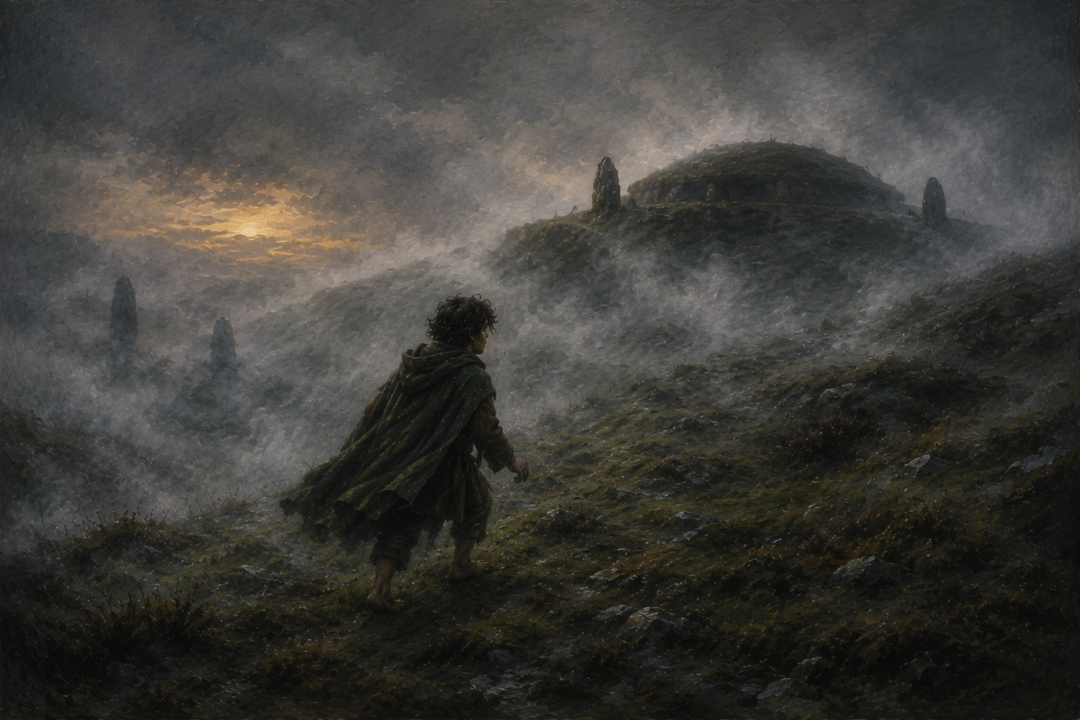
Eventually Frodo sees dark shapes rising on either side ahead.
He believes they have reached the gap at the northern end of the downs. If they pass between those shoulders, he thinks, they will be free.
Instead, the shapes resolve into two enormous standing stones.
This is one of the episode’s most disturbing details.
Frodo had not noticed these stones when looking north from the hill earlier. Now they stand precisely where he expects escape to be.
The text does not provide a mechanical explanation for this. It never lays out a rule stating that Barrow-wights can rearrange terrain or manufacture illusory landmarks. It is therefore safer not to claim that the stones literally move.
But Frodo’s experience strongly suggests that ordinary navigation has ceased to be trustworthy.
After his pony throws him and flees, he hears his companions and follows their voices. He thinks he is going east, yet soon realizes that he has been climbing steeply and has arrived before a barrow.
His perceptions of direction, slope, distance, and sound no longer combine into a coherent map.
The landscape has become a trap whether through supernatural deception, disorientation in fog and darkness, or—as the atmosphere strongly encourages us to suspect—some combination of both.
The Downs Were Already a Haunted Landscape
The Barrow-downs are not merely inconvenient hills.
They are an ancient burial country later connected with the wars that destroyed the northern Dúnedain realms. After Tom rescues the hobbits, he tells of the Men of Westernesse who fought the evil kingdom of Angmar. The blades he gives the hobbits come from that history.
Elsewhere in the narrative’s background, the Barrow-wights are associated with the Witch-king’s assault upon the surviving people of Cardolan. The evil inhabiting the downs is therefore connected to a much older catastrophe than Frodo’s journey.
That context changes how the landscape should be understood.
These hills contain the dead, the remains of a defeated people, and hostile spirits associated with an ancient war against Angmar. The hobbits are not crossing neutral countryside where an unfortunate patch of weather happens to descend.
They are entering a place where old evil has occupied the monuments of the dead.
The fog is frightening because it allows that buried history to close around living travelers.
Why Daylight Does Not Protect Them
The most interesting answer to the original question is that broad daylight does protect the hobbits—just not automatically.
Goldberry’s warning is precise: make haste while the Sun shines.
During the morning they can see enormous distances. They can establish north. They can glimpse their destination. Nothing attacks them openly.
But daylight only helps travelers who keep moving through it.
Their fatal mistake is stopping at the standing stone and sleeping through the afternoon.
Even that, however, would not be so dangerous in ordinary country. What makes the Barrow-downs exceptional is the combination of exhaustion, deceptive scale, repeating terrain, ancient monuments, and the supernatural danger associated with the barrows.
The hobbits are vulnerable before darkness because the Downs have already weakened their confidence in distance and direction.
The fog then removes the remaining landmarks.
Darkness completes the process.
The Trap Works by Turning Confidence Into Uncertainty
There is an elegant progression to the entire chapter.
At Goldberry’s hill, the world appears almost limitless. The hobbits feel so invigorated by the view that travelling directly toward the distant Mountains seems momentarily imaginable.
A few hours later, they cannot confidently find a road that they believe lies only a short distance away.
That reversal is the heart of the Barrow-downs episode.
The danger does not begin with a monster emerging from a tomb. It begins when a landscape that appears open and readable proves neither.
Their eyes work.
Their memory works.
Their plan is sensible.
And still the country defeats them.
Only after their ordinary means of orientation fail does the Barrow-wight finally seize them.
That is why the Barrow-downs remain one of the eeriest landscapes in The Fellowship of the Ring. The hobbits do not simply walk into darkness. They begin beneath a clean autumn sky with instructions, landmarks, ponies, food, and a visible destination.
The horror is watching those advantages disappear one by one.
By the time Frodo reaches the barrow, the hills have accomplished something more frightening than hiding the road.
They have made him unable to trust his own understanding of where the road should be.
Sources & Notes
- https://www.glyphweb.com/arda/b/barrowdowns.html
- https://www.glyphweb.com/arda/b/barrowwights.html
- https://www.glyphweb.com/arda/t/tombombadil.html
- https://www.glyphweb.com/arda/g/goldberry.html
- https://www.glyphweb.com/arda/e/eastroad.html
Sources on the geography and supernatural history of the Barrow-downs, the Barrow-wights, Goldberry’s guidance, Tom Bombadil, and the East Road destination.