When Glaurung first crawled from Angband, he changed the wars of Beleriand. He was enormous, armored, cunning, and devastating—but he did not fly. For most of the First Age, the dragons known to the enemies of Morgoth were creatures of the earth.
Then, at almost the last possible moment, something unprecedented came out of Angband.
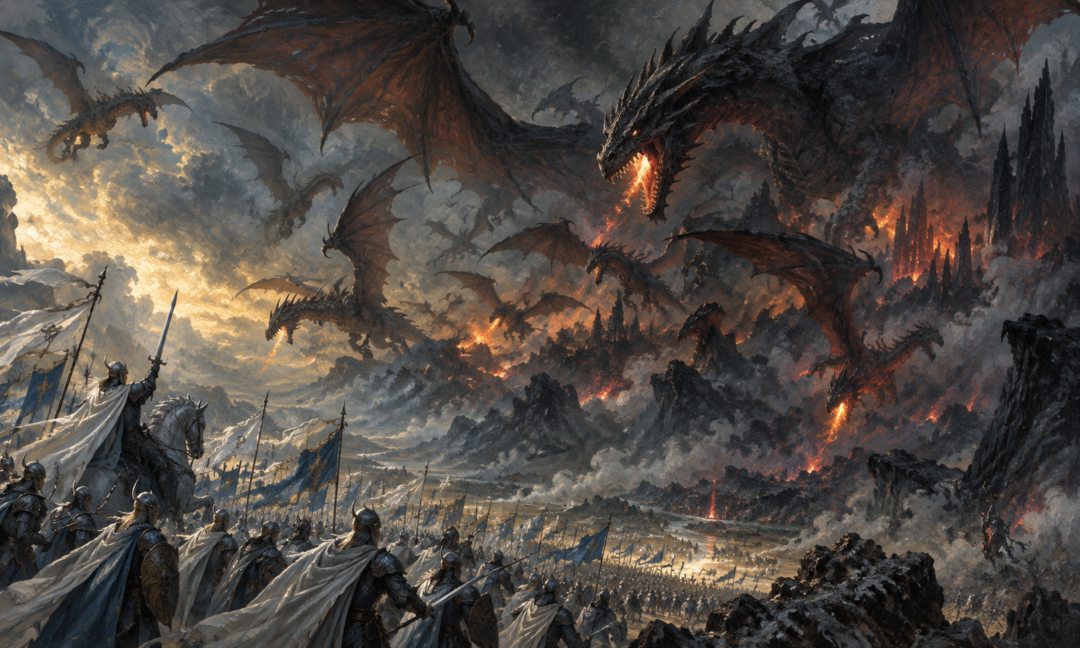
During the War of Wrath, Morgoth’s power had been broken in battle. His armies were being destroyed, the Host of Valinor was advancing, and his defeat appeared near. Only then did he release the winged dragons, creatures the opposing host had never encountered before.
The Silmarillion describes their arrival as sudden and astonishing. Their assault was powerful enough to drive the Host of Valinor back.
That timing matters. Tolkien never calls the winged dragons a “strategic reserve,” and we should not pretend that he does. But their placement in the narrative strongly supports that interpretation: Morgoth unveils an entirely new military capability only after his conventional resistance is collapsing.
The result is one of the most revealing moments in the history of the First Age. Morgoth had spent centuries breeding monsters for war, yet one of his most formidable creations entered the conflict only when nearly everything else had failed.
Before Wings: Glaurung and the First Dragons
Dragons had existed long before the War of Wrath.
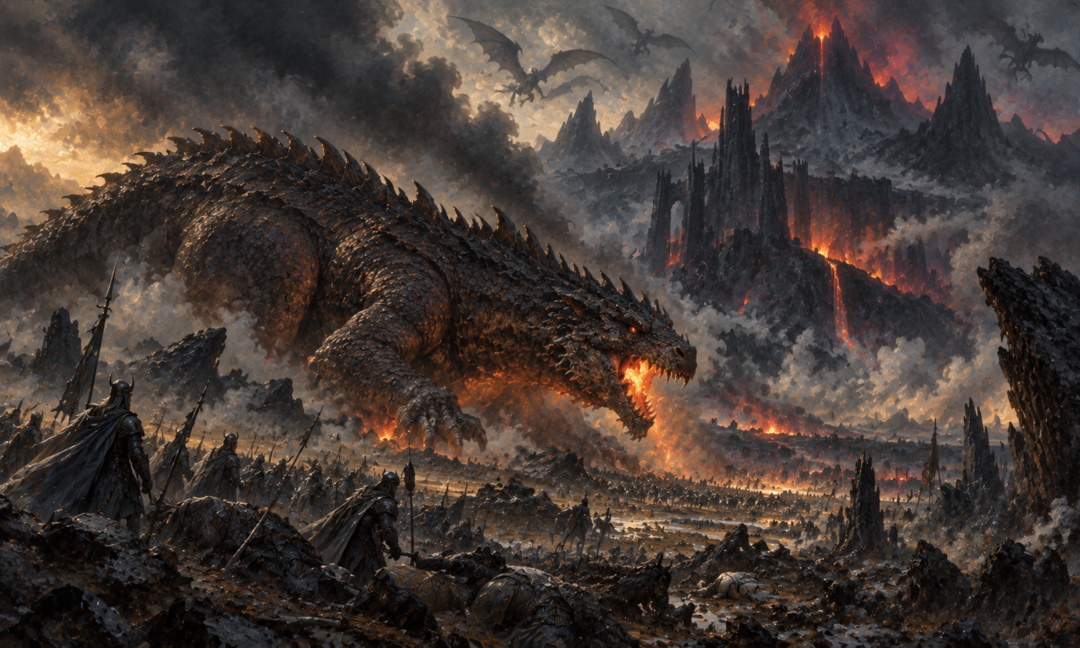
Glaurung first emerged from Angband roughly two centuries after the rising of the Sun. But this appearance was premature. Though already formidable, he had not yet reached his full strength, and Fingon drove him back with mounted archers. Morgoth was angered that Glaurung had revealed himself too soon.
That episode establishes something important about Morgoth’s use of dragons: their development required time, and he did not necessarily want to expose them before they were ready.
When Glaurung appeared again in the Dagor Bragollach, the situation was very different. Now fully grown, he helped break the Siege of Angband. Fire poured from him, and the forces of Morgoth devastated the northern defenses of the Noldor.
Later, in the Nirnaeth Arnoediad, dragons again formed part of Morgoth’s forces. Glaurung played a crucial role in the catastrophe, and other dragons were present with him.
Yet these dragons were not described as flying.
That distinction becomes explicit at the end of the age, because the winged dragons unleashed during the War of Wrath are described as creatures that had never before been seen.
Morgoth had not merely produced more dragons. He had developed a new kind.
The Long Preparation Behind Angband
Exactly when Morgoth began breeding winged dragons is never stated.
The texts do not provide a detailed biological history of dragons, nor do they explain the process by which Morgoth produced different varieties. Tolkien gives us outcomes rather than a technical account of their creation.
But the chronology makes one point difficult to miss.
Morgoth had been breeding and deploying dragons for centuries before flying dragons entered open warfare. The first immature appearance of Glaurung occurred long before the final destruction of Beleriand, while winged dragons remained unseen until the closing stage of the War of Wrath.
That suggests prolonged development within Angband, although anything more specific would be speculation.
It also fits Morgoth’s broader military pattern. Angband was not simply a fortress from which Orc armies marched. It was a vast center of subterranean power where weapons were made, creatures were bred, prisoners were enslaved, and new terrors could be prepared beyond the knowledge of Morgoth’s enemies.
The winged dragons were perhaps the most dramatic example of this hidden capacity.
For generations, the wars against Morgoth had established certain expectations about dragons. They were terrifying, but they operated on the ground. Armies could at least conceive of confronting them with infantry, cavalry, fortifications, or exceptionally powerful individual warriors.
Flight changed the problem.
Why Wings Changed the Battlefield
The significance of the winged dragons is demonstrated by what happened when they appeared.
By the War of Wrath, the military balance had turned overwhelmingly against Morgoth. Eönwë led the Host of Valinor into Middle-earth, and the forces of Angband were defeated across the north. The struggle was so destructive that Beleriand itself was eventually broken.
Morgoth’s armies could not stop the advance.
Then came his final major counterstroke.
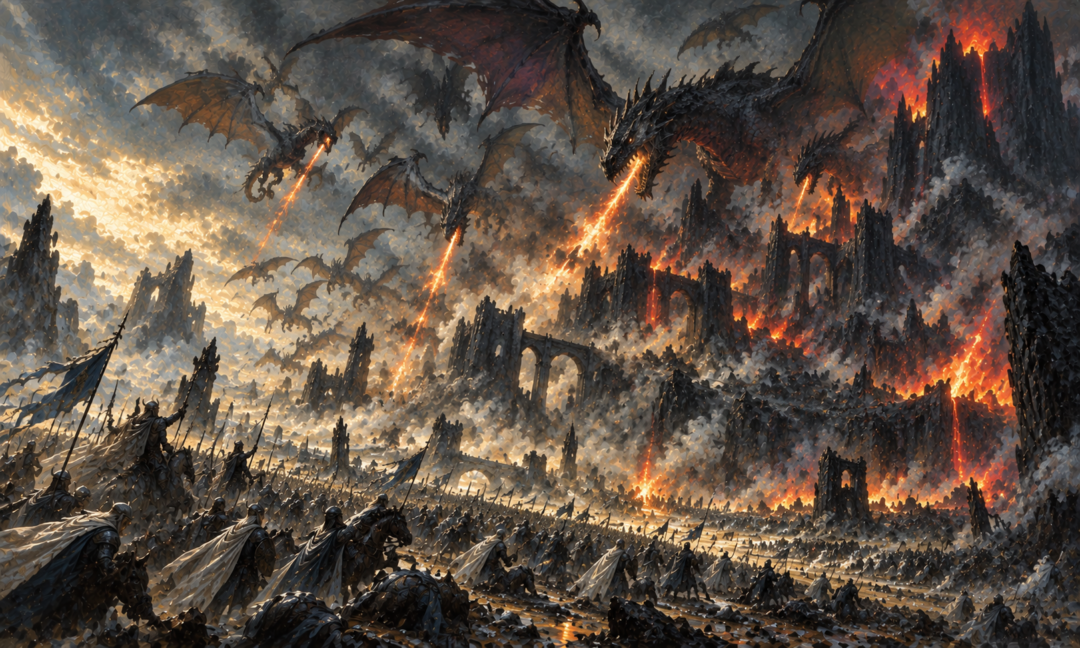
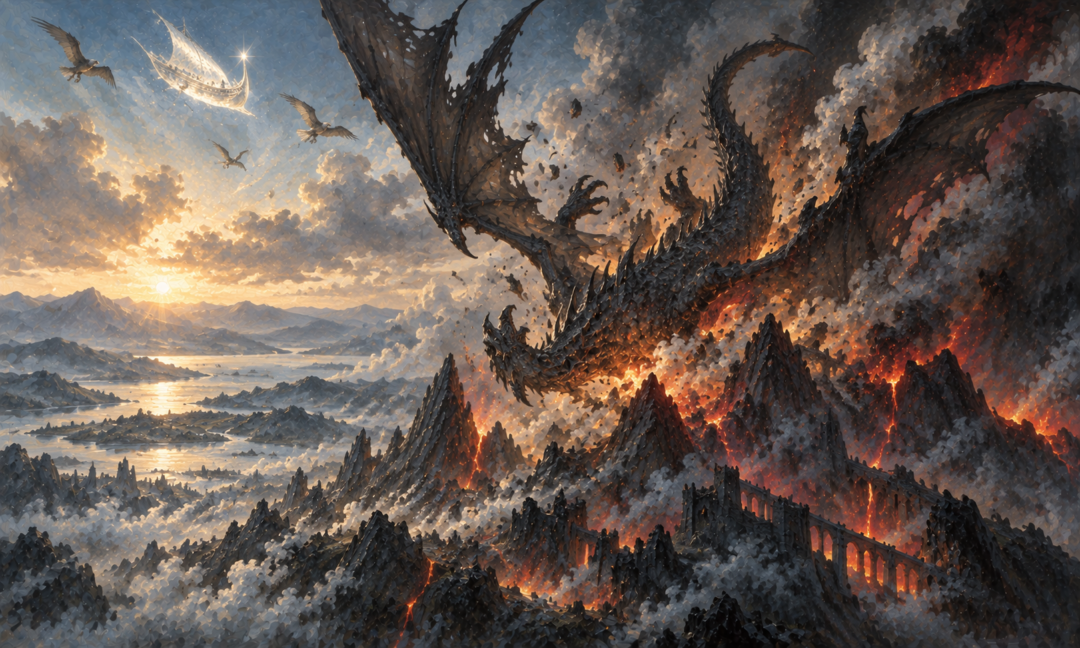
The Silmarillion says that Morgoth released the winged dragons from the pits of Angband, and that the Host of Valinor was driven back by their assault. Their arrival was accompanied by thunder, lightning, and a tempest of fire.
This is remarkable because the same host had already overcome the immense military power Morgoth had accumulated.
The winged dragons temporarily reversed that momentum.
Calling them a strategic reserve is therefore an interpretation rather than Tolkien’s terminology, but it describes their narrative function unusually well. A reserve is held from the main fighting until a decisive moment. Morgoth’s winged dragons appear precisely when his existing forces can no longer preserve Angband.
They are new, concentrated, and initially effective.
But Morgoth had one problem.
His enemies possessed an answer he could not easily have anticipated.
Eärendil Takes the War Into the Sky
The response to the winged dragons did not come principally from the armies fighting below.
It came from above.
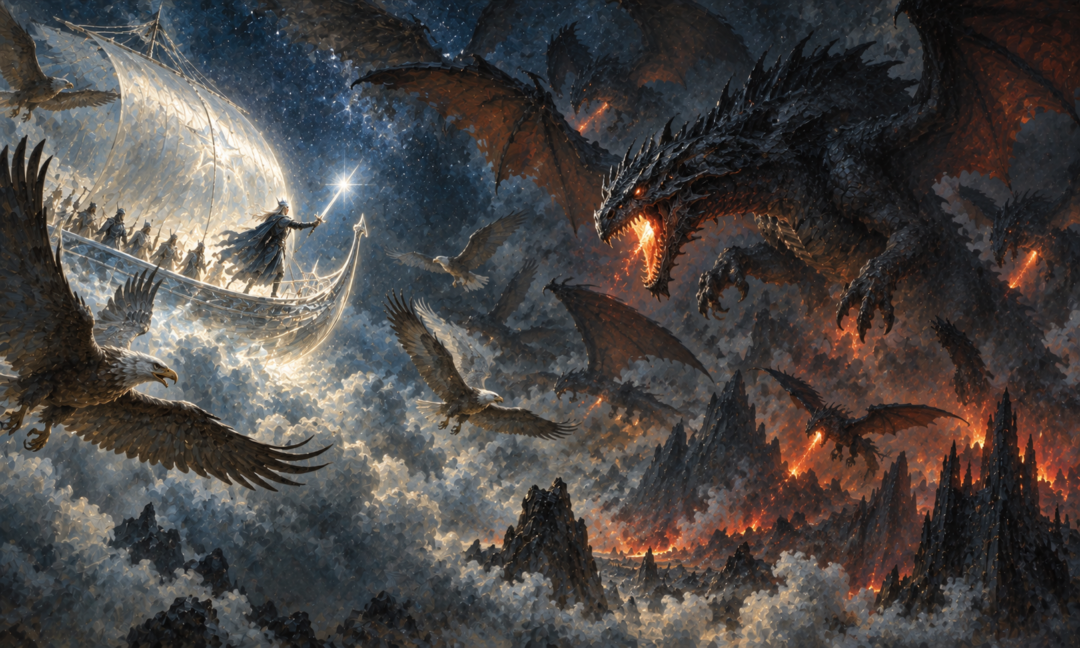
Eärendil had already crossed the Sea in Vingilot and reached Aman, bearing the Silmaril. His voyage helped bring about the intervention of the West. During the final battles, Vingilot was present in the heavens.
Against the winged dragons came Eärendil and the great Eagles.
The battle lasted through the night.
This is one of the most extraordinary transitions in Tolkien’s account of the First Age. A war that had largely been fought through sieges, marches, cavalry charges, monsters, fortresses, and ruined kingdoms suddenly became an aerial struggle above the shattered north.
At its center was Ancalagon the Black.
The text identifies Ancalagon as the mightiest of the dragon-host. Eventually Eärendil slew him, and Ancalagon fell upon Thangorodrim, breaking its towers.
The image is immense, but it is worth keeping its scale within what the text actually says. Tolkien does not provide measurements for Ancalagon, and later attempts to calculate a precise size from the destruction of Thangorodrim go beyond the evidence.
What matters is the consequence.
The greatest of Morgoth’s winged dragons was defeated, and the surprise that had briefly checked the Host of Valinor failed.
Morgoth’s Final Weapon Could Delay Defeat, Not Prevent It
There is a tragic irony in Morgoth’s deployment of the winged dragons.
They worked.
For a moment, at least.
Their appearance was not an empty gesture by an already defeated tyrant. They inflicted a genuine reversal upon an enemy that had been sweeping aside Morgoth’s forces. Whatever long preparation had gone into breeding them produced exactly the kind of battlefield shock one might expect from a secret weapon.
Yet their effectiveness exposed the deeper weakness of Morgoth’s position.
By this stage of the war, he was running out of layers of defense.
His armies had been beaten. The Host of Valinor was approaching Angband. The winged dragons represented an extraordinary escalation, but there was no larger recovery behind them. Once Eärendil and the Eagles overcame the dragon-host, Morgoth had no comparable force left to restore the situation.
Angband was broken.
Morgoth fled into its deepest places and sought to escape. He was captured, his feet were cut from under him, his Iron Crown was beaten into a collar, and he was ultimately thrust beyond the Doors of Night.
The winged dragons had arrived with enough force to change the battle.
They had arrived too late to change the war.
Why Did Morgoth Wait So Long?
The text never explicitly answers this question.
There is no statement that Morgoth deliberately saved the winged dragons for the War of Wrath according to a carefully designed military plan. Nor are we told that he could have deployed mature winged dragons during earlier battles and simply chose not to.
The safest conclusion is more limited.
Winged dragons first appear only at the end of the First Age, and their novelty is specifically emphasized. This strongly suggests that they were a late development in Morgoth’s long breeding of dragons.
Glaurung’s history provides a useful parallel. His premature first emergence angered Morgoth, and only much later did he return at full strength. Morgoth clearly understood that such creatures could require maturation before their full power was available.
Whether the same exact process applied to the winged dragons is unstated.
Their late appearance may therefore reflect readiness rather than mere strategic withholding—or some combination of both. Tolkien does not give enough information to choose confidently between those possibilities.
What we can say is that when Morgoth finally possessed a host of flying dragons capable of battle, he unleashed them at the moment of greatest need.
That is why they function so convincingly as his last strategic reserve.
The Final Escalation of Morgoth’s War
There is also a broader pattern running through Morgoth’s wars.
His victories repeatedly depend upon escalation.
Orcs are joined by Balrogs. Siege gives way to sudden fire and volcanic destruction. Dragons enter the wars. Human allies are corrupted or deceived. Strongholds that seemed secure are attacked by forces their defenders struggle to anticipate.
The winged dragons stand at the end of that progression.
They are not simply bigger monsters added to an existing army. Their ability to fly changes the dimension in which the war can be fought. The armies of the West are confronted by an enemy that can descend from above, and the answer requires Eärendil and the Eagles to meet them in the air.
Yet this escalation also illustrates the limits of Morgoth’s power.
He can produce terror after terror, but each new weapon costs him something and does not repair the underlying collapse of his realm. By the War of Wrath, even an innovation as terrible as the winged dragons can only interrupt the advance against him.
That distinction is essential.
The dragons are powerful enough to surprise the Host of Valinor.
They are not powerful enough to restore Morgoth’s dominion.
The Last Surprise of Angband
Winged dragons occupy surprisingly little space in the surviving narrative compared with their enormous place in the imagination of Middle-earth.
Their First Age appearance is concentrated at the very end.
That brevity makes their role more striking, not less.
For centuries, Morgoth had transformed living creatures and accumulated military power beneath the Iron Mountains. Glaurung had helped destroy kingdoms and shatter alliances. Dragons had become one of the defining horrors of his wars.
But the final form of that weapon remained hidden until Angband itself was threatened.
Then the skies opened.
For a short time, Morgoth’s last great innovation achieved what his armies could no longer accomplish: it forced the victorious Host of Valinor backward.
And then Eärendil rose against it.
The fall of Ancalagon onto Thangorodrim is therefore more than the death of a mighty dragon. Within the structure of the War of Wrath, it marks the destruction of Morgoth’s final extraordinary battlefield answer.
His enemies had survived the Orcs, the Balrogs, the fires of the north, and the dragons of the earth.
At the end, they survived the dragons of the sky as well.
And after that, there was almost nothing left between the Host of Valinor and the darkness beneath Angband.
Sources & Notes
- Tolkien Gateway, “War of Wrath” — The late release of previously unseen winged dragons. https://tolkiengateway.net/wiki/War_of_Wrath
- Tolkien Gateway, “Ancalagon” — Winged dragon opposed by Eärendil in the final battle. https://tolkiengateway.net/wiki/Ancalagon
- Tolkien Gateway, “Glaurung” — Earlier wingless dragon in the wars of Beleriand. https://tolkiengateway.net/wiki/Glaurung
Sources document War of Wrath, Ancalagon, Glaurung. Interpretive claims remain distinguished from the primary narrative.