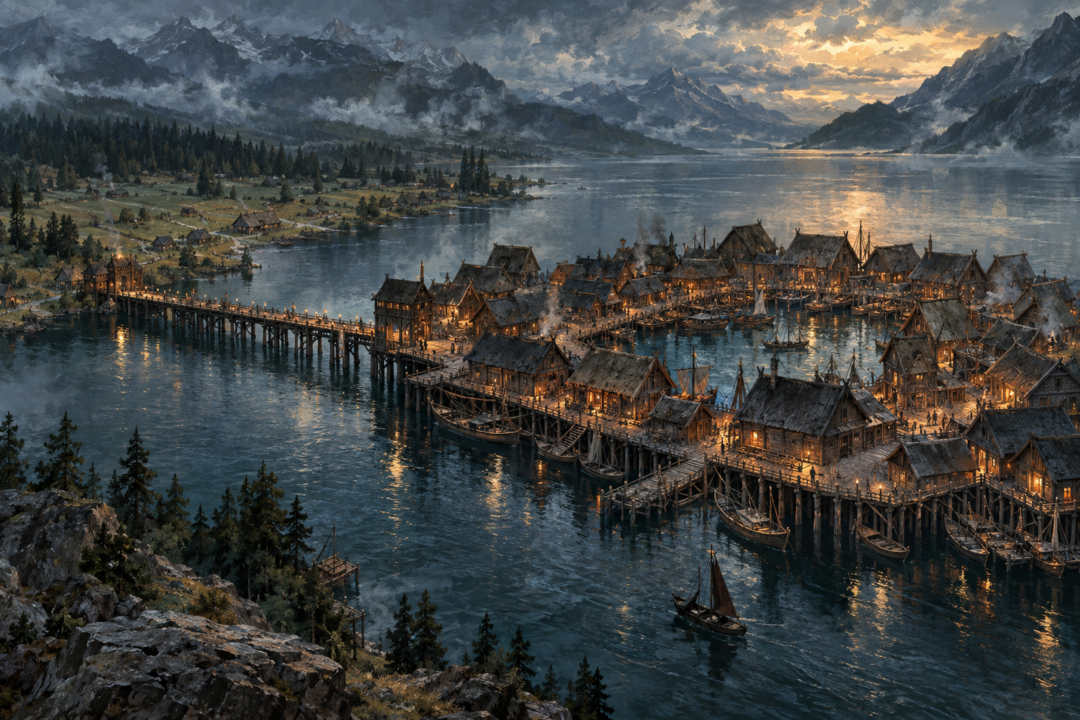
When Smaug descends upon Lake-town, the people of Esgaroth face a terrifying contradiction. Their town was built upon water partly because water made it defensible. Yet when the dragon finally attacks, that same design leaves thousands of frightened movements compressed onto wooden platforms surrounded by a cold, dark lake.
The destruction of Esgaroth in “Fire and Water” is therefore more than an action sequence. Read beside the earlier description of Lake-town in “A Warm Welcome,” it becomes one of the clearest demonstrations of how the settlement actually worked.
The bridge could be destroyed. Boats could reach the town from within. Quays, steps, ladders, and openings connected its platforms directly to the water. And when fire overwhelmed the buildings, people did not depend entirely upon the bridge to escape.
The evacuation effectively gives us a second architectural tour of Lake-town—this time under catastrophic pressure.
Lake-town Was Not Simply a Village Beside the Lake
The first important detail is easy to overlook: Esgaroth stood out upon the Long Lake.
Its buildings rested on great wooden piles driven into the lake bed, with a long wooden bridge connecting the settlement to the western shore. The arrangement made the water itself part of the town's defenses.
When Thorin and his companions first enter Esgaroth, they cross the bridge and pass through gates before reaching the market-place. That market-place is not a conventional paved square. It is a broad area of quiet water surrounded by piles supporting the larger houses and by long wooden quays equipped with numerous steps and ladders descending toward the lake.
This is crucial for understanding everything that happens later.
Lake-town was not merely a wooden settlement surrounded by water. Water penetrated its civic structure.
Its inhabitants lived above the lake but were repeatedly given ways to descend to it.
That makes sense for a community whose life depended heavily on boats, river traffic, and commerce. It also creates an accidental emergency system when Smaug arrives.
The Bridge Was a Chokepoint—and a Defensive Weapon
The bridge seems at first like Lake-town's greatest vulnerability.
It was the principal land connection between the settlement and the shore. An attacking force approaching by land would naturally be concentrated there.
But the people of Esgaroth had an answer.
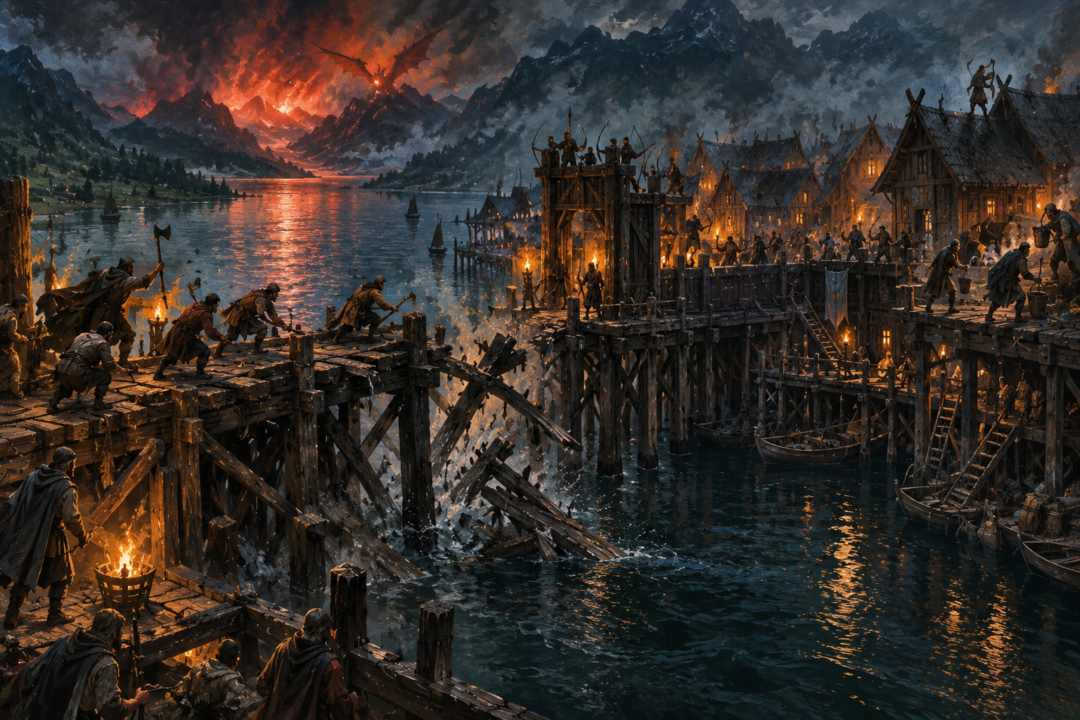
When Bard recognizes the glow from the north as the coming of Smaug, preparations begin rapidly. Weapons are readied, water is collected, and the bridge is thrown down and destroyed.
That decision tells us something important about Lake-town's defensive logic.
The bridge was expendable.
Esgaroth could deliberately sever its normal connection with land because the surrounding lake then became a defensive barrier. Smaug reaches the place where the bridge should be and finds his enemies isolated in deep water.
Against an ordinary landward enemy, this arrangement would have been formidable. Anyone attacking Esgaroth would have needed either the bridge, boats, or some other means of crossing open water.
Smaug, of course, can fly.
Even so, the destroyed bridge initially frustrates his approach, while the lake beneath remains dangerous to him. The text emphasizes that its deep, cold water is something even the dragon cannot simply disregard.
Lake-town's defenses work.
They simply cannot save a settlement made almost entirely of combustible material from an airborne fire-drake.
Destroying the Bridge Created an Evacuation Problem
There is a darker side to Bard's defensive decision.
Once the bridge was destroyed, Lake-town's easiest pedestrian route to safety was gone.
This was not necessarily a mistake. The approaching threat was Smaug, and the immediate priority was preventing him from using the landward approach. But the consequence becomes severe once the roofs begin burning.
The inhabitants cannot simply flee in a mass across the bridge.
Instead, the lake becomes their escape route.
This is where the earlier description of the town suddenly becomes vital. Lake-town already possessed quays, steps, and ladders descending to the water. Boats were not peripheral equipment stored somewhere beyond the settlement. They belonged to the normal functioning of the place.
The architecture had been built around constant movement between platform and water.
Under ordinary circumstances, those access points served trade and transportation.
During the attack, they became escape routes.
The Evacuation Shows That Boats Were Distributed Through the Town
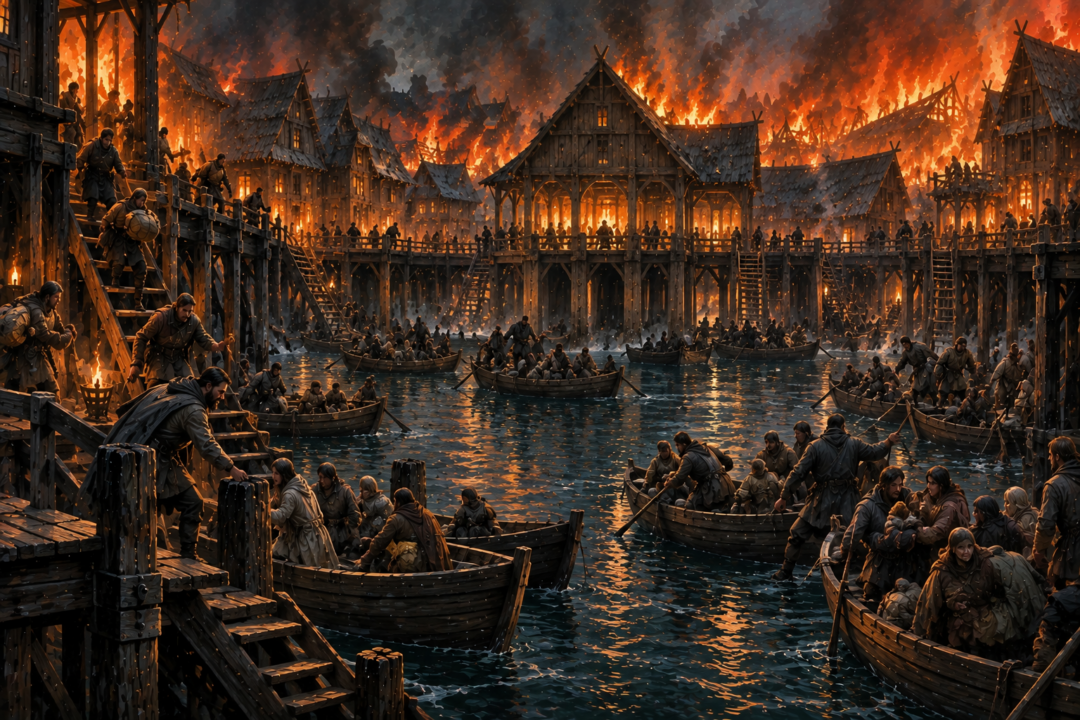
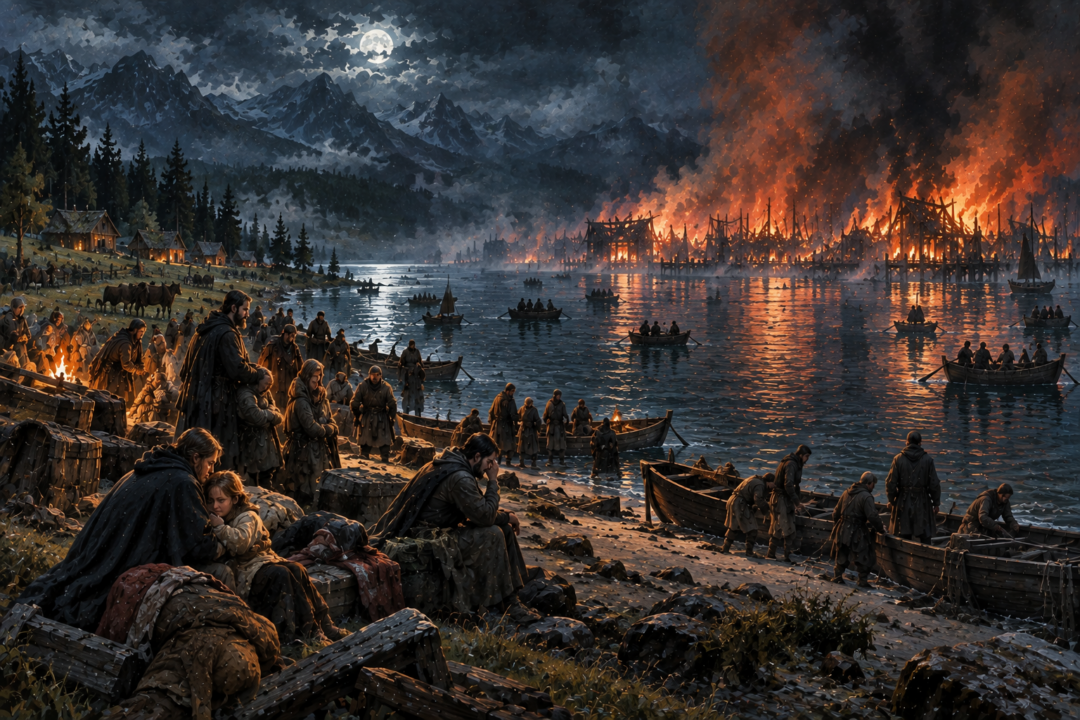
After Smaug begins setting Esgaroth ablaze, the inhabitants turn toward the water.
People leap into the lake. Boats are filled. The Master himself escapes in his great gilded boat rather than attempting to reach land across the destroyed bridge.
After Smaug is killed and the smoke and mist begin clearing, many boats can be seen scattered across the lake.
That detail is one of the strongest clues to Lake-town's practical layout.
The surviving population had been able to launch or reach enough craft during a rapidly spreading fire for large numbers of people to escape. The text later states that roughly three quarters of the inhabitants survived and that most of the town's boats remained undamaged.
We should not turn that into a precise architectural plan that the book never supplies. But the evidence strongly suggests that access to boats was not restricted to one remote harbor outside the settlement.
That fits perfectly with the earlier description of quays, ladders, steps, and water within the town itself.
Lake-town functioned less like a fortress with a harbor attached to it and more like a settlement structurally integrated with its harbor.
The Market-Place Was Also a Waterway
Perhaps the strangest feature of Esgaroth is its market-place.
A casual reader might imagine a conventional town square surrounded by halls and houses. The actual description is much more distinctive: the market-place includes a wide circle of quiet water, bordered by wooden quays and the piles supporting the greater buildings.
This suggests that commercial traffic could penetrate directly into the center of the settlement.
The implications during the evacuation are significant.
People living or working around the central area were already close to the water. They did not necessarily have to travel to the town's outer edge before descending toward boats or the lake.
Again, the text does not provide a detailed evacuation map, so we should resist inventing specific routes. But the physical principle is clear.
Esgaroth possessed vertical connections from its inhabited platforms down to water level throughout important parts of the settlement.
The same design that allowed cargo and passengers to move efficiently between boat and building also offered alternative exits when the elevated wooden town became an inferno.
Fire Turned Lake-town’s Strength Into Its Weakness
Lake-town's location had been chosen intelligently.
Water separated its inhabitants from enemies. Its bridge could be sacrificed. Its boats provided mobility. Its quays connected commerce directly to the settlement.
But nearly everything depended upon timber.
Against Smaug, that became catastrophic.
The defenders wet roofs and fill vessels with water, showing that they immediately understand the danger. Yet Smaug's fire overwhelms their preparations. Once several buildings are burning, the settlement's tightly connected wooden environment becomes increasingly impossible to defend.
Here lies the central irony of Esgaroth's design.
The lake protects the town from the dragon physically, but the town itself provides the dragon with fuel.
Smaug does not need to enter the streets as a conventional attacker would. He can remain above the water, descend upon the settlement, breathe fire onto its structures, and use his physical strength against buildings.
The defensive perimeter survives conceptually.
The inhabited structure inside it does not.
The Lake Became Both Moat and Lifeboat
Yet Lake-town's unusual construction probably prevented an even greater loss of life.
Once the town could no longer be held, its inhabitants had water beneath and around them.
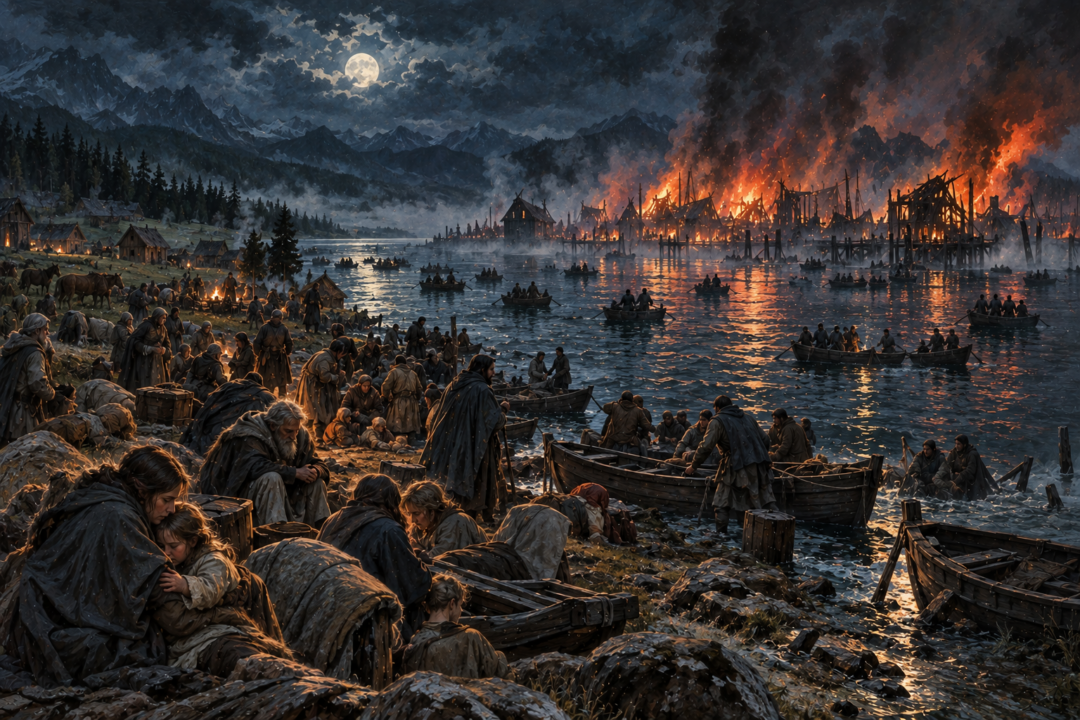
Some escaped in boats. Others entered the lake directly. Bard himself ultimately survives in the water after Smaug falls.
The result is remarkable considering the scale of the disaster: about three quarters of Lake-town's people survive.
The text does not explicitly say that Esgaroth was designed as a giant evacuation system, and it would be an exaggeration to claim that it was. The steps, ladders, quays, boats, and internal waterways existed primarily because this was a lake settlement and trading community.
But they had an unintended survival value.
A comparable wooden settlement surrounded by dry ground might have forced inhabitants into streets while flames spread around them.
Esgaroth offered another direction.
Down.
Below the burning platforms lay the very element Smaug disliked most.
The Survivors’ Destination Reveals the Town’s Relationship With the Shore
After the destruction, the survivors gather on the western shore.
That geographical detail matches the town's earlier orientation. The bridge had connected Esgaroth with the western side of the Long Lake, and the people also possessed resources on land: woods, fields, pastures, cattle, and buildings or huts around the shore.
Lake-town was therefore not economically isolated from land even though its main settlement stood offshore.
Its inhabitants lived within a broader landscape.
The town was the commercial and residential center, but the surrounding shore supported activities that could not exist on wooden platforms above deep water.
This becomes critically important after the disaster. Although their houses and possessions are largely lost, the survivors still have most of their boats as well as their woods, fields, pastures, and cattle.
Smaug destroys the town.
He does not destroy the entire economic territory of the Lake-men.
That distinction helps explain how the community survives long enough for aid to reach it.
Esgaroth Was Designed Around an Older Fear
There is another melancholy detail behind the architecture.
Lake-town exists in the shadow of the Lonely Mountain. Its people know the old stories of Dale and the dragon. The town upon the water belongs to a region already transformed by Smaug's presence.
Its architecture therefore reflects a world in which danger has shaped ordinary life.
The long bridge, the gates, the deep water, the boats, and the elevated platforms create a settlement capable of separating itself from the land.
When the dragon finally comes, those defenses are not meaningless. The destroyed bridge genuinely alters his approach, and the water remains dangerous to him.
But no defensive system can perfectly answer every form of the threat it was meant to resist.
Esgaroth can deny Smaug easy access from the shore.
It cannot prevent fire from falling from the sky.
The Evacuation Is the Clearest Map We Have
Lake-town's destruction gives us no architectural blueprint.
Instead, it gives us something more revealing: people moving through the town when every normal assumption has collapsed.
The bridge is destroyed because it is structurally separable from the settlement. Boats become essential because water access is built into daily life. People can descend from the platforms because quays, steps, and ladders connect the inhabited level with the lake. Survivors converge on the western shore because that is the landward side to which Esgaroth is physically and economically tied.
Seen this way, the evacuation is not incidental background to Bard's confrontation with Smaug.
It is a demonstration of how Lake-town worked.
Esgaroth was simultaneously a fortress, harbor, marketplace, and wooden island. Its inhabitants had turned the Long Lake into their road, their moat, and part of their commercial infrastructure.
When Smaug came, almost everything made of wood was lost.
But the water remained.
And in the final terrible minutes of Lake-town, the element that had shaped the settlement's design became the means by which most of its people escaped it.
Sources & Notes
- Tolkien Gateway, “Lake-town” — Its bridge, market pool, quays, and boat access. https://tolkiengateway.net/wiki/Lake-town
- Tolkien Gateway, “Fire and Water” — Smaug’s destruction of the bridge and the inhabitants’ escape by boat. https://tolkiengateway.net/wiki/Fire_and_Water
- Tolkien Gateway, “A Warm Welcome” — The Hobbit chapter depicting arrival at Lake-town. https://tolkiengateway.net/wiki/A_Warm_Welcome
Sources document Lake-town, Fire and Water, A Warm Welcome. Interpretive claims remain distinguished from the primary narrative.