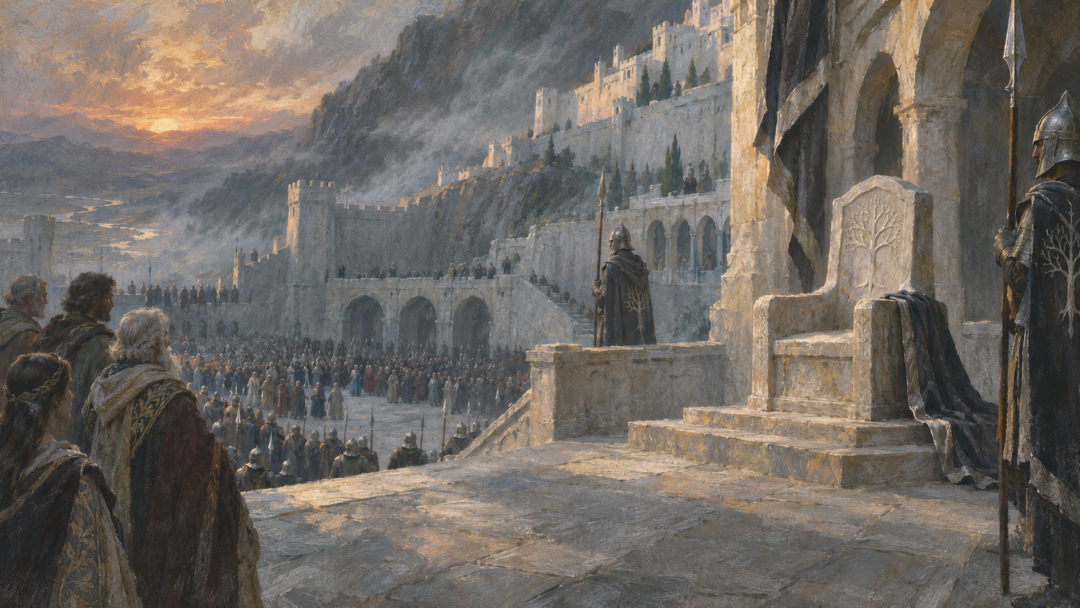
The battle of the Pelennor Fields is won, yet the man who helped save Minas Tirith does not stride through its broken gate and take the throne. Aragorn stays outside the city, with his banner furled, while Gondor still has a Steward and a war to finish. For someone carrying the sword of Elendil, that restraint is striking. If the crown is his by descent, why wait for anyone's welcome?
Because Gondor's kingship is more complicated than either automatic inheritance or an election by powerful families. Aragorn has a hereditary claim, but the story makes its acceptance visible: the Steward recognises him, leading captains support him, and the people acclaim him. None of this is a modern ballot. Yet neither are the people and their rulers merely spectators at a coronation decided somewhere else.
What Aragorn Actually Claims
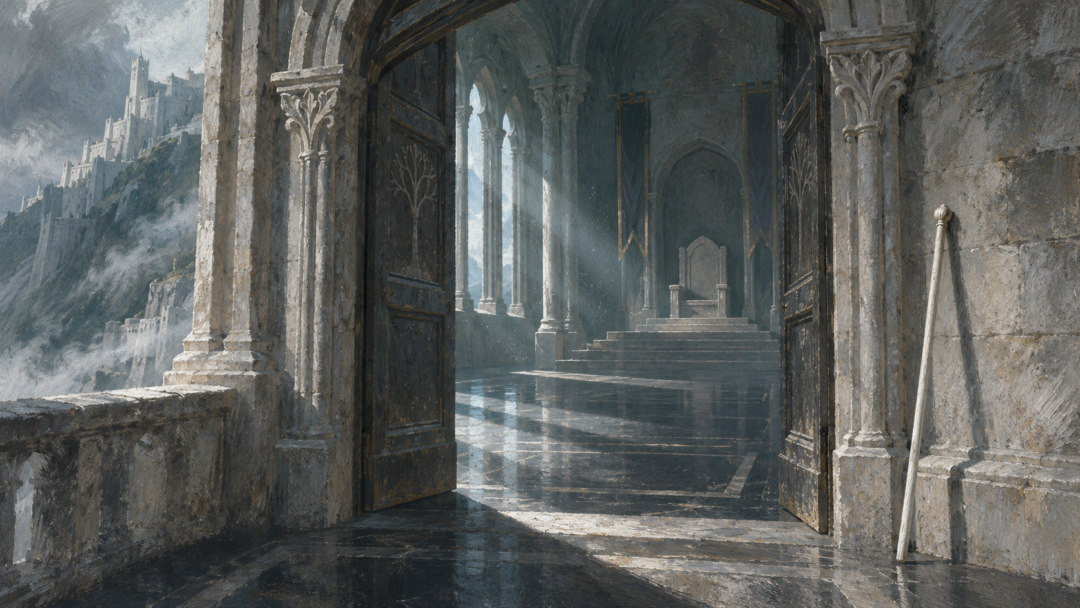
Aragorn is the heir of Isildur, eldest son of Elendil, the founder of the kingdoms in exile. Gondor, however, had long been ruled by descendants of Elendil's younger son, Anárion. The distinction had mattered for centuries. Isildur's descendants maintained the royal line in the North, while Gondor followed its own southern line. So Aragorn's ancestry is illustrious, but the bare statement that he descends from Isildur does not by itself settle every question in Gondor's history.
His claim is stronger than that alone. Through Arvedui, a king of the northern line, and Arvedui's wife Fíriel, daughter of King Ondoher of Gondor, Aragorn also inherits a connection to the southern royal house. That marriage had already raised a dispute over the crown generations earlier. The full family history is not recited to the crowd at Minas Tirith, but it stands behind the name that Faramir will announce: Elessar of the line of Valandil, Isildur's son.
Aragorn also arrives with signs that make his claim recognisable. He carries Andúril, the reforged sword of Elendil, and unfurls the royal standard as his ships approach the Pelennor. In The Passing of the Grey Company, he asserts his right to use the Orthanc-stone and summons the Dead to discharge an oath once sworn to Isildur. These deeds are not legal tests that automatically confer a crown. They establish that the ranger from the North is acting in the identity he claims, at considerable risk, before Gondor ever welcomes him as king.
What the Stewards' Office Had Become
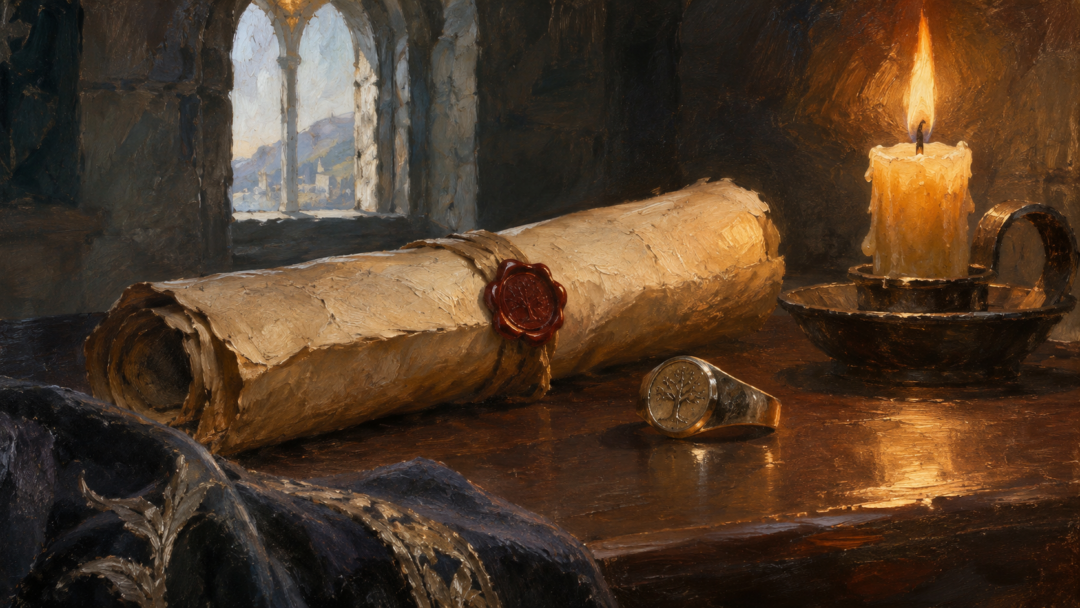
The Stewards were not a rival royal dynasty. They began as the kings' chief servants and advisers, and the office passed into the House of Húrin. After Pelendur, it became hereditary. When Eärnur, Gondor's last king before Aragorn, rode to Minas Morgul and never returned, Mardil governed in his absence. His successors exercised royal powers for centuries, but their title remained Steward, and the ancient throne stood unused. They carried a white rod rather than the crown.
Appendix A preserves the oath by which a Steward held authority in the king's name until his return. With time it became a ritual, while the men who repeated it commanded armies, administered the realm, and dealt with danger as its effective rulers. Denethor was no ornamental caretaker. His decisions during the siege of Minas Tirith show the enormous practical weight of the office, even though its stated source of authority was still the absent kingship.
That distinction explains why Faramir cannot simply be treated as an official whose permission is irrelevant. He is Denethor's successor and the lawful figure through whom government continues after the battle. Nor does it mean he personally owns the crown and can award it at whim. Gondor has bitter memories of the Kin-strife, when resistance to King Eldacar and the rebellion led by Castamir tore the kingdom apart. Recognition of a claimant could have consequences far beyond a family argument about ancestry.
Faramir's Recognition Is the Hinge
Faramir has already encountered Aragorn before the public ceremony. In The Houses of Healing, Aragorn comes to him while he lies under the Black Shadow, calls him back to consciousness, and is greeted as king by the recovering Steward. The scene matters because Faramir's acknowledgement precedes the formal surrender of office. The man entitled to continue Gondor's government responds to Aragorn personally, in a moment when healing rather than military command reveals who stands before him.
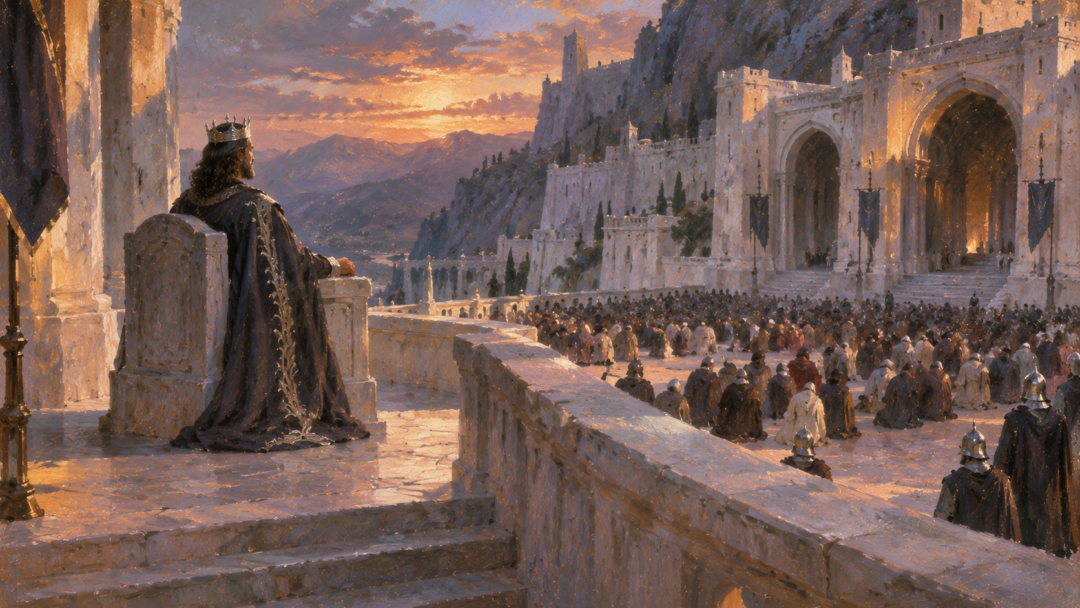
When the day of coronation arrives, Faramir goes out through the gate with Húrin of the Keys, followed by guards carrying a casket. Before the assembled host he kneels and offers Aragorn his white rod, asking leave to surrender the Stewardship. Aragorn immediately returns it. The office is to continue under his kingship and pass to Faramir's heirs. The gesture changes the relationship between crown and Steward without pretending that centuries of service, authority, and responsibility have been erased.
Then Aragorn tells Faramir to perform his office. This is the revealing turn in the sequence. Faramir rises not as a dismissed regent but as the acknowledged Steward of the realm. He publicly presents Aragorn's ancestry and his deeds: northern chieftain, captain of the western host, bearer of the reforged sword, victor in battle, and healer. Faramir does not merely announce that a descendant exists. He asks, “Shall he be king and enter into the City and dwell there?”
Only then comes the shouted assent. Faramir uses the authority of his office to bring forward the crown kept in the tombs of the kings, since the old custom of receiving it from a royal father cannot apply. Aragorn holds it up but asks Frodo to bear it to Gandalf, who places it on his head. Even the crowning honours more than inherited rank: the Steward's custody, the Ring-bearer's labour, and Gandalf's part in the victory are made visible.
The Captains and the People Are Not Bystanders
Aragorn's caution begins before this ceremony. After the Pelennor, he does not wish to press a claim while Sauron may still win, and he is careful not to challenge Gondor's existing order at the very moment it needs unity. He enters the city briefly to tend the wounded, but otherwise remains outside. The distinction between helping Minas Tirith and taking possession of it is deliberate. A man may rescue a city without making its government an immediate spoil of battle.
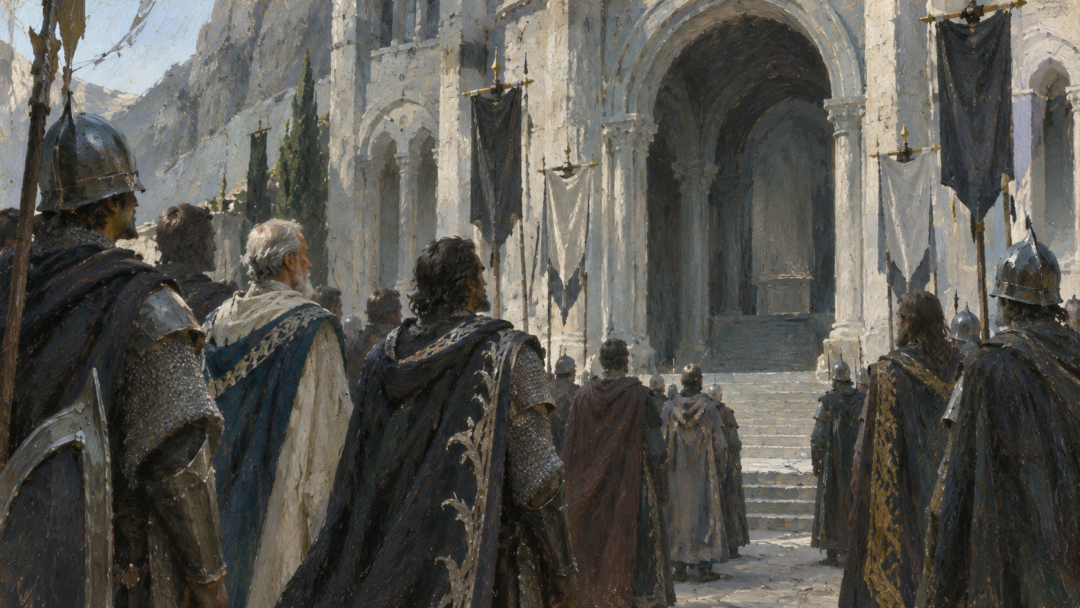
The council in The Last Debate shows the same restraint in another setting. Aragorn says, “I do not yet claim to command any man.” He supports Gandalf's desperate plan to march against Mordor, but the other leaders must choose whether to follow. Éomer pledges his help as an ally and friend. Prince Imrahil declares Aragorn his liege-lord, even while insisting that, as the man then standing in for Gondor's Steward, he must think of the city's defence. Their support has substance precisely because they are not depicted as helplessly bound to obey.
At the gate, Faramir speaks before soldiers and captains and a crowd gathered from the city and wider land. Their answer is unanimous in the account, not counted household by household or weighed according to noble rank. Ioreth even remarks that the public welcome is a ceremony, since Aragorn has already entered Minas Tirith to heal its people. Her interruption is affectionate and revealing: the formal question follows events that have helped ordinary inhabitants recognise the returning king for themselves.
Could They Have Rejected Him? Gondor Had Rejected a Claim Before
There is a particularly useful answer in Appendix A. When King Ondoher and his sons were killed in the Third Age, Arvedui of the North claimed Gondor's crown. He was descended from Isildur and married to Ondoher's surviving daughter, Fíriel. The claim was rejected, with Steward Pelendur taking the leading part. The Council of Gondor argued that the southern kingship belonged to the heirs of Anárion, reckoned through sons. Arvedui answered by invoking Isildur's senior descent from Elendil and Númenor's older inheritance custom, which could include daughters.
Gondor did not accept that answer. Instead the crown went to Eärnil, a victorious commander descended through the male line of Anárion's house, with the approval of the Dúnedain of Gondor. Arvedui did not force the dispute. His claim nevertheless survived in the memory of his descendants, including Aragorn. This is an actual historical refusal, not a hypothetical one, although it is reported in the annals rather than enacted as a confrontation in the main narrative.
The later disappearance of Eärnur makes Gondor's caution even clearer. Appendix A says no acceptable claimant could be found whose right everyone would acknowledge, and people feared another Kin-strife. The Stewards continued to rule instead. That outcome shows how seriously a disputed succession was taken. It does not establish a permanent legal veto for every nobleman, or a fixed council procedure that must be followed whenever an heir appears.
So could Faramir, Imrahil, or other leading Gondorians have resisted Aragorn in 3019? As a question of political reality, opposition was possible: Gondor's past proves that descent did not make recognition inevitable. But the book never stages a rejected claim by Aragorn, and it supplies no rules for what a divided acclamation would have meant. By the time he approaches the gate, his lineage, deeds, the Steward's acknowledgement, and the captains' allegiance have come together. There is no contested decision left to dramatise.
The most telling object at Minas Tirith is therefore not only the White Crown. It is the Steward's plain rod, offered up and placed back into Faramir's hands. The kingdom's old guardianship does not vanish when its king returns; it finds its proper place beside him. Beyond the gate stand the people whose welcome makes that return more than a name recovered from an ancient line.
Sources & Notes
- The Encyclopedia of Arda - Council of Gondor — https://www.encyclopedia-of-arda.com/c/councilofgondor.html
- The Encyclopedia of Arda - Steward of the King — https://www.encyclopedia-of-arda.com/s/stewardoftheking.html
- The Steward and the King - Tolkien Gateway — https://tolkiengateway.net/wiki/The_Steward_and_the_King
The Return of the King, ‘The Steward and the King’, supplies the acclamation; Appendix A, ‘Gondor and the Heirs of Anárion’, supplies Arvedui’s rejected claim. These precedents do not establish a modern election or a universal legal veto.