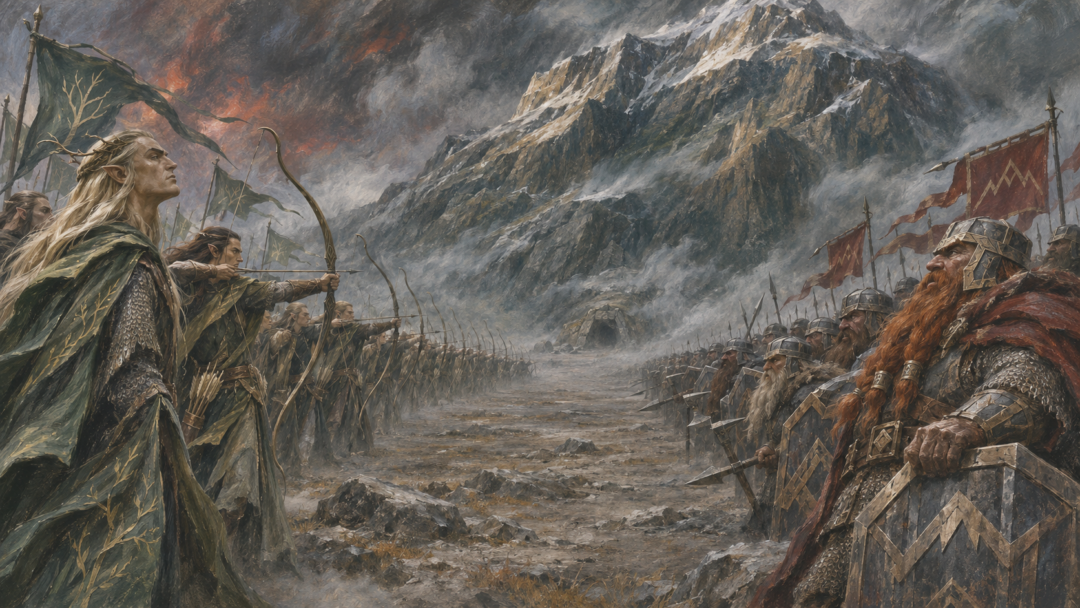
Outside the Lonely Mountain, two forces that ought to be allies are close to attacking each other. Thranduil's Elven archers prepare to shoot at Dáin Ironfoot's Dwarves. A flight of arrows appears likely to give the Elves an immediate advantage. Instead, large spinning projectiles sweep into the air and disrupt the volley. For a few seconds, an unexpected Dwarven countermeasure changes the balance of the confrontation.
The sequence in The Hobbit: The Battle of the Five Armies raises a precise question: does this anti-arrow device belong to J.R.R. Tolkien's Middle-earth, was it introduced by Peter Jackson's filmmakers, or was it based on a real weapon? The onscreen appearance is identifiable, and the film can be compared with Tolkien's story. Its individual creator and precise historical inspiration, however, remain unverified.
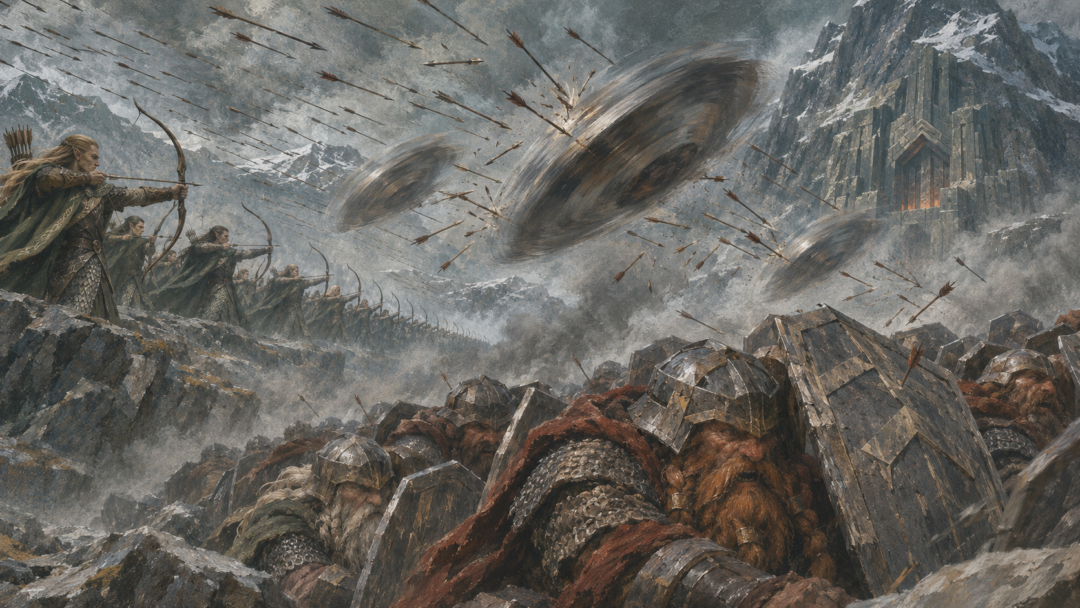
The weapon that appears in the Extended Edition
The clearest starting point is Movie-Censorship's scene-by-scene comparison of the theatrical and Extended Editions. It documents an alternative confrontation between Dáin and Thranduil in which their hostility becomes a short skirmish. Dáin exchanges insults with the Elvenking, orders his troops to send in the goats, and faces Elven archers preparing to fire. Their arrows are diverted by large spinning projectiles. Delighted, Dáin calls the contraptions his “twirly-whirlies.” Dwarves then overrun some of the Elves before noises from the mountains bring the fighting to a halt. Gandalf objects to the confrontation as madness, underlining that this is not simply a friendly contest between rival fighting styles. The weapon interrupts a genuinely dangerous escalation, even though the exchange is staged with humor.
The arrow-deflection moment belongs to the Extended Edition, which adds Dwarf-versus-Elf combat before the armies confront their common enemy. The theatrical cut handles the standoff differently and more briefly. Viewers who recall no spinning defenses may simply have watched another cut.
The comparison lists the alternative sequence as 128.3 seconds longer in the Extended Edition, a little over two minutes. That is the net difference between two versions of the broader scene, not the weapon's screen time. The additional material includes dialogue, reaction shots, staging and fighting; the spinning projectiles appear for only part of it. The comparison also notes alternative shots and altered background details around Dáin. Its timing is a guide to editing differences rather than a specification for the weapon.
The projectiles visibly spin and interrupt arrows, but the comparison does not establish their composition, exact launching method, range or reliability. “Anti-arrow weapon” describes their onscreen function, not a verified class of Middle-earth artillery. Dáin's nickname is a joke in the moment, not evidence of a standardized technical term.
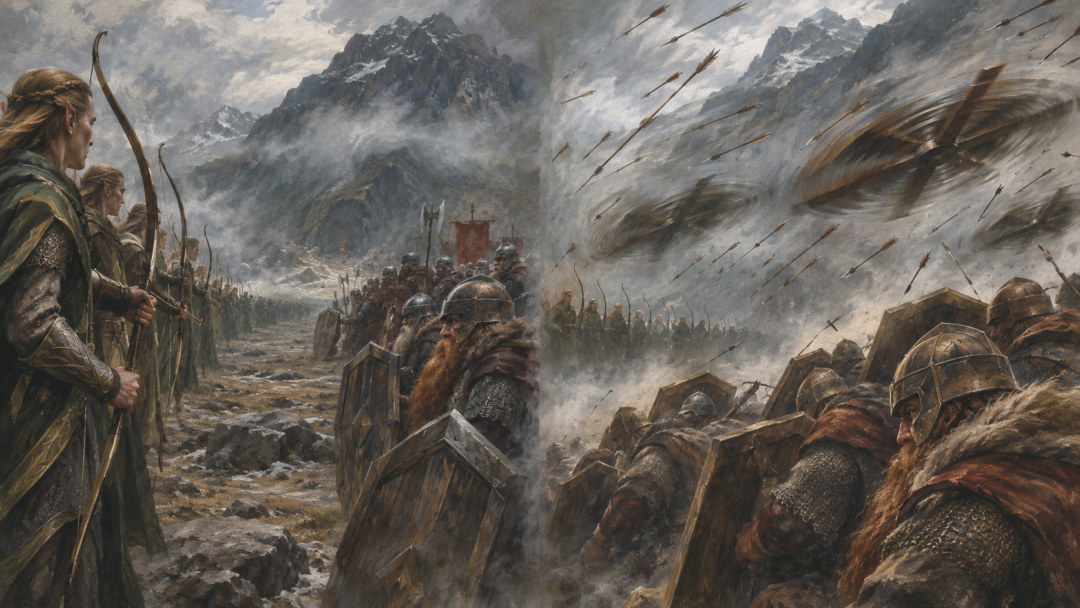
What Tolkien actually gives us at Erebor
Tolkien's The Hobbit contains the confrontation, but not this conspicuous defense. In Chapter 17, “The Clouds Burst,” Dáin arrives with armed Dwarves as Bard and the Elvenking dispute Thorin's refusal to share the treasure under the Mountain. Bilbo has secretly passed the Arkenstone to Thorin's opponents, hoping it can secure a settlement. Instead, Thorin's anger and Dáin's arrival push the dispute dangerously close to violence. The competing claims concern more than a personal insult: Bard and the Elvenking have reasons to demand a settlement, while Thorin regards the wealth as his inheritance. The near-battle grows out of choices already established in the story.
The Penguin Random House teacher's guide to The Hobbit describes the essential reversal: goblins and Wargs arrive, forcing the rival groups into a joint defense. Its summary is condensed, not a precise inventory of every aggressive move. In the novel, the Dwarves move to attack and the danger of combat is immediate. What the cited account does not describe is a sustained skirmish featuring spinning missiles that defeat an Elven volley.
Tolkien does not depict perfectly peaceful negotiations while the movie invents hostility. Both stories bring the Free Peoples near battle over the treasure. The Extended Edition turns that danger into a visible clash and gives the Dwarves a startling tactical success before the greater threat arrives. The device expands the action, not the motive for the confrontation. That matters when evaluating adaptation choices. A filmmaker can preserve the larger plot movement—rivalry giving way to alliance—while inventing individual maneuvers that make the rivalry more physical. The new action should not be mistaken for a faithful illustration of each event in Tolkien's chapter.
A teacher's guide is not a catalogue of weapons across The Hobbit, The Lord of the Rings, Unfinished Tales and Tolkien's other writings. The supplied material gives no textual precedent for these spinning arrow-deflectors. A film-specific addition is therefore the best-supported description, though it would be too categorical to claim every possible resemblance across Tolkien's legendarium has been ruled out.
“Lord of the Rings universe” also blurs two meanings. Tolkien's The Hobbit and The Lord of the Rings share Middle-earth, but Jackson's films adapt that world with new scenes, designs and emphases. A weapon can exist in cinematic Middle-earth without being documented in Tolkien's fiction. Looking appropriate for Dwarves is not the same as having a literary source.
How a fantasy weapon becomes a film image
Onscreen, the weapon's purpose is instantly legible. Orderly, threatening Elven archery meets the Dwarves' conspicuous spinning counterattack. In a crowded battle, the effect communicates a tactical reversal without technical exposition. Its outlandish motion also makes Dáin's delighted reaction funnier; the sequence cares more about surprise than engineering detail.
There is genuine production reporting about the broader design effort. TheOneRing.net's preview of a Cinefex issue 141 feature describes collaboration involving production designer Dan Hennah, conceptual artists Alan Lee and John Howe, visual-effects supervisor Joe Letteri, Peter Jackson's teams, Weta Workshop and Weta Digital. Weta Workshop co-founder Richard Taylor discusses the enormous amount of armor, weapons and prosthetic work needed to give the different forces their identities.
That account explains the production's scale but does not identify the spinning projectiles' designer. It does not say who proposed them, whether a concept changed for the Extended Edition or whether a historical design inspired them. Crediting this individual invention to Jackson, Lee, Howe, Taylor or a particular Weta artist would go beyond the reporting. Nor would a department credit identify the individual inventor.
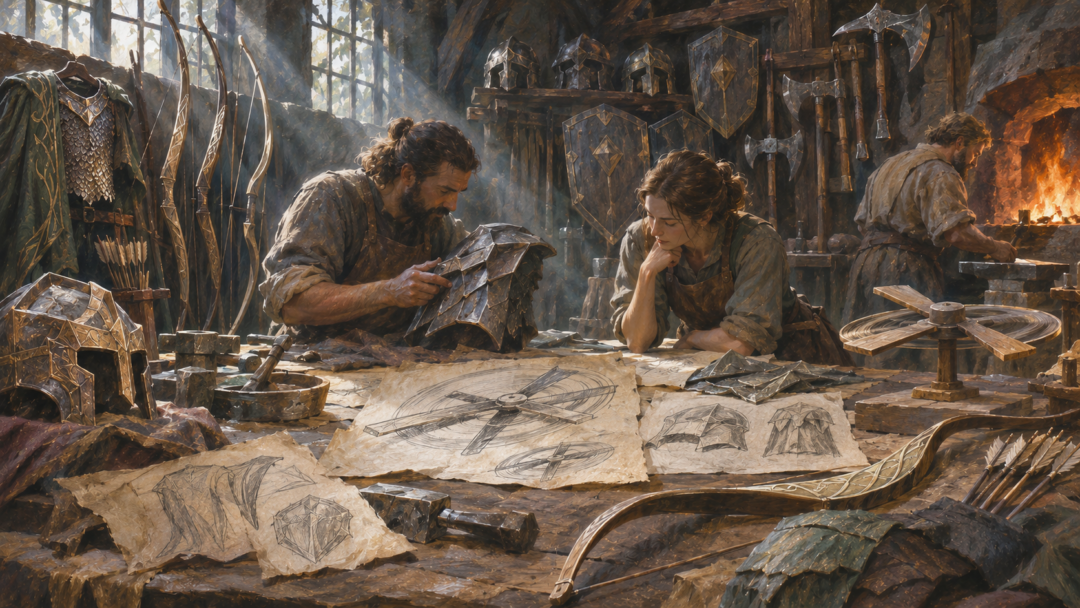
One might picture a fantasy-film workshop full of sketches for improbable airborne defenses, but that would be an imagined editorial scene, not a documented production session. The firmer claim is that the device appears in the filmmakers' completed sequence; the decisions behind its design remain unknown from these sources.
Could medieval warfare have supplied a precedent?
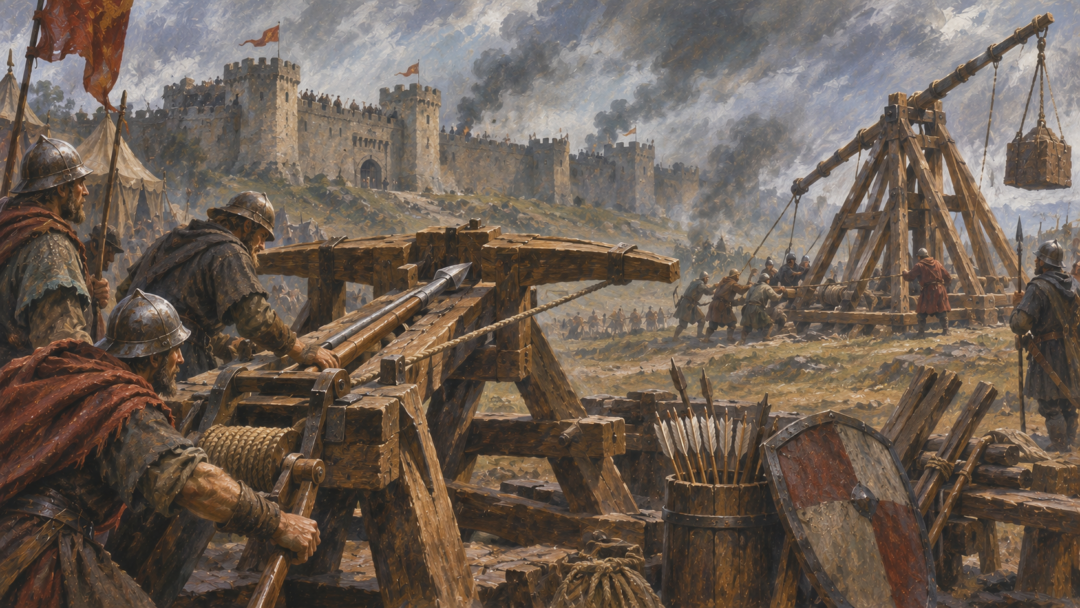
The device invites comparison with siege engines. English Heritage's overview of medieval siege warfare describes armies using large machines and defensive preparations before gunpowder artillery became established. Siege towers, mining, stockpiles and missile launchers demanded specialized knowledge. Elaborate machinery is therefore not inherently out of place in medieval-looking fantasy.
English Heritage describes the ballista as a frame-mounted crossbow firing a large bolt. It also discusses engines launching arrows, stones and incendiary projectiles, while medieval illustrations show devices such as mangonels. These provide parallels for mechanical artillery, not documented instances of a projectile flying into an arrow storm and sweeping incoming shafts aside.
A ballista sends a missile toward a target; a trebuchet or mangonel hurls a projectile on a destructive trajectory. The Dwarven device instead protects troops by apparently intercepting numerous objects already in flight. A vaguely similar mechanical appearance does not establish the same operating principle. Siege engines are generally discussed in connection with striking defenders, breaking defenses or helping attackers reach a fortified position. The movie reverses the logic: it shows artillery-like objects acting as a moving screen for soldiers who are about to be shot. The cited history identifies no medieval counterpart to Dáin's spinning defenses.
A working interceptor would need to reach the arrows' path at the right instant, cover enough space and avoid endangering friendly troops. Rotation suggests sweeping coverage visually, but that does not demonstrate workable medieval engineering. Nor is it clear whether the spinning shapes are meant to physically catch arrows, collide with them or simply scatter the formation of incoming shafts. The scene offers too little information about launch equipment, materials or timing to test the mechanism.
Historical defenders used shields, walls, cover and careful positioning to reduce exposure to missiles. Those tactics share the Dwarves' defensive goal, not their spectacular method. Without a documented comparable device, claiming the filmmakers borrowed a specific medieval anti-arrow weapon would be speculation. Nor does the absence of a match in these sources prove no loosely similar experiment ever existed.
Why this short moment sticks
The scene gives Dáin's soldiers a distinctive answer to the Elves. Disciplined bows meet a noisy, ungainly contraption, followed by Dáin's gleeful taunt. One interpretation is that this draws on Dwarves' association with craft and metalwork: rather than simply endure an arrow volley, they counter it with machinery. That is a reading of the scene, not a documented design intention or a fixed rule of Tolkien's world.
The comedy has an uneasy edge. The Dwarves use their ingenuity against people who will soon fight beside them. Their fleeting success becomes irrelevant when noises from the mountains announce a greater danger. The added skirmish makes the cost of rivalry visible: future allies are attacking one another when they most need to cooperate.
The moment also sticks because the weapon is barely explained. No manufacturing tradition, tactical doctrine or history of similar machines is provided. The film asks viewers to recognize the threat, enjoy its surprising defeat and move on. That economy serves the spectacle while making confident claims about the device's provenance difficult.
So is the technology original to the “Lord of the Rings universe”? It appears in the Extended Edition's cinematic Middle-earth, but the evidence does not establish it as Tolkien's invention. The production account names no individual creator, and the historical source offers analogies for siege machinery rather than a proven anti-arrow prototype. The best-supported description is a film-specific addition whose exact inspiration remains uncertain. Its narrative purpose is clearer than its mechanics: it makes the Free Peoples' disastrous quarrel briefly and spectacularly visible.
Sources & Notes
This article is based on close reading and interpretation of Tolkien's published works and related source material where relevant.