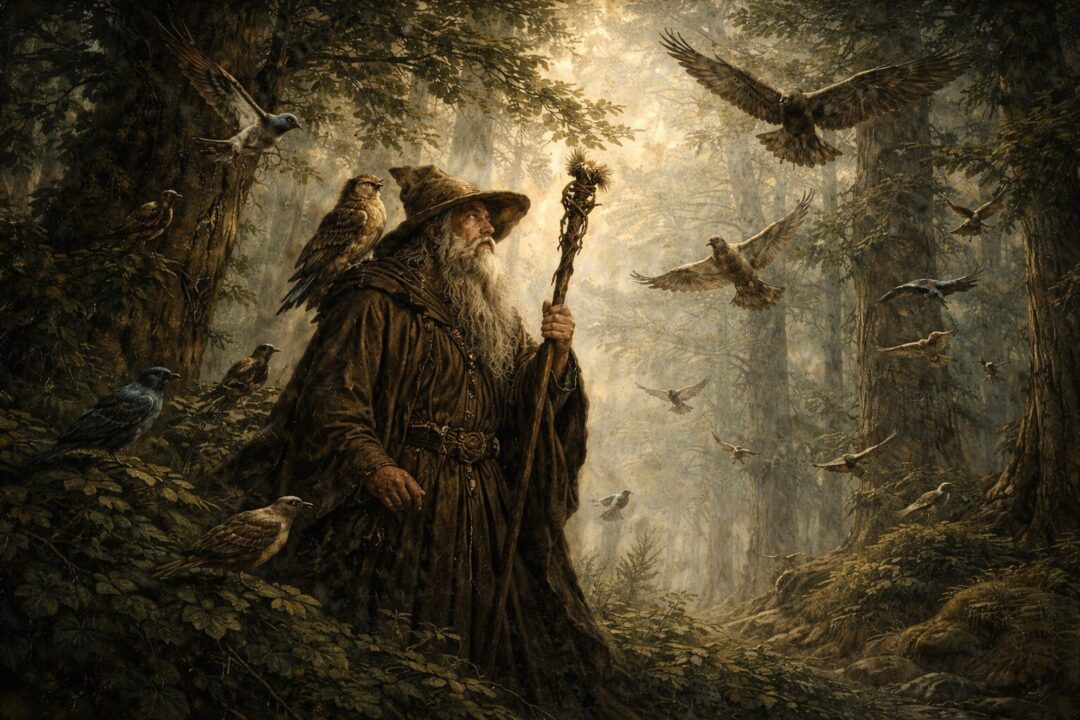
Among the five Wizards sent to Middle-earth, Radagast remains the most obscure—and the most misunderstood.
He does not lead armies like Saruman.
He does not wander among peoples and kings like Gandalf.
He does not confront Sauron openly, challenge dark towers, or shape the fate of realms through speeches and fire.
In fact, by the time The Lord of the Rings reaches its final act, Radagast has quietly slipped out of the narrative altogether.
For many readers, this absence feels like failure.
Surely a Wizard who disappears must have fallen short of his task. Surely one who prefers animals to councils, forests to fortresses, has turned aside from the real struggle.
But Radagast is not an accident.
He is not a lesser being.
And his fading from the story may not be failure at all—but something far more deliberate.
Radagast is one of the Istari: spirits of the same order as Gandalf and Saruman, sent from the West with a shared mission—to oppose Sauron without seeking domination themselves.
So why does he fade from history?
And was that fading a betrayal of his purpose… or its quiet fulfillment?

Who Radagast Really Is
Radagast the Brown appears only briefly in The Lord of the Rings. We are told that he dwells near Mirkwood, that he is closely associated with birds and beasts, and that he is regarded by others—especially Saruman—as foolish and easily manipulated.
But these surface impressions hide a deeper truth.
Radagast’s true name in the West was Aiwendil, meaning “lover of birds.” This was not a nickname he acquired later. It was who he already was before he ever came to Middle-earth.
When the Valar chose the Istari and sent them east, they did not select five identical figures with identical strengths. Each Wizard was chosen for particular qualities.
Saruman was selected for knowledge, craft, and deep study of the devices of the Enemy.
Gandalf was chosen for wisdom, patience, and pity toward the Free Peoples.
Radagast was chosen for his love of all living things that grow and move upon the earth.
This was not a flaw.
It was the reason he was sent.
Sauron’s war was never only about crowns and armies. It was also a war against the land itself—against forests, beasts, and the natural order. Mordor is not merely a political tyranny; it is an ecological one. Where Sauron’s power spreads, the earth sickens, creatures are twisted, and life becomes fuel for domination.
Radagast’s charge lay precisely there.
The Wizard Closest to the Shadowed Lands
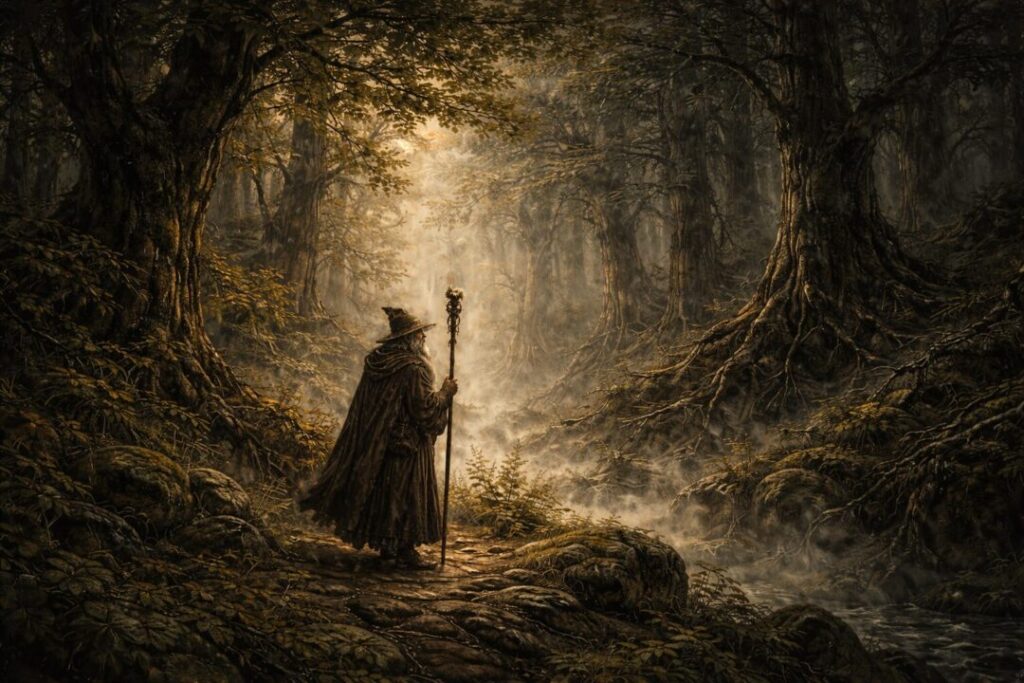
Radagast does not settle in a safe haven like Rivendell, nor does he roam freely among friendly realms. He lives near Mirkwood—a forest already long poisoned by Sauron’s influence, once known as Greenwood the Great.
This choice matters.
Mirkwood is not a battlefield in the traditional sense. It is a slow front. A place where corruption creeps rather than conquers, where darkness spreads root by root rather than through banners and siege engines.
Radagast remains close to this corruption for centuries.
He does not cleanse the forest with dramatic acts of power. He does not drive out evil with fire and proclamation. Instead, he holds the line quietly—maintaining what can still be saved, resisting total collapse.
In a war defined by spectacle, this kind of resistance is easy to overlook.
What Radagast Actually Did
Radagast’s greatest actions are easy to miss because they happen largely offstage.
He gathers intelligence through birds when roads are watched and spies are everywhere. News travels through the skies long before it reaches councils.
It is Radagast who sends messages by way of eagles and birds when others cannot move openly. This network of natural messengers becomes an invisible counter to Sauron’s surveillance.
Most famously, Radagast unknowingly exposes Saruman’s treachery.
When Gandalf is imprisoned atop Orthanc, Saruman uses Radagast as a messenger—assuming him to be harmless and easily manipulated. Radagast delivers Saruman’s message, but in doing so reveals that Saruman has already turned from the mission entrusted to the Istari.
Radagast does not uncover Saruman through cunning or confrontation.
He does it simply by being what he is—unguarded, sincere, and still aligned with the original purpose of the Wizards.
This is not dramatic heroism.
It is quiet consequence.
Did Radagast Fail His Mission?
This question has divided readers for decades.
Gandalf himself suggests that Radagast “turned aside” from his original task, becoming overly absorbed in animals and growing things. But this statement is often misunderstood.
It is not condemnation.
It is observation.
Radagast does not seek power.
He does not build strongholds.
He does not attempt to lead or command others.
But unlike Saruman, Radagast does not fall.
He does not betray his purpose.
He does not attempt to dominate others for “their own good.”
He does not believe that victory justifies control.
In a world where even the Wise can fail catastrophically, Radagast’s greatest distinction may be that he does not overreach.
He remains within the bounds of his nature.
And that restraint may be the very thing that saves him.
Strength Without Spectacle
Radagast’s strength is not measured in enemies slain or fortresses broken.
It lies in what survives.
Forests that are damaged but not destroyed.
Creatures that are wary but not wholly corrupted.
Knowledge preserved beyond the reach of tyranny.
Middle-earth does not only need heroes who confront darkness directly. It also needs guardians who ensure there is still something worth saving when the war is over.
Without living forests, what victory remains?
Without beasts and growing things, what world is reclaimed?
Radagast’s work is preventative rather than triumphant. It does not end evil—but it limits the damage evil can do.
This kind of strength rarely earns songs.
Why Radagast Fades From the Story
Like many ancient powers in Middle-earth, Radagast does not disappear because he is irrelevant.
He fades because the story no longer centers on beings like him.
The War of the Ring belongs to Hobbits.
To endurance rather than authority.
To small hands carrying unbearable burdens.
As the age turns, great powers step back. Elves depart. Wizards diminish. The world passes increasingly into the hands of the ordinary.
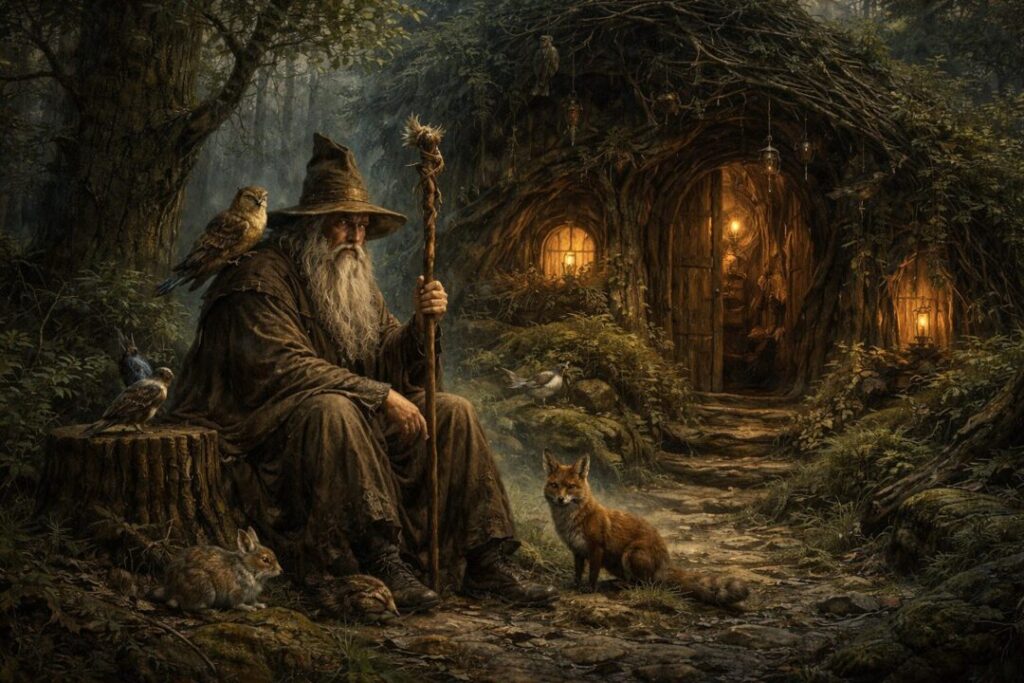
Radagast remains where he always was—in the wild places, beyond the notice of chronicles, guarding life quietly while history marches elsewhere.
He does not need recognition to fulfill his purpose.
Was Radagast Weak—or Was He the Only One Who Stayed True?
If strength is measured by domination, Radagast is weak.
If success is measured by survival, he may be the most successful Wizard of them all.
Saruman seeks power and is destroyed by it.
Gandalf uses power sparingly and only at great cost.
Radagast avoids power almost entirely—and endures.
He does not shape history through fire and speeches.
He shapes it by ensuring that the world still breathes when the fire is gone.
And perhaps that was the task he was given all along.