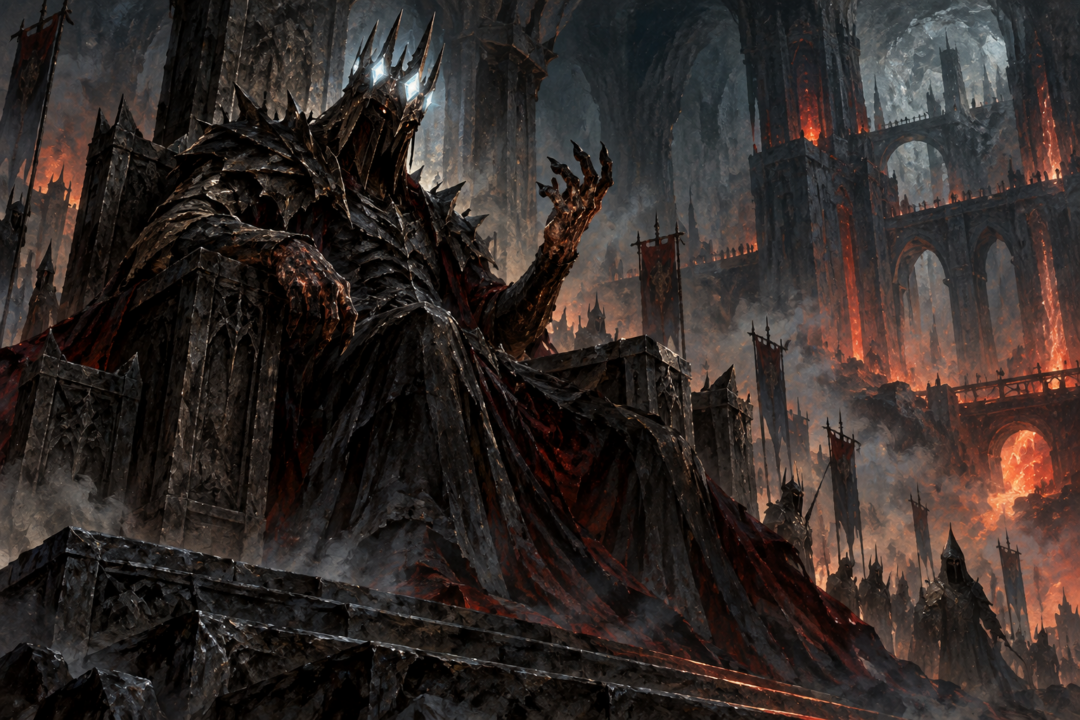
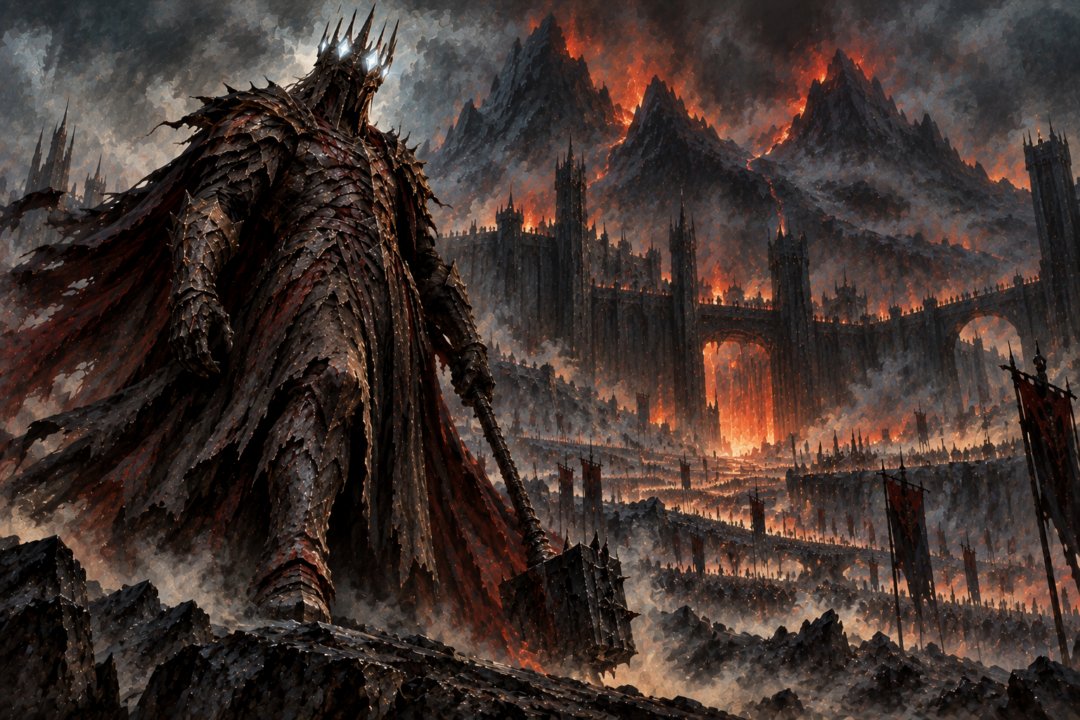
The Iron Crown of Morgoth looks, at first, like the perfect symbol of absolute victory.
After destroying the Two Trees and fleeing from Valinor, Morgoth returned to Angband with the three Silmarils. There he forged a great crown of iron, proclaimed himself King of the World, and set the stolen jewels into it. The greatest treasures of the Noldor now shone above the brow of their greatest enemy.
Yet there is a disturbing detail hidden inside that image of triumph.
Morgoth could not possess the Silmarils without suffering.
Their touch burned his hands black. The pain remained afterward. The crown itself eventually became a terrible burden, yet he refused to remove it. And as the First Age continued, Morgoth accumulated still more permanent injuries while defending the dominion that crown represented.
The text does not say that the Iron Crown magically wounded Morgoth every time he wore it. The reality is subtler—and arguably more revealing. Morgoth deliberately turned stolen beauty into a symbol of sovereignty, and thereafter his greatest trophy became inseparable from pain, weariness, wounds, and an increasingly constrained physical existence.
The Silmarils Were Something Morgoth Could Steal but Not Master
The crucial distinction begins before the Iron Crown was forged.
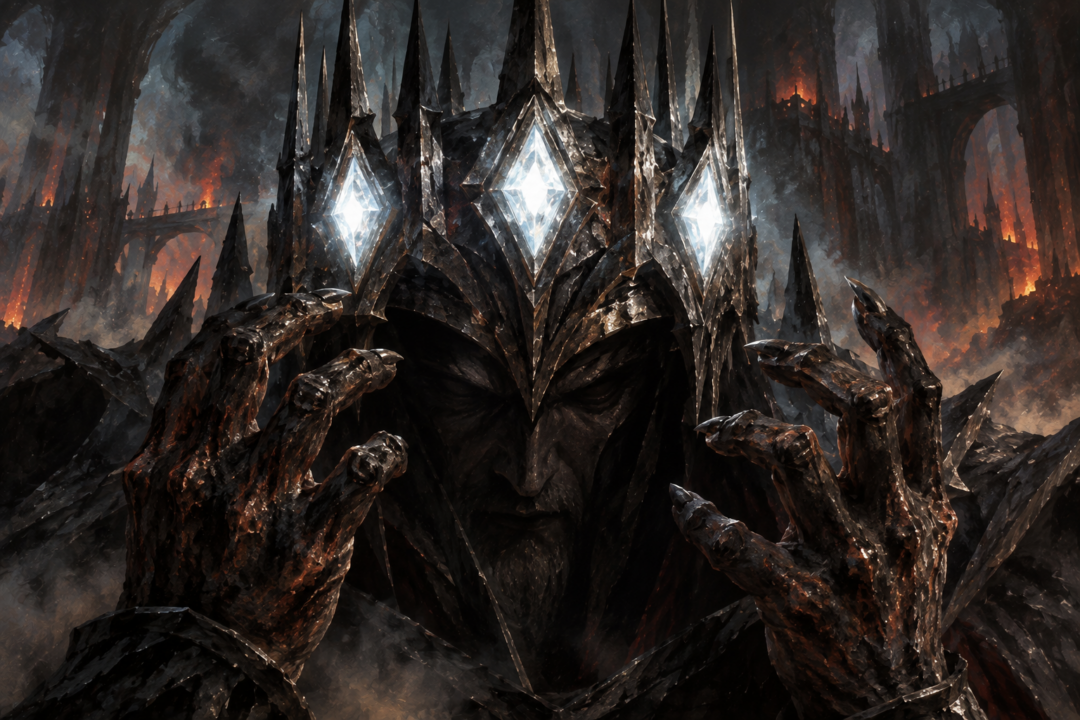
The Silmarils were not merely extraordinarily beautiful jewels. Fëanor had captured within them the blended light of the Two Trees, and Varda hallowed them so that no mortal flesh, nor any hands unclean or evil, could touch them without being burned.
That condition becomes important almost immediately after Morgoth takes them.
Even while the Silmarils were enclosed in their crystal case, they began to burn him during his flight with Ungoliant. Later, when Morgoth returned to Angband and placed the jewels into his newly forged crown, their direct touch burned his hands black. The injury remained permanently, and so did the pain. Ae Lib
This establishes one of the most important limits on Morgoth’s victory.
He possesses the Silmarils legally in no meaningful sense and spiritually not at all. He can seize them, transport them, imprison them in iron, and display them before his servants. What he cannot do is change what they are.
The light inside them does not become Morgoth’s light.
The hallowing upon them does not recognize his claim.
His conquest therefore produces a strange physical contradiction: the jewels sit in his crown as proof of his power while the burns on his hands remain proof that there is a kind of power over which conquest gives him no authority.
The Crown Turns Theft Into Kingship
Morgoth could have hidden the Silmarils.
Instead, he put them on his head.
That choice matters.
In Angband he forged the Iron Crown, called himself King of the World, and set the three Silmarils within it as a token of that claim. Ae Lib The jewels therefore became more than stolen treasure. Morgoth incorporated them into the public image of his rule.
That makes the crown almost a summary of his ambition.
He wants not merely to destroy beautiful things but to possess them. He wants what others have made to become evidence of his own supremacy. The Silmarils, creations he could neither reproduce nor corrupt into something truly his own, become the brightest ornaments of his kingship.
But there is a cost built directly into that symbolism.
The hands that installed those symbols of victory were burned by them.
And the crown did not become an effortless ornament. The account explicitly says Morgoth never removed it even though its weight became a deadly weariness. Ae Lib
This is more precise than saying the crown continuously burns him. The Silmarils caused the burning, while the crown’s weight became its own terrible burden.
Morgoth nevertheless continued wearing it.
Why Would Morgoth Keep Wearing Something So Burdensome?
The text does not explicitly give Morgoth’s private reasoning, so any answer must remain interpretation.
But the symbolism is difficult to miss.
Removing the crown would mean setting aside the visible sign of the title he had claimed. The Iron Crown announced that Morgoth possessed the Silmarils and, through them, displayed his victory over Fëanor, the Noldor, and the bliss of Valinor from which their light ultimately came.
So he endures it.
This fits a larger pattern in Morgoth’s history. His pursuit of domination repeatedly gives him greater control over the physical world while making him increasingly committed to—and dependent upon—that world.
Later writings concerning Morgoth describe his power as dispersed into the matter of Arda itself, in contrast with Sauron’s concentration of power in the One Ring.
That broader conception helps illuminate the Iron Crown without turning the crown itself into a magical mechanism it was never said to be.
Morgoth’s power becomes domination.
His domination requires possession.
And possession increasingly binds him to the things he insists on ruling.
The crown is therefore an extraordinarily effective physical image of his decline: the self-proclaimed King of the World carrying his own conquest as an exhausting weight upon his head.
Fingolfin Makes Another Victory Permanent
The same pattern appears with terrible clarity when Fingolfin comes alone to Angband.
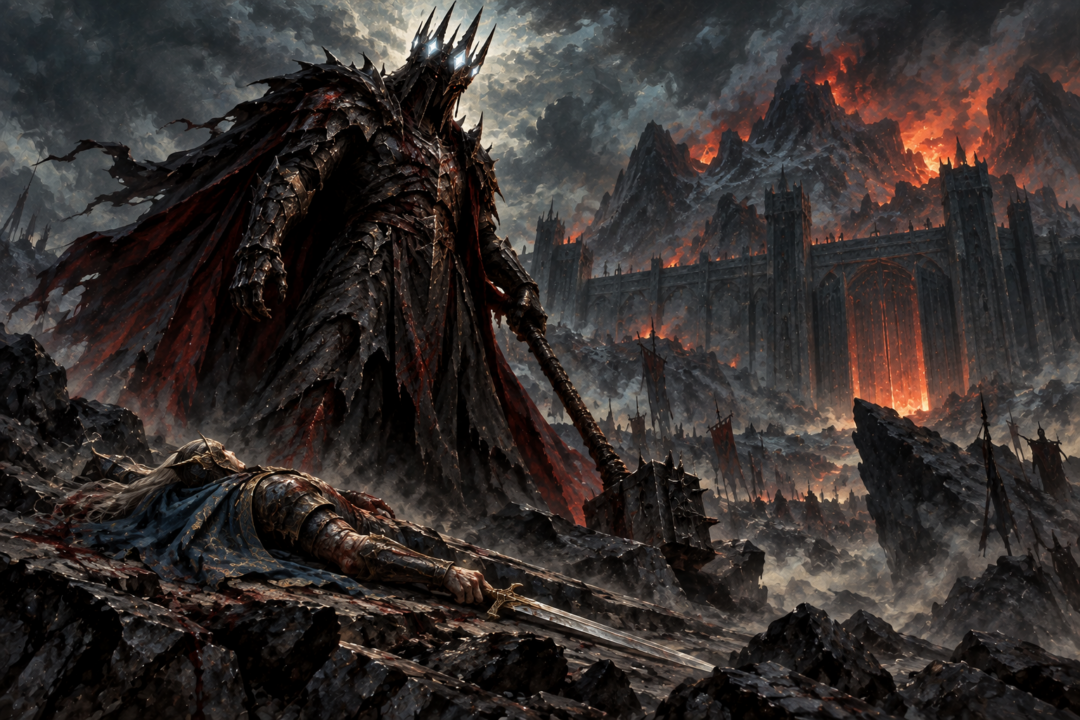
After the catastrophic Dagor Bragollach, Fingolfin rides north in despair and wrath and challenges Morgoth to single combat. Morgoth cannot easily ignore the challenge before his captains, but he does not meet it eagerly.
He comes forth.
Morgoth ultimately kills Fingolfin, so in the simplest military sense Morgoth wins. Yet this is another victory that leaves something behind.
Fingolfin wounds Morgoth seven times during their duel. At the end, after being thrown down, the Elven king strikes Morgoth’s foot with his sword.
Morgoth kills him—but he does not recover completely from what Fingolfin has done.
Afterward Morgoth walks with a limp.
This matters because Morgoth is no ordinary mortal warrior temporarily inhabiting a disposable body. By this period his relationship with his physical form has become increasingly fixed. The ruler who once operated on an almost cosmic scale is now a tyrant who sits within a fortress, wears a heavy crown, bears burned hands, and can be permanently wounded.
Fingolfin dies.
Morgoth survives.
Yet Morgoth carries evidence of the encounter afterward.
Once again, victory has become something his body must remember.
Then Beren Takes a Jewel From the Crown
The humiliation becomes even more remarkable in the tale of Beren and Lúthien.
Thingol demands a Silmaril from Morgoth’s crown as the bride-price for Lúthien—a demand intended to be impossible. Yet Beren and Lúthien eventually reach Angband itself.
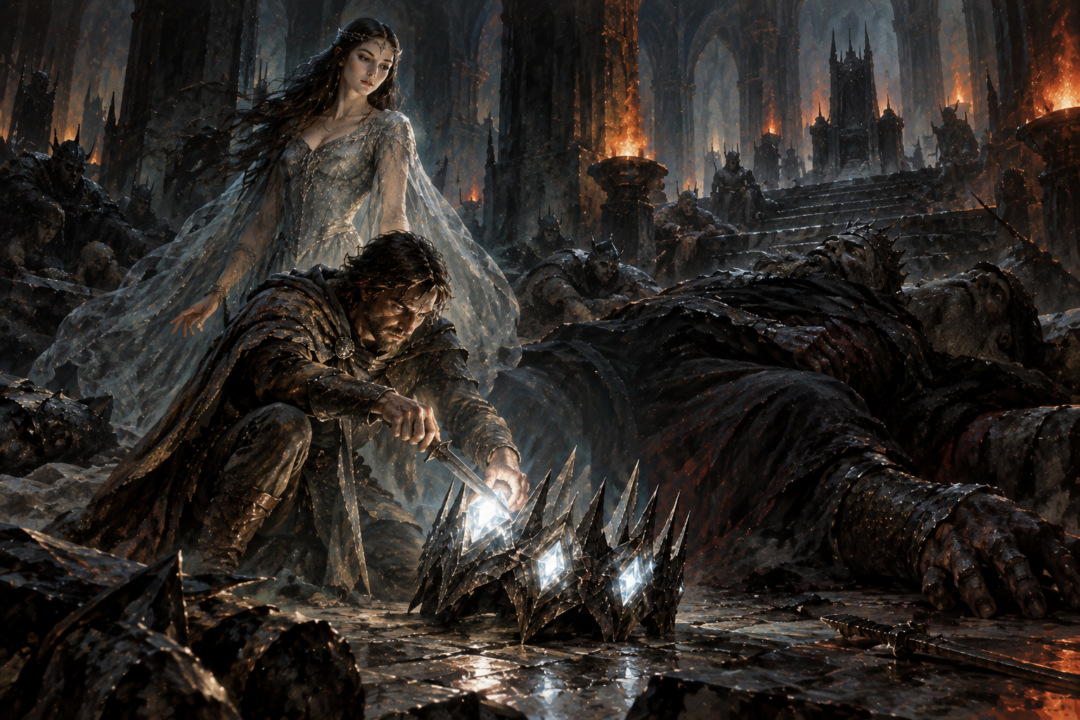
There, Lúthien overcomes Morgoth and his court through her enchantment. Morgoth falls into sleep, and the Iron Crown rolls from his head.
For perhaps the most striking moment in the crown’s history, the object representing Morgoth’s claim to universal kingship is lying on the floor.
Beren takes Angrist and cuts one Silmaril free.
The jewel does not burn him. Instead, its radiance shines through his living hand.
The contrast with Morgoth could hardly be sharper.
Morgoth stole all three Silmarils through murder, destruction, and alliance with Ungoliant, and their touch burned him permanently. Beren enters Morgoth’s own fortress and takes one from the Iron Crown, yet the jewel accepts his touch without harming him.
Beren then attempts to take another. Angrist breaks, and a fragment strikes Morgoth, beginning to wake him. Beren and Lúthien must flee.
Encyclopedia of Arda
Morgoth retains two Silmarils.
Technically, his treasure is still mostly his.
Symbolically, something enormous has happened.
The Iron Crown has been breached.
The Crown Slowly Records Morgoth’s Failure
By the end of the First Age, the Iron Crown no longer means what it meant when Morgoth forged it.
Originally it proclaimed total possession: three Silmarils, captured and placed above the head of the self-declared King of the World.
After Beren and Lúthien, one setting is empty.
Meanwhile Morgoth himself bears the consequences of his long war. His hands remain black. The burning pain remains. Fingolfin’s wounds remain, including his lameness. And the crown remains a burden.
None of these details means that every Morgoth victory literally activates a supernatural punishment.
The pattern is thematic rather than mechanical.
Morgoth repeatedly gains what he wants through force, but force cannot make the consequences disappear.
He can steal the Silmarils, but cannot make them tolerate his touch.
He can kill Fingolfin, but cannot undo the wound Fingolfin gives him.
He can keep Beren from taking all three jewels, but cannot restore the one already cut from his crown.
His victories increasingly preserve reminders of resistance.
The Final Fate of the Iron Crown Completes the Irony
The crown’s ending makes its symbolism even darker.
At the conclusion of the War of Wrath, Morgoth is finally defeated. Angband falls, and the remaining Silmarils are removed from his crown.
Then the Iron Crown itself is beaten into a collar for Morgoth’s neck.
The transformation is devastatingly appropriate.
The object Morgoth created to proclaim himself King of the World becomes part of his captivity.
Iron that once declared sovereignty now declares defeat.
The Silmarils themselves pass beyond him entirely.
That final reversal reveals what the crown had represented all along. Morgoth could dominate things without truly making them his. He could imprison beauty inside iron, but he could not corrupt its essential nature simply by claiming ownership. He could proclaim himself ruler of the world, but the symbol of that claim could eventually be turned into a restraint.
The Iron Crown therefore tells a miniature version of Morgoth’s entire tragedy.
He seeks power without limits and becomes increasingly limited.
He seeks possession and becomes burdened by what he possesses.
He destroys others and becomes more deeply bound to a wounded physical existence.
And above all, he steals light because he cannot create its equal.
That is why the image of Morgoth wearing the Silmarils is more complicated than a Dark Lord displaying conquered treasure.
His crown certainly announces victory.
But the blackened hands beneath it tell the other half of the story.
Sources & Notes
This article is based on close reading and interpretation of Tolkien's published works and related source material where relevant.